

How Do You Choose Stainless Steel Compression Springs Sizes?
Last Updated: October 25, 2026
Quick Summary
To choose stainless steel compression springs sizes, define six dimensions: outside diameter, inside diameter, wire diameter, free length, solid height and active coils. Work backwards from your bore, installed length and working load, calculate the required rate, then check solid height, stress and spring index before selecting a stock or custom part.
- Outside diameter minus twice the wire diameter equals inside diameter, so any two figures fix the third.
- Measure an existing spring with a caliper at two positions 90 degrees apart and average the readings.
- In a size chart, L1 is the recommended minimum working length, not the solid height.
- Rate equals shear modulus times wire diameter to the fourth power, divided by eight times mean diameter times active coils.
- Keep working length at least about 15% of free length clear of solid height.
Table of Contents
- Why Stainless Steel Compression Spring Sizes Decide Whether a Design Works
- The Six Dimensions Behind Every Compression Spring Size
- How to Measure a Compression Spring You Already Have
- Reading a Compression Spring Size Chart Without Making a Costly Mistake
- Compression Spring Rate Calculation: Matching Load to Deflection
- Stainless Steel Grades, Corrosion and Dimensional Tolerance
- When Custom Compression Springs Beat the Nearest Stock Size
- Order Your Stainless Steel Compression Springs from SpringXpert
- Frequently Asked Questions
Why Stainless Steel Compression Spring Sizes Decide Whether a Design Works
Get the size wrong and no amount of good engineering downstream will save the assembly.
A compression spring is a helical coil that resists a compressive force along its axis, storing energy and returning to free length when the load is removed.
Selecting from a catalogue is a repeatable process, not a guessing game. Below, we show how to measure an existing spring, read a size chart without misreading it, and calculate the rate needed for your load and deflection.
The Six Dimensions Behind Every Compression Spring Size
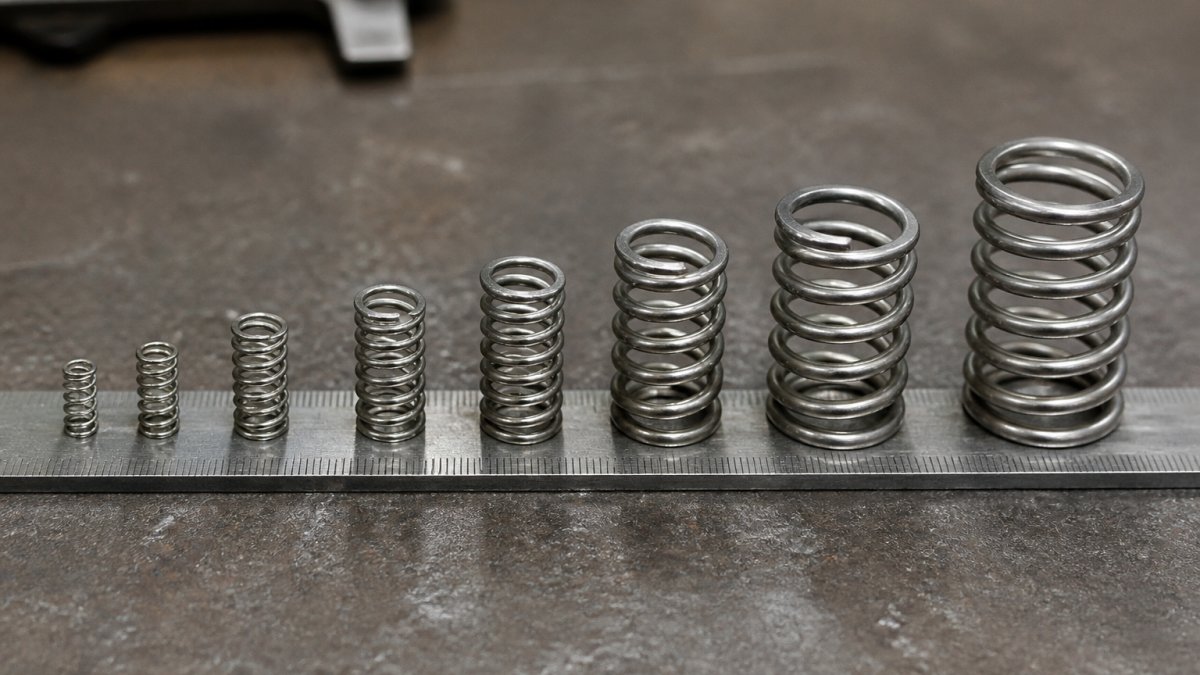
Six measurements define any compression spring, and every catalogue entry and part number is built from them. Miss one and the part will not fit or perform.
Outside Diameter, Inside Diameter and Wire Diameter
The three diameter figures are linked by a single relationship: outside diameter minus twice the wire diameter equals inside diameter. Get any two and the third is fixed.
- Outside diameter (Do): the overall width of the coil, which must clear the bore or housing
- Inside diameter (ID): the clearance over a rod or mandrel
- Wire diameter (d): the thickness of the material itself, the biggest single driver of load capacity
A common mistake is specifying outside diameter and wire diameter but leaving inside diameter unchecked. On small springs the wire takes up a surprising share of the space. A 0.4mm wire removes 0.8mm from the inside diameter, which matters when the spring runs over a guide pin.
Free Length, Solid Height and Active Coils
Length and coil count set how far the spring can travel before it binds.
Free length (Lo) is the unloaded overall length. Solid height (Sh) is the length when every coil touches, the physical limit of compression. Active coils are the turns that actually deflect, excluding the closed end coils.
The gap between free length and solid height is your maximum travel. Exceed it and the spring becomes a solid tube of metal, transferring shock straight into the assembly.
How to Measure a Compression Spring You Already Have
Measuring an existing spring takes a vernier caliper, a steel rule and five minutes. Accuracy decides whether your replacement matches the original or introduces a new problem.
Work through it in this order:
- Measure outside diameter across the widest point of the coil with the caliper, at two positions 90 degrees apart, and take the average
- Measure wire diameter on a straight section of wire at the end, not on a curved coil
- Calculate inside diameter by subtracting twice the wire diameter from the outside diameter
- Measure free length with the spring standing on end and unloaded
- Count total coils, then subtract the end coils to estimate active coils
- Measure solid height by compressing gently by hand or calculating it from coil count and wire diameter
- Note the end type, whether closed, closed and ground, or open
Watch out: measuring a spring that has been in service gives you the worn dimension, not the original.
Note the end type carefully: wire up to 0.80mm is typically squared and unground, while 1.00mm and over is squared and ground.
Reading a Compression Spring Size Chart Without Making a Costly Mistake
A compression spring size chart lists part numbers against dimensions and loads, and misreading one column is the most expensive error in spring selection. Read every row across, never down a single column.
Most catalogue tables follow the same structure:
| Symbol | Meaning | Why It Matters |
|---|---|---|
| Do | Outside diameter (mm) | Must clear the bore |
| d | Wire diameter (mm) | Sets load capacity |
| Lo | Free length (mm) | Defines installed height |
| L1 | Recommended minimum working length (mm) | Your travel limit |
| Sh | Solid height (mm) | Absolute compression limit |
| P1 | Load at L1 working length (N) | Force at that length |
| R | Spring rate (N/mm) | Load per mm of deflection |
Two traps catch buyers repeatedly. First, L1 is not the solid height: it is the recommended minimum working length, and running to solid height risks over-stress. Second, part number prefixes carry meaning: in our catalogue, D1 is music wire and D2 is stainless steel 302, so a single character separates two very different materials. Understanding how compression springs are manufactured explains why chart tolerances differ between stock and custom parts.
British Standard BS 1726 on helical compression springs sets out the dimensional and force tolerances that reputable catalogues work to, and it is worth knowing which grade a chart is quoting before you compare rows.
Compression Spring Rate Calculation: Matching Load to Deflection
Spring rate, also called the spring constant, is the load required to deflect the spring by one unit of distance, in newtons per millimetre.
The rate depends on wire diameter, mean coil diameter and active coils. The standard relationship is:
R = (G × d⁴) ÷ (8 × D × Na)
The fourth power on wire diameter is why small wire changes have large effects. Double the wire diameter and, all else equal, the rate rises by a factor of sixteen. Double the mean coil diameter or the active coil count and the rate halves.
A Worked Example You Can Check
Take a stainless spring with d = 0.50mm, Do = 5.00mm and Na = 8.
Metric Compression Springs Stainless Steel 0.2mm to 0.4mm Wire →
- Mean coil diameter D = 5.00 − 0.50 = 4.50mm
- R = (69,000 × 0.50⁴) ÷ (8 × 4.50 × 8)
- R = (69,000 × 0.0625) ÷ 288
Now apply a working load. If you need 30 N at working length, deflection = load ÷ rate = 30 ÷ 15 = 2.0mm. The installed length is therefore free length minus 2.0mm. If free length is 20mm, working length is 18mm.
The Three Checks That Catch Bad Selections
A rate that delivers the right force is only the first test. Run all three before committing:
- Solid-height check. Solid height for a squared and ground spring is approximately (total coils) × d. With 10 total coils at 0.50mm, solid height is about 5.0mm. Your working length of 18mm leaves ample margin here, but a shorter free length or a longer deflection would not. Never design working length closer to solid height than about 15% of free length.
- Stress check. The shear stress in the wire is τ = (8 × F × D × K) ÷ (π × d³), where F is the working load and K is the Wahl correction factor (roughly 1.1 to 1.3 for typical index ratios). For 30 N on this spring, τ is on the order of 300 N/mm², comfortably inside the allowable range for 302 stainless in static service. Push the load to 100 N and stress triples, which is where fatigue and set become real risks.
- Index check. The spring index is D ÷ d, here 4.50 ÷ 0.50 = 9. Most practitioners treat an index below 4 as difficult to coil and prone to high stress concentration, and above 15 as prone to buckling. An index of 9 sits in the comfortable middle.
A Selection Workflow From Load and Travel
Rather than browsing a chart and hoping, work backwards from the application:
- Step 1: Fix the bore and rod dimensions, which set the maximum outside diameter and minimum inside diameter.
- Step 2: Fix the installed length and the working travel, which set the free length and the deflection at working load.
- Step 3: Calculate the required rate as load ÷ deflection.
That last point is where designs fail. Matching load to deflection is a two-variable problem, and fixing one variable forces the other. Check the resulting stress against the material's allowable stress before committing, because a spring that delivers the right force at too high a stress will fail early. Our guide to preventing premature spring failure covers stress and fatigue in detail.
Stainless Steel Grades, Corrosion and Dimensional Tolerance
Material grade decides where a spring can survive, and stainless steel 302 is the workhorse for most applications, offering good corrosion resistance and consistent mechanical properties across a wide temperature range.
Stainless steel earns its place where mild steel would rust: washdown environments, humid plant rooms, outdoor equipment and subsea assemblies. Our subsea spring materials guide goes deeper into grade selection and the standards that apply.
Tolerance is the permitted variation on a dimension, and it is where catalogue and custom parts diverge.
Watch out: specifying a tolerance tighter than the standard band without saying so leaves the supplier no choice but to work to the standard. State your critical dimensions explicitly.
When Custom Compression Springs Beat the Nearest Stock Size
Custom compression springs make sense when no stock size meets your load, travel and fit requirements together.
Stock is faster and cheaper for most designs. Custom wins when the compromise costs more than the tooling. If you find yourself stacking washers to make a stock spring fit, or accepting a rate 15% off target, the custom route usually pays back.
The Four Signs a Stock Size Will Not Do
Work through these before assuming a catalogue part will fit:
- The bore is between standard outside diameters. Stock ranges step in fixed increments, so a bore that falls between two steps leaves you either too loose (the spring rattles and wears) or too tight (it will not seat).
- The required rate sits between two catalogue rates. A spring 20% off target changes the installed load and the working length, which can push a mechanism out of specification.
- The travel exceeds the stock spring's recommended working length. If your deflection takes the spring past L1 and towards solid height, no amount of rate matching will save it.
What to Specify for a Custom Spring
A manufacturer can quote accurately only if you supply the full picture. Send:
- Outside diameter and inside diameter, with the critical one marked
- Wire diameter, or the load and travel from which it can be derived
- Free length and installed length
Supplying load and travel rather than just dimensions lets the manufacturer choose the wire diameter and coil count that meet both, rather than reverse-engineering a part that only fits.
When Standard Sizes Are the Right Answer
Custom is not automatically better. If a stock spring meets your diameter, rate and travel within about 10%, and the environment suits 302 stainless, buy stock: it ships faster, costs less and carries a known tolerance band.
For readers ready to move from sizing theory to buying, you can browse a real metric compression springs stainless steel 0.2mm to 0.4mm wire size range and see how the dimensions map to part numbers.

Order Your Stainless Steel Compression Springs from SpringXpert
Getting the size right is the whole game, and the fastest route to a correct part is a supplier who stocks the range and can make the bespoke version when stock will not do.
At SpringXpert, we hold over 20,000 standard products and manufacture bespoke springs and wire forms to drawing.
Send us your dimensions, load and travel requirements, and we will confirm the right spring or quote a custom part. See how quickly custom-sized springs can be delivered and get your project moving.
Frequently Asked Questions
How do I measure the size of a compression spring?
Use a digital vernier caliper and record three figures: wire diameter (one coil's thickness), outside diameter (across the full spring) and free length (end to end, uncompressed). Subtract twice the wire diameter from the outside diameter to get the inside diameter. Count the total coils, then subtract two for squared ends to estimate active coils. Take each measurement twice and note the end type, because squared and ground ends change the solid height you can safely compress to.
What sizes of stainless steel compression springs are available from stock?
SpringXpert stocks metric compression springs in stainless steel EN10270-3 302 with wire diameters from 0.2mm up to 5.00mm, priced from £4.00. Each product page carries a size guide listing outside diameter, wire diameter, free length, recommended minimum working length, solid height, load at working length and spring rate. Part numbers prefixed D2 identify the stainless steel 302 range, so you can filter stock sizes quickly before requesting a bespoke quote.
How do I choose a compression spring for a required load?
Start with the load you need at working length and the travel available. Divide the load by the deflection to get the spring rate you require, then find a stock size whose rate is close. Check that the solid height leaves headroom so the spring never compresses coil on coil, and confirm the outside diameter fits your bore. If no catalogue size lands within tolerance on rate and fit, a custom compression spring is usually cheaper than redesigning the housing.
Are stainless steel springs suitable for corrosive or subsea environments?
Stainless steel EN10270-3 302 covers most industrial and washdown applications, but highly chlorinated or saltwater conditions can still pit it. For subsea and oil and gas work, specify a higher grade or a special alloy such as Inconel, Phynox or MP35, which SpringXpert can manufacture to order. Always state the operating temperature and the medium the spring will contact, because both affect fatigue life and the allowable stress you can design to.
Sizing a spring correctly takes measurement, a clear rate calculation and an honest check against tolerance. If you would rather not work it out alone, send your requirements to SpringXpert. With over 20 years of manufacturing experience, a 12 hour response guarantee and ISO 9001 certification behind every order, we will match your application to the right stainless steel compression spring. Get started with SpringXpert and specify your next spring with confidence.
