

Compression Spring Manufacturing Process 2026
Table of Contents
- How Compression Springs Are Made: The Complete Process
- Spring Design and Specification
- Compression Spring Materials and Wire Selection
- Coiling and Winding: Cold and Hot Processes
- Cutting, Grinding, and End Finishing
- Heat Treatment and Stress Relief
- Compression Spring Quality Control and Testing
- Compression Spring Surface Coating for Corrosion Resistance
- Frequently Asked Questions
Last Updated: October 21, 2026
How Compression Springs Are Made: The Complete Process
Understanding the compression spring manufacturing process is essential for engineers, procurement managers, and operations teams who rely on precision components. At SpringXpert, we've spent over 20 years refining how compression springs move from raw material to finished product.

The complete compression spring manufacturing process involves multiple stages: design specification, wire selection, coiling, cutting, heat treatment, grinding, and quality verification. Each step directly affects the spring's performance, lifespan, and suitability for its application. What separates a spring that performs reliably from one that fails prematurely often comes down to decisions made during manufacturing, decisions that many suppliers rush through or compromise on cost grounds.
This guide walks you through every stage of compression spring manufacturing, explaining the technical parameters, material choices, and quality standards that separate industrial-grade components from inferior alternatives. Whether you're evaluating a supplier, designing a custom spring, or troubleshooting field failures, you'll find the detail you need to make informed decisions.
Pro Tip
The most common mistake in spring sourcing is treating all compression springs as commodity items. Springs designed for subsea applications, high-cycle fatigue environments, or extreme temperature ranges require fundamentally different manufacturing approaches than general-purpose springs. Specify your operating environment upfront, it changes everything about material selection and heat treatment.
Spring Design and Specification
Compression spring design begins with translating application requirements into precise specifications. The designer must define the spring rate (how much force is needed to compress the spring by a given distance), the working load range, the free length, the solid height, and the number of active coils.
The spring rate is calculated from material properties, wire diameter, coil diameter, and number of coils. A stiffer spring requires thicker wire, a smaller coil diameter, or fewer coils; a softer spring does the opposite. This relationship is non-linear, which is why spring design demands precision rather than guesswork.
Solid height is the compressed height when all coils touch, and it determines the maximum compression the spring can sustain without permanent deformation. If an application requires extreme deflection, the design must account for this by using a smaller coil diameter or more coils, both of which increase manufacturing complexity and cost.
ISO 2162-1 spring design standards define the calculation methods and safety factors engineers use across industries. Tolerances on critical dimensions, particularly wire diameter and coil diameter, must be specified to ensure the spring performs consistently across production batches.
Compression Spring Materials and Wire Selection
Material selection is where many springs fail, not because the material is poor but because the wrong material was chosen for the environment. Carbon steel music wire (EN10270-1) is the industry standard for general-purpose compression springs, offering excellent spring properties, good fatigue resistance, and cost-effectiveness. Music wire is cold-drawn, which creates internal stress that must be relieved during manufacturing.
Stainless steel (EN10270-3, typically 302 grade) is essential for applications exposed to moisture, salt spray, or chemical environments. Stainless steel has slightly lower spring rate than music wire for the same dimensions, which designers must account for. For subsea applications and high-corrosion environments, upgraded stainless grades like 316 or specialist alloys such as Inconel and Phynox become necessary.
Wire diameter determines the spring's load capacity and fatigue life: thicker wire means higher load capacity but also higher spring rate. For a given application, wire diameter is often constrained by the required spring rate and coil diameter. If the calculated diameter falls between standard sizes, the designer must choose the next size up or recalculate.
Watch Out
Surface cracks in heat-treated springs are a leading cause of premature failure in the field. This happens when heat treatment is rushed or the surface isn't properly cleaned before tempering. If you've experienced spring failures with surface cracking, the root cause is usually inadequate stress relief or contamination during the hardening process. Verify your supplier's heat treatment procedures and surface inspection protocols before placing high-volume orders.
The material's tensile strength and fatigue limit determine how many compression cycles the spring can endure before cracking. Music wire has a tensile strength around 1,770 MPa, which is why it's preferred for high-cycle applications. Stainless steel 302 is slightly lower at around 1,550 MPa. For applications requiring millions of cycles, hydraulic equipment, automotive suspensions, industrial machinery, material selection is non-negotiable.
Coiling and Winding: Cold and Hot Processes
Coiling is where the wire transforms into a spring shape, using either cold or hot winding. Cold winding is used for wire diameters up to approximately 1.0mm.
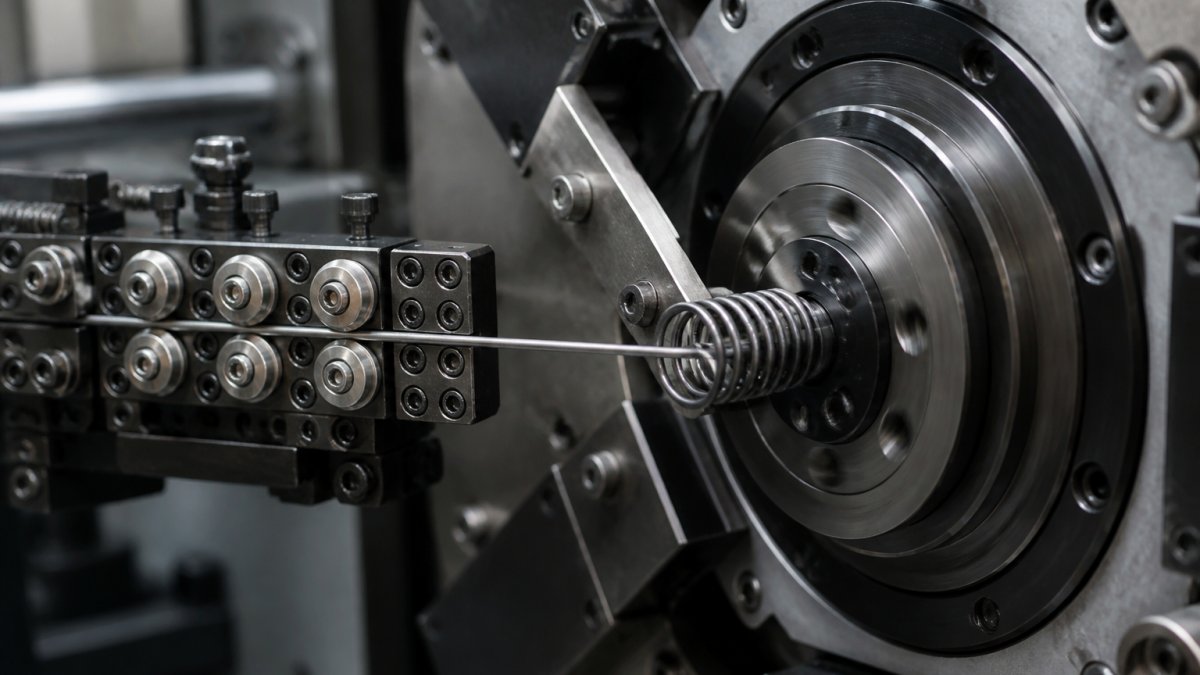
Cold winding creates residual stress because the material is plastically deformed without heat; this must be relieved during heat treatment, or the spring will have inconsistent properties and poor fatigue resistance.
Hot winding is used for wire diameters above approximately 1.0mm and for applications requiring specific mechanical properties. The wire is heated to 800-1,000°C before coiling, reducing yield strength and allowing larger deformations without cracking.
CNC coiling machines are the backbone of modern spring manufacturing, featuring precision wire feed systems, rotating mandrels with adjustable speeds, and automated pitch control.
Pitch (spacing between coils) is critical: coils too close may touch during compression, creating a solid height that's too short, while coils too far apart make the spring longer than necessary.
Cutting, Grinding, and End Finishing
After coiling, the spring must be cut to the correct free length and the ends finished. Cutting is done with a high-speed rotary saw or shearing machine. Precision is critical: a spring cut 0.5mm too short will have a different spring rate than specified. Modern equipment uses laser measurement to verify length in real time, stopping the cut when the target dimension is reached.
End finishing determines how the spring sits in the application. Compression springs typically have squared and ground ends (wire diameters 1.00mm and above) or squared and unground ends (smaller wire). Squared ends mean the end coils are compressed flush with adjacent coils; ground ends are further processed on a cylindrical grinder to create a flat surface, improving seating and load distribution.
Open ends are acceptable for many applications but create stress concentration points where the wire transitions to the end coil. Closed and ground ends distribute load more evenly and are preferred for high-cycle or high-load applications. Grinding removes material, so it must be done carefully to avoid overheating the surface and creating micro-cracks.
Heat Treatment and Stress Relief
Heat treatment is where the spring's mechanical properties are finalised. For music wire springs, the process involves heating to approximately 450-500°C and holding at temperature for a specific duration (typically 30 minutes to 2 hours, depending on wire diameter). This stress-relief process removes residual stress created during cold winding without significantly reducing the material's hardness.
Metric Compression Springs Music Wire 0.2mm to 0.4mm Wire →
Furnace temperature must be controlled precisely. Too low, and residual stress remains, leading to inconsistent spring rate and poor fatigue life. Too high, and the material softens, reducing load capacity. Temperature uniformity is essential: springs in hot spots will be over-tempered while those in cool spots remain under-stressed.
Stainless steel springs require different heat treatment. Stainless steel 302 is typically solution-annealed at 1,000-1,100°C and then cooled rapidly. This process removes work-hardening from the coiling process and restores ductility. Some applications require age-hardening treatments to increase strength further.
Key Takeaway
Heat treatment is where most premature field failures originate. If your springs are cracking or losing load capacity after a few thousand cycles, the problem is usually inadequate stress relief or temperature control during this stage. Reputable suppliers invest in automated furnaces with thermocouples and data logging to prove temperature consistency across every batch.
Cooling rate after heat treatment also matters. Rapid cooling (quenching) can create thermal stress, while slow cooling may not fully relieve residual stress. Many suppliers use controlled cooling, removing springs from the furnace to cool in air or a controlled atmosphere, ensuring the desired properties without introducing new stresses.
Compression Spring Quality Control and Testing
Quality control begins with incoming inspection of the wire: diameter, tensile strength, and surface condition are verified against specifications. Non-destructive testing (eddy current or ultrasonic) can detect subsurface defects before the wire is wound, preventing them from propagating through manufacturing.
After coiling and before heat treatment, visual inspection checks for uneven coil spacing, kinks, or surface damage. After heat treatment, dimensional inspection measures free length, coil diameter, and solid height. Modern quality systems use automated vision and laser measurement to verify dimensions on 100% of springs, not just samples.
Load testing is the final verification: springs are compressed to specified loads, deflection is measured, and spring rate is calculated from the load-deflection curve. Springs outside tolerance are rejected. High-volume manufacturers use automated load testers processing hundreds of springs per hour, logging data for traceability.
| Quality Control Stage | What's Tested | Tolerance Typical | Method |
|---|---|---|---|
| Wire Incoming | Diameter, tensile strength | ±0.02mm, ±5% | Micrometer, tensile tester |
| Post-Coiling | Visual defects, pitch uniformity | Visual inspection | Operator inspection |
| Post-Heat Treatment | Free length, coil diameter | ±0.5mm | Automated vision system |
| Load Testing | Spring rate, deflection | ±10% of specified rate | Automated load tester |
| Final Inspection | Dimensional accuracy, surface finish | Per specification | Laser measurement, visual |
Statistical process control (SPC) tracks production trends. If load testing shows spring rates drifting upward, it signals wire diameter may be increasing or coil diameter decreasing; catching this early prevents an entire batch from being out of specification.
Compression Spring Surface Coating for Corrosion Resistance
Surface coating protects springs from corrosion in demanding environments.
Zinc plating is the most common industrial coating: a thin layer of zinc (typically 5-25 micrometers) is electroplated onto the spring surface, corroding preferentially to the underlying steel and sacrificing itself to protect the base material.
Stainless steel springs don't require additional coating in most environments because the stainless steel itself resists corrosion. However, in extreme environments (high chloride concentration, acidic conditions), even stainless steel can corrode.
Powder coating and paint finishes are used when appearance matters or additional environmental protection is needed.
SpringXpert supplies compression springs in music wire with oiled finish as standard, with stainless steel options available from stock. Our ISO 9001 certification ensures that every coating process is documented and controlled.
Compression spring manufacturing is a precision discipline where material science, mechanical engineering, and process control converge.
At SpringXpert, we manufacture compression springs to DIN 2095 and BS 1726 standards, maintaining tolerances and mechanical properties that exceed general-purpose requirements.
Frequently Asked Questions
What are the main steps in the compression spring manufacturing process?
The compression spring manufacturing process follows a sequence: design and specification, wire material selection, coiling (cold or hot winding), cutting to length, end grinding, heat treatment and stress relief, surface finishing, and quality testing. Each step is critical to ensure the spring meets load, deflection, and fatigue life requirements. Tolerances conform to DIN 2095 (Grade 2) or BS 1726 Class B standards.
What materials are best for compression springs in different operating environments?
Carbon steel EN10270-1 music wire suits most general industrial applications and offers cost-effectiveness. Stainless steel EN10270-3 302 resists corrosion in wet or chemical environments. For extreme temperatures or aggressive conditions, manufacturers specify special alloys including Inconel, Phynox, or MP35. Material selection depends on load, temperature range, corrosion exposure, and fatigue life requirements.
Why are compression springs heat-treated after coiling?
Heat treatment relieves residual stresses introduced during coiling and winding, which improves fatigue life and prevents premature failure. Stress relief tempering also stabilises the spring's dimensions and ensures consistent spring rate across production batches. Proper heat treatment and cooling prevent surface cracking and brittleness that can occur without controlled thermal processing.
How do you verify compression spring quality and prevent field failures?
Quality control includes dimensional inspection using laser measurement and vision systems, load testing to verify spring rate and deflection, surface finish inspection for defects, and statistical process control to track batch consistency. ISO 9001 certification ensures documented procedures for every stage. Load testing confirms the spring performs within specified tolerances before dispatch, preventing the surface crack and premature failure issues that occur with inadequate process control.
What surface coatings protect compression springs from corrosion?
Music wire springs typically receive an oiled finish for light protection. Stainless steel springs resist corrosion naturally. For harsh environments, electroplating (zinc, nickel), powder coating, or specialist corrosion-resistant finishes are available. Coating selection depends on operating temperature, chemical exposure, and aesthetic requirements. Proper surface finishing extends service life in subsea, oil and gas, and marine applications.
Can you manufacture custom compression springs with tight tolerances?
Yes. Custom compression springs are engineered to your exact specifications for wire diameter, coil diameter, free length, solid height, and spring rate. CNC coiling equipment and precision grinding ensure consistent tolerances across batches. SpringXpert delivers custom springs with 12-hour response times and ISO 9001 quality assurance, eliminating the revision cycles and delays that plague multi-supplier approaches.