

Subsea Spring Materials: Corrosion Resistance & Standards Guide
Table of Contents
- Why Subsea Spring Material Selection Matters
- Spring Material Types and Corrosion Resistance in Seawater
- Subsea-Specific Corrosion Mechanisms: Chloride Pitting and Stress Cracking
- Subsea Spring Material Selection: Matching Alloys to Service Conditions
- Spring Material Corrosion Testing and Qualification Standards
- Subsea Spring Material Certification and Standards Crosswalk
- Spring Material Specification Checklist for Subsea Applications
- Galvanic Compatibility and Mixed-Material Corrosion Risks
- Frequently Asked Questions
Last Updated: October 14, 2026
Why Subsea Spring Material Selection Matters
Selecting the right subsea spring material determines whether equipment lasts decades or fails catastrophically. Subsea environments combine extreme pressure, saltwater, temperature swings, and cyclic loading that destroy ordinary springs within months. A failed spring in a blowout preventer, Christmas tree valve, or hydraulic system can trigger shutdowns costing millions per day and compromise safety. Material selection drives service life, failure modes, and total cost of ownership.
SpringXpert has supported subsea oil and gas clients for over 20 years. The most common mistake is treating subsea spring material selection as a simple upgrade from onshore standards. Subsea conditions demand materials engineered for chloride-rich environments, stress corrosion cracking resistance, and predictable mechanical properties.
Spring Material Types and Corrosion Resistance in Seawater
Subsea spring materials fall into distinct families with different corrosion resistance and mechanical characteristics. Matching these categories to service conditions is essential.
Stainless Steel Grades for Subsea Service
Stainless steel remains the baseline for most subsea springs, balancing cost, availability, and corrosion resistance, though not all grades suit subsea environments. Type 316L stainless steel (EN 1.4404) resists general corrosion and pitting in seawater better than 302 or 304 grades. 316L's critical limitation emerges in deep water and high-chloride environments.
Duplex stainless steel (Type 2205, EN 1.3245) combines austenitic corrosion resistance with ferritic strength. Its PREN typically exceeds 30, giving superior pitting and crevice resistance versus 316L under cyclic deep-water loading. Super-duplex stainless steel (UNS S32750, EN 1.4410) has PREN values above 40 and resists stress corrosion cracking in high-chloride environments where duplex may still be at risk.
Nickel-Based Alloys and Inconel for Extreme Conditions
When stainless steel grades reach their limits, nickel-based alloys take over. Inconel X-750 and Inconel 718 are the workhorses of extreme subsea environments. Inconel 718 (UNS N07718) is a precipitation-hardening nickel-based superalloy built for high strength and corrosion resistance across a wide temperature range. Inconel X-750 (UNS N07750) offers similar corrosion resistance with slightly different mechanical properties. Both alloys are NACE MR0175-approved for sour service, suitable for subsea wells in challenging formations.

SpringXpert manufactures Inconel 718 disc springs (also called Belleville washers) specifically designed for subsea and cryogenic service.
Titanium and Specialty Alloys
Titanium and titanium alloys represent the frontier of subsea spring materials. Commercially pure titanium (CP Ti, Grade 2) and Ti-6Al-4V (Grade 5) offer exceptional seawater corrosion resistance, superior to most stainless and nickel-based alloys. The primary limitation is cost: titanium runs 3-5 times higher than duplex stainless steel, and manufacturing requires specialised equipment and expertise. Titanium springs are reserved for high-value subsea equipment or long-service-life components where corrosion resistance is non-negotiable.
Specialty alloys such as MP35N (cobalt-nickel-chromium-molybdenum) and Phynox (cobalt-nickel-chromium) offer corrosion resistance approaching Inconel at slightly lower cost, used where Inconel is overkill but stainless steel is insufficient.
Subsea-Specific Corrosion Mechanisms: Chloride Pitting and Stress Cracking
Understanding how subsea environments corrode springs is essential for material selection. The corrosion mechanisms differ fundamentally from onshore or freshwater service.
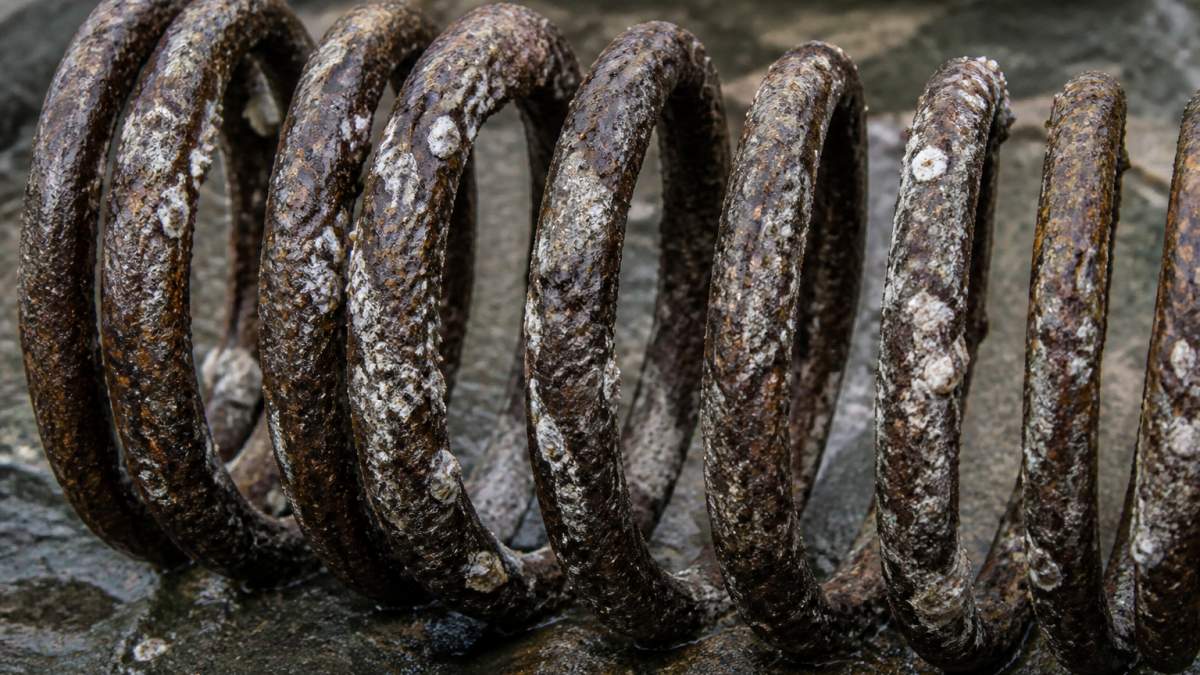
Chloride pitting corrosion occurs when chloride ions penetrate the protective oxide film on stainless steel or nickel alloys. Pitting potential defines the threshold at which pitting becomes possible. Type 316L stainless steel sits around 250-400 mV (standard calomel electrode) in seawater; duplex stainless steel reaches 600-800 mV; Inconel 718 and titanium alloys exceed 1000 mV.
Crevice corrosion initiates in confined spaces, under a spring seat, in a threaded connection, or beneath surface deposits, where chloride concentrates and oxygen depletes.
Stress corrosion cracking (SCC) is the most insidious failure mode. It occurs when a susceptible material under sustained tensile stress, applied or residual, meets a corrosive environment. Austenitic stainless steel (Type 316L) is susceptible to chloride SCC in seawater, particularly above 50°C or under high sustained stress.
Subsea Spring Material Selection: Matching Alloys to Service Conditions
Selecting the right subsea spring material requires a systematic approach considering depth, temperature, chloride exposure, stress state, and service life expectations.
Shallow water (0-500 metres), moderate temperature (<40°C), standard oil and gas environments: Type 316L stainless steel is typically adequate, cost-effective, widely available, and proven. Verify the design minimises crevices and that residual stresses are managed through proper heat treatment.
Deep water (500-2,000 metres) or high-chloride zones: Duplex stainless steel (Type 2205) becomes the baseline.
Ultra-deep water (>2,000 metres), sour service (H₂S present), or sustained high temperature (>50°C): Inconel 718 or super-duplex stainless steel are required.
Extreme corrosion environments or long service life (>20 years): Titanium or specialty nickel-cobalt alloys.
A practical framework: start with the least expensive material that meets corrosion resistance for your depth and environment, then adjust upwards if stress state, temperature, or service life demand higher SCC resistance.
Spring Material Corrosion Testing and Qualification Standards
Materials don't earn subsea approval through specification alone. Corrosion resistance must be validated through standardised testing that simulates subsea conditions. Testing commonly includes exposure to ferric chloride solutions at elevated temperatures (similar to ASTM G48 Method A and D), salt spray testing (similar to ASTM G47), and cyclic potentiodynamic polarisation tests. ISO 12944 defines corrosivity categories and coating systems for different environments, helping classify subsea corrosion severity and inform material selection. Most subsea components must pass a combination of these tests. Duplex stainless steel typically requires testing for pitting, crevice corrosion, and SCC resistance.
Subsea Spring Material Certification and Standards Crosswalk
Subsea equipment is governed by multiple overlapping standards. Understanding which apply to your application is critical for material and component selection.
ISO Requirements for Subsea Springs
ISO 3096 specifies compression, extension, and torsion spring requirements, including material grades, tolerances, and testing. Subsea springs often need custom specifications beyond its scope. SpringXpert manufactures to ISO 3096 tolerances as a baseline.
ISO 6931 covers flat springs, including disc springs (Belleville washers), common subsea for load bearing and vibration isolation. It specifies dimensional tolerances and load-deflection characteristics.
NACE/AMPP and Offshore Specifications
NACE MR0175 approval requires:
- Maximum hardness: typically 350 HV (Vickers hardness)
- Tensile strength limits to prevent SCC initiation
- Proof of SCC resistance through NACE TM0177 testing
- Traceability and certification of material composition and heat treatment
If your subsea application involves hydrogen sulfide (sour wells, sour production systems), material selection must satisfy NACE MR0175. Standard 316L stainless steel is not NACE-approved and will fail rapidly in sour subsea service.
NACE SP0172 (Design, Fabrication, and Inspection of Metallic Pressure Vessels Used in Subsea Service) guides material selection, design, and fabrication for subsea pressure vessels and equipment.
API 579-1/ASME FFS-1 (Fitness-for-Service) provides a framework for evaluating the structural integrity of pressure equipment with corrosion, cracking, or other damage.
DNV (Det Norske Veritas) and ABS (American Bureau of Shipping) standards govern subsea equipment in the North Sea and other regulated deepwater environments.
Spring Material Specification Checklist for Subsea Applications
When specifying a subsea spring, use this checklist to ensure all critical material and corrosion parameters are addressed.
| Parameter | Specification | Rationale |
|---|---|---|
| Material grade (e.g., 316L, Duplex 2205, Inconel 718) | Define exact UNS or EN designation | Prevents substitution with lower-grade alternatives |
| Corrosion environment | Depth, temperature, chloride, H₂S | Determines minimum material corrosion resistance |
| Pitting resistance equivalent (PREN) | Minimum acceptable PREN value | Quantifies pitting corrosion resistance |
| Stress state | Applied stress, residual stress, cyclic loading | Informs SCC risk assessment |
| Service life | Design life in years | Justifies material cost and qualification testing |
| Corrosion testing | ASTM G48, ASTM G129, NACE TM0177 | Validates material suitability before use |
| Hardness limit | Maximum HV if NACE-applicable | Prevents SCC initiation in susceptible materials |
| Heat treatment | Stress relief, solution anneal, precipitation harden | Controls residual stress and mechanical properties |
| Surface finish | Passivation, electropolish, or other | Removes iron contamination and enhances oxide film |
| Traceability | Certification of composition, heat treatment, testing | Enables verification of material compliance |
| Coating (if applicable) | Type, thickness, adhesion testing | Provides secondary corrosion protection |
A complete subsea spring specification should confirm each checklist parameter is defined and validated. Many subsea failures trace back to incomplete specifications, material grade defined but corrosion testing omitted, or service life underestimated and material selection insufficient.
Galvanic Compatibility and Mixed-Material Corrosion Risks
Subsea springs rarely operate in isolation; they're installed in assemblies with fasteners, housings, and other components of different materials. Galvanic coupling occurs when two metals with different electrochemical potentials connect in a conductive electrolyte. The galvanic corrosion rate depends on the potential difference between materials, the cathode-to-anode surface area ratio, electrolyte conductivity, and each material's polarisation characteristics.

Material compatibility hierarchy for subsea service:
- Most compatible: materials with similar electrochemical potentials (e.g., duplex stainless steel with super-duplex fasteners)
- Moderately compatible: materials separated by <300 mV in the galvanic series (e.g., 316L spring with duplex fastener)
- Poorly compatible: materials separated by >500 mV (e.g., stainless steel spring with carbon steel housing)
- Incompatible: active metals coupled to noble metals (e.g., aluminium spring with stainless steel housing)
Mitigation strategies for galvanic corrosion:
- Isolate dissimilar metals with non-conductive spacers or coatings
- Use materials within the same alloy family (e.g., all duplex stainless steel components)
- Apply protective coatings to the more active material to break the galvanic circuit
- Use impressed current cathodic protection systems to shift the potential of the more active material and prevent corrosion
- Specify fasteners and hardware from the same material family as the spring
In practice, specify subsea springs with fasteners and adjacent components of compatible material.
SpringXpert manufactures springs in multiple material grades and can advise on material compatibility for your assembly.
Subsea spring material selection balances corrosion resistance, mechanical properties, cost, and service life.
Frequently Asked Questions
Which materials are most commonly used for subsea spring applications?
Stainless steel grades Type 316, duplex stainless steel (Type 2205), and nickel-based alloys like Inconel 718 dominate subsea spring material selection. Type 316 offers good general corrosion resistance in seawater. Duplex alloys provide superior strength and pitting resistance. Inconel 718, certified to NACE MR 0175, excels in extreme-pressure and high-temperature subsea environments. Selection depends on depth, temperature, chloride exposure, and mechanical load requirements.
What is chloride stress corrosion cracking and why does it matter for subsea springs?
Chloride stress corrosion cracking (SCC) occurs when tensioned metal is exposed to chloride-rich seawater, causing brittle failure without visible corrosion. Subsea springs experience cyclic and sustained loads in high-chloride environments, making SCC a critical failure mode. Austenitic stainless steels (Type 302, 304) are particularly vulnerable. Duplex and super-duplex alloys, plus nickel-based alloys, resist SCC far better. Material certification to NACE MR 0175 or ISO 15156 ensures the alloy has been tested for SCC resistance.
How do I verify that a subsea spring material meets the right certification standards?
Request documentation confirming compliance with relevant standards such as ISO 15156 and NACE MR 0175 for your specific depth and service conditions. SpringXpert's Inconel 718 disc springs carry NACE MR 0175 certification for subsea use.
What surface treatments improve corrosion resistance in subsea springs?
For high-performance subsea applications, material selection (e.g., duplex or Inconel) is more effective than coatings alone, since coatings can degrade or fail under cyclic loading and abrasion. Combine material grade with appropriate surface treatment for optimal spring material corrosion protection.
How does galvanic corrosion affect subsea springs assembled with other metals?
When dissimilar metals contact in seawater, the less noble metal corrodes rapidly. A spring made from Type 316 stainless steel paired with carbon steel fasteners or housings will accelerate corrosion at the interface. Always match alloy nobility or electrically isolate components. Duplex, super-duplex, and Inconel springs are more noble than austenitic stainless steel, so pairing them with lower-grade materials creates galvanic risk. Specify compatible materials across the entire subsea assembly and use isolation washers or coatings to prevent galvanic couples.
What tests confirm a spring material's corrosion resistance in subsea conditions?
Standardised tests such as those outlined in ASTM G48 (for pitting and crevice corrosion) and ASTM G129 (for stress corrosion cracking) are used to assess material performance. ISO 15156 provides acceptance criteria for subsea materials in sour environments.
What is the difference between Type 316 and duplex stainless steel for subsea springs?
Type 316 (austenitic stainless steel) offers moderate corrosion resistance and good ductility but lower yield strength. Duplex stainless steel (Type 2205) has roughly double the yield strength, superior pitting resistance, and better chloride stress corrosion cracking resistance. Duplex is more cost-effective for high-load subsea applications where space is limited. Type 316 suits lower-pressure or shallower-depth applications. Both require NACE MR 0175 certification for subsea use. Choose based on operating temperature, depth, load, and lifecycle cost.
How do I create a spring material specification checklist for a subsea component?
Start with operating depth, temperature range, and design life. Specify material grade (e.g., Type 316, Duplex 2205, Inconel 718) and relevant standards (ISO 15156, NACE MR 0175). Define mechanical properties: yield strength, tensile strength, fatigue life, and spring rate. List corrosion test requirements and acceptance criteria. Include surface treatment and inspection protocols. Document traceability requirements and material certifications. Define galvanic compatibility constraints with mating components. SpringXpert's 12-hour response time allows rapid clarification of your spring material specification checklist before tooling begins.