

Induction Hardening vs Furnace Heat Treatment: Which Suits Your Springs?
Last Updated: November 4, 2026
Quick Summary
Induction hardening heats a local surface zone in seconds using electromagnetic induction, while furnace heat treatment heats the whole load slowly in a controlled atmosphere. Induction is fast, selective and repeatable, while furnaces are thorough, flexible and better suited to through-hardening and batch work. Choose induction for high-volume, fatigue-critical springs and furnaces for through-hardened, varied batches.
- Induction hardening heats only the skin, so the core stays tough while the surface becomes a hard martensitic layer.
- Higher frequency gives a shallower hardened layer, and lower frequency gives a deeper one.
- Furnace treatment heats the whole part and quenches the whole load, so warpage and residual stress are higher.
- Induction cycle times are measured in seconds per part, furnace cycles in hours per batch.
- Specify surface hardness, a hardness profile, case depth and a microstructure check as acceptance criteria.
Table of Contents
- Induction Hardening vs Furnace Heat Treatment: The Core Differences
- Case Hardening vs Through Hardening: Choosing the Right Depth
- Heat Treatment Distortion Control: What Each Process Does to Your Part
- Energy Efficiency in Industrial Heat Treatment: Where the Kilowatts Go
- Hardness, Wear Resistance and Fatigue Strength: Like-for-Like Comparison
- Production Scale, Part Size and Total Cost of Ownership
- Inspection, Acceptance Criteria and Metallurgical Limits
- Specifying Heat-Treated Springs with SpringXpert
- Frequently Asked Questions
Induction Hardening vs Furnace Heat Treatment: The Core Differences
Choosing between induction hardening and furnace heat treatment is one of the most consequential decisions a spring designer or buyer makes. Over more than 20 years of spring manufacturing, the choice of process often decides whether a part survives repeated loading or fails in the field. The short answer: induction hardening heats a local surface zone in seconds using electromagnetic induction, while furnace heat treatment heats the whole load slowly in a controlled atmosphere. One is fast, selective and repeatable. The other is thorough, flexible and better suited to through-hardening and batch work.
Below, we break down how each process works, where each is best suited, and how to specify heat-treated springs.
How Induction Heating and Electromagnetic Principles Work
Induction hardening passes an alternating current through a copper coil shaped around the part. That current creates a rapidly changing magnetic field, and the field induces eddy currents in the steel surface. The surface resists those currents, heats in seconds, and is then quenched, usually with a water-based polymer or spray. Only the skin heats, so the core stays tough while the surface becomes a hard martensitic layer. Coil design and power supply frequency control case depth: higher frequency gives a shallower hardened layer, lower frequency gives a deeper one. The process is generally fast and repeatable, which is why it is often suited to high-volume production where cycle time and dimensional accuracy matter.
How Conventional Furnace Heat Treatment Works
Furnace heat treatment heats the entire part, or an entire batch, in a chamber held at austenitizing temperature. Parts soak until the core reaches temperature, then quench as a load, often in oil or polymer, before tempering. Because the whole section transforms, furnace treatment delivers through-hardening and predictable core properties. Atmosphere control, whether protective gas or vacuum, limits decarburisation and scaling. The trade-offs are time and distortion: a batch takes hours, not seconds, and thick sections cool unevenly, which is where heat treatment distortion control becomes the hard part. Furnaces are also flexible, and can handle mixed batches more readily than a dedicated induction coil.
Case Hardening vs Through Hardening: Choosing the Right Depth
Case hardening hardens only the outer layer, leaving a tough core to absorb shock and resist crack propagation. Through hardening transforms the full section, giving uniform hardness from surface to centre. That distinction drives most process choices. Case depth is the number to specify: too shallow and the hardened layer spalls under load; too deep and you lose the tough core you were paying for. Ask for a hardness profile, not a single surface reading.
Heat Treatment Distortion Control: What Each Process Does to Your Part
Distortion is where the two processes diverge most sharply. Induction hardening heats a narrow zone for seconds, so the bulk of the part never expands, and dimensional accuracy stays tight. Furnace treatment heats the whole part and quenches the whole load, so thermal gradients and uneven cooling introduce warpage and residual stress. That does not make furnaces unusable. If distortion is your recurring problem, the way tempering temperatures are set matters as much as the hardening method.
Energy Efficiency in Industrial Heat Treatment: Where the Kilowatts Go
Energy efficiency in industrial heat treatment comes down to how much of the input power reaches the part. Induction heating is generally considered efficient because the heat is generated inside the surface itself, with little wasted on the surrounding air. Furnaces heat a chamber and a load, so energy goes into the atmosphere, the fixtures and the walls as well as the parts. The gap narrows when a furnace runs full and continuously, because a well-loaded furnace spreads its overhead across many parts. Run a furnace half-empty and the energy consumption per part climbs fast. The practical rule: induction wins on energy per part for high-volume, repeatable geometries; furnaces hold their own on full batches of varied work.
Hardness, Wear Resistance and Fatigue Strength: Like-for-Like Comparison
Compare the two processes on the properties that actually fail springs, and the picture is nuanced. Induction hardening generally produces a hard surface layer with compressive residual stress at the surface, which can resist fatigue crack initiation.
| Property | Induction Hardening | Furnace Heat Treatment |
|---|---|---|
| Hardened depth | Localised case, controlled by frequency | Full section or deep case |
| Surface hardness | High, repeatable | High, load-dependent |
| Core toughness | Preserved by design | Uniform through section |
| Distortion risk | Low, localised heating | Higher, whole-part quench |
| Cycle time | Seconds per part | Hours per batch |
| Best for | High-volume, fatigue-critical springs | Through-hardened, varied batches |
The honest limitation: induction is less forgiving of complex geometry, because a coil must be designed around the part. Where a part has awkward features, furnace treatment may be the only practical route. If you are weighing the two methods more broadly, our heat treatment for spring durability guide sets out the full process picture before you commit.
Production Scale, Part Size and Total Cost of Ownership
Total cost of ownership rarely follows the sticker price of the equipment, and the two processes carry their costs in different places. Induction lines carry high capital cost and need dedicated coils per part family, but they run fast, cut rework from distortion, and use less energy per part at volume. Furnaces cost less to tool up and handle mixed batches, but the hours-long cycle, larger footprint and higher rework rate on distortion-prone parts add up.
Disc Springs EN 16983 DIN 2093 6mm to 28mm O/D →
Build the comparison from six cost lines. First, equipment and tooling: induction needs a power supply, cooling system and a coil per part family, while a furnace needs a chamber, atmosphere control and fixturing. Second, energy per part: induction generates heat in the surface itself with little waste, whereas a furnace heats the chamber, fixtures and atmosphere alongside the load, so energy per part falls sharply as load fill rises. Third, labour: induction is easy to automate and often runs with minimal attendance, while furnace loading, unloading and quench control are more manual. Fourth, maintenance: coils wear and need replacement, and furnace elements, atmosphere sensors and quench media need scheduled attention. Fifth, throughput: induction cycle times are measured in seconds per part, furnace cycles in hours per batch, so the same annual volume needs very different plant capacity. Sixth, scrap and rework: distortion-driven rework and quench cracking are the hidden costs that decide the comparison on tight-tolerance parts.
Production volume is the pivot, but part geometry sets the boundary. High-volume, repeatable springs justify induction because the coil cost is spread over many parts and the short cycle removes the need for large batch capacity. Small-batch runs change the maths again, which is why we point buyers to our guide on small batch spring production before they commit to a process route.
Watch out: comparing quoted piece prices without agreeing the acceptance criteria and sampling frequency hides the rework and scrap that actually separate the two routes.
Inspection, Acceptance Criteria and Metallurgical Limits
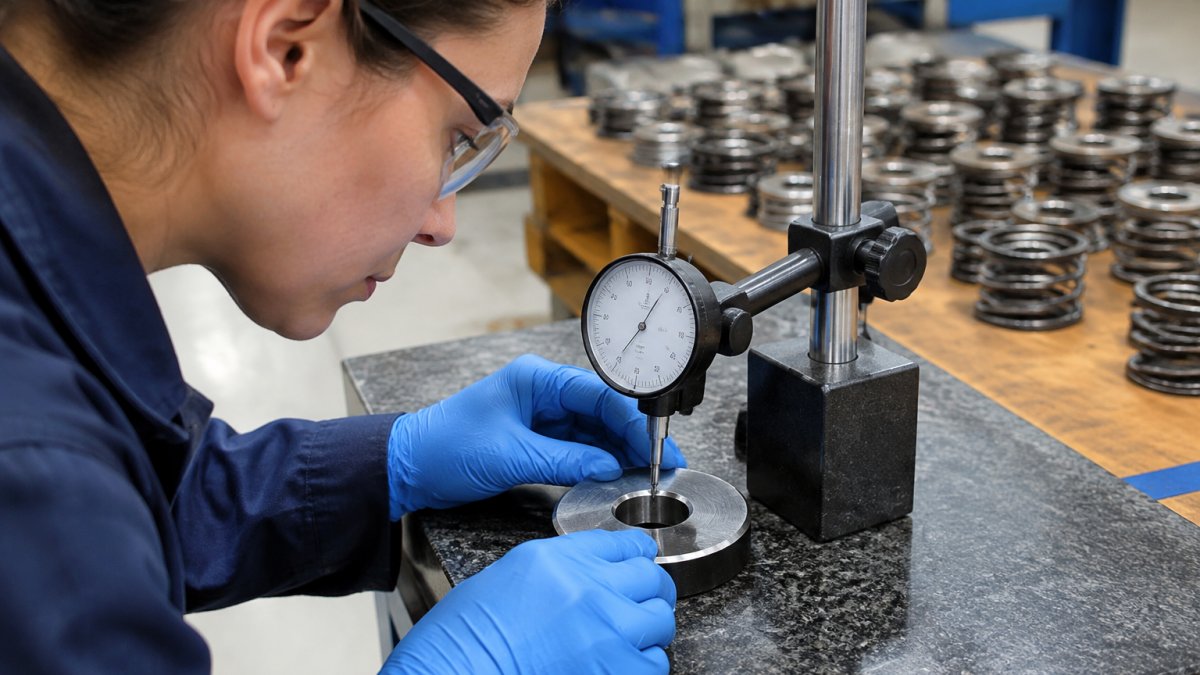
Acceptance should be written around measurable criteria, not assurances. For either process, specify surface hardness and a hardness profile through the case, case depth with a tolerance, and a microstructural check for the hardened layer. Our guide on measuring spring hardness after heat treatment walks through the practical procedure.
The metallurgical limits are where the two processes diverge, and they are worth understanding before you specify. Hardenability sets the ceiling: a steel that transforms easily can be through-hardened in a furnace but may not develop the same depth under a fast induction cycle, so the grade and the process must be chosen together. Quench cracking is a risk in both routes but is concentrated in furnace quenching of thick sections and in induction of thin sections where the power is set too high.
Write the acceptance criteria as a short schedule rather than a single hardness number. Specify the test method and location, the number of readings per lot, the case-depth tolerance, the microstructure acceptance (for example, the absence of unacceptable decarburisation or grain growth), and the distortion tolerance against the drawing.
Watch out: a single surface hardness reading can pass a part that has the wrong case depth or a decarburised skin, so insist on a hardness profile and a microstructure check at first article.
Specifying Heat-Treated Springs with SpringXpert
Specification is where a good process choice becomes a reliable part. Tell us the load, the cycle count, the environment and the tolerance that matters, and we match the heat treatment route to the application rather than defaulting to one method. We hold ISO 9001 certification and have over 20 years of industry experience, with testimonials from clients in industries including robotics and medical devices. Our range covers over 20,000 standard products plus bespoke spring and wire form engineering, with a 12-hour response time guaranteed. For disc springs, our EN 16983 disc spring range from 6mm to 28mm is available to specify, and we offer discounts on bulk orders.

Frequently Asked Questions
What are the primary differences between induction hardening and furnace heat treatment?
Induction hardening heats only the surface layer of a part using an electromagnetic coil, then quenches it immediately, so the core stays soft and tough. Furnace heat treatment heats the whole component in a controlled atmosphere, which suits through-hardening and batch processing. Induction gives faster cycle times and selective hardening; furnaces give uniform results across large batches and complex geometries. The right choice depends on whether you need a hard case over a tough core or uniform properties throughout the section.
Is induction hardening more energy-efficient than furnace heating?
For localized surface hardening, induction is usually more energy-efficient because heat is generated only where it is needed and the cycle lasts seconds rather than hours. A furnace must heat its chamber, atmosphere and load, and much of that energy is lost between cycles. However, energy efficiency in industrial heat treatment depends on load factor: a continuously loaded furnace running at full capacity can be competitive, while an induction line idling between small batches wastes power. Match the process to your production volume before assuming savings.
Does induction hardening cause more distortion than furnace heat treatment?
Usually less, not more, when the coil is designed for the component. Induction concentrates heating in a shallow layer, so the bulk of the part stays cool and resists movement during quenching. Furnace treatment heats the entire section, and the resulting thermal gradients plus the quench can bend thin sections such as spring legs. That said, induction distortion control depends on coil design, heating rate and quench uniformity. Poorly controlled induction can distort parts just as badly as a furnace, so specify straightness tolerances and agree the inspection method upfront.
Which method gives better core toughness for springs?
Furnace through-hardening followed by tempering gives a uniform tempered martensite structure across the section, which is predictable for springs that must store and release energy repeatedly. Induction hardening leaves the core in its original, usually tougher, condition while hardening only the surface, which suits wear resistance on disc springs and Belleville washers. For fatigue-critical springs, the deciding factor is the hardness profile and residual stress, not the process name. Ask for hardness traverse data and fatigue test evidence for the specific component.
The real test of a heat treatment decision is how the spring performs after a million cycles, not how it looks on the quote. If premature failures or distortion have cost you before, bring us the application and let our engineers specify the route that fits. Get started with SpringXpert and specify heat-treated springs built to your load, cycle and tolerance requirements.
