

How Do You Size a Rubber Lined P-Clip Correctly?
Last Updated: November 4, 2026
Quick Summary
P-clip sizing starts with the part number, which describes the clamping size rather than the steel: PC010 denotes a 10mm hose size, and that figure is the inside diameter of the rubber liner. Measure the true outer diameter with a caliper at three points, add wall thickness for tape or conduit, then round down to the nearest nominal size so the liner compresses and grips.
- Measure outer diameter with a caliper at three points and use the largest reading.
- Round down to the nearest nominal size, not up, so the rubber liner compresses.
- BZP steel clips cost £0.21 each; 304 stainless versions cost £0.42 per clip.
- Overtightening is the most common installation fault and splits the rubber liner.
- Wider band widths suit heavier runs and larger diameters than narrow bands.
Table of Contents
- Why P-Clip Sizing Goes Wrong Before You Even Order
- How to Measure Pipe Diameter for Clips
- Matching Nominal Diameter to the Clip Part Number
- BZP vs Stainless Steel P-Clips: Choosing the Right Material
- What the Rubber Liner Actually Does for Vibration and Wear
- Rubber Lined P-Clip Installation Best Practices
- Load, Shear and Chemical Limits Most Buyers Overlook
- Ordering P-Clips for Your Next Build
- Frequently Asked Questions
Why P-Clip Sizing Goes Wrong Before You Even Order
Most P-clip sizing mistakes happen at the bench, not at the checkout. A fitter measures a hose with a tape, orders a 10mm clip, then discovers the rubber liner has compressed the clearance to the point where the hose will not seat without force.
Rubber lined P-clip sizing and selection comes down to one principle: the part number describes the clamping size, not the steel. As the SpringXpert product range confirms, PC010 denotes a 10mm hose size, and that figure is the inside diameter of the rubber liner, not the metal band. Get that distinction wrong and every downstream decision follows it.
Below, we break down how to measure correctly, match diameter to part number, and choose between BZP and 304 stainless without guessing.
How to Measure Pipe Diameter for Clips
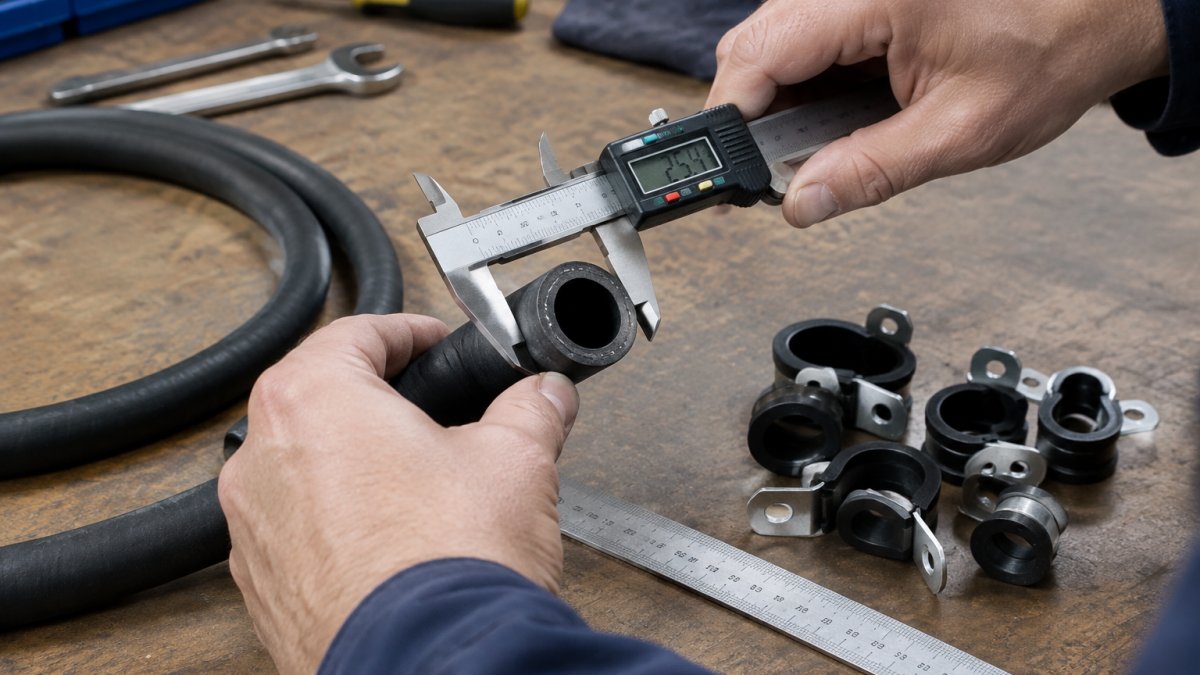
Measure the true outer diameter of the pipe, hose or cable bundle with a caliper, not a tape measure. Take three readings at 120-degree intervals along the run and use the largest. A pipe that nominally measures 25mm can run 25.4mm or more at a weld seam or fitting shoulder, and that extra fraction is where clips split or hoses deform.
For clips that must clamp a hose already fitted to a barb or spigot, measure at the point of contact, not the free length. Hose swells under pressure and relaxes when drained, so measure in the fitted, at-rest condition.
Measuring Cable Bundles and Loomed Runs
Bundles behave differently from rigid pipe. Loom tape, spiral wrap and split conduit each add wall thickness, and a bundle measured before looming will be undersized once dressed. Measure the finished, loomed bundle with a caliper across its widest axis, because oval bundles clamp on the long dimension.
For automotive loom and multi-cable runs, add a small allowance so the liner compresses slightly rather than the conductors. A clip that grips too tightly crushes insulation; one that grips too loosely lets the loom chafe against the fixing surface.
Matching Nominal Diameter to the Clip Part Number
Nominal diameter is the clamping size the part number describes, and it should match your measured outer diameter directly. If you measured 12.5mm, you want a clip whose nominal size sits at or just under that figure so the rubber liner compresses by a fraction of a millimetre and holds.
Here is the selection sequence we recommend:
- Measure outer diameter with a caliper at three points.
- Add wall thickness for tape, sleeve or conduit.
- Round down to the nearest nominal size where the liner will compress, not up.
- Confirm the fixing hole suits your bolt or screw diameter.
- Check band width against the load the run will carry.
The common mistake is rounding up "for clearance." With a rubber lined clip, rounding up removes the compression that does the gripping, and the run rattles. You can browse the full rubber lined P-clip range to match a measured diameter to a part number before ordering.

BZP vs Stainless Steel P-Clips: Choosing the Right Material
Material selection for a rubber lined P-clip is two decisions, not one: the steel finish and the liner compound. Most buyers settle the steel question and then assume the black rubber is generic. It is not, and the liner is the part that touches the hose.
Bright zinc plated steel is the default for indoor machinery, cable management and general pipe support where moisture is not a factor. Bright zinc plated steel is the lower-cost option for dry conditions. The 304 stainless version is made from 304 stainless steel strip with the same rubber liner, at £0.42 per clip compared with £0.21 for the zinc plated version.
| Criterion | BZP Steel | 304 Stainless |
|---|---|---|
| Typical unit price | £0.21 | £0.42 |
| Corrosion resistance | Indoor, dry | Washdown, coastal, humid |
| Best for | Enclosures, cable routing, machinery | Food plant, marine air, chemical exposure |
| Cost premium justified by | Volume and dry conditions | Service life in aggressive environments |
If the run sits outdoors or sees regular cleaning, the stainless premium pays back quickly. For everything else, BZP does the job. You can review the 304 stainless rubber lined P-clips to confirm sizes and specifications before committing to material.

Choosing the Liner Compound, Not Just the Steel
| Service condition | EPDM liner | Nitrile (NBR) liner | Fluoroelastomer liner |
|---|---|---|---|
| Water, steam, coolant | Suitable | Suitable | Suitable |
| Outdoor weathering, ozone | Suitable | Poor | Suitable |
| Mineral oil, hydraulic fluid, diesel | Poor (swells) | Suitable | Suitable |
| Petrol and fuel blends | Poor | Suitable | Suitable |
| Ketones, strong solvents | Poor | Poor | Suitable |
| Dilute acids and bases | Suitable | Variable | Suitable |
Check the liner and steel against the specific fluid, concentration and temperature of your run before ordering.
P-Clips/Rubber Lined P-Clips →
What the Rubber Liner Actually Does for Vibration and Wear
The rubber section damps impacts and vibration and eliminates wear between the clip and the pipe or cable.
Rubber Lined P-Clip Installation Best Practices
Correct installation preserves the liner and the clamping force you paid for. Follow these steps:
- Seat the clip square to the run so the band sits perpendicular to the pipe axis.
- Fit the correct bolt or screw through the fixing hole; an oversized fastener distorts the band.
- Tighten to a torque that compresses the liner without crushing the hose; stop when the liner just starts to deflect.
- Support long runs at intervals that prevent sag between clips.
- Re-check torque after the first thermal or pressure cycle.
Watch out: overtightening is the most common installation fault. It splits the rubber liner, exposes bare metal to the hose, and creates the exact wear point the clip was bought to prevent.
Load, Shear and Chemical Limits Most Buyers Overlook
Load capacity is the specification nobody asks about until a run fails. A P-clip carries load in two directions: the pull-out load on the fixing, and the shear load across the band where it wraps the pipe. Band width and steel thickness govern shear strength, so a wider clip spreads the load and resists deformation better than a narrow one of the same nominal size.
The fixing, not the band, is often the limiting feature on a well-chosen clip. The pull-out load is set by the screw or bolt diameter, the substrate it goes into and the number of fixings per clip, so a clip rated for a heavy run will still pull out of plasterboard or thin panel if the fastener is undersized. On vibrating equipment, a single fixing per clip works loose faster than a two-hole clip, and a thread-locking compound or a nyloc nut is often the difference between a run that stays put and one that needs re-torquing every few months.
Shear across the band is a different failure mode. A narrow band concentrates stress at the point where it wraps the pipe, and under vibration that point work-hardens and eventually cracks. As a rule of thumb, wider band widths suit heavier runs and larger diameters, while narrow bands are adequate for cable and light hose. Where a run is long and unsupported, the clips nearest the supports carry more load than the ones in the middle, so spacing and band width should be chosen together rather than independently.
Chemical resistance is the second blind spot, and the steel and the liner fail for different reasons. Zinc plating corrodes in acids and some cleaning agents, while the rubber liner swells or hardens in contact with certain oils and solvents. The liner compatibility table in the material section above sets out which compound suits which service condition; the point here is that a clip can pass on steel and fail on liner, or the reverse, so both must be checked against the fluid and the washdown chemistry.
Troubleshooting loose or rattling clips usually traces back to one of three causes: the wrong nominal size rounded up, a liner that has degraded and lost compression, or a fixing that has worked loose under vibration. Re-measure the run in its fitted condition, inspect the liner for swelling, hardening or splitting, and re-torque or replace the fixing before replacing the clip. If a replacement clip rattles again within weeks, the cause is usually the liner compound or the fixing substrate rather than the nominal size.
Ordering P-Clips for Your Next Build
Ordering is straightforward once the sizing is right: confirm measured diameter, nominal size, material and fixing hole, then order against the part number. SpringXpert holds over 20,000 standard products, with over 20 years of manufacturing experience and ISO 9001 certification.
Call us for a competitive quotation, as discounts are available on bulk orders. Where a standard clip does not fit a bespoke run, SpringXpert offers bespoke spring and wire form engineering. You can order P-clips and O-clips for your next build directly from the range.
Frequently Asked Questions
How do you measure a rubber lined P-clip correctly?
Measure the true outer diameter of the pipe, hose or cable bundle with calipers, not the nominal bore printed on the pipe. Add roughly 1mm of clearance so the liner compresses slightly rather than being crushed. Then match that figure to the clip's stated clamping size: the part number denotes the hose or cable size, so PC010 is a 10mm hose size. Check the band width and fixing hole diameter against your mounting surface before ordering.
What happens if a P-clip is too small for the pipe?
An undersized clip cannot close properly around the pipe. The rubber liner gets pinched and thins on one side, the band distorts, and the fixing hole may no longer sit flat against the mounting surface. In service this shows up as accelerated liner wear, loosening under vibration and, on cable runs, abrasion of the sheath. Always size to the measured outer diameter rather than forcing the clip closed with longer bolts.
Can rubber lined P-clips be used in high-vibration environments?
Yes, that is what the liner is for. The rubber section damps impacts and vibration and eliminates wear between the clip and the pipe or cable. For genuinely high-vibration machinery, keep the clip size matched to the measured outer diameter, mount to a rigid surface, and use the correct installation torque so the liner is compressed but not flattened. Where corrosion is also a risk, the 304 stainless version gives the same dampening with better corrosion resistance.
Should I choose BZP or stainless steel P-clips?
Bright zinc plated steel suits most indoor machinery, automotive loom and general cable management work at the lower price point of £0.21 per clip. The 304 stainless version is available at £0.42 per clip, compared with £0.21 for the zinc plated version. Both are supplied with the same rubber liner, so the vibration behaviour is comparable and the decision comes down to corrosion exposure.
Getting the clip right the first time saves the rework, the rattle and the failed inspection. SpringXpert supplies rubber lined P-clips in BZP steel and 304 stainless, backed by over 20,000 standard products, ISO 9001 certified manufacturing and a 12-hour response guarantee. Get started with SpringXpert and specify the correct clip for every run on your build.
