

Small Batch Spring Production: A Practical Guide
Table of Contents
- What Small Batch Spring Production Means
- Understanding the Spring Production Process
- Custom Spring Manufacturing for Prototyping and Low-Volume Runs
- Spring Quality Control in Small Batch Operations
- Spring Surface Coating and Corrosion Protection
- Planning Your Small Batch Spring Production Run
- Small Batch Versus Mass Production: When to Choose Each
- Frequently Asked Questions
Last Updated: October 12, 2026
What Small Batch Spring Production Means
Small batch spring production refers to manufacturing runs of custom or semi-custom springs in quantities typically ranging from dozens to hundreds of units, rather than thousands or millions. At SpringXpert, we understand that not every application demands mass production volumes, yet quality and precision cannot be compromised.
The distinction between small batch and mass production isn't just about quantity. It's about responsiveness. A small batch run allows for design iteration, material experimentation, and rapid adjustments based on real-world testing. This approach suits design engineers developing new machinery, procurement managers sourcing components for limited production runs, and product development teams validating concepts before committing to larger volumes.
What makes small batch spring production viable is the shift in cost structure. Rather than spreading tooling and setup costs across millions of units, smaller runs accept higher per-unit costs in exchange for flexibility, faster turnaround, and the ability to pivot quickly if specifications change.
Understanding the Spring Production Process
The spring production process combines wire selection, precision coiling, heat treatment, and finishing into a coordinated workflow. Each step directly impacts the final spring's performance, durability, and reliability in the field.
Wire selection and coiling
Wire selection is the foundation of spring performance. The material must match the application's demands: corrosion resistance, temperature tolerance, load capacity, and fatigue life all depend on choosing the right wire grade and diameter.
Common materials for small batch production include carbon steel EN10270-1 for general-purpose applications, stainless steel EN10270-3 for corrosive environments, and specialist alloys like Inconel or Phynox for extreme conditions. Wire diameter ranges from 0.1 mm for delicate applications to 5.00 mm or larger for heavy-duty compression springs.

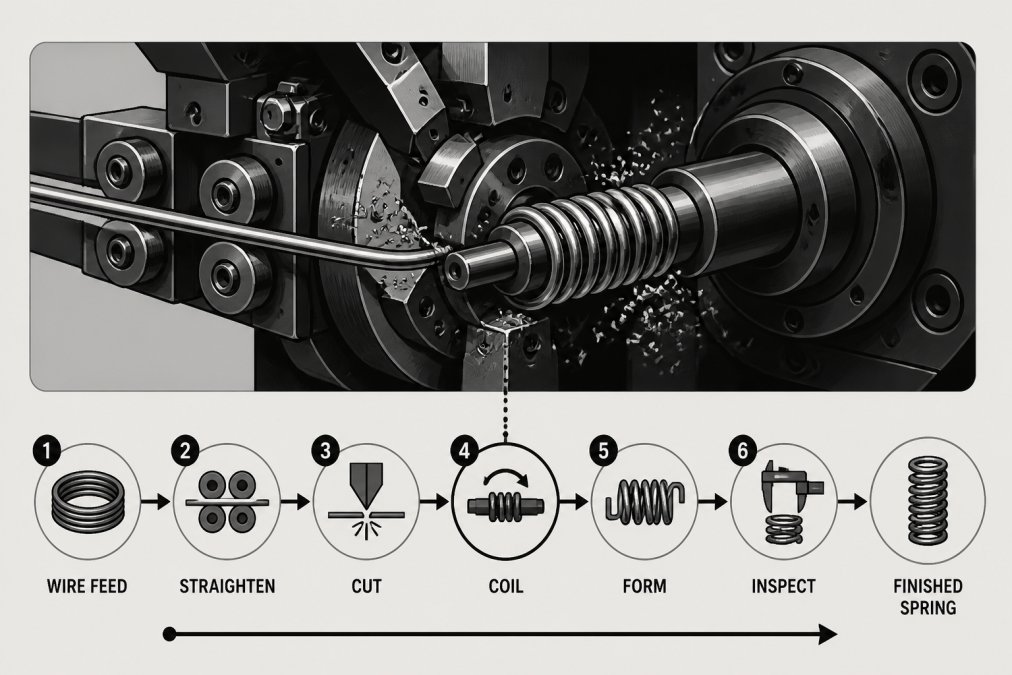
Coiling transforms the selected wire into the spring's characteristic helical form. The process requires precision equipment that controls wire tension, rotation speed, and mandrel positioning to within tight tolerances.
Heat treatment and hardening
Heat treatment is where raw coils become functional springs. The process involves heating the coiled wire to specific temperatures, holding it at that temperature for a controlled duration, then cooling it in a controlled manner. This transforms the material's crystalline structure, increasing hardness and elasticity while relieving internal stresses introduced during coiling.
The challenge in small batch operations is maintaining consistent heat treatment across limited quantities. Industrial furnaces designed for high-volume production can struggle with small runs because temperature gradients and cooling rates vary when processing fewer pieces. Experienced manufacturers compensate by adjusting process parameters and using smaller furnace zones to maintain quality across small batches.
Surface condition matters significantly during heat treatment. Oxidation and scale formation on the wire surface can lead to surface cracks if not managed carefully. This is a common concern for clients who've experienced premature spring failures with other suppliers, proper atmosphere control during heating and appropriate descaling procedures prevent these defects.
Custom Spring Manufacturing for Prototyping and Low-Volume Runs
Custom spring manufacturing transforms engineering specifications into physical components. This process requires close collaboration between the design team and the manufacturer to validate assumptions, test material choices, and refine tolerances based on real-world performance.
Prototyping benefits from small batch flexibility. A design engineer can specify a torsion spring with particular leg angles and load characteristics, receive a small quantity for testing, identify any issues, and adjust the design without waste or financial penalty.
Low-volume production runs serve niche markets where demand doesn't justify large-scale tooling. Medical device manufacturers, robotics firms, and specialist automotive suppliers often operate in these volumes.
The key advantage of custom manufacturing at small batch volumes is cost control. Rather than paying for minimum quantities of 10,000 units from a mass producer, you can source exactly what you need now and expand volumes later as demand grows.
Spring Quality Control in Small Batch Operations
Quality control in small batch production is more intensive per unit than mass production, yet it's essential for reliability. Every spring in a small batch represents a larger proportion of the total order, so defects have proportionally greater impact.
Dimensional and load testing
Dimensional testing verifies that each spring meets its specified outside diameter, wire diameter, free length, and solid height. Precision measuring equipment, micrometres, callipers, and automated gauges, checks these dimensions against design drawings and tolerances (typically conforming to DIN 2095 Grade 2 or BS 1726 Class B standards).
Load testing measures how a spring performs under force. A compression spring is compressed to a specified working length and measured for load at that point. The spring rate, the force required to deflect the spring by one unit of length, is calculated and verified. This testing ensures the spring will perform as designed when installed in the application.
For small batches, load testing is often performed on a sample basis rather than every unit, though critical applications may warrant testing each piece. The testing protocol depends on the industry: medical devices and aerospace applications typically require 100% verification, whilst general industrial applications may accept statistical sampling.
Pro Tip
Request load testing data sheets for any custom spring order. These documents prove compliance and provide baseline performance data for troubleshooting if issues arise in the field.
Surface inspection and defect detection
Surface inspection catches cracks, pits, and deformations that could compromise spring life. Visual inspection under magnification identifies surface-breaking defects; more sophisticated techniques like magnetic particle inspection or eddy current testing detect subsurface flaws invisible to the eye.
Surface condition directly affects fatigue life. A crack or pit acts as a stress concentrator, initiating failure much earlier than an unblemished surface would. This is why clients who've experienced premature failures often ask about heat treatment surface quality, it's a legitimate concern that separates reliable suppliers from those cutting corners.
Small batch operations allow for detailed surface inspection of every piece without the production pressure to rush through checks. This attention to detail is a tangible quality advantage over high-volume suppliers operating under strict throughput targets.
Spring Surface Coating and Corrosion Protection
Surface coating extends spring life in corrosive environments. Without protection, carbon steel springs oxidise and lose strength; stainless steel resists corrosion naturally but costs more. Coating options bridge this gap by applying protective layers to lower-cost materials.
Metric Extension Springs 0.5mm to 1.00mm Music Wire →
Common coatings include oil finishes (providing temporary protection during storage and transport), zinc plating (offering moderate corrosion resistance for indoor and mild outdoor use), and specialist coatings like nickel plating or electroless nickel for demanding environments.
The coating process adds cost and lead time, yet it's essential for springs exposed to moisture, salt spray, or chemical environments. SpringXpert's Metric Compression Springs Music Wire range is available in oiled finish as standard, with other finishes available on request, a flexibility that mass producers often don't offer.

Coating thickness and adhesion matter. Too thin, and corrosion breaches the coating quickly. Too thick, and the coating may crack or flake during service. Proper coating specification and quality control ensure protection lasts for the spring's intended service life.
Planning Your Small Batch Spring Production Run
Successful small batch production begins with clear planning. Specification, lead time, cost, and quality expectations must align before manufacturing begins.
Lead times and turnaround expectations
Lead times for small batch spring production vary based on complexity and current workload. Standard springs from established product lines, such as compression springs in common sizes, may ship within days. Custom springs requiring design validation, material procurement, or specialised heat treatment typically require 2-4 weeks.
SpringXpert guarantees a 12-hour response time to all enquiries, meaning your specification reaches an engineer who can assess feasibility and provide a preliminary timeline the same working day. This rapid feedback loop helps you plan project schedules confidently.
Rush options exist for urgent requirements, though expedited production incurs additional costs. Planning ahead, specifying requirements 4-6 weeks before you need springs, allows manufacturers to sequence your order optimally and avoid premium charges.
Cost considerations and unit pricing
Small batch unit pricing is higher than mass production because setup costs, quality control, and handling are spread across fewer units.
Factors influencing cost include material selection (stainless steel costs more than carbon steel), wire diameter (larger wire costs more), custom specifications (non-standard lengths or diameters require custom tooling), and coating (additional finishes add cost and time).
Understanding the cost breakdown helps with budgeting. Material cost is typically 20-30% of the final price; labour, tooling, quality control, and overhead make up the remainder. This structure means that moving from 50 to 500 units doesn't proportionally reduce cost because fixed costs per unit decrease but labour and quality control remain substantial.
Requesting a competitive quotation is the only way to lock in pricing for your specific requirements. SpringXpert provides quotations promptly, with discounts available for bulk orders, a recognition that larger volumes do offer economies that can be passed on.
Small Batch Versus Mass Production: When to Choose Each
The choice between small batch and mass production depends on volume, urgency, cost tolerance, and flexibility needs.
Choose small batch production when:
- You're prototyping or validating a new design before committing to larger volumes
- Your annual demand is fewer than 5,000 units
- Design changes are likely during the product lifecycle
- Lead time matters more than per-unit cost
- You need material flexibility or custom specifications
Choose mass production when:
- You have predictable demand for 50,000+ units annually
- Design is finalised and unlikely to change
- Per-unit cost is the dominant factor in purchasing decisions
- You can commit to long lead times and large minimum orders
- Standardised products meet your requirements without customisation
The decision isn't binary. Many manufacturers use small batch production initially, then transition to mass production as volume grows. This staged approach reduces financial risk and allows market validation before large capital commitment.
SpringXpert's strength lies in serving the small batch segment, the businesses that don't fit into mass producers' minimum order quantities or timelines.
| Aspect | Small Batch | Mass Production |
|---|---|---|
| Typical Volume | 50-5,000 units | 50,000+ units annually |
| Lead Time | 2-4 weeks | 8-12 weeks or longer |
| Setup Cost Impact | Significant per unit | Negligible per unit |
| Design Flexibility | High, easy to modify | Low, changes costly |
| Per-Unit Cost | Higher | Lower |
| Quality Control Intensity | High per unit | Statistical sampling |
| Best For | Prototypes, niche markets | High-volume commodity supply |
Small batch spring production bridges the gap between prototype and mass production. It demands precision, responsive service, and material expertise, exactly what SpringXpert delivers. Our ISO 9001 certification, over 20 years of manufacturing experience, and 12-hour response guarantee mean your specifications receive the attention they deserve.
Frequently Asked Questions
What does small-batch spring production mean?
Small batch spring production refers to manufacturing springs in limited quantities, typically ranging from dozens to a few hundred units per run. Unlike mass production, which prioritises volume and cost per unit, small batch production emphasises customisation, flexibility, and precise tolerances. This approach suits prototyping, niche applications, and specialised industries where exact specifications matter more than economies of scale.
How does the spring production process differ for small batches?
The spring production process remains consistent regardless of batch size, but small batch runs allow for tighter control at each stage. Wire is selected based on exact specifications, coiled to precise dimensions, heat-treated to achieve the required hardness, and finished with appropriate surface coatings. Small batches enable manufacturers to adjust parameters between runs without the constraints of high-volume tooling, making custom specifications feasible without prohibitive setup costs.
What quality control measures are essential for small batch springs?
Spring quality control for small batches includes dimensional verification using precision instruments, load testing to confirm spring rate accuracy, and visual inspection for surface defects or cracks. Each unit or representative sample is checked against design specifications. This rigorous approach catches issues early, preventing field failures. ISO 9001 certification ensures these processes follow documented standards consistently across every production run.
When should I choose small batch production over mass production?
Choose small batch production when you need custom specifications, are testing a new design, require tight tolerances, or operate in industries like medical devices, robotics, or subsea applications where precision outweighs per-unit cost. Mass production becomes more economical when you need thousands of identical units and can absorb high tooling costs across a large volume. Small batches also suit businesses scaling up gradually or managing inventory constraints.
What surface coatings are available for small batch springs?
Common surface coatings for springs include oiled finish (standard on music wire springs for basic corrosion resistance), stainless steel materials for enhanced durability, and specialist coatings for harsh environments. The choice depends on your application's exposure to moisture, chemicals, or temperature extremes. Small batch production allows you to specify the exact coating your application demands without minimum order penalties.