

Choosing the Right Spring Manufacturer: A B2B Procurement Guide for 2026
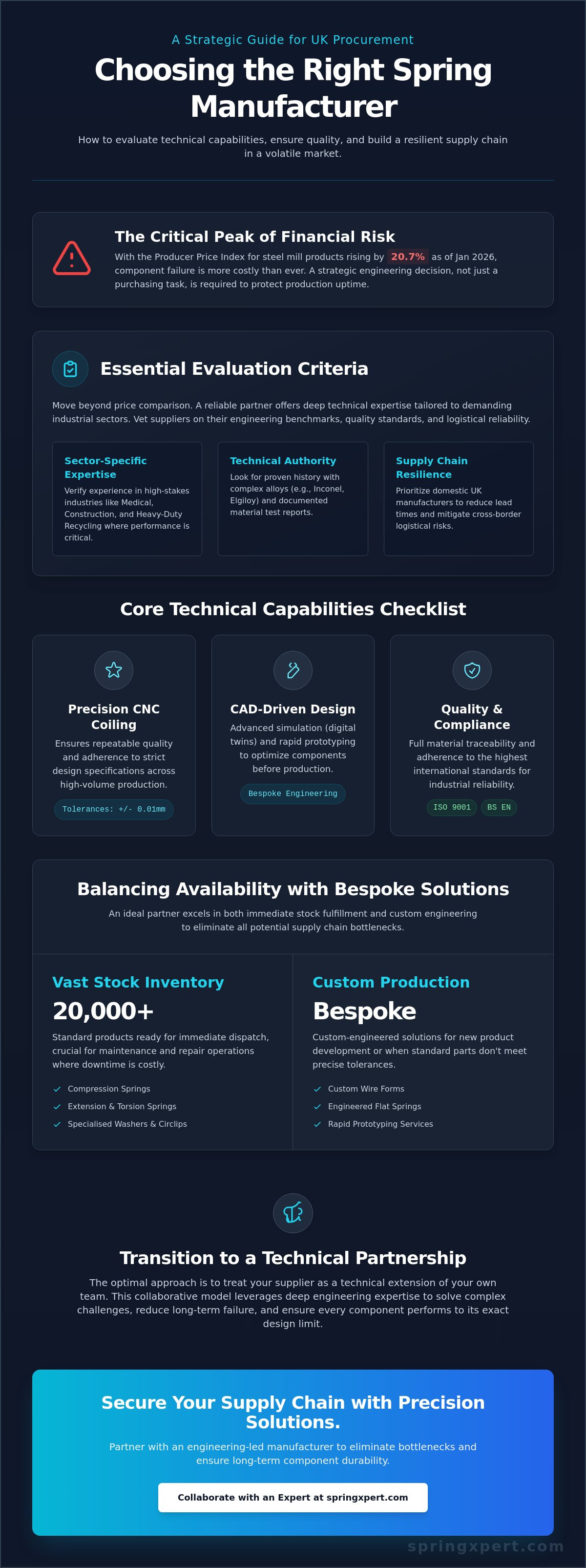
With the Producer Price Index for steel mill products rising by 20.7% as of January 2026, the financial risk of component failure has reached a critical peak. For UK procurement professionals, choosing the right spring manufacturer is no longer just a purchasing task; it's a strategic engineering decision that dictates production uptime. You've likely dealt with the disruption caused by inconsistent component quality or custom wire forms that arrive weeks behind schedule. These delays often happen when a supplier lacks the technical support required during the design phase to handle complex alloy specifications.
This guide demonstrates how to evaluate technical capabilities and quality standards, such as the newly published ISO 14001:2026, to ensure your supply chain remains resilient. You'll learn to vet manufacturers on their CNC precision, tensile strength testing, and ability to meet strict BS EN standards for bespoke solutions. We'll outline the exact engineering benchmarks you need to reduce downtime and secure components that offer long term durability in demanding industrial environments. By treating your supplier as a technical extension of your own team, you can ensure every compression, torsion, and extension spring performs to its exact design limit.
Key Takeaways
- Identify the specific engineering benchmarks and sector-specific expertise required to evaluate a supplier's technical depth across the medical, construction, and recycling industries.
- Learn how precision CNC coiling and CAD-driven design serve as critical indicators when choosing the right spring manufacturer for high-tolerance requirements.
- Verify material traceability and compliance with BS EN ISO 9001 standards to secure components that withstand extreme tensile stress and operational wear.
- Evaluate the logistical benefits of a domestic UK supply chain, focusing on lead time reduction and the reliability of local manufacturing for custom wire forms.
- Transition from a standard purchasing model to a technical collaboration that leverages over 20,000 standard products and bespoke prototyping to eliminate supply chain bottlenecks.
Essential Criteria for Choosing a Spring Manufacturer
Selecting a supplier in the UK industrial sector requires a meticulous audit of technical depth rather than a simple price comparison. When choosing the right spring manufacturer, procurement teams must look beyond the initial quote to evaluate how a partner manages the physical reality of precision manufacturing. A reliable partner provides more than just components. They offer a specialized understanding of how material fatigue and environmental stressors impact performance in sectors like medical device manufacturing, construction, and heavy-duty recycling. Transparency regarding lead times and national supply chain logistics is also vital in a post-Brexit market where cross-border delays can compromise production schedules.
Evaluating Technical Authority and Experience
Technical authority is demonstrated through a manufacturer's history with complex alloys and high-stress applications. An engineering team must possess a granular understanding of tensile strength and elastic limits to ensure component durability. This expertise is vital for understanding spring technology and how it applies to your specific mechanical requirements. In the UK industrial landscape, vetting a manufacturer involves reviewing their long-term partnerships with established British firms. You need evidence that their master technicians can manage tight tolerances using both traditional craftsmanship and modern CNC technology. High-stakes sectors like aerospace or medical engineering require specific experience with exotic alloys like Inconel or Elgiloy, where failure isn't an option. Ask for documented case studies or material test reports to verify their claims of industrial reliability.
The Balance Between Stock and Custom Production
Effective procurement involves balancing immediate availability with the need for custom-engineered solutions. A manufacturer that maintains over 20,000 standard products in stock provides a significant advantage for maintenance and repair operations where downtime costs are high. This vast catalog should include everything from compression and extension springs to specialized washers and circlips. However, the ability to pivot to bespoke wire forms or custom-engineered flat springs is equally essential for new product development. If a standard part doesn't meet the precise tolerances of your assembly, the manufacturer must offer rapid prototyping services. This flexibility ensures that whether you require high-volume extension springs or a single specialized prototype, the production process remains seamless. Choosing the right spring manufacturer means finding a partner who can scale from a single hand-finished prototype to a production run of millions without losing precision.
Technical Capabilities: From Design to CNC Production
Modern spring manufacturing relies on the seamless transition from digital design to physical execution. When choosing the right spring manufacturer, it's vital to assess their technical consultancy capabilities. Engineering specialists in UK workshops now use advanced CAD software to simulate how a component will react under specific loads before the production line even starts. This digital twin approach, which gained significant traction in early 2026, allows for the optimization of wire diameter and coil pitch to prevent premature fatigue. A manufacturer's ability to provide this level of technical oversight ensures that the final product aligns with the theoretical performance requirements of your assembly.
Precision on the factory floor is driven by multi-axis CNC coiling technology. These machines deliver repeatable quality by maintaining tolerances as tight as +/- 0.01mm across high-volume production runs. Beyond the coiling process, industrial reliability depends on secondary operations such as precision grinding, shot peening to improve fatigue life, and specialist heat treatments. These processes are managed under strict ISO 9001 quality standards to ensure every batch meets the necessary tensile strength requirements. For complex requirements, verify that the facility can handle both intricate wire forms and pressed metal products within a single, integrated workflow.
Bespoke Engineering and Prototyping
Custom design services are the most effective way to reduce long term component failure in specialized machinery. Rapid prototyping allows engineers to physically test load and deflection characteristics before committing to a full manufacturing run. Utilizing bespoke spring design ensures that unique assemblies aren't forced to rely on standard parts that may not meet exact performance envelopes. This collaborative process between your procurement team and our master technicians creates a more resilient end product. If you're facing a complex engineering challenge, we invite you to initiate a technical collaboration to explore custom-engineered solutions.
Specialist Spring Types and Applications
Different industrial applications demand varying manufacturing constraints, from high-pressure disc springs to heavy-duty die springs used in recycling plant machinery. A versatile manufacturer manages the delicate handling requirements of small precision torsion springs while maintaining the capacity for large-scale extension spring production. Choosing the right spring manufacturer requires confirming they have the specialized tooling for these diverse geometries. CNC technology ensures that every component in a 10,000 unit run remains within the exact specified tolerances, eliminating the variance common in manual production. This consistency is what maintains the stability of your production line and reduces unexpected downtime.
Quality Assurance and Material Standards
Choosing the right spring manufacturer involves a deep dive into their quality management systems and material procurement protocols. In 2026, industrial reliability isn't an abstract promise; it's a measurable metric that dictates production uptime. Following the publication of ISO 14001:2026 on April 15, 2026, professional manufacturers have integrated stricter environmental and quality controls into their production lines. Material traceability is your first line of defense against component failure. With the Producer Price Index for steel mill products increasing by 20.7% in January 2026, the cost of using sub-standard alloys has become prohibitive. A meticulous manufacturer provides full chemical analysis reports for every batch of high-grade spring steel. This ensures that the tensile strength and elastic limits match your exact mechanical specifications before coiling begins.
In-house quality control departments are essential for maintaining these standards. These teams use specialized equipment to perform load-deflection and fatigue life testing, ensuring that every batch of extension or disc springs performs consistently. This level of oversight is vital when meeting government procurement standards for high-stakes infrastructure projects. By centralizing these testing protocols within a UK facility, manufacturers eliminate the risks associated with third-party verification and maintain a clear chain of accountability. This systematic approach reinforces the image of an organized and efficient operation that prioritizes precision over simple volume.
Material Selection for Industrial Durability
Selecting the correct alloy is a technical decision that dictates the lifespan of your assembly. While standard carbon steel is sufficient for many applications, the UK's harsh industrial environments often demand the corrosion resistance of 316 stainless steel or the high-temperature stability of Inconel. A solution-oriented specialist evaluates how material choice impacts the spring rate and fatigue life under operational stress. High-tensile alloys can reduce component weight by up to 20% in automotive applications, which is a key trend for the 2026 market. This precision ensures that your components don't just fit the assembly but thrive within the specific chemical and thermal conditions of your sector.
Testing and Certification Processes
Rigorous testing is the only way to predict how a spring will behave over millions of cycles. In a dedicated UK factory setting, skilled British engineers utilize modern CNC testing rigs to verify load and deflection characteristics against theoretical CAD models. These master technicians perform destructive and non-destructive tests to identify any microscopic defects in the wire surface. You should always demand load-testing certificates for critical components to verify that the parts meet BS EN standards. This empirical approach, framed through the Xpert lens of specialized knowledge, provides the technical depth required to support complex B2B requirements. It ensures that every bespoke wire form or spring clip arrives with the necessary certification to prove its industrial durability.
Supply Chain Reliability and National Logistics
Supply chain volatility remains a dominant factor in 2026, making the geographic location of your supplier a critical metric. When choosing the right spring manufacturer, the ability to bypass international shipping delays is a quantifiable advantage. Domestic manufacturing within the United Kingdom eliminates customs bottlenecks and reduces the carbon footprint associated with long-range logistics. By aligning your procurement with a UK-based partner, you gain access to technical support during standard British business hours. This ensures that design queries or production adjustments are resolved without the time-zone lag common with overseas suppliers. With the Producer Price Index for steel mill products rising by 20.7% as of January 2026, localized inventory management has become a vital tool for cost stabilization.
Reliable logistics are built on a foundation of transparency and inventory depth. A manufacturer that maintains a steady supply of raw alloys can better insulate clients from the price fluctuations seen throughout early 2026. Industrial reliability is also improved through bulk ordering capabilities and dedicated stocking programs. These services allow procurement teams to secure long-term component availability while maintaining lean on-site inventory levels. Choosing the right spring manufacturer means selecting a partner who understands the rhythmic demands of your production cycle.
Stock vs. Bespoke: Choosing the Right Procurement Route
Procurement managers must often decide between the speed of stock components and the precision of custom engineering. For standard maintenance or high-volume assemblies, utilizing extension springs from a stock catalog of 20,000 items is the most efficient route. However, specialized machinery often requires bespoke wire forms to manage specific load profiles. The following table outlines the technical and logistical differences between these two paths:
| Criteria | Stock Components | Custom Manufacturing |
|---|---|---|
| Lead Time | Same-day or Next-day | 2 to 6 weeks (typical) |
| Cost-per-unit | Lower (standardised) | Higher (setup/tooling) |
| Design Flexibility | Fixed specifications | Fully bespoke |
| Application | General purpose | High-stress or Unique |
Managing Just-In-Time (JIT) requirements is simpler when your manufacturer maintains a buffer of your custom inventory in their own UK warehouse. This arrangement reduces the risk of production stops caused by localized material shortages.
National Support and Technical Collaboration
Industrial reliability is rooted in clear, direct communication. There is significant value in being able to speak directly to the engineer supervising the CNC coiling of your components. In our UK factory, experienced British engineers oversee every stage of production, from initial wire straightening to final heat treatment. This environment reflects a legacy of master craftsmanship combined with modern industrial automation. A partner with over 20 years of national industry presence provides a level of stability that global suppliers cannot replicate. If your project requires high-volume precision without the risk of international delays, you can request a logistics consultation with SpringXpert Ltd to optimize your supply chain.
Partnering with SpringXpert Ltd for Precision Solutions
SpringXpert Ltd represents the culmination of technical authority and industrial reliability in the UK manufacturing sector. Choosing the right spring manufacturer involves selecting a partner that manages the complexities of modern engineering while maintaining a steady supply chain. We provide access to over 20,000 standard products, including specialized finger spring washers and wave washers, all available for rapid national delivery from our domestic warehouse. This inventory depth ensures that your production lines remain operational even during periods of market volatility. Our facility is designed to support the UK's most demanding sectors, from the electric vehicle segment, projected to grow at a CAGR of 8.3% between 2026 and 2035, to heavy-duty recycling infrastructure.
Our commitment to precision is reflected in our adherence to the latest industrial benchmarks. As organizations transition to the ISO 14001:2026 standard, SpringXpert Ltd remains at the forefront of quality and environmental management. We rely on the inherent weight of engineering facts rather than marketing hyperbole to demonstrate our capability. This creates an atmosphere of competence and stability, positioning us as a dependable partner for complex B2B requirements. By focusing on the physical reality of our products, we ensure that every component delivered meets the exact tensile strength and durability requirements of your application.
The Xpert Engineering Process
In our UK-based facility, the transition from a CAD file to a physical component is managed by master technicians with decades of experience. These skilled British engineers oversee the setup of multi-axis CNC machines to ensure every coiling operation meets tolerances as tight as +/- 0.01mm. This process isn't just about automation; it's about the technical oversight required to manage material behavior under stress. Our team at SpringXpert Ltd analyzes tensile strength and alloy composition to ensure that bespoke wire forms or constant force springs perform exactly as modeled. This methodical approach eliminates the risk of component failure in the field. We invite you to collaborate with our engineering team on your next mechanical assembly project to ensure every specification is met with precision.
Next Steps for Your Procurement Strategy
Integrating SpringXpert Ltd into your supply chain is a straightforward process designed for industrial efficiency. You can request a technical consultation to review your CAD designs or secure a bulk quote for high-volume production runs of tool clips or hose clamps. Our logistics framework is optimized for the UK market, providing a level of stability that international suppliers cannot match in the current landscape. By centralizing your procurement with a partner that values quality and durability, you reduce the administrative burden of managing multiple vendors. Whether you require standard washers and circlips or custom-engineered flat springs, our facility provides the capacity and expertise needed for 2026 and beyond. Contact SpringXpert Ltd today to discuss your manufacturing requirements and secure a reliable engineering partner for your business.
Securing Your Industrial Component Supply Chain
Finalizing your procurement strategy for 2026 requires a transition from transactional purchasing toward a technical partnership. Choosing the right spring manufacturer is the decisive factor in mitigating the operational risks of material fatigue and supply chain disruption. By auditing a supplier’s technical authority and their adherence to harmonized standards like prEN ISO 9606, you ensure that every component contributes to the longevity of your machinery. This systematic vetting process transforms your supply chain from a potential bottleneck into a reliable engine for industrial growth.
SpringXpert Ltd provides the industrial reliability required to navigate these complexities through 20+ years of engineering expertise. Our UK-based facility operates as a master technician’s workshop where skilled British engineers utilize advanced CNC technology to produce components that meet exact BS EN specifications. With over 20,000 standard products in stock and a dedicated team for bespoke design and rapid prototyping, we offer the flexibility needed for both high-volume production and specialized assemblies. We invite you to Partner with the UK’s leading spring specialists at SpringXpert Ltd to optimize your manufacturing strategy. We look forward to supporting your next engineering project with precision and reliability.
Frequently Asked Questions
What are the most important certifications to look for in a spring manufacturer?
The most critical certifications are ISO 9001:2015 and the newly published ISO 14001:2026, which became effective on April 15, 2026. These standards ensure the facility maintains a rigorous quality management system and follows updated environmental protocols. In high-stakes sectors like automotive or aerospace, you should also verify IATF 16949 compliance. These certifications provide a documented framework for consistent production and material traceability throughout the manufacturing process.
Can a spring manufacturer help with the design phase of a new product?
Qualified manufacturers provide technical consultancy during the design phase to optimize component performance. Using CAD simulation, engineers identify potential fatigue points and refine wire diameter or coil pitch before production begins. This collaboration reduces the risk of mechanical failure and ensures the final compression or torsion spring meets its exact load requirements. Early engagement with a specialist technician often leads to more durable and cost-effective mechanical assemblies.
What is the typical lead time for custom compression springs in the UK?
Typical lead times for custom compression springs in the UK range from 2 to 6 weeks, depending on material availability and production complexity. Domestic manufacturers bypass the customs delays associated with post-Brexit international shipping, which can add significant time to overseas orders. For standard items, many UK facilities offer next-day delivery from stock. Securing a local partner ensures more predictable production schedules for high-volume industrial clients.
How do I know if I need a custom spring or a standard stock part?
Standard stock parts are ideal for general applications where speed and cost-per-unit are the primary considerations. However, choosing the right spring manufacturer involves identifying when a project requires the precise tolerances of a custom-engineered solution. If your assembly has unique space constraints or demands specific load characteristics that standard items can't meet, a bespoke spring is necessary. Custom production allows for the use of specialist alloys and exact geometries tailored to your mechanical environment.
What materials are commonly used for high-performance industrial springs?
High-performance industrial springs commonly utilize carbon steel, 316 stainless steel, and exotic alloys like Inconel or Elgiloy for extreme environments. High-tensile steel alloys are a key trend in 2026 because they can reduce component weight by up to 20% in automotive applications. The choice of material directly impacts corrosion resistance, tensile strength, and the overall spring rate. Meticulous material selection ensures the component survives the thermal and chemical stresses of its specific industrial application.
Do UK spring manufacturers provide material traceability and testing certificates?
UK spring manufacturers provide full material traceability and load-testing certificates to verify compliance with BS EN standards. In a dedicated UK factory, skilled British engineers perform rigorous tests to confirm tensile strength and fatigue life. These certificates serve as empirical proof that the components meet the required safety and performance benchmarks. You should always demand this documentation for critical components to maintain a clear chain of accountability within your supply chain.
What is the difference between a spring supplier and a spring manufacturer?
A spring supplier acts as a distributor of third-party products, while a spring manufacturer owns the physical CNC machinery and employs the engineering staff. Choosing the right spring manufacturer gives you direct access to technical expertise and the ability to request bespoke modifications. Manufacturers maintain control over the entire production process, from wire straightening to final heat treatment. This direct relationship ensures higher quality control and more flexible responses to complex engineering challenges.