

Belleville Washers Stockist: A Technical Buyer’s Guide to Disc Springs
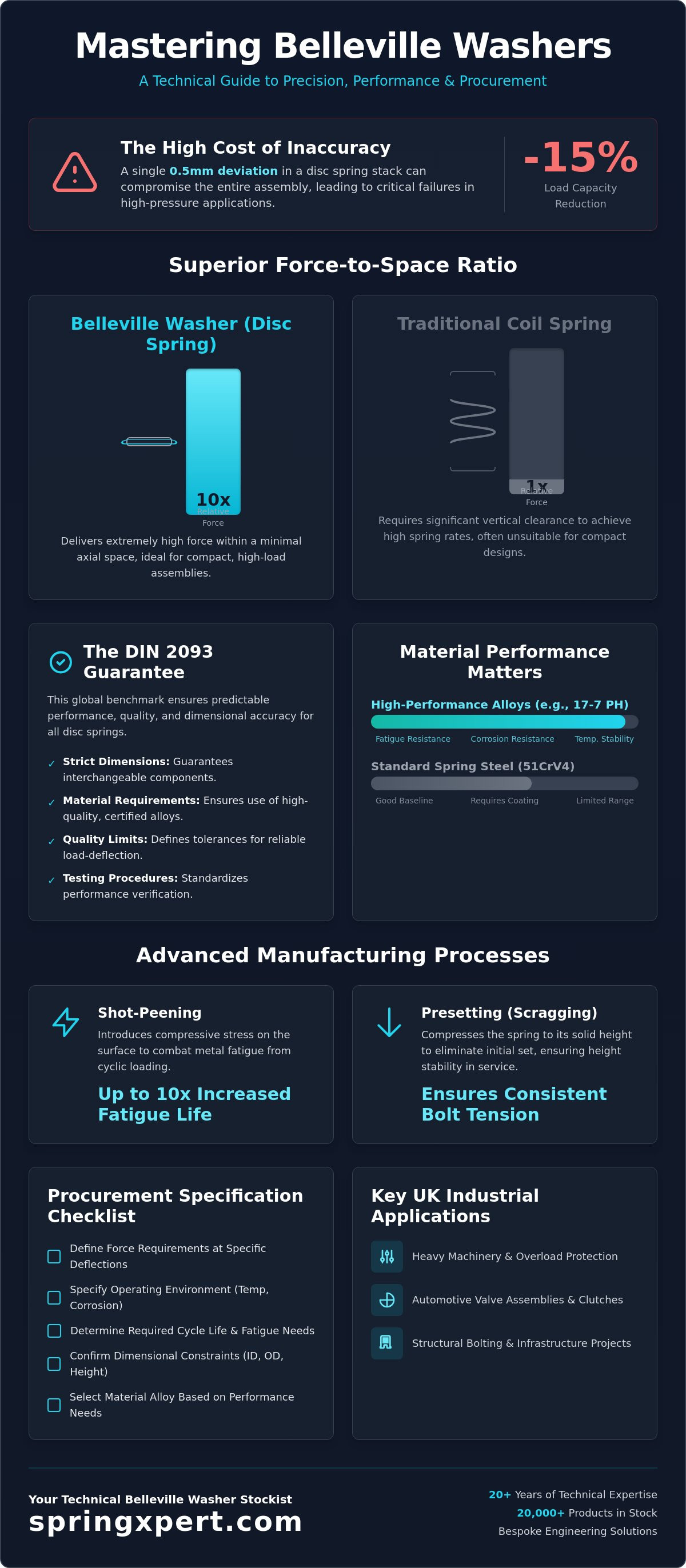
A single 0.5mm deviation in a disc spring stack can reduce load capacity by up to 15% in high-pressure valve assemblies, which is why specialist suppliers like OG VALVES LTD. demand the highest manufacturing tolerances. When precision is the primary requirement, relying on a generic component supplier often leads to inconsistent tolerances and critical failures. You're likely aware that sourcing from a specialist belleville washers stockist is the only way to ensure every component meets the rigorous DIN 2093 standards required for UK industrial applications. It's frustrating when stock levels fluctuate or technical support for bespoke alloy requirements is unavailable during the design phase.
This guide provides the technical framework you need to master material selection and stack performance calculations. We'll examine why specific material choices, such as 17-7 PH stainless steel versus standard carbon steel, dictate the longevity of your assembly. You'll gain the insights necessary to establish a reliable supply chain partner who offers the engineering depth your projects demand. We'll start with a breakdown of standard dimensions before moving into custom-engineered solutions for high-temperature environments.
Key Takeaways
- Understand the engineering advantages of conical disc springs and how they provide superior force-to-space ratios compared to traditional coil springs.
- Master the DIN 2093 standards to ensure your components meet global benchmarks for quality and dimensional accuracy across all thickness groups.
- Evaluate material performance by comparing standard 51CrV4 spring steel against high-performance alloys to mitigate fatigue and corrosion in demanding environments.
- Streamline your procurement process by defining precise force requirements at specific deflections before contacting a belleville washers stockist.
- Leverage over 20 years of technical expertise to access bespoke engineering solutions and a stock of over 20,000 products available for immediate dispatch.
The Role of Belleville Washers in High-Load Engineering
A Belleville washer, frequently identified as a conical disc spring, is a precision-engineered component designed to provide high force within restricted axial spaces. These washers function by storing energy as the cone height is compressed toward a flat state. Unlike standard flat washers that only distribute load, the conical profile acts as a heavy-duty spring. Partnering with a specialist belleville washers stockist is essential for sourcing components that meet the rigorous DIN 2093 standards required for industrial reliability.
Traditional coil springs often require substantial vertical clearance to achieve high spring rates, which isn't always feasible in compact assemblies. Belleville washers offer a superior space-to-load ratio, often delivering 10 times the force of a helical spring of equivalent diameter. Their primary engineering functions include maintaining bolt tension, absorbing mechanical shock, and compensating for thermal expansion. In high-temperature environments, they maintain a constant load even as metal components expand and contract, preventing the loss of joint integrity.
Technical precision is the foundation of these components. A dedicated belleville washers stockist provides the necessary material certifications and dimensional accuracy to ensure predictable performance. When tolerances are missed by even 0.05mm, the spring rate can deviate significantly from the design requirements, leading to premature fatigue or assembly failure.
Key Applications Across UK Industry
Heavy machinery manufacturers in the UK utilise these springs in automotive valve assemblies to ensure consistent pre-loading. In structural bolting, they're vital for maintaining tension during intense vibration or thermal cycling. By maintaining up to 95% of initial tension, they mitigate the risk of bolt loosening in steel frameworks. They're also integrated into slip clutches and overload protection devices, where they provide the precision torque control needed to prevent mechanical damage during sudden load spikes.
The Advantage of Conical Design
The performance of a disc spring is governed by the ratio of its internal cone height (h) to its thickness (t). This h/t ratio dictates the specific load-deflection curve of the spring. A ratio below 1.4 typically results in a linear spring characteristic. Ratios exceeding this value produce regressive curves where the force remains relatively stable despite increased deflection. This geometry ensures concentric force dispersal, which eliminates the uneven side-loading issues often found in traditional helical springs. It's this predictable physics that makes them indispensable for precision torque and tensioning tasks.
- High Load Capacity: Supports massive weights in small footprints.
- Stacking Flexibility: Can be arranged in series or parallel to modify spring travel and force.
- Durability: Engineered from high-tensile alloys to resist fatigue over millions of cycles.
- Thermal Stability: Compensates for expansion in systems reaching temperatures over 200°C.
Reliability in high-load engineering depends on the quality of the raw materials and the accuracy of the manufacturing process. We invite technical collaboration to ensure your specific load requirements are met with the correct alloy and geometry configurations.
Technical Specifications and DIN 2093 Standards
DIN 2093 serves as the primary global benchmark for disc spring dimensions, material requirements, and quality limits. This standard ensures that components meet strict performance criteria across diverse industrial applications. As a specialist belleville washers stockist, SpringXpert Ltd maintains inventory that strictly adheres to these engineering parameters to guarantee predictable load-deflection characteristics. It's the technical rigor of this standard that allows engineers to calculate spring stacks with high levels of certainty.
The manufacturing process directly influences the fatigue life and reliability of the washer. For high-cycle applications, shot-peening is applied to introduce compressive residual stresses on the surface. This process typically increases the fatigue life of a disc spring by up to 10 times compared to non-peened variants. Additionally, presetting involves compressing the spring to its solid height to eliminate initial set. This ensures the component doesn't lose height during service, which is critical for maintaining consistent bolt tension in UK infrastructure projects.
Understanding DIN 2093 Groups
The standard categorises springs into three distinct groups based on material thickness, which determines the necessary production method and finish:
- Group 1: Thicknesses under 1.25mm. These are cold-formed from strip or sheet steel. The process allows for high precision in thin-gauge applications without the need for additional machining on the edges.
- Group 2: Thicknesses between 1.25mm and 6mm. These require machined inner and outer diameters. Machining removes the heat-affected zones or micro-cracks from laser or plasma cutting, which is vital for load accuracy and longevity.
- Group 3: Thicknesses exceeding 6mm. These components are fully machined from forged blanks or heavy plate. This group is reserved for heavy industrial equipment where load requirements are extreme and structural integrity is paramount.
Tolerances and Quality Control
Precision in disc spring manufacturing is measured by strict adherence to dimensional tolerances. Allowable deviations in the outer diameter (De) and inner diameter (Di) are tightly controlled to prevent binding or misalignment within an assembly. Engineers often reference a systematic method for designing and analyzing these components to ensure they perform under specific stress levels without premature failure.
Variations in thickness (t) have the most significant impact on performance. A 5% increase in thickness can result in a 15% increase in the spring rate. SpringXpert Ltd verifies every batch by testing loads at specific deflection points, typically at 25%, 50%, and 75% of the total stroke. This verification ensures that the delivered components match the theoretical calculations required for your project. Accuracy isn't just a preference; it's a requirement for safety-critical assemblies. If your application requires specific material grades or non-standard dimensions, you can consult our technical team for bespoke engineering support.
Material Selection and Stacking Strategies
Standard carbon spring steel, specifically 51CrV4 (1.8159), remains the industry benchmark for general mechanical applications due to its high fatigue resistance and tensile strength. For standard operations between -15°C and +120°C, this material provides optimal performance. However, environmental factors like humidity or chemical exposure necessitate advanced alloys. As a specialist belleville washers stockist, we recognize that material failure often stems from hydrogen embrittlement or chloride stress corrosion. Choosing an alloy with the correct Pitting Resistance Equivalent Number (PREN) is vital for component longevity.
Temperature fluctuations significantly impact the modulus of elasticity. A standard steel disc loses approximately 3% of its spring force for every 100°C increase in operating temperature. High-performance alloys mitigate this loss, ensuring that bolted joints or valve actuators maintain constant pressure in fluctuating thermal environments. Precision engineering requires a data-driven approach to material selection to avoid premature fatigue and costly downtime.
Choosing the Right Material Grade
Stainless steel alloys like 301 and 316 offer basic corrosion resistance for maritime or food-grade applications. 17-7 PH (Grade 631) is preferred for aerospace or medical components because it maintains high strength after precipitation hardening. Inconel 718 and Nimonic 90 are essential for extreme thermal environments, retaining mechanical properties at temperatures exceeding 700°C. For non-magnetic or electrical requirements, phosphor bronze and beryllium copper provide low magnetic permeability and high electrical conductivity, making them suitable for sensitive electronics or ATEX-rated spark-proof environments.
Stacking Configurations: Parallel vs. Series
Engineers can manipulate the performance of a single disc by arranging multiple washers in stacks. This flexibility allows a belleville washers stockist to provide solutions for specific load-deflection curves without requiring custom-manufactured single discs. The three primary methods include:
- Parallel stacks: Washers face the same direction. This configuration multiplies the load capacity by the number of washers while keeping the deflection equivalent to a single disc. A stack of four washers will support four times the load of one.
- Series stacks: Washers face opposite directions (point-to-point or edge-to-edge). This increases the total deflection of the assembly in proportion to the number of washers, while the load remains the same as a single unit.
- Compound stacks: These involve nested parallel sets arranged in series. They are used for non-linear load requirements or to provide a safety factor against fatigue in high-cycle applications.
SpringXpert engineers provide technical collaboration to determine the exact stacking sequence required for your assembly. We ensure that friction factors and guide rod tolerances are accounted for in every configuration.
Specification Checklist for Procurement
Procurement of high-precision components requires a data-led approach. A professional belleville washers stockist provides technical consultation based on specific variables to ensure component longevity. If your engineering data is incomplete, the risk of fatigue failure or incorrect seating increases significantly. A reputable belleville washers stockist will provide the documentation needed to verify performance before dispatch.
Start by defining the required force in Newtons (N) at a specific deflection point measured in millimetres (mm). General approximations often lead to component drift during operation. You must also confirm the physical space constraints. This involves measuring the maximum outer diameter and minimum inner diameter to prevent interference with housings or guide bolts. Professional procurement teams use the following checklist to maintain accuracy:
- Identify the required force (N) at a specific deflection (mm) before contacting a supplier.
- Verify the available space by confirming maximum outer diameter and minimum inner diameter.
- Evaluate the working environment, focusing on temperature, chemical exposure, and cycle frequency.
- Determine the required finish, such as zinc plating, phosphating, or mechanical galvanising.
- Check for standard stock availability versus the need for bespoke manufacturing.
Environmental factors dictate material choice and longevity. Document the operating temperature, potential chemical exposure, and the expected cycle frequency. For instance, applications in the North Sea oil and gas sector require different corrosion resistance than indoor automotive assemblies. High-cycle applications, often exceeding 500,000 cycles, require specialized alloys to prevent premature stress fractures.
Calculating Load and Deflection
Load in these components increases non-linearly. You must verify the specific load-deflection curve matches your assembly requirements. Friction in stacked configurations is a critical variable; it increases the total force required and can lead to hysteresis. Engineering teams should consult this disc springs technical guide to cross-reference standard sizes against calculated data.
Surface Treatment and Coatings
Selecting the correct finish prevents environmental degradation and maintains performance over the component life. Different coatings offer varying levels of protection:
- Phosphating: This is the standard industrial finish. It's preferred for its oil-retention properties and provides sufficient protection for internal, lubricated environments. It's a cost-effective solution for high-volume industrial orders.
- Zinc Flake: A high-performance coating that offers superior salt-spray resistance. It's often specified for offshore or external UK infrastructure projects where moisture is a constant factor.
- Electroless Nickel: This treatment is ideal for wear resistance. It ensures a uniform thickness across the entire surface, maintaining tight tolerances in precision assemblies where plating thickness might otherwise cause fitment issues.
Our technical department assists with custom engineering specifications to ensure your procurement process remains accurate and efficient.
SpringXpert: Your Technical Belleville Washer Stockist
SpringXpert operates as a specialized belleville washers stockist with a foundation built on 20 years of technical engineering experience. Our UK facility maintains an inventory exceeding 20,000 standard products. This scale allows for immediate dispatch, reducing downtime for industrial maintenance and assembly lines. We focus on technical precision rather than just high-volume distribution. Because our manufacturing is UK-based, every batch undergoes rigorous quality assurance. We provide full material traceability and certificates of conformity upon request. This ensures that every washer meets the exact tensile strength and fatigue life required for your specific application.
Bespoke Design and Prototyping
Standard components don't always satisfy the unique load-deflection characteristics required by modern engineering. Our team bridges this gap through a collaborative design process. We translate your technical specifications into precise CAD models before moving to production. We frequently work with non-standard alloys, including 17-7 PH stainless steel and Inconel, to withstand extreme thermal or corrosive environments. Prototyping capabilities at our facility allow for physical testing of low-volume runs. This allows engineers to verify performance in real-world conditions before initiating a full production schedule. It's a method that prioritizes accuracy and reduces the risk of mechanical failure in complex assemblies.
Reliable Supply Chain and Logistics
A dependable belleville washers stockist must provide more than just a product; they must offer logistical certainty. We've optimized our supply chain to ensure consistent national delivery across the United Kingdom. Lead times are communicated clearly at the point of order to help you manage project timelines effectively. To support large-scale industrial projects and repeat procurement, we utilize tiered pricing structures. This provides a clear cost-benefit for bulk orders while maintaining the high standards expected of precision-engineered parts. Our systems are designed for transparency, ensuring you can track your components from the raw material stage to your facility floor.
Contact our engineering team for a technical consultation to discuss your specific load requirements or custom material needs.
Optimising High-Load Assemblies with Precision Disc Springs
Selecting the correct disc spring requires a thorough understanding of DIN 2093 standards and the specific fatigue life requirements of your application. Achieving exact load-deflection characteristics depends on precise material selection and calculated stacking configurations. As a specialist belleville washers stockist, SpringXpert provides the technical depth needed to navigate these complex engineering variables. Our ISO 9001 certified manufacturing processes ensure every component meets rigorous industrial tolerances and performance benchmarks.
You'll find technical support from our qualified spring engineers essential when calculating bespoke specifications or choosing alloys for corrosive environments. We maintain national UK delivery on over 20,000 stock items, ensuring your production timelines remain secure. Whether you're managing thermal expansion in bolted joints or require high force in limited spaces, our team delivers the stability your project demands. We're ready to partner with you to solve your most challenging mechanical requirements through data-driven solutions and proven manufacturing expertise.
Browse our full range of Belleville Washers and Disc Springs
Frequently Asked Questions
What is the difference between a Belleville washer and a disc spring?
Belleville washers and disc springs share the same conical geometry, but the distinction lies in their manufacturing standards and intended applications. Disc springs specifically adhere to DIN 2093 specifications, which mandate precise force-deflection characteristics and high fatigue life for heavy duty cycles. Standard Belleville washers often serve as simple tensioning devices in static bolted joints where tolerances aren't as critical.
How do I calculate the load of a stacked Belleville washer?
You calculate the load based on the stacking configuration, where parallel stacks increase force and series stacks increase deflection. In a parallel stack, the total load equals the load of a single washer multiplied by the number of washers. For a series stack, the load remains equal to a single washer, but the total deflection is the sum of each individual unit. As a leading belleville washers stockist, we provide technical charts to verify these calculations against DIN 2093 tolerances.
Are Belleville washers better than standard compression springs?
Belleville washers are superior for applications requiring high force within a restricted axial space. While a standard coil spring provides a linear rate over a long stroke, a disc spring generates substantial loads with minimal travel. This makes them the optimal choice for thermal expansion compensation or vibration dampening in compact industrial assemblies. They offer a customisable spring rate through various stacking combinations that standard springs can't match.
What materials are best for high-temperature Belleville washers?
Inconel 718 and Inconel X750 are the primary materials for applications exceeding 350°C. These nickel-chromium alloys maintain their tensile strength and resist relaxation at temperatures reaching 700°C. For less extreme environments up to 250°C, 17-7 PH stainless steel provides excellent corrosion resistance and mechanical stability. Selecting the correct alloy ensures the component doesn't lose its spring characteristics under thermal stress.
Can Belleville washers be used in dynamic applications?
Belleville washers are effective in dynamic applications provided they're manufactured to DIN 2093 Group 2 or Group 3 standards. These specific grades undergo shot peening and precision machining of the inner and outer diameters to enhance fatigue life. In cycling environments, such as clutch mechanisms or valve actuators, the washers must maintain a minimum preload of 15% to 20% of their total deflection to prevent premature failure from stress reversals.
What is the standard tolerance for DIN 2093 disc springs?
The standard tolerances for DIN 2093 disc springs are categorised into three groups based on material thickness. For Group 1 washers under 1.25mm, the diameter tolerances are held within h12 or H12 limits. Force tolerances typically range between plus 25% and minus 7.5% at the specified test height. These rigorous parameters ensure that every batch from your belleville washers stockist performs reliably within engineered safety margins.
How does friction affect the performance of stacked disc springs?
Friction causes hysteresis, where the measured load during compression is higher than the load during release. In parallel stacks, friction increases proportionally with the number of washers because the sliding surfaces rub against one another. This effect can alter the calculated load by 5% to 15% depending on the lubrication used. Engineers must account for this energy dissipation when designing systems that require precise damping or consistent return forces.