

Custom Extension Spring Design Guide
Last Updated: October 23, 2026
Quick Summary
Extension spring design translates application requirements into precise specifications by calculating spring rate, selecting wire diameter and coil diameter, determining active coil count, and verifying working length to ensure the spring fits and performs reliably under load.
- Spring rate, measured in newtons per millimetre, quantifies force required to extend the spring by one millimetre.
- Wire diameter is the primary driver of spring characteristics: larger wire increases spring rate, load capacity, and cost.
- Mean coil diameter and body length work together to adjust spring rate without changing wire diameter.
- Fatigue failure is common in springs cycling more than 10,000 times; design conservatively by keeping maximum torsional stress below 50% of ultimate tensile strength.
- Standard tolerances are ±1.0 mm for free length, ±0.2 mm for wire diameter, and ±0.3 mm for outside diameter.
Table of Contents
- Extension Spring Fundamentals and How Springs Work
- Spring Dimensions and Geometry: Wire Diameter, Coil Diameter, and Free Length
- Extension Spring Design Calculations: Rate, Load, and Deflection
- Extension Spring Hook Types and End Configuration
- Extension Spring Materials and Wire Selection
- Stress, Fatigue Life, and Safety Factors in Custom Design
- Extension Spring Specification Template and Tolerance Stack-Up
- Frequently Asked Questions
Extension Spring Fundamentals and How Springs Work
An extension spring is a helical spring that resists pulling forces and stores energy when extended beyond its free length.
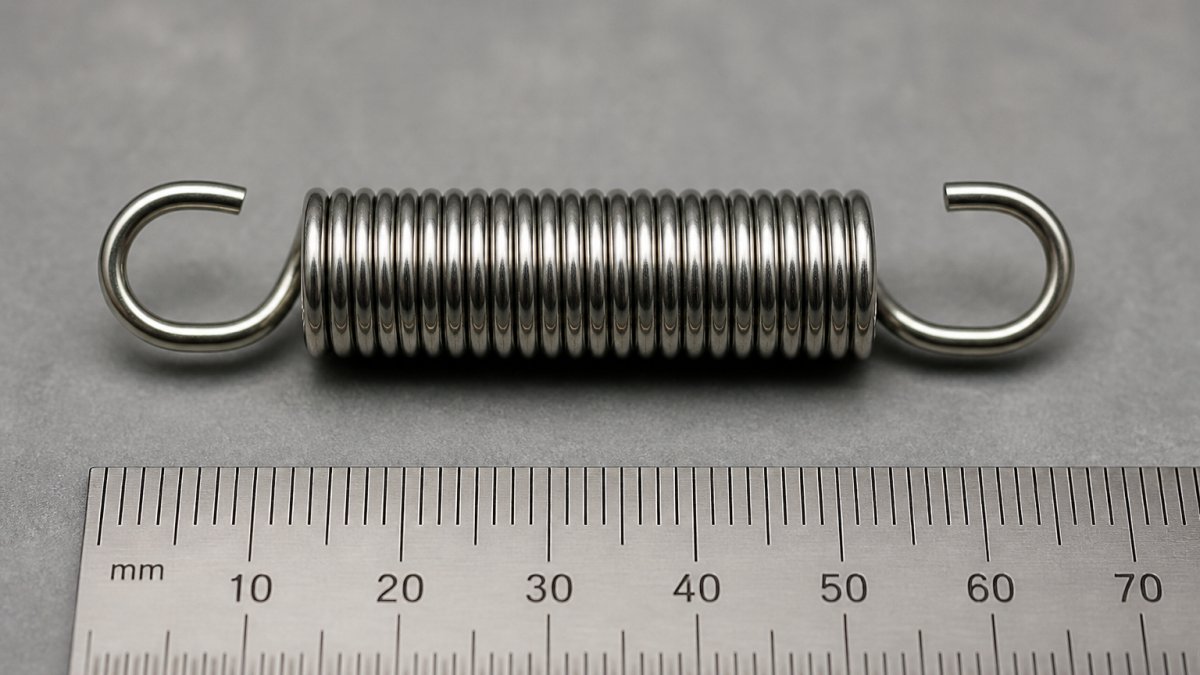
Pulling the spring beyond its free length puts the wire under torsional stress as the coils try to return to their original configuration.
Compression springs handle axial pushing forces, torsion springs handle rotational forces, and extension springs handle tensile (pulling) loads. At SpringXpert, we've engineered thousands of custom extension springs, and the physics is constant: the spring resists extension proportionally to how far you pull it.

Initial tension is unique to extension springs: a pre-stress built into the coils during manufacturing that makes the spring resist opening before any external load is applied.
Pro Tip
Initial tension is not the same as spring rate. Initial tension is a fixed pre-stress; spring rate is the force required per unit of extension beyond that pre-stress. Understanding both is essential for accurate custom specifications.
Spring Dimensions and Geometry: Wire Diameter, Coil Diameter, and Free Length
Extension spring geometry determines performance, manufacturability, and cost. Every dimension, from wire diameter to hook length, affects behaviour under load.
Wire diameter and outside diameter
Wire diameter is the thickness of the wire, measured in millimetres. It drives most spring characteristics: larger wire increases spring rate (stiffer), load capacity, and material cost; smaller wire reduces all three.
Outside diameter (OD) is the largest dimension across the spring, measured from outer edge to outer edge. It determines whether the spring fits into your assembly space: for a given coil diameter, larger wire means larger outside diameter.
When selecting wire diameter for a custom extension spring, weigh three factors: load (larger loads need larger wire), space constraints (tight spaces demand smaller wire), and budget (wire diameter scales material cost significantly). SpringXpert stocks extension springs from 0.1mm to 5mm wire diameter in carbon and stainless steel.
Mean coil diameter and body length
Mean coil diameter (often called pitch diameter) is the average diameter of the coils, measured to the centre of the wire, distinct from outside diameter.
Body length is the length of the coiled portion of the spring, excluding the hooks, unlike free length, which includes the hook extensions.
For custom extension spring design, mean coil diameter and body length work together.
Key Takeaway
Mean coil diameter and body length are your primary levers for adjusting spring rate without changing wire diameter. This flexibility allows you to meet load requirements within spatial constraints.
Extension Spring Design Calculations: Rate, Load, and Deflection
Custom extension spring design requires translating application requirements into precise specifications. The calculations below bridge that gap, including a worked example.
Spring rate and force requirements
Spring rate, measured in newtons per millimetre (N/mm), quantifies the force required to extend the spring by one millimetre.
Calculating spring rate requires four inputs: wire diameter, mean coil diameter, number of active coils, and material properties (specifically the shear modulus). The formula is:
Spring Rate (k) = (G × d⁴) / (8 × D³ × n)
Where G is shear modulus, d is wire diameter, D is mean coil diameter, and n is the number of active coils.
In practice, work backwards from your application: dividing the load by the distance it must move gives the required spring rate.
Initial tension and working length
Initial tension (measured in newtons) is the pre-stress built into the coils during manufacturing. It resists the first bit of extension before the spring rate takes over.
Working length is the spring's length when fully extended under maximum load, distinct from free length (unloaded) and body length (coil portion only). For custom design, specify free length, working length, and the difference between them, maximum deflection.
Worked design example: from requirements to finished specification
Requirements: A piece of machinery needs a spring to return a sliding mechanism to its home position.
Step 2: Select wire diameter and mean coil diameter. The outside diameter constraint is 15 mm.
Step 4: Determine free length and hook configuration. With 8 active coils at 1.4 mm wire diameter and 12 mm mean coil diameter, the body length is approximately 11.2 mm. Add hook lengths (typically 15 mm per hook for a standard eye configuration) = 41.2 mm free length.
Step 6: Select material for environment. Humid industrial environment requires corrosion resistance. Specify 302 stainless steel instead of carbon steel.
Final specification:
- Wire diameter: 1.4 mm
- Outside diameter: 13.4 mm
- Mean coil diameter: 12 mm
This specification can now be quoted, manufactured, and tested.
Watch Out
Never skip the working length verification step. Springs that bind (coils touching) under load will fail prematurely and may jam in the assembly. Verify that maximum deflection plus free length does not exceed your available space with margin for safety.
Extension Spring Hook Types and End Configuration
The hooks or eyes at the end of an extension spring determine how it attaches to the assembly. Hook type affects load distribution, stress concentration, and manufacturability; the wrong configuration can cause premature failure or assembly difficulties.
Hook position matters as much as hook type. If both hooks are aligned on the same plane, the spring will twist during extension; if they're offset (typically 90 or 180 degrees), the spring tracks straight.
Hook length, the distance from the spring body to the end of the hook, affects overall free length and stress concentration at the hook-to-body transition.
Extension Spring Materials and Wire Selection
Material selection determines strength, durability, cost, and environmental performance. The wrong choice can cause corrosion failure, brittleness, or premature fatigue, especially in subsea or oil and gas applications.
Metric Extension Springs 0.5mm to 1.00mm Music Wire →
Material properties and tensile strength
Carbon steel EN10270-1 is the most common material for extension springs in general industrial applications. It offers good strength, is cost-effective, and is widely available. Tensile strength for music wire (a high-carbon steel) typically ranges from 1,400 to 1,900 N/mm² depending on wire diameter.
Tensile strength determines how much load the spring can handle before permanent set occurs. Higher tensile strength allows smaller wire for the same load, reducing cost and weight, but such materials are often more brittle and more susceptible to fatigue failure if not designed carefully.
Corrosion resistance and environmental factors
Carbon steel corrodes readily in humid or wet environments. Indoors in a climate-controlled space, carbon steel is fine; outdoors, near salt water, or in a chemically aggressive environment, stainless steel is essential.
Stainless steel's corrosion resistance comes from a passive oxide layer that can break down in seawater or high-chloride environments, causing pitting corrosion.
Environmental factors extend beyond corrosion. At elevated temperatures, spring rate decreases and permanent set increases; at very low temperatures, materials become brittle.
Pro Tip
For subsea and oil and gas applications, do not default to 316 stainless. Consult material compatibility data for the specific fluid and temperature. Some applications require superalloys or exotic materials. SpringXpert's team can guide material selection based on your specific conditions.
Stress, Fatigue Life, and Safety Factors in Custom Design
Extension springs in real applications don't experience a single static load. They cycle repeatedly over weeks, months, or years, and fatigue failure (sudden breaking after many cycles) is more common than static overload failure. Understanding stress, fatigue, and safety factors is essential for reliable custom design.
Torsional stress and permanent set
When an extension spring is loaded, the wire experiences torsional (twisting) stress, not bending stress.
Permanent set is how much the spring has been permanently deformed. Extend a spring and release it: ideally it returns to its original free length; if it stays slightly longer, that's permanent set.
For custom design, calculate maximum torsional stress and ensure it stays below the material's yield strength by a safety margin.
Cycle-based fatigue estimation and failure analysis
Fatigue life depends on stress amplitude, mean stress, material properties, surface finish, and stress concentration.
For custom extension springs, fatigue life estimation requires either testing or reference to published S-N data for the material.
A practical approach: if your application cycles more than 10,000 times, design conservatively.
Surface finish significantly affects fatigue life. A rough surface from coiling has stress concentrations that reduce life.
Key Takeaway
Fatigue failure in extension springs is not rare, it's common when springs cycle thousands of times. Design for fatigue by keeping stress low, specifying surface treatments like shot peening, and testing prototypes if possible. A spring that handles static load fine may fail quickly under cyclic load.
Extension Spring Specification Template and Tolerance Stack-Up
Specifying a custom extension spring requires precision. Missing or ambiguous parameters lead to manufacturing delays, prototype revisions, or worse, springs that don't fit or perform. The template and tolerance considerations below make custom springs manufacturable.
Manufacturing tolerances and dimensional inspection
Manufacturing tolerances define the acceptable range for each dimension.
Standard tolerances for extension springs are typically ±1.0 mm for free length, ±0.2 mm for wire diameter, and ±0.3 mm for outside diameter.
Tolerance stack-up occurs when multiple tolerances accumulate.
Dimensional inspection requires measuring the spring with precision instruments. Free length is measured with the spring hanging under its own weight (a standard reference state).
Design-for-manufacturability checklist
Before finalizing a custom extension spring specification, review this checklist to ensure the design is manufacturable and cost-effective:
- Wire diameter is available from the chosen material supplier (not custom-drawn wire)
- Mean coil diameter is at least 4 times the wire diameter (tighter coils are difficult to wind)
- Mean coil diameter is no more than 20 times the wire diameter (looser coils are difficult to control)
This checklist is not restrictive, custom springs can deviate from all of these guidelines if application requirements justify it. But each deviation adds cost, lead time, or both.
Designing a custom extension spring requires balancing load capacity, spatial constraints, fatigue durability, cost, and environmental performance.
The most common mistake we see is treating spring design as an afterthought. Teams specify a spring late in the product development cycle, then discover it doesn't fit or doesn't perform.
At SpringXpert, we've engineered custom extension springs for robotics, medical devices, subsea applications, and oil and gas environments. Whether you're designing a single prototype or specifying springs for a production run, our 12-hour response guarantee and ISO 9001 certification mean you get precision engineering without delays. ISO 9001 standard requirements ensure consistent quality across every project.
Frequently Asked Questions
How do you design a custom extension spring from scratch?
Start by defining your operating requirements: maximum load in Newtons, desired deflection in millimetres, and cycle life. Calculate the required spring rate (N/mm) by dividing load by deflection. Select wire diameter and mean coil diameter based on stress limits and space constraints. Verify initial tension, check torsional stress against material tensile strength, and estimate fatigue life using cycle-based analysis. Prototype and test before full production. SpringXpert's 12-hour response time means you can move from concept to quotation rapidly.
What measurements are needed to specify an extension spring?
Provide wire diameter (mm), outside diameter (mm), free length (mm), number of active coils, hook type and position, material grade, initial tension (N), and maximum working load (N). Include surface finish (oiled, stainless, etc.) and any special requirements such as corrosion resistance or heat treatment. For custom designs, state the operating environment and cycle life expectation. This information allows manufacturers to calculate spring rate, deflection, and stress to confirm the design meets your performance envelope.
What is initial tension in an extension spring, and why does it matter?
Initial tension is the preload force built into the spring during manufacturing, the force required to just begin extending the coils from their close-wound state. It reduces the load needed to start extension and prevents the coils from separating under light loads. Initial tension is critical in applications requiring smooth, predictable force response from zero displacement. Too much initial tension increases stress and reduces fatigue life; too little may cause coil separation. Specify it explicitly when ordering custom springs.
How do you choose the right material for an extension spring?
Match material to your environment and performance needs. Carbon steel (EN10270-1) offers cost-effectiveness for standard indoor applications and is widely stocked. Stainless steel (302 grade) resists corrosion in humid or chemical environments. Consider tensile strength (higher strength allows thinner wire, saving space), elasticity (ability to return to original shape), and fatigue resistance (critical for high-cycle applications). SpringXpert stocks both carbon steel and stainless options; custom materials are available on request.
What types of hooks are used on extension springs?
Common hook types include open hooks (simple eye, lowest cost), closed hooks (full loop, better load distribution), and machine hooks (threaded or pinned attachment). Hook position, centred or offset, affects load alignment and assembly fit. The choice depends on attachment method, space constraints, and load direction. Specify hook type, position, and any dimensional requirements when designing custom springs to ensure proper assembly fit and load transfer.
How do you calculate the spring rate of an extension spring?
Spring rate (k) in N/mm equals the load (N) divided by the deflection (mm): k = F / x. Alternatively, use the formula k = (G × d⁴) / (8 × D³ × n), where G is the material's shear modulus, d is wire diameter, D is mean coil diameter, and n is the number of active coils. Higher wire diameter and lower coil diameter increase rate; more coils decrease it. For custom springs, specify your required rate and load range, and the manufacturer will select wire and coil geometry to match. Test prototypes to validate calculations before production.
What happens if an extension spring is overstretched beyond its design limit?
Overstretching causes permanent set (plastic deformation), reducing elasticity and spring rate. Continued overextension leads to fatigue cracking, usually at the hook root where stress concentration is highest. The spring loses its ability to return to free length and may fail suddenly in service. Design custom springs with a safety factor of 1.5 to 2.0 on maximum working load, and specify maximum extension limits in the assembly design. Tolerance stack-up analysis ensures the spring cannot accidentally exceed its design deflection during normal operation.
What information should I provide when ordering a custom extension spring?
Supply: intended application and operating environment; required load range (minimum and maximum in Newtons); desired deflection (mm); estimated cycle life; wire material and finish; outside diameter and free length constraints; hook type and attachment method; any special requirements (corrosion resistance, temperature range, vibration resistance). Include a sketch or CAD model showing assembly context. The more detail you provide, the faster SpringXpert can validate the design and provide an accurate quotation. Our 12-hour response guarantee applies to complete specifications.
