

What Is a Die Spring Used For? An Industrial Engineering Guide
A standard compression spring might seem sufficient for heavy machinery, but using one in a high-stress environment is often the primary cause of premature system failure. When a production line stops because a component couldn't withstand 500,000 cycles, the engineering cost far exceeds the price of the part. Understanding what is a die spring used for requires looking at the specific demands of high-load, high-frequency applications where space is at a premium. These components are engineered with a rectangular wire profile to provide significantly higher force than traditional round-wire springs of the same dimensions.
You likely recognise that standard springs lack the fatigue resistance needed for industrial stamping or heavy-duty braking systems. This guide provides the technical clarity you need to select the correct load rating and interpret international colour-coding standards accurately. We will examine the mechanics of chrome silicon alloys and explore how these springs perform in sectors ranging from automotive manufacturing to precision aerospace assemblies. By the end of this analysis, you'll have the data required to implement die springs that ensure long-term operational stability and precision.
Key Takeaways
- Understand exactly what is a die spring used for in high-stress environments, ranging from heavy-duty metal stamping to critical industrial safety mechanisms.
- Learn how the engineering of rectangular wire profiles significantly increases load capacity and performance density compared to standard round wire springs.
- Identify the correct load ratings for your specific application by utilizing the ISO 10243 colour-coding system standard within the UK market.
- Discover how to prevent premature component failure and avoid common issues like coil bind through precise installation and engineering oversight.
- Gain the technical insights required to select the appropriate heavy-duty components for complex industrial tooling and bespoke engineering projects.
Defining the Die Spring: Engineering Intent and Mechanics
A die spring is a heavy-duty compression spring specifically engineered for high-load, high-stress environments. While it shares a basic profile with a standard Coil spring, its internal metallurgy and wire cross-section are optimized for industrial fatigue. The name stems from traditional tool and die manufacturing. In these settings, the springs provide the stripping pressure necessary to separate metal sheets from the punch after a stroke. A die spring is a high-force mechanical energy storage device used in precision tooling.
Engineering teams often ask what is a die spring used for when standard components fail under rapid cycling. These springs are designed to handle extreme force within restricted dimensions; they often operate at 1,000 cycles per hour or more in automated press lines. Unlike standard coils, die springs typically use rectangular or trapezoidal wire sections. This geometry increases the volume of material available for energy storage, allowing the spring to exert massive force over a short travel distance.
The Role of Die Springs in Metal Stamping
In metal stamping, the die spring maintains the pressure required to hold material securely during the press stroke. This prevents shifting, which ensures dimensional tolerances remain within specified microns. The stripping force is equally critical; it removes the finished part from the punch efficiently. Without consistent pressure, the material can deform or stick to the tooling, causing costly downtime in production environments. Reliability in this sector is measured by the spring's ability to maintain its free length over millions of cycles.
High-Force-to-Space Ratio: The Core Advantage
Die springs are the preferred choice when axial space is limited. They offer a significantly higher energy density than standard compression springs. This high force-to-space ratio allows engineers to design compact mechanical assemblies without sacrificing load capacity. A die spring's high spring rate means it can store 25% to 40% more energy in the same physical footprint as a traditional round-wire spring. This capability is vital for modern manufacturing where machine footprints are increasingly constrained. When considering what is a die spring used for, the primary answer is often the management of extreme axial loads where a larger spring simply won't fit.
- Load Capacity: Designed for high-stress applications exceeding standard industrial limits.
- Durability: Engineered to withstand rapid, repetitive cycling without significant relaxation.
- Compact Design: Maximises force output within small installation envelopes.
Performance Characteristics: Rectangular Wire vs. Round Wire
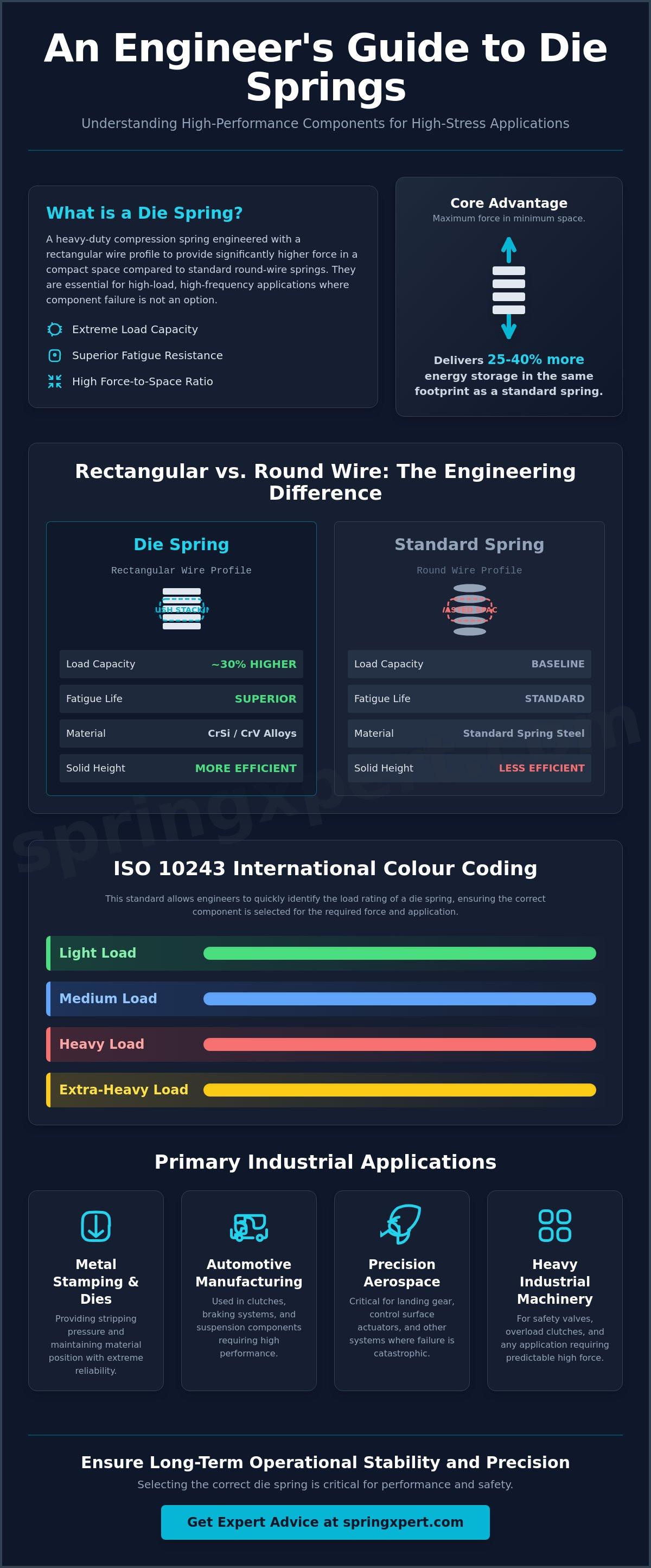
The fundamental distinction between a standard compression spring and a die spring lies in the cross-sectional geometry of the wire. While typical springs use round wire, die springs utilise rectangular or 'D-shaped' wire. This design choice isn't aesthetic; it's a calculated engineering requirement to maximise force within restricted spaces. Rectangular wire allows for a higher volume of material to occupy the same physical envelope. By eliminating the wasted gaps found between the curves of round wire, engineers can increase the load capacity by approximately 30% without expanding the outer diameter of the component.
The physics of solid height play a critical role in tool design. In a round wire spring, the coils meet at narrow contact points, which limits the total travel before the spring reaches its solid state. Rectangular wire coils stack flush against one another. This efficiency optimises the travel-to-length ratio, providing a longer working stroke. Understanding what is a die spring used for involves recognising these space-saving benefits in heavy-duty stamping and injection moulding environments where every millimetre of tool steel is valuable.
Material Composition and Tensile Strength
Die springs are manufactured from high-tensile alloys to withstand extreme cyclic loading. Most industrial variants use Chrome Silicon (CrSi) or Chrome Vanadium (CrV) steels. These alloys provide the necessary elastic limit to prevent permanent set. After coiling, the springs undergo shot peening. This process bombards the surface with steel shot to create a layer of compressive residual stress, which significantly increases fatigue resistance. Precise heat treatment ensures the spring maintains its preset height, even after surviving 5 million or 10 million cycles in high-speed production lines.
Stress Distribution and Fatigue Life
Cross-sectional geometry dictates how internal shear stress moves through the metal. In round wire, stress concentrates heavily on the inner radius of the coil. Rectangular wire distributes these forces more evenly across its flat surfaces. This reduction in localized stress prevents the premature fractures that typically plague round-wire springs in high-frequency applications. UK manufacturing facilities operating 24/7 rely on this durability to avoid costly downtime. For projects requiring specific load ratings, our team provides custom-engineered die springs tailored to exact tool specifications. The flat-wire profile ensures the spring remains stable under high-velocity compression, making it the standard choice for rigorous industrial stamping tasks.
Primary Industrial Applications Beyond Tooling
While die springs are fundamental to metal stamping, their engineering profile makes them indispensable for any mechanism requiring high-density force in a compact space. These components are frequently integrated into safety-critical systems where mechanical failure isn't an option. Because they are manufactured to strict ISO 10243 specifications, they offer predictable performance under extreme cycles. Understanding what is a die spring used for involves looking at environments where standard wire springs lack the necessary fatigue resistance or load capacity.
Outside of traditional tool rooms, five common applications include:
- Industrial Braking Systems: Providing the mechanical force required to hold loads in a fail-safe state during power loss.
- High-Torque Clutches: Ensuring consistent pressure plate engagement in heavy-duty commercial vehicles.
- Aircraft Landing Gear: Absorbing high-impact energy within the restricted volume of a wing or fuselage assembly.
- Mining Crushers: Acting as a release mechanism to protect machinery frames from uncrushable debris.
- Agricultural Tensioners: Maintaining belt and chain drive alignment despite constant vibration and dirt.
Automotive and Aerospace Systems
In high-performance automotive clutches, die springs provide the clamping force necessary for efficient power transfer. They maintain this pressure across thousands of engagements, resisting the heat-induced relaxation that affects lower-grade alloys. Aerospace engineers utilise them in valve mechanisms and landing gear due to their exceptional force-to-volume ratio. In these sectors, space is at a premium. A die spring can deliver significantly more force than a standard compression spring of the same dimensions, ensuring fail-safe operation in critical flight systems where weight must be minimised.
Heavy Machinery and Agricultural Equipment
Heavy plant used in UK construction and mining requires components that withstand 24-hour vibration and debris ingress. Die springs are often used as shock absorbers in large-scale crushers or as counterbalances in heavy access doors. In agricultural harvesters, they're essential for maintaining tension in belt and chain drives. This prevents slippage when the equipment encounters varying crop densities or uneven terrain. Their durability is a result of specialised rectangular wire cross-sections, which distribute stress more evenly than round wire. This design choice extends the service life of the machinery by up to 40% in harsh, debris-heavy environments. When you consider what is a die spring used for in these contexts, it's clear they're chosen for their ability to survive where standard components would snap or deform.
Selection Criteria: Colour Coding and ISO 10243 Standards
Selecting the correct die spring depends on a precise understanding of load requirements and international standardisation. In the United Kingdom, the ISO 10243 standard governs the dimensions, tolerances, and load ratings for these high-stress components. Adhering to this framework ensures that springs from different manufacturers are interchangeable within the same die set. A frequent error in procurement involves confusing ISO metric standards with US inch-standard springs. These systems aren't compatible. Mixing them leads to fitment issues and uneven force distribution across the tool. Understanding these technical boundaries is essential when determining what is a die spring used for in high-precision manufacturing environments.
Choosing the wrong load rating carries significant risks. If the rating's too light, the tool won't have enough stripping force to function. If it's too heavy, you risk catastrophic tool damage or unnecessary wear on the press. Precision in selection isn't just about fit; it's about protecting your capital equipment.
Understanding the Colour-Coding System
The industry utilises a standardised colour-coding system to identify load capacities. This visual shorthand allows engineers to quickly verify that the correct components are installed during maintenance or assembly. The categories include:
- Light Load (Green): These springs are designed for applications that require significant travel but lower force.
- Medium Load (Blue): This is the most common industrial standard, used in a wide range of press tools.
- Heavy Load (Red): These are engineered for high-pressure requirements where the available stroke is often shorter.
- Extra Heavy Load (Yellow): These provide extreme force for heavy-duty stamping and forming operations.
- Ultra Heavy Load (Silver or Orange): These are specialised components reserved for the most demanding industrial pressure requirements.
Technical Specifications: Calculating Requirements
To determine the correct configuration, you must calculate the total force by multiplying the number of springs in the die by the individual load rating of each unit. It's vital to compare the working stroke against the maximum deflection. Exceeding the recommended deflection limits, which vary by load class, leads to rapid metal fatigue and premature failure. Most ISO 10243 springs are rated for a specific number of cycles based on their deflection percentage.
Environmental factors also influence material selection. If your production line operates in high-temperature zones or involves exposure to corrosive fluids, standard alloys might fail. In these cases, custom-engineered coatings or specific chrome-vanadium alloys are necessary to maintain tensile strength and operational stability. This level of technical scrutiny defines what is a die spring used for in professional engineering. Every variable, from the wire cross-section to the surface finish, impacts the longevity of the tool.
Our technical team provides expert guidance on ISO 10243 compliant die springs to ensure your tooling achieves maximum cycle life and reliability.
Optimising Service Life and Failure Prevention
Die springs are high-stress components designed for millions of cycles. While manufacturing defects are rare, premature failure remains a common issue in industrial presses. Most breakdowns result from improper installation or exceeding the design limits of the component. When engineers examine what is a die spring used for, the focus must remain on the mechanical limits of the steel alloy. Coil bind is a frequent cause of catastrophic failure. This occurs when the spring is compressed to its solid height, causing the coils to impact one another. This creates a massive spike in internal stress that leads to immediate fracture.
Preventative maintenance prevents costly downtime. Regular inspections should identify surface cracks or any significant loss of free length. If a spring shows a reduction in height exceeding 10% of its original specification, it has lost its structural integrity. Replacing these components before they break protects the tool and the press from secondary damage.
Best Practices for Installation and Maintenance
Proper guidance is a technical requirement for any high-load spring. You must ensure the spring is supported by either an internal rod or a precision-machined hole to prevent buckling. Without this support, the spring will bow under pressure, causing uneven wear on one side of the coils. Pre-loading is equally vital. We recommend a minimum pre-load of 5% to 10% of the total travel. This keeps the spring under constant tension, which eliminates the shock loading that occurs when a moving tool hits a loose spring. In UK workshops where dust or metal shavings are present, regular cleaning and the application of light machine oil prevent abrasive wear between the coils.
Bespoke Engineering at SpringXpert
Standard ISO 10243 springs cover most industrial needs, but specific applications require tailored solutions. The question of what is a die spring used for often leads to unique requirements for custom load ratings or non-standard dimensions. SpringXpert provides technical consultancy for material selection, especially when springs must operate in temperatures exceeding 230°C or in corrosive chemical environments. We draw on 20 years of manufacturing experience to help clients bridge the gap between a CAD design and a physical component. Our team ensures that every bespoke spring meets the exact tensile strength and fatigue life required for your specific duty cycle. Whether you need a single prototype or a large production run, we provide the engineering data to support your decision.
SpringXpert remains a dedicated partner for UK manufacturers, offering both a comprehensive stock of standard components and the technical depth required for custom engineering projects. Our focus on precision and durability ensures your operations remain efficient and predictable.
Optimising Machine Reliability with Precision Die Springs
Identifying exactly what is a die spring used for allows engineers to maintain tight tolerances and ensure consistent performance in heavy-duty environments. These components are designed to deliver high force within restricted spaces, typically using rectangular wire to increase energy density. Following ISO 10243 standards and colour codes is essential for preventing premature fatigue and operational downtime. Selecting the correct spring grade ensures your machinery handles the required loads without compromising component integrity.
SpringXpert maintains over 20,000 standard products in stock to support your immediate manufacturing needs. We've delivered UK-based manufacturing excellence for 20+ years, providing the technical depth required for both standard and custom-engineered projects. If your application demands specific tolerances, our expert technical consultancy can develop solutions for unique load requirements. Partner with SpringXpert for high-performance die springs and bespoke engineering solutions to enhance your industrial output.
Frequently Asked Questions
What is the difference between a die spring and a standard compression spring?
Die springs are heavy-duty components designed for high-load environments where standard compression springs would fail. They typically feature a rectangular wire cross-section to maximise material volume within a restricted space. This design allows them to exert significantly more force than round-wire springs of the same size. You'll find them in heavy industrial machinery where precision and high resistance are critical for operational stability.
How do I know which colour die spring I need?
You select a die spring colour based on the ISO 10243 load classification system. Green indicates light load, blue is medium load, red represents heavy load, and yellow is for extra-heavy load applications. It's vital to choose the colour that matches your tool's required force and stroke length. Using the wrong load rating leads to 50% faster fatigue failure or insufficient stripping force in press tools.
Can die springs be used for applications other than metal stamping?
Yes, die springs are used in heavy machinery, braking systems, and industrial clutches. While many ask what is a die spring used for in a press tool, their high-force characteristics suit any application requiring controlled energy absorption. They provide reliable performance in safety valves and aircraft components where standard springs lack the necessary tensile strength. Their compact design makes them ideal for high-stress mechanical assemblies.
What causes a die spring to fail prematurely?
Excessive compression beyond the manufacturer's recommended limit is the primary cause of failure. Operating a spring at 25% over its maximum travel rating reduces fatigue life significantly. Corrosion from industrial solvents and misalignment within the spring pocket also contribute to 40% of early replacements. Ensuring proper guidance and maintaining travel limits prevents these issues. Regular inspections for surface cracks help identify potential failures before they stop production.
Are die springs compatible with Belleville or disc springs in the same assembly?
Die springs and disc springs are compatible if the assembly accounts for their different deflection rates. Engineers often stack them to achieve specific damping characteristics in heavy-duty UK manufacturing equipment. However, you must ensure the spring pocket accommodates both diameters and that load distribution remains axial. Improper stacking results in uneven wear and potential assembly binding, which disrupts the 100% precision required in tool design.
What is the ISO 10243 standard for die springs?
ISO 10243 is the international standard that specifies dimensions, tolerances, and load requirements for rectangular wire die springs. It ensures interchangeability between different manufacturers' products across the global market. This standard covers wire sizes, hole diameters, and the four primary colour-coded load ranges. Adhering to this ensures your components meet rigorous UK industrial safety and performance benchmarks. It provides a reliable framework for engineering consistency in high-pressure environments.
How do I calculate the fatigue life of a die spring?
Fatigue life is calculated by comparing the operating stroke to the spring's total available travel. Springs operated at 15% of their total travel can last for 1,000,000 cycles or more. If you increase the stroke to 30%, the lifespan often drops below 100,000 cycles. You should use the manufacturer's load charts to determine the optimal balance between force and longevity. Monitoring these cycles helps prevent unexpected downtime in high-volume production lines.
Do die springs require specific lubrication?
Most modern die springs come with a protective coating like powder coating or phosphate to resist corrosion. However, light lubrication with a high-pressure industrial oil reduces friction against the guide pin. In high-speed stamping operations running at 200 strokes per minute, regular lubrication prevents heat build-up. This maintenance step extends the spring's functional life by 15% in harsh environments. It's a simple process that maintains the integrity of the spring's alloy steel.