

What is a Die Spring Used For? A Guide to High-Load Industrial Applications
Why do standard round-wire compression springs often fail within 50,000 cycles when integrated into high-pressure stamping dies? Understanding what is a die spring used for requires a shift from general-purpose elastic components to high-performance, rectangular-wire technology designed for extreme stress. Most engineers agree that space constraints in modern tool design leave no room for frequent maintenance shutdowns or component fatigue. It's frustrating when a simple part failure halts a production line, especially when the cause is a lack of clarity regarding load capacities or material tolerances.
At SpringXpert, we believe that technical precision is the foundation of industrial reliability. This guide provides the engineering data needed to identify the correct ISO 10243 colour-coded standards for your specific application. You'll discover how the mechanical advantages of chrome vanadium alloys and rectangular wire cross-sections extend the lifecycle of your industrial tooling by up to 300 percent compared to standard alternatives. We'll examine the critical load standards, high-cycle performance metrics, and bespoke engineering solutions that define modern precision manufacturing in the UK. Our Xpert analysis ensures you select the right component for every high-load requirement, ensuring your operations remain stable and efficient.
Key Takeaways
- Learn how heavy-duty helical compression springs provide the consistent pressure and stability required for high-load tool and die machinery.
- Understand exactly what is a die spring used for across critical sectors like automotive and aerospace manufacturing to maintain precise alignment during high-speed operations.
- Master the standardised colour-coding system to accurately identify load capacities and enhance safety protocols within busy factory environments.
- Discover why standard compression springs fail in industrial die-sets and how the specific performance metrics of die springs offer superior durability.
- Identify the critical technical factors, including hole diameters and environmental tolerances, necessary for specifying the correct bespoke spring for your project.
Defining the Die Spring: Engineering and Mechanical Design
Understanding what is a die spring used for requires a look at its mechanical architecture. A die spring is a heavy-duty helical compression spring engineered specifically for high-load industrial environments. These components provide the consistent, predictable pressure necessary for tool and die machinery to operate during repetitive cycles. Unlike standard springs, die springs must withstand extreme stresses while maintaining precise dimensions. They serve as the primary force provider in heavy-duty press tools, plastic injection moulds, and various automotive assemblies.
The manufacturing process relies on high-tensile chrome silicon steel alloys. These alloys offer superior resistance to fatigue and heat compared to standard carbon steel. The engineering focus remains on high energy density, which allows the spring to store a significant amount of potential energy relative to its mass. This efficiency is critical in modern manufacturing where precision is non-negotiable. To understand the broader context of spring mechanics, one must differentiate between general-purpose coils and these high-performance variants designed for millions of cycles.
The Importance of Rectangular Wire Cross-Sections
The defining feature of a die spring is its rectangular wire profile. Standard springs use round wire, but rectangular wire provides more material volume within the same physical footprint. This geometry ensures that stress is distributed evenly across flat surfaces. It reduces localized stress concentrations that lead to premature fatigue. By using this shape, engineers achieve higher solid height loads without increasing the outer diameter of the spring. It's a design choice that prioritises durability under constant compression.
High-Load Performance in Confined Spaces
Industrial applications often present severe axial space limitations. Die springs are the primary choice when a machine requires a high spring rate but lacks the room for a large-diameter round wire coil. The flat-sided wire allows for more active coils in a shorter free length. This design maximises the force-to-space ratio, ensuring the equipment performs reliably without requiring massive housing units. This spatial efficiency is vital for complex multi-stage pressing operations.
- Increased load capacity per millimetre of compression.
- Longer service life in high-frequency cycling environments.
- Resistance to operating temperatures exceeding 230 degrees Celsius.
- Predictable performance across standardized colour-coded load ranges.
A die spring is a high-tensile mechanical component designed to provide extreme force and durability within the restricted spatial envelopes of heavy-duty industrial pressing and moulding equipment. When determining what is a die spring used for, it's clear that their role is fundamental to the stability of high-pressure manufacturing systems.
Primary Industrial Applications: What is a Die Spring Used For?
Industrial manufacturing relies on components that can withstand extreme cycles and high force. Understanding what is a die spring used for requires looking at environments where standard coil springs fail. These heavy-duty components support automotive assembly lines and aerospace production by maintaining precise alignment during high-speed strokes. They manage the kinetic energy of a 500-tonne press, converting potential energy into controlled mechanical force. The unique Properties of die springs, such as their rectangular wire cross-section, allow for higher load capacities within a smaller footprint than conventional wire alternatives.
Beyond alignment, these springs function as critical safety mechanisms. In heavy-duty braking and clamping systems, they provide the stored energy required to engage a fail-safe lock if power is lost. This reliability is why they're found in everything from high-speed packaging machinery to large-scale industrial valves. To see how these principles apply to high-capacity industrial machinery, you can discover Choice Bagging Equipment and their specialized bulk bag filling systems. They don't just provide force; they provide predictability in high-stress environments.
Metal Stamping and Press Tooling
In metal stamping, die springs provide the vital stripping pressure needed to pull the punch out of the material after a stroke. If this force isn't sufficient, the metal workpiece sticks to the tool, causing production delays and potential tool damage. These springs hold the workpiece securely during the 0.05mm precision cutting or forming process. Reliability is critical here. A single spring failure leads to uneven pressure, resulting in scrapped parts and expensive downtime. High-grade alloys are typically used to ensure the springs maintain their free length after millions of cycles.
Injection Moulding and Precision Engineering
Plastic injection moulding utilizes die springs to return ejector plates to their home position after a part is released. They maintain constant tension on the mould halves. This tension is necessary to prevent flashing, a defect where molten plastic leaks between the plates. In precision engineering, these springs are integrated into jigs and fixtures where repeatable force is required for 100,000 cycles or more. This consistency ensures that every component meets strict quality standards. It's a matter of technical necessity rather than simple mechanical preference.
Heavy Machinery and Shock Absorption
The application of die springs extends to agricultural and construction equipment, where they serve as vibration dampeners. They protect sensitive hydraulic systems from the impact damage inherent in rock crushing or heavy tilling. In heavy-duty clutch mechanisms, they ensure positive engagement and disengagement under high torque loads. For projects requiring specific load ratings, consulting with a bespoke spring manufacturer ensures the component matches the exact mechanical requirements of the machinery. This protective role prevents premature wear on bearings and structural frames by absorbing the shock of high-impact operations.
Understanding Die Spring Load Classifications and Colour Coding
Industrial tool rooms are high-pressure environments where visual clarity prevents mechanical failure. Identifying a spring's capacity by sight is essential for both safety and assembly speed. Because die springs often look identical in size but possess vastly different spring rates, a standardised colour system is used to categorise their load-bearing capabilities. This system ensures that engineers don't accidentally install a light-duty spring in a high-tonnage stamping tool, which would lead to immediate deformation or catastrophic tool damage.
The load rating of a spring dictates its maximum travel and its lifespan. When determining what is a die spring used for in a specific press tool, the engineer must balance the required force against the available stroke. Higher load ratings typically offer higher force but require shorter travel distances to avoid reaching "solid height," the point where the coils touch and the spring ceases to function as a flexible component.
Standardised Colour Coding Systems (ISO 10243)
The ISO 10243 standard is the primary reference for die springs in the UK and Europe. It provides a consistent framework for identifying four distinct load ranges:
- Green (Light Duty): Designed for lower force requirements with maximum deflection.
- Blue (Medium Duty): A versatile balance of force and travel for standard industrial tooling.
- Red (Heavy Duty): Used for high-pressure stripping and forming operations.
- Yellow (Extra Heavy Duty): Provides maximum force in compact spaces, often with limited travel.
It's vital to recognise that alternative standards, such as JIS (Japanese Industrial Standards), use a different colour sequence. For example, a JIS "Heavy Duty" spring might use a different shade than an ISO equivalent. Mixing ISO and JIS components within the same tool design can cause uneven pressure distribution. Engineers should standardise on a single system to maintain predictable maintenance cycles and avoid operational errors.
Calculating Load Requirements for Industrial Tooling
Determining the correct spring force involves more than just selecting a colour. The basic formula (Force = Rate x Deflection) must account for the weight of the upper die and the specific stripping force needed to release the workpiece. Precision is mandatory here. An under-powered spring won't return the tool, while an over-powered one causes unnecessary wear on the press. Knowing exactly what is a die spring used for in your specific assembly allows for more accurate force calculations.
Applying a "pre-load" is a standard practice in professional tool design. By compressing the spring by 5% to 10% of its free length during installation, you eliminate internal movement and vibration. This small adjustment significantly extends the spring's fatigue life. For complex applications where standard catalogues don't meet the required tolerances, consulting with a bespoke spring design specialist ensures the component is engineered for your specific cycle counts and environmental conditions. This technical partnership is often the difference between a tool that lasts 100,000 cycles and one that reaches 1,000,000.
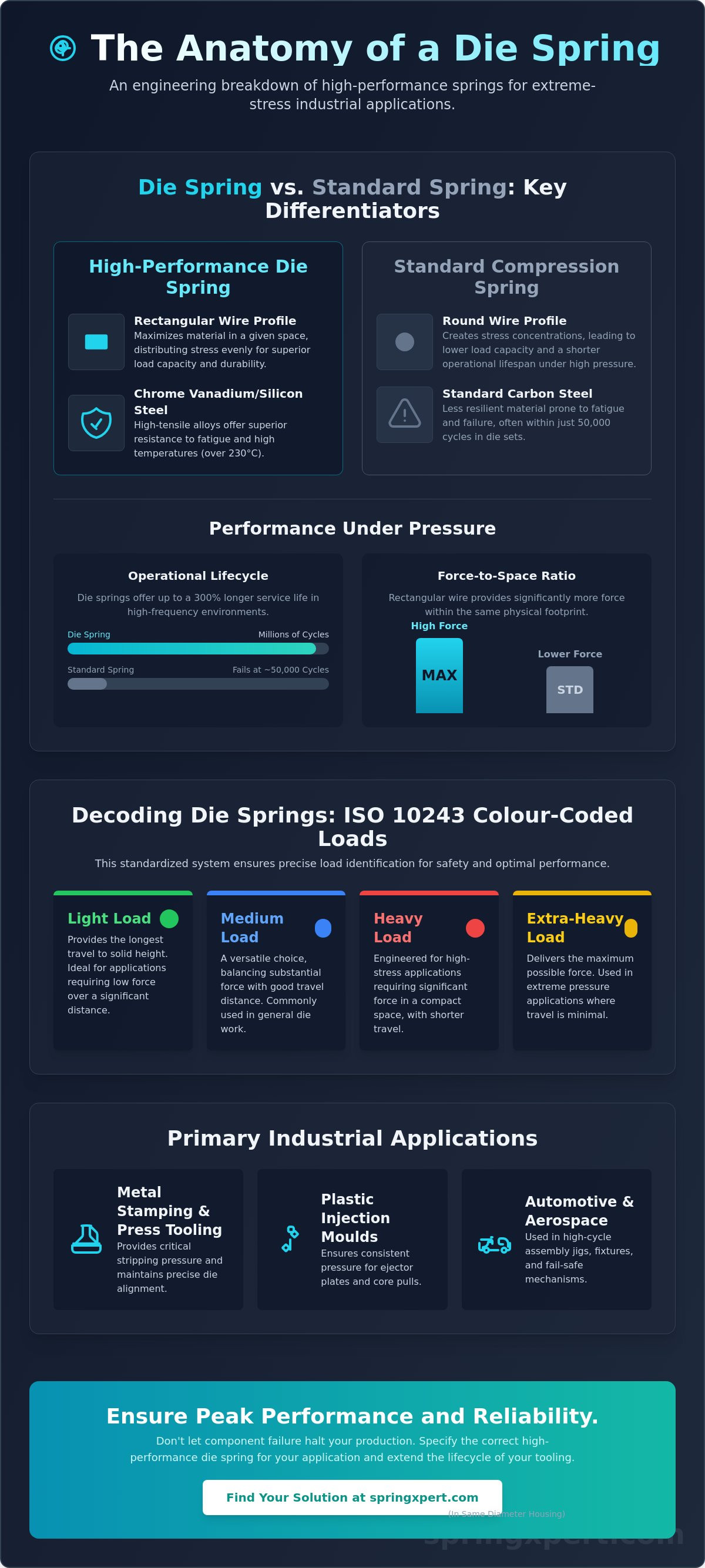
Die Springs vs. Standard Compression Springs: Key Differentiators
Selecting the wrong component for a high-pressure environment leads to rapid fatigue and catastrophic failure. While they appear similar, the engineering specifications of die springs and standard hardware are vastly different. Understanding what is a die spring used for involves recognising that these components are designed to withstand forces that would deform a common spring instantly. High-stress applications require the specialised alloys and geometry found only in die-rated products. Standard springs don't possess the structural integrity to survive the millions of cycles required in modern manufacturing environments.
Stress Distribution and Fatigue Resistance
The primary physical difference lies in the wire cross-section. Standard springs use round wire, which concentrates stress on the inner diameter during compression. Die springs utilise a rectangular wire profile to distribute internal stress more evenly across the material volume. While a standard spring might fail at 100,000 cycles in a heavy-duty press, a high-quality die spring can exceed 1,000,000 cycles. Die springs are engineered for infinite life when operated within specific parameters, such as staying within 15% to 20% of their total travel capacity.
Dimensional Stability Under Extreme Pressure
Die springs are manufactured from Chrome Vanadium alloys that resist permanent deformation. Unlike standard compression springs, they maintain their free length after millions of cycles. The rectangular wire provides a wider footprint, which prevents buckling or lateral movement during high-speed operation. Precision ground ends ensure a square seating surface for uniform load application. This squareness is critical for protecting the die set from uneven wear, misalignment, or sudden impact damage during the stroke.
The cost-benefit analysis of these components focuses on total cost of ownership rather than initial purchase price. A standard spring might cost £2, while a die spring costs £15. However, if a standard spring fails in a high-speed production line, the resulting downtime can cost a UK manufacturer upwards of £650 per hour in lost productivity and damaged tooling. Investing in die-rated hardware is a strategy for maintaining uptime and protecting expensive die sets. If your application involves high-frequency strokes or heavy loads, determining what is a die spring used for in your specific workflow is the first step toward long-term industrial reliability.
For technical assistance with your high-load requirements, consult our engineering team for a bespoke spring analysis.
Specifying the Right Die Spring for Long-Term Reliability
Selecting a component requires more than a cursory glance at a catalogue. When engineers ask what is a die spring used for, the answer often involves maintaining precise pressure within high-cycle stamping tools and heavy machinery. To ensure reliability, you must specify the hole diameter and rod diameter accurately. These dimensions prevent buckling and internal friction during rapid compression. The free length determines the total travel available before reaching solid height, which is a critical calculation for tool safety. Sourcing from a reputable UK manufacturer ensures material traceability, providing confidence that the alloy meets BS EN standards. This documentation is vital for aerospace and automotive supply chains where failure analysis is rigorous.
Environmental factors significantly influence component longevity. High-speed presses generate internal heat, while external factors like cleaning solvents or hydraulic fluids can cause hydrogen embrittlement or surface corrosion. Precise specification at the design stage prevents premature failure and protects the integrity of the entire tool assembly.
Material Selection for High-Stress Environments
Chrome silicon (CrSi) stands as the industry standard for high-performance die springs. It offers superior fatigue resistance and tensile strength compared to standard carbon steels. In harsh industrial settings, optional finishes like powder coating or galvanising protect the substrate from corrosive fluids. Operating temperatures also dictate performance. Standard die springs begin to lose load retention at temperatures exceeding 230°C. For extreme environments, specialized alloys or adjusted spring rates are necessary to compensate for thermal relaxation and ensure the tool maintains its required force.
Preventive Maintenance and Cycle Life Management
Spring fatigue usually manifests as a loss of free length or visible surface cracks. If a spring loses 5% of its original free length, it's reached the end of its functional life and requires immediate replacement. Machine stroke and frequency determine the maintenance schedule. Heavy-duty cycles often require replacement every 500,000 to 1,000,000 compressions to avoid catastrophic tool damage. Understanding what is a die spring used for in high-pressure contexts helps in setting these realistic maintenance intervals.
SpringXpert supports industrial clients with robust stock management to prevent unplanned downtime. We also provide custom engineering for bespoke solutions where standard ISO specifications don't meet specific load requirements. These custom projects involve specific engineering fees, ensuring the final product is tailored to the exact tolerances of your application.
Final Engineering Checklist:
- Confirm hole and rod clearances match manufacturer tolerances to prevent lateral deflection.
- Verify that maximum deflection doesn't exceed the recommended 25% to 40% of free length for long life.
- Check chemical compatibility of coatings with onsite lubricants and coolants.
- Review material traceability certificates to ensure compliance with UK manufacturing standards.
- Establish a replacement schedule based on the projected million-cycle count of the press.
Optimising Industrial Performance with Precision Die Springs
Selecting the correct component is critical for the durability of high-load machinery. Die springs provide the high-force output and fatigue resistance required for heavy-duty metal stamping and injection moulding. Understanding exactly what is a die spring used for ensures that your production lines maintain peak efficiency under extreme mechanical stress. Proper specification based on colour-coded load ratings prevents premature component failure and reduces downtime in demanding UK manufacturing environments.
SpringXpert supports your operations with ISO 9001 certified manufacturing processes and a comprehensive inventory. We maintain over 20,000 standard products in stock for immediate national delivery across the UK. For unique requirements, our team provides technical consultancy for bespoke material selection and precise load calculations. This data-driven approach guarantees that every spring meets your exact engineering tolerances and performance benchmarks.
Partner with SpringXpert for high-performance die springs and technical engineering support to secure the reliability of your industrial applications. We're ready to help you solve your most complex mechanical challenges through expert collaboration.
Frequently Asked Questions
Can I use a standard compression spring in a die set?
You shouldn't use a standard compression spring in a die set because they aren't engineered to withstand the high-stress cycles required in metal stamping. Standard springs are designed for lower load applications, whereas die springs provide maximum force in confined spaces. Using a standard spring often leads to premature fatigue failure within 10,000 cycles, which risks damaging expensive UK manufacturing tooling and increasing unplanned downtime.
What does the yellow colour coding mean on a die spring?
Yellow colour coding signifies an extra heavy duty load rating under the ISO 10243 international standard. These springs provide the highest force output of the four primary colour categories, which include green, blue, and red. When determining what is a die spring used for in heavy-duty stamping, yellow springs are the industry choice for applications requiring maximum resistance and minimal deflection during the press stroke.
How do I calculate the life expectancy of a die spring?
You calculate life expectancy by measuring the operating deflection against the spring's total available travel. Operating at 25% of the total travel can extend the component's lifespan to 1,000,000 cycles, while pushing to 40% reduces it to approximately 100,000 cycles. Engineers must account for these cycle counts during the tool design phase to ensure predictable maintenance intervals for high-volume UK production lines.
What is the difference between ISO and JIS die spring standards?
The primary difference lies in the dimensional specifications and load classifications. ISO 10243 is the European standard using metric dimensions and a specific colour sequence for load identification. JIS B5012 follows Japanese Industrial Standards, which feature different outside diameters and hole sizes. Most UK manufacturers standardise on ISO 10243 to ensure compatibility with global supply chains and consistent performance metrics across different suppliers.
Why are die springs made from rectangular wire instead of round wire?
Rectangular wire provides a larger surface area and more material volume within the same spatial envelope compared to round wire. This configuration allows the spring to store more energy and handle 50% more load than a round wire equivalent of the same diameter. It's a critical factor when understanding what is a die spring used for, as it enables high-force performance within the restricted dimensions of a die set.
Can die springs be used in high-temperature environments?
Standard die springs operate effectively up to 230°C, but performance degrades rapidly beyond this threshold. For high-temperature applications, you must specify alloys like Chrome Vanadium or Chrome Silicon, which maintain 95% of their tensile strength at elevated temperatures. Using standard carbon steel springs in heat-intensive environments causes a 15% loss in load capacity within the first 500 cycles, leading to tool failure.
How much pre-load should I apply to a die spring?
A minimum pre-load of 5% to 10% of the total free length is required to ensure the spring remains seated during the press stroke. Without this initial tension, the spring can shift within the pocket, leading to uneven wear and potential breakage. UK safety guidelines recommend this practice to maintain constant contact between the spring and the die plates, which significantly extends the component's operational life.
What happens if a die spring is compressed to its solid height?
Compressing a spring to its solid height creates excessive internal stress that leads to permanent deformation or "set." This reduces the free length and load capacity, making the spring useless for precision applications. In many cases, reaching solid height results in catastrophic failure where the wire snaps. This sends metal debris into the die, causing structural damage to the tool steel and expensive repair requirements.