

Bulk Compression Springs Quote: The Industrial Procurement Guide for 2026
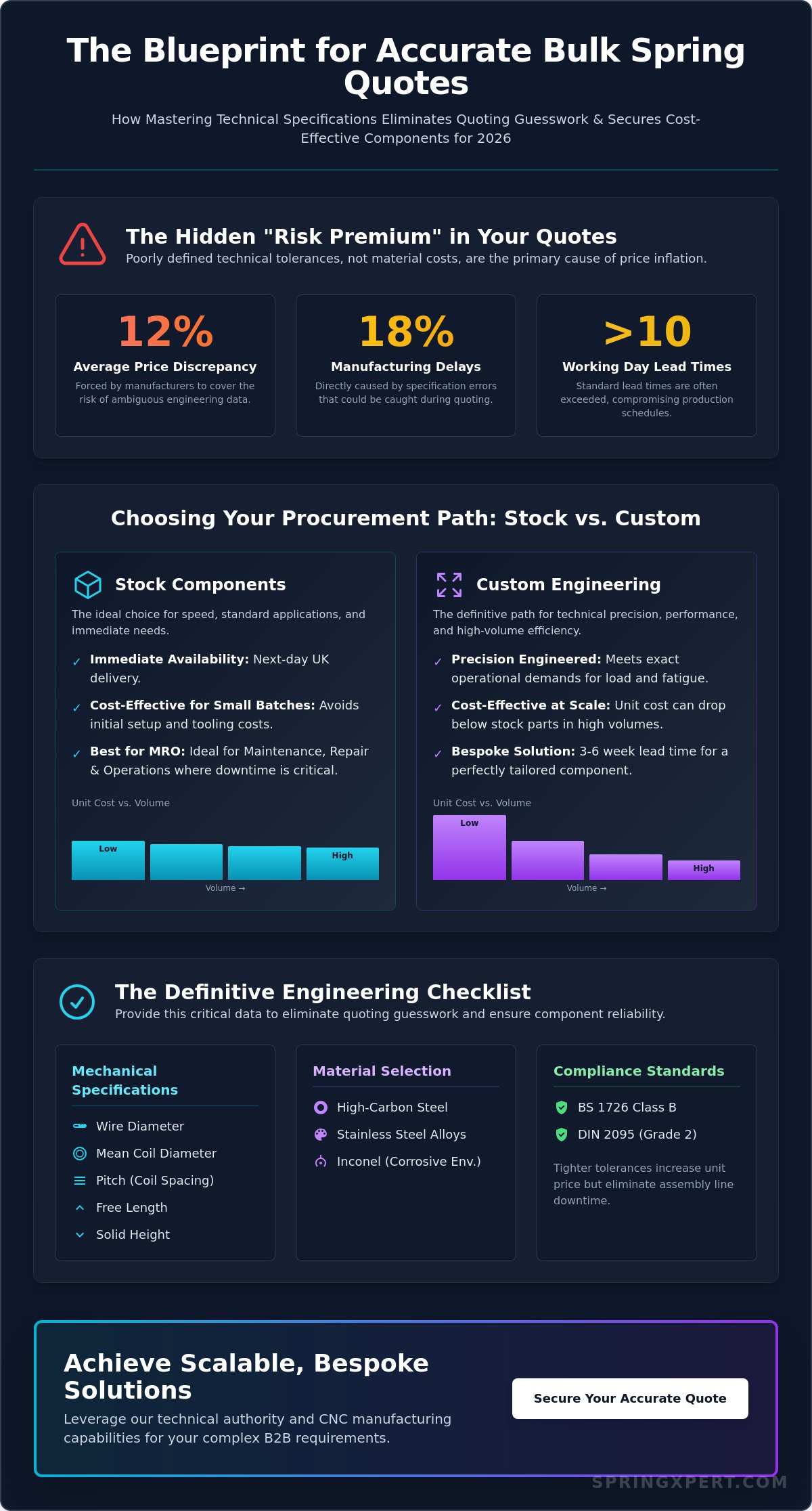
A 12% discrepancy in unit pricing across industrial suppliers often stems from poorly defined technical tolerances rather than raw material costs. When you request a bulk compression springs quote, the lack of precise engineering data usually forces manufacturers to add a risk premium to their pricing. It’s a common frustration for UK procurement teams who face inconsistent quotes and lead times that often stretch beyond the standard 10 working days. These delays compromise production schedules and inflate the total cost of ownership for precision components.
You’re likely aware that securing reliable components at scale requires more than just a high-volume order; it demands a deep understanding of load requirements and material fatigue. We promise to show you how to secure the most accurate and cost-effective bulk compression springs quote by mastering technical specifications and volume procurement strategies for 2026. This guide details the transition from stock components to bespoke solutions. It provides a roadmap for optimising unit costs while ensuring your assembly line maintains strict technical compliance with current industrial standards.
Key Takeaways
- Identify the critical technical specifications required to ensure industrial safety and long-term component reliability across UK manufacturing sectors.
- Master volume procurement strategies to secure a highly accurate bulk compression springs quote by balancing stock availability against custom-engineered performance.
- Evaluate how 2026 market trends for high-carbon steel and stainless steel alloys directly influence total procurement costs and component longevity.
- Utilise a definitive engineering checklist to eliminate quoting guesswork, prioritising essential spatial constraints such as solid height and free length.
- Discover how to leverage SpringXpert Ltd’s technical authority and CNC manufacturing capabilities to achieve scalable, bespoke solutions for complex B2B requirements.
Table of Contents
- Understanding Compression Spring Specifications for Bulk Quotes
- Stock vs. Custom: Choosing the Right Procurement Path
- Material Selection and Surface Finishes for Industrial Performance
- The Engineering Checklist: Data Required for an Accurate Quote
- Partnering with SpringXpert for Scalable Manufacturing
Understanding Compression Spring Specifications for Bulk Quotes
Compression springs are open-coil helical springs engineered to resist axial compression forces. When a load is applied to these components, the coils compress to store energy, which is then released upon unloading. Securing an accurate bulk compression springs quote is the foundation of industrial safety and component longevity. Precision at the procurement stage ensures that the final assembly operates within its intended design life, which often exceeds 1 million cycles in high-performance applications. Without technical clarity during the initial consultation, manufacturers risk delivering parts that fail prematurely under stress.
Industries such as medical device manufacturing and heavy construction machinery rely on these components for critical functions. In medical settings, springs must meet stringent precision standards to ensure the reliability of life-saving equipment. In construction, they support massive static and dynamic loads in hydraulic systems. A failure to define exact specifications during the quoting phase often leads to production delays or catastrophic component failure. Industry data suggests that 18% of manufacturing delays are caused by specification errors that could've been caught during the quote process. Precision prevents the need for costly emergency re-tooling and keeps supply chains moving efficiently.
The Mechanics of Helical Compression
The performance of compression coil springs depends on the interaction between wire diameter, mean coil diameter, and pitch. These variables dictate the spring rate, which is measured in Newtons per millimetre (N/mm). Engineers must choose between linear profiles for constant resistance or conical and hourglass shapes for variable loads and space-saving requirements. For a detailed breakdown of these mechanical principles, refer to our guide on compression springs. Accurate spring rate calculations are vital because even a 0.5mm deviation in wire diameter can significantly alter the load-bearing capacity of the batch.
Standardisation and Compliance (BS & DIN)
Manufacturing consistency in the UK is governed by rigorous standards like BS 1726 Class B and DIN 2095 (Grade 2). These frameworks establish permissible tolerances for wire diameter, free length, and load. Specifying a standard grade during a bulk compression springs quote ensures that every unit in a 10,000-piece run performs identically. While tighter tolerances increase the quoted unit price, they eliminate the risk of assembly line downtime caused by out-of-spec parts. We provide clear data on how these standards affect your unit cost, allowing for a rational decision based on your specific engineering requirements and budget constraints.
Material selection also plays a major role in the final quote. Whether you require standard carbon steel or high-performance alloys like Inconel for corrosive environments, the material choice must be fixed before the production run begins. This technical transparency ensures that the quoted price reflects the actual physical reality of the manufacturing process.
Stock vs. Custom: Choosing the Right Procurement Path
Selecting between off-the-shelf components and bespoke manufacturing is a critical decision in the procurement process. Stock springs offer immediate availability for standard applications, while custom engineering ensures that every variable, from spring rate to material fatigue, meets specific operational demands. When seeking a bulk compression springs quote, the choice often hinges on the balance between speed and technical precision.
The price gap between these two paths narrows significantly as volume increases. For small batches, stock parts are often more cost-effective because they bypass initial setup costs. However, in high-volume production, the unit cost of a custom spring can drop below that of a catalogued part. This occurs through a unit-based sales model, where fixed costs like tooling and bespoke design are spread across thousands of units. While stock items are typically available for next-day delivery across the UK, high-volume custom runs require lead times ranging from three to six weeks, depending on material availability and finishing requirements.
When to Choose Stock Components
Stock components are the primary choice for Maintenance, Repair, and Operations (MRO) where downtime costs exceed part costs. We maintain a catalogue of over 20,000 standard products designed for rapid national delivery. These parts offer proven performance and require no initial design fees or technical validation. They're ideal for rapid prototyping or applications where standard dimensions and materials, such as music wire or stainless steel 302, meet the necessary load requirements without the need for specialized alloys.
The Case for Custom Engineering
Standard parts often fail when faced with extreme temperatures, corrosive environments, or restricted installation spaces. Custom engineering allows for the selection of specific alloys and precise tolerances that stock items cannot match. Following a rigorous spring design methodology ensures that the component survives its intended lifecycle without premature fatigue or failure. This technical depth is essential for aerospace, medical, and high-performance automotive sectors.
While bespoke designs involve initial engineering fees, these are amortised over the total production run in a bulk compression springs quote. This makes custom solutions financially viable for orders exceeding 1,000 units. Our technical consultancy helps clients refine their specifications to reduce material waste and optimize manufacturing efficiency. If your project requires non-standard wire forms or specific tensile strengths, it's best to speak with a technical specialist to determine the most efficient production route for your specific application.
Material Selection and Surface Finishes for Industrial Performance
Material selection represents the most significant variable in any bulk compression springs quote, often accounting for 45% to 60% of the total unit cost. In the UK market, material specifications are governed by strict BS EN standards. By 2026, industry forecasts suggest a 4.8% increase in the adoption of high-performance alloys as engineers prioritise longer component lifecycles over initial procurement savings. This shift is driven by the need for higher reliability in automated assembly lines where downtime costs are prohibitive.
Tensile strength and fatigue requirements dictate the grade of wire required for your project. If a spring must endure 10 million cycles without failure, a high-grade valve spring wire is necessary rather than standard carbon steel. Environmental conditions like corrosive marine atmospheres or high-temperature industrial ovens necessitate specific metallurgical properties. We consult the Institute of Spring Technology to ensure our material recommendations align with the latest fatigue testing data and metallurgical standards. Choosing the wrong alloy can lead to premature stress relaxation or catastrophic failure in the field.
Common Industrial Spring Materials
- Music Wire (DIN 17223 / BS 5216): This is the industry standard for high-strength applications in non-corrosive environments. It offers the highest tensile strength and can withstand high stress levels without permanent deformation.
- Stainless Steel (302, 316): Grade 302 is the workhorse for general corrosion resistance. Grade 316 is required for medical, food-grade, or marine applications where molybdenum is needed to resist chlorides.
- Specialist Alloys: Inconel X750 is used for extreme environments where temperatures exceed 370°C. Chrome Vanadium (ASTM A231) remains the preferred choice for heavy-duty die springs in the UK automotive sector.
Value-Added Finishes and Coatings
Surface treatments extend the functional life of a component but influence the final bulk compression springs quote. Zinc plating and powder coating provide vital barriers against oxidation in construction equipment. These coatings must be applied with precision to avoid hydrogen embrittlement, a common cause of failure in high-tensile steels. We use controlled de-embrittlement baking cycles to mitigate this risk.
End grinding is a critical technical consideration for stability. Squaring and grinding the ends ensures the spring stands vertically and distributes loads evenly across the mating surfaces. This process involves additional CNC machining time, which typically increases the base cost by 12% to 18% depending on the wire diameter. For aesthetic requirements or specific industrial friction needs, chemical blacking or passivating for stainless steel provides a clean, professional finish without altering the spring's dimensional tolerances.
The Engineering Checklist: Data Required for an Accurate Quote
Precision in manufacturing begins with the technical data sheet. When you request a bulk compression springs quote, providing exhaustive specifications reduces the need for back-and-forth clarification and ensures the final component performs as intended within your assembly. We rely on these metrics to calculate material volume, machine setup time, and stress tolerances. Every millimetre matters in high-stakes industrial applications.
Dimensional Data Points
The physical envelope of the spring is defined by three primary diameters: Wire Diameter (d), Outside Diameter (OD), and Inside Diameter (ID). It's vital to specify which diameter is critical for your fitment. If the spring fits inside a bore, the OD is the priority. If it slides over a shaft, the ID takes precedence. Engineering drawings must also distinguish between total coils and active coils. Active coils are the ones that store and release energy. Total coils include the inactive end coils used for seating and stability. This distinction is the basis for all accurate spring rate calculations.
- Free Length (Lo): The overall length of the spring in an unloaded, rest state.
- Solid Height: The length of the spring when compressed until all coils are touching. This is a critical spatial constraint because the spring cannot physically compress further without damage.
- Spring Rate: The constant force required to compress the spring by one millimetre, usually expressed in N/mm.
Operational Requirements
A spring doesn't exist in a vacuum; it has a specific mechanical role. We need to know the required load at specific compressed lengths, often referred to as P1 and P2. For instance, a heavy-duty valve spring might need to exert 50N at a length of 40mm. Define the cycle life clearly. Is the application static, or will it undergo millions of cycles in a high-speed engine? High-frequency environments require premium alloys and specific surface treatments like shot-peening to prevent premature fatigue failure. If your application demands exceptionally high loads in a restricted space where a standard coil doesn't fit, disc springs serve as a robust alternative.
Manufacturing complexity also hinges on the end types and helix direction. Most industrial applications require closed and ground ends. This process involves grinding the last coil flat to ensure the spring stands square, which prevents buckling under load. While this adds a step to the production line, it's necessary for stability. The direction of the helix (right-hand or left-hand) is equally vital if you're nesting one spring inside another to prevent them from locking together. Providing these details ensures your bulk compression springs quote reflects the true cost of a high-performance component. Contact our engineering team for a technical review of your specifications.
Partnering with SpringXpert for Scalable Manufacturing
SpringXpert delivers over 20 years of engineering expertise to the UK's precision manufacturing landscape. Our "Xpert" methodology bridges the gap between manual craftsmanship and high-speed CNC multi-slide technology. This combination allows us to maintain tight tolerances across production runs exceeding 500,000 units. We manage a robust national supply chain that services high-volume industrial contracts for the energy, medical, and transport sectors. Our quality assurance protocols involve systematic production monitoring, where we verify wire diameter, coil pitch, and spring rate at defined intervals. This data-driven approach ensures that every bulk compression springs quote we provide is backed by a verifiable manufacturing capability.
We operate with a focus on metallurgical integrity and mechanical reliability. Our facility is equipped to handle a diverse range of alloys, from standard carbon steels to high-performance inconel and stainless steel grades. We don't rely on guesswork. Every production batch undergoes rigorous stress-relief heat treatment and shot peening where required to enhance fatigue life. This level of technical depth positions us as a stable partner for B2B clients who require consistent component performance across their entire inventory.
From CAD to Component
Our engineers use CAD software to validate the mechanical feasibility of your designs. We check for potential stress points and calculate the optimal wire diameter for your specific application. Before we start full-scale production, we offer a prototyping phase. This allows you to test custom wire forms in real-world conditions to verify performance metrics like load at height and solid height. We scale our operations to meet your demand; our tiered volume pricing structures mean that larger orders benefit from increased production efficiency. We don't just supply parts; we provide engineered solutions that fit your assembly line requirements exactly.
Securing Your Quote Today
Our technical collaboration process is built for industrial speed. You can submit your technical drawings or physical samples directly to our facility for a comprehensive analysis. We examine the alloy composition and spring geometry to ensure the replacement or new component exceeds the original specification. Working with a dedicated UK manufacturer eliminates the risks associated with long-distance shipping and customs delays. It's a strategic move for businesses that prioritise supply chain stability and technical accountability. Contact SpringXpert today to receive a detailed bulk compression springs quote and start a partnership with a specialist who understands the physical reality of your engineering challenges.
Securing Precision for Your 2026 Procurement Cycle
Successful industrial procurement in 2026 relies on technical accuracy and verified manufacturing standards. You've seen how precise material selection and adherence to tight tolerances prevent mechanical failure in high-cycle applications. Whether your project requires standard alloys or custom-engineered components, using a structured engineering checklist ensures your specifications align with production capabilities. This reduces lead times and eliminates costly redesigns during the manufacturing phase.
SpringXpert supports UK manufacturers with over 20 years of industrial engineering expertise. Our ISO 9001 certified quality management systems guarantee consistency across every batch. With over 20,000 standard products in stock for national delivery, we provide the scalability needed for both immediate repairs and long-term production runs. When you're ready to finalise your specifications, we'll provide a detailed bulk compression springs quote that reflects current market conditions and technical requirements.
Request a Technical Quote for Bulk Compression Springs
We're ready to help you solve your most complex engineering challenges with reliable, high-performance solutions.
Frequently Asked Questions
How long does it typically take to receive a bulk compression spring quote?
We provide a formal bulk compression spring quote within 24 to 48 hours for most standard industrial specifications. Complex engineering requests involving bespoke alloys or non-standard geometries require up to 3 business days for a full technical assessment. Our Xpert team reviews wire diameters and spring rates to ensure manufacturing feasibility before issuing the final document. This structured approach prevents errors during the high-volume production phase.
Can I get a prototype before committing to a high-volume order?
Yes, we offer a formal prototyping service to validate mechanical performance before you commit to a high-volume production run. We typically manufacture 5 to 10 sample units using the exact CNC equipment designated for the full order. This allows you to test tolerances and fatigue life in your specific application. It's a critical step that reduces risk for large-scale industrial projects across the UK.
What is the minimum order quantity (MOQ) for custom-manufactured springs?
Our standard minimum order quantity for custom-manufactured springs starts at 500 units for small-scale components. For heavy-duty industrial springs with wire diameters exceeding 10mm, the MOQ reduces to 50 units. These thresholds ensure that setup costs for our CNC coiling machines remain cost-effective for your project. We maintain flexibility for specialized aerospace or medical components where lower volumes are technically necessary.
Does SpringXpert offer tiered pricing for bulk orders?
We implement a structured tiered pricing model where unit costs decrease as order volume increases. Significant price breaks occur at the 5,000; 10,000; and 50,000 unit thresholds. This reflects the reduced impact of machine setup times and administrative overhead on larger production batches. Our Xpert advisors provide a detailed breakdown of these tiers during the initial consultation to help you optimise your procurement budget.
What technical standards do your compression springs adhere to?
All SpringXpert products comply with BS EN 13906-1:2013 standards for cylindrical helical springs. We maintain ISO 9001:2015 certification across our UK manufacturing facilities to ensure consistent quality and traceability. Every batch undergoes rigorous testing for tensile strength and dimensional accuracy. We provide full material certificates and certificates of conformity upon request to meet your specific regulatory compliance needs.
How do material price fluctuations affect my long-term supply contract?
Long-term supply contracts include a transparent raw material adjustment clause based on the London Metal Exchange or relevant steel indices. We fix manufacturing labour and overhead costs for 12 to 24 months, while material costs are reviewed quarterly. If the price of high-carbon steel or stainless steel fluctuates by more than 5%, we adjust the unit price accordingly. This ensures a stable and fair partnership for both parties.
Can you manufacture springs from a physical sample instead of a CAD drawing?
Our engineering department uses advanced 3D scanning and tactile measurement tools to reverse-engineer springs from physical samples. We accurately determine the wire gauge, mean diameter, and active coils to create a precise digital blueprint. Once the data is captured, we generate a formal CAD drawing for your approval. This process ensures the replacement component matches the performance of the original part exactly.
What are the delivery lead times for national bulk orders in 2026?
Current projections for 2026 indicate a standard lead time of 15 to 20 working days for national bulk orders within the UK. Express manufacturing options are available for urgent requirements, reducing the timeline to 7 working days for stocked wire materials. We utilise a network of UK-based logistics partners to ensure 98% of deliveries arrive on the scheduled date. This reliability is core to our industrial service model.