
Wave Springs vs Disc Springs Comparison: An Engineering Guide for 2026
The most traditional choice for heavy industrial loading might actually be the primary cause of your assembly's excessive footprint. While disc springs are the standard for high-force static applications, relying on them for every scenario often results in unnecessary axial space consumption and inconsistent performance across dynamic ranges. You understand that in the competitive UK manufacturing sector, every millimetre of housing space impacts both material costs and component weight.
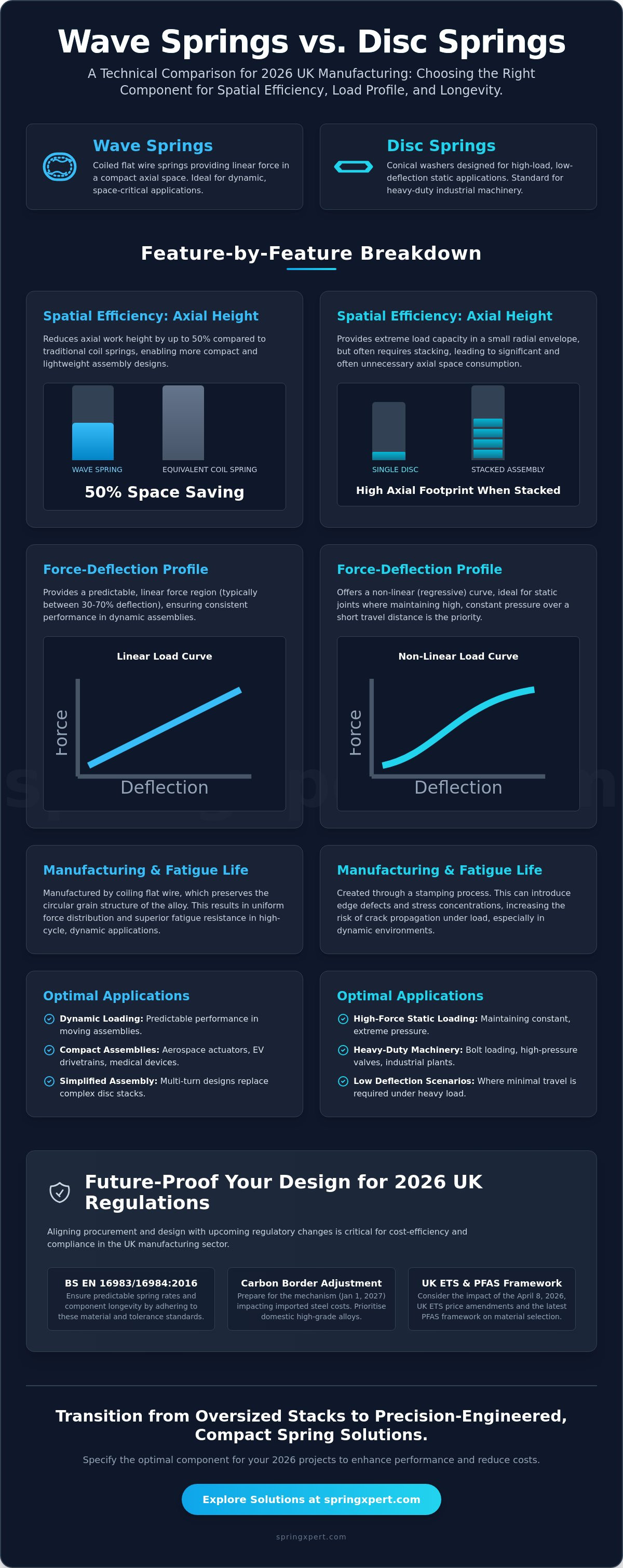
This wave springs vs disc springs comparison delivers a technical analysis of load profiles, spatial efficiency, and fatigue life to help you specify the correct component for your 2026 projects. We'll evaluate how wave springs can reduce axial requirements by up to 50% and discuss the impact of the April 8, 2026, UK ETS price amendments on domestic material selection. By aligning your design with BS EN 16983:2016 and BS EN 16984:2016 standards, you can ensure predictable spring rates and reliable component longevity in high-cycle industrial environments. This guide provides the data necessary to transition from oversized stacks to precision-engineered, compact spring solutions.
Key Takeaways
- Identify the optimal load profile for your application by comparing the non-linear curves of disc springs against the consistent linear force regions provided by wave springs.
- Utilise a technical wave springs vs disc springs comparison to determine where multi-turn designs can replace complex stacks to simplify assembly and reduce installation costs.
- Evaluate component longevity by assessing the fatigue resistance of circular grain structures in coiled flat wire versus the edge stress risks associated with stamped disc components.
- Align your procurement strategy with 2026 UK regulatory updates, including the latest PFAS framework and the upcoming Carbon Border Adjustment Mechanism for steel imports.
Wave Springs vs Disc Springs: Defining the Mechanical Trade-off
British engineering projects in 2026 demand higher power densities within smaller footprints. This requirement forces a critical decision between two distinct spring geometries. A standard Belleville washer (disc spring) provides a conical profile designed for high-load, low-deflection scenarios. Conversely, wave springs are manufactured from coiled flat wire with multiple waves per turn to provide axial force. SpringXpert Ltd identifies these components as critical fasteners in the UK industrial manufacturing chain; choosing the wrong one can lead to premature assembly failure or excessive production costs. The primary engineering dilemma involves balancing high force requirements with restricted axial work heights. This wave springs vs disc springs comparison examines the mechanical trade-offs necessary to maintain structural integrity in high-cycle environments.
The Fundamentals of Disc Spring Design
The conical geometry of a disc spring is its defining technical characteristic. This shape allows for extreme load capacity within a very small radial envelope. When a technician at a UK manufacturing facility installs these, they're typically looking for high force over a short travel distance. These components are essential for heavy-duty machinery, bolt loading, and high-pressure valves where static pressure is the priority. All specifications should adhere to BS EN 16983:2016 to ensure material quality and manufacturing tolerances. For a deeper look at the specific geometry and stacking configurations, you can refer to our Disc Springs Guide. These parts are often custom-engineered to withstand the tensile strength requirements of offshore or heavy industrial plant equipment. The stamping process used for these springs requires precision tooling to avoid edge defects that could lead to crack propagation under load.
The Mechanics of Flat Wire Wave Springs
Wave springs utilise a coiled flat wire design that effectively eliminates the "spring fingers" found in some traditional stamped washers. This construction provides a more uniform distribution of force across the radial surface. Multi-turn wave springs achieve significant deflection in spaces where a standard coil would be too tall. In modern UK precision assemblies, wave springs are increasingly replacing standard compression springs because they can reduce the work height by up to 50%. This space-saving capability allows engineers to design more compact housings without sacrificing spring rate or reliability. The manufacturing process involves coiling rather than stamping, which preserves the grain structure of the alloy and improves fatigue resistance in dynamic applications. This makes them the Xpert choice for electric vehicle drivetrains and aerospace actuators where weight reduction is a primary performance metric in the 2026 market.
Load Capacity and Force-Deflection Characteristics
Designers must evaluate the specific force-deflection behaviour of each component to ensure assembly reliability. In any wave springs vs disc springs comparison, the load curve is the most significant differentiator. Disc springs offer a non-linear curve. This is ideal for static joints where maintaining constant pressure is the priority. Wave springs, however, provide a linear force region typically between 30% and 70% of their deflection range. This consistency allows for predictable performance in moving assemblies where load accuracy is paramount. Accurate load delivery ensures that adjoining components aren't subjected to unexpected stress spikes during operation.
The influence of material thickness and alloy selection on spring rate cannot be overstated. Higher tensile strength alloys allow for thinner cross-sections without sacrificing load capacity. In the UK, the introduction of the Carbon Border Adjustment Mechanism on January 1, 2027, will impact the cost of imported steel. This makes the selection of domestic high-grade alloys a strategic choice for UK manufacturers. Precision sectors such as aerospace and medical device manufacturing demand tolerances that standard washers cannot meet. These industries require custom-engineered solutions to maintain safety and functional standards. We focus on these minute details to ensure every component performs to its specified limit.
High-Load Density: The Strength of Disc Springs
Disc springs provide exceptional load density for applications with minimal travel. Stacking these components in parallel multiplies the total load capacity, while series stacking increases the available deflection. This modular approach allows engineers to create bespoke force profiles for heavy-duty industrial fasteners. Belleville washers are particularly effective at managing high forces in compact radial spaces. Using high-tensile alloys ensures these springs resist permanent set even under extreme pressure. This capability is vital for maintaining bolt tension in high-temperature or high-vibration environments.
Load Repeatability and Predictability
For dynamic assemblies, wave springs offer superior load repeatability. The flat wire geometry minimizes the friction and hysteresis that occurs when disc springs rub against one another in a stack. This reduction in internal resistance leads to more accurate load control over the component's lifespan. Wave springs maintain 50% axial space savings while matching the load of traditional extension springs or coil springs. If your project requires high-precision force delivery, you can consult our technical team for a bespoke design review. This collaborative approach ensures that the specified spring meets the exact requirements of your UK industrial application.
Spatial Efficiency: Managing Axial Work Height
Managing the physical footprint of a spring assembly is a primary concern for design engineers seeking to optimise power density. A comprehensive wave springs vs disc springs comparison reveals that axial height is where wave springs offer the most distinct technical advantage. These components can reduce total assembly size by up to 50% when compared to traditional coil springs or complex disc stacks. This reduction is achieved by leveraging the "work height" vs "free height" ratio. While a disc spring requires a specific conical height to generate force, a wave spring utilizes its multiple waves per turn to provide equivalent axial force at a significantly lower operating height. This allows for the design of shorter housings and lighter overall components.
Radial space requirements also differ significantly between these two geometries. Disc springs often require larger outside diameters to achieve high load capacities. This can be a constraint in narrow bore applications. Wave springs, however, maintain a consistent radial footprint while adjusting load through the number of waves or turns. Bespoke design allows for the integration of these springs into existing housings without major modifications to the surrounding hardware. This flexibility is essential when retrofitting older machinery or updating precision assemblies where the external envelope is fixed. SpringXpert focuses on these spatial parameters to ensure that every custom-engineered solution fits the specific geometric constraints of the application.
Achieving Compact Assemblies in UK Industry
The drive for miniaturisation is evident across the British manufacturing landscape. In a recent 2025 project involving hydraulic valve redesigns, switching from a disc stack to a multi-turn wave spring allowed for a 35% reduction in the valve body's total length. This type of spatial efficiency is critical for safety-critical UK construction equipment where every kilogram of weight saved improves fuel efficiency and handling. Picture a senior mechanical engineer, a British man at a precision facility in Redditch, Worcestershire, using a digital micrometer to inspect a compact wave spring assembly. He ensures the dimensional stability meets the rigorous requirements of UK industrial standards, confirming that the reduced work height hasn't compromised the component's required force output.
Stacking Limitations and Geometric Constraints
Stacking disc springs to achieve greater deflection often introduces technical complications. Inter-element friction in a stack leads to unpredictable wear and hysteresis, which can degrade performance over time. Multi-turn wave springs eliminate the need for these complex stacking configurations by providing the necessary travel within a single, continuous component. This simplified architecture reduces the potential for assembly errors and ensures that tolerances are met within custom-engineered housings. By removing the friction points inherent in disc stacks, wave springs offer a more reliable and predictable service life in dynamic UK manufacturing environments. This streamlined approach to spring design supports the industry's move toward higher reliability and lower maintenance requirements in 2026.
Operational Longevity: Fatigue Life and Environmental Considerations
Component longevity is determined by the intersection of metallurgical integrity and manufacturing methodology. Coiled flat wire wave springs feature a continuous circular grain structure that significantly enhances fatigue resistance. In contrast, disc springs are produced through a stamping process. This process interrupts the metal's grain at the edges, creating potential sites for crack propagation under cyclic stress. When conducting a wave springs vs disc springs comparison for dynamic assemblies, the method of production is as vital as the material itself. Wave springs distribute the axial load more evenly across their entire radial surface, reducing the localized stress concentrations that often lead to premature failure in stamped conical washers.
Environmental conditions in UK industrial sectors demand rigorous material selection. UK manufacturers must now account for the 2026 government plan addressing Per- and polyfluoroalkyl substances (PFAS) under the UK REACH framework. This regulation affects the coatings and lubricants applied to springs used in domestic applications. Selecting the correct alloy ensures that components remain functional in corrosive or high-temperature environments without relying on restricted chemical treatments. We prioritize the physical reality of material performance to ensure that every spring meets the required service life in demanding British manufacturing environments.
Fatigue Resistance in High-Cycle Applications
The cycle life of a spring is a direct reflection of its surface finish and internal stress distribution. Disc springs are susceptible to edge burrs and micro-fractures during the stamping phase, which act as stress risers. We utilize advanced CNC coiling technology to ensure uniform stress distribution throughout the wave spring's geometry. This precision manufacturing eliminates the unpredictable wear patterns often seen in stacked disc configurations. A senior quality inspector, a British man working in a Sheffield-based metallurgy lab, might use fluorescent penetrant inspection to verify the absence of micro-fractures in a batch of high-cycle wave springs. This level of scrutiny ensures that the components can withstand millions of cycles in high-speed industrial machinery without degradation.
Material Selection and Alloy Performance
Selecting the appropriate alloy is the first step in engineering a reliable spring solution. Carbon steel is suitable for standard applications, but 17-7 PH stainless steel or Inconel is required for bespoke springs used in corrosive UK recycling or outdoor construction sectors. These materials provide the necessary tensile strength and oxidation resistance to maintain spring rates in harsh environments. Metallurgical purity directly correlates to the predictable fatigue life of industrial springs. Choosing high-grade, domestic alloys also helps mitigate the impact of the upcoming Carbon Border Adjustment Mechanism on imported steel. Request a technical consultation for your custom-engineered spring requirements. This collaborative approach ensures your material choice aligns with both performance needs and 2026 UK regulatory standards.
Specifying the Optimal Component for UK Industrial Applications
Selecting the final component for an industrial assembly requires a systematic synthesis of the technical data presented in the previous sections. Engineers must prioritize the primary mechanical requirement: extreme static load or precision dynamic deflection. This decision determines whether the assembly will maintain its structural integrity over its intended service life or fail due to improper specification. A rigorous wave springs vs disc springs comparison involves evaluating the available axial and radial envelope alongside the required fatigue life. In 2026, UK manufacturers face increased pressure to optimise these designs for both performance and regulatory compliance, particularly regarding material traceability and carbon impact.
Operational cycles provide the baseline for longevity. If a machine operates at 500 cycles per minute, the fatigue resistance of coiled flat wire becomes a non-negotiable requirement. Conversely, a high-pressure seal that remains static for 95% of its life will benefit from the high-load density of a disc spring. Consulting with our technical team early in the design phase prevents the costly redesigns that occur when a component cannot meet the physical realities of the housing. We apply our Xpert identity to every design review, ensuring that the selected spring geometry aligns with the specific tensile and yield requirements of the application.
The Decision Matrix for Mechanical Engineers
Precision is achieved by matching the spring geometry to the specific functional demand. Use the following framework to guide your selection process:
- Specify disc springs for: High-pressure valve seals, heavy-duty bolt tensioning, and static assemblies requiring extreme force in a narrow radial space.
- Specify wave springs for: Bearing preload in electric motors, aerospace actuators, and space-constrained precision valves where axial height is limited.
Technical consultancy serves as a critical safeguard against design errors. Our engineers review CAD models to ensure that tolerances and spring rates align with the environmental constraints of the application, such as the 2026 UK REACH standards for surface treatments. This level of technical oversight is essential for maintaining safety in high-pressure or high-velocity environments.
Partnering with SpringXpert for Bespoke Solutions
SpringXpert has supported the UK manufacturing sector for over 20 years, providing specialized knowledge in precision spring design. Our bespoke process leads a project from initial CAD prototyping through to bulk production, ensuring that each component meets exact industrial requirements. In a West Midlands production facility, a British senior production manager oversees the CNC coiling of a custom wave spring batch, ensuring that every turn meets the ±0.05mm tolerance specified in the brief. This meticulous attention to detail ensures your manufacturing chain remains stable. We maintain a robust inventory of high-quality standard and custom stock to mitigate supply chain disruptions. Contact our technical department to begin a collaborative design review.
Advancing Your Engineering Specifications for 2026
Engineering precision in the UK manufacturing sector requires a definitive understanding of component geometry and material fatigue. This wave springs vs disc springs comparison has detailed how wave springs can reduce axial footprints by 50% while disc springs remain the standard for high-force static loading. Selecting the correct component ensures your assembly meets the rigorous demands of 2026 industrial environments, including compliance with the latest UK REACH and Carbon Border Adjustment Mechanism frameworks. Every millimetre of saved space and every cycle of extended fatigue life contributes to the overall stability of your production output.
SpringXpert provides the technical depth needed to navigate these complex specifications. With over 20,000 standard products in stock and 20+ years of UK engineering expertise, we're positioned to support your production chain from initial CAD prototyping to bulk delivery. Our bespoke design services allow you to integrate custom-engineered solutions that fit your exact housing constraints without compromising on performance. We maintain a focus on the physical reality of our products to ensure they perform exactly as specified in your technical brief.
Consult the SpringXperts for your bespoke spring design requirements to ensure your next assembly achieves maximum reliability and spatial efficiency. We look forward to partnering with your engineering team on your next industrial project.
Frequently Asked Questions
What is the main advantage of a wave spring over a disc spring?
The primary advantage is a reduction in axial space by up to 50% compared to traditional coil or disc stacks. This spatial efficiency allows for more compact housings in precision assemblies. A wave springs vs disc springs comparison typically highlights this benefit in dynamic applications where work height is restricted. This reduction doesn't compromise the required force, making wave springs the Xpert choice for miniaturised industrial equipment.
Can wave springs handle the same high loads as Belleville washers?
Wave springs generally cannot match the extreme load capacity of disc springs within the same radial footprint. Disc springs are engineered for high-force, low-deflection static applications like bolt loading. While wave springs provide consistent force over a wider deflection range, they're better suited for moderate loads. For applications requiring forces exceeding 50kN with minimal travel, disc springs remain the technically superior option.
Why are wave springs better for bearing preload applications?
Wave springs provide a more uniform 360-degree contact and accurate load control, which is essential for bearing longevity. Their linear force-deflection curve ensures consistent preload even as components expand or wear during operation. This predictability reduces vibration and noise in electric motors. By maintaining precise pressure, they prevent the bearing skidding that often occurs with the non-linear loading of standard washers.
How does stacking disc springs affect their performance?
Stacking disc springs in parallel increases the total load capacity, while stacking them in series increases the total deflection. However, stacking introduces internal friction and hysteresis, which can cause unpredictable wear over time. This friction can lead to a 5% to 10% variance in actual load delivery. Using a single multi-turn wave spring often eliminates these issues by providing the required travel without the need for multiple components.
Are wave springs more expensive than standard disc springs?
The cost difference depends on production volume and tooling requirements. Wave springs are coiled from flat wire, eliminating the need for expensive stamping dies used for disc springs. This makes bespoke wave springs more cost-effective for small to medium production runs. While individual unit costs for standard disc springs may be lower, the total assembly savings from reduced housing sizes often favour wave spring technology in the 2026 market.
Which material is best for springs used in corrosive environments?
17-7 PH stainless steel and Inconel alloys are the most reliable choices for corrosive UK industrial environments. These materials maintain their tensile strength and spring rate when exposed to moisture or chemicals. They're particularly relevant for the UK recycling and construction sectors where components face harsh outdoor conditions. Selecting these alloys also ensures compliance with the 2026 UK government regulations regarding PFAS-free coatings and lubricants.
How do I calculate the spring rate for a bespoke wave spring?
Calculating the spring rate for a bespoke wave spring involves a complex formula considering the number of waves, material thickness, and the number of turns. Because small changes in wave count can alter the rate by over 20%, we recommend using our CAD prototyping services. This ensures that your custom-engineered spring meets the exact tolerances required for your specific industrial application. Our technical team provides these calculations as part of our collaborative design process.