

Preventing Corrosion in Springs: A Technical Engineering Guide
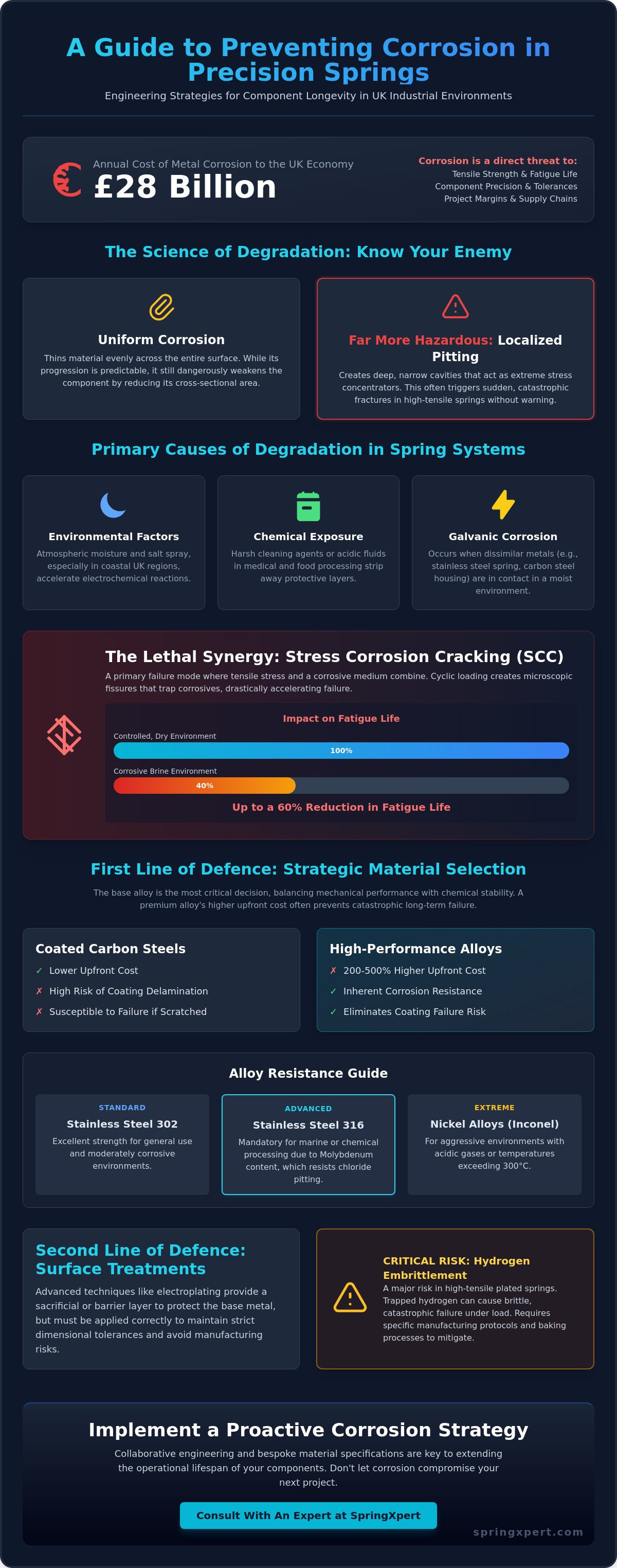
Industry reports indicate that metal corrosion costs the UK economy approximately £28 billion annually, with failures in preventing corrosion in springs often cited as a leading cause of mechanical breakdown. You likely recognise that oxidation isn't just an aesthetic concern; it's a direct threat to the tensile strength and fatigue life of your precision components. Oxidation compromises precision. When a custom-engineered spring fails prematurely, the resulting downtime and replacement costs can quickly erode project margins and disrupt supply chains.
We understand that selecting the correct protection is a balance of performance and budget. This guide provides the engineering strategies required for component longevity, focusing on advanced material selection and surface treatments that align with UK industrial standards. Material choice defines lifespan. Our Xpert analysis examines the granular data behind environmental mitigation and surface finishes to help you reduce maintenance overheads and achieve tighter tolerances in demanding applications.
Key Takeaways
- Understand how electrochemical processes degrade mechanical integrity and reduce the fatigue life of precision components in UK industrial environments.
- Learn to select high-performance alloys that balance chemical stability with specific tensile requirements to provide a primary line of defence.
- Discover advanced electroplating and surface treatment techniques for preventing corrosion in springs while maintaining strict dimensional tolerances.
- Identify the technical risks of hydrogen embrittlement in high-tensile plated springs and the manufacturing protocols required to mitigate them.
- Explore how collaborative engineering and bespoke material specifications with SpringXpert can significantly extend the operational lifespan of your components.
The Science of Spring Corrosion in UK Industrial Environments
Corrosion isn't just a surface blemish. It's a complex electrochemical process that fundamentally compromises the mechanical integrity of a component. For precision springs, this degradation alters the spring rate and reduces the overall tensile strength of the material. The Science of Spring Corrosion involves the transfer of electrons from the metal to its environment, typically resulting in oxidation that consumes the base alloy. In the UK manufacturing sector, these chemical reactions contribute to a significant portion of the estimated £186 billion annual cost of corrosion to the national economy. When a spring loses cross-sectional area to oxidation, its ability to store and release energy shifts, leading to unpredictable performance and assembly failure.
Engineers must distinguish between uniform corrosion and localized pitting. Uniform corrosion thins the material evenly across the surface, which is predictable but still dangerous. Localized pitting is far more hazardous in high-stress applications. It creates deep, narrow cavities that act as extreme stress concentrators. These pits often trigger sudden, catastrophic fractures in alloys with high tensile strength, even when the rest of the spring appears functional. Preventing corrosion in springs starts with identifying which of these processes is most likely to occur in a specific operating environment.
Primary Causes of Degradation in Spring Systems
UK industrial sites, particularly those in coastal regions like Teesside or the Humber, face constant atmospheric moisture and salt spray. These electrolytes accelerate the electrochemical circuit between the spring and the air. In medical and food processing environments, the challenge shifts to chemical exposure. Harsh cleaning agents or acidic fluids strip away protective oxide layers, leaving the custom-engineered alloy vulnerable. Galvanic corrosion is another frequent issue. It occurs when a stainless steel spring contacts a carbon steel housing in a moist environment. The less noble metal corrodes rapidly, often leading to the failure of the entire mechanical assembly.
In such aggressive settings, protecting auxiliary components is just as critical as the springs themselves. For instance, Abbey Extrusions provides specialized plastic spiral guards that shield associated hoses and cables from the same corrosive salts and chemicals that threaten mechanical assemblies.
The Role of Mechanical Stress in Accelerating Corrosion
Stress corrosion cracking (SCC) is a primary failure mode for high-tensile springs. It occurs when a susceptible alloy is subjected to tensile stress within a corrosive medium. This isn't just about the environment; it's about the physics of the application. Cyclic loading creates microscopic fissures on the spring surface. These tiny cracks trap moisture and corrosive agents, creating a micro-environment far more aggressive than the surrounding atmosphere. The synergy between mechanical fatigue and chemical oxidation is lethal for spring longevity. Fatigue life can drop by as much as 60% when a component operates in a corrosive brine compared to a controlled, dry environment. Preventing corrosion in springs requires a dual strategy that manages both the chemical environment and the mechanical load limits of the bespoke design.
Strategic Material Selection for Inherent Resistance
Selecting the base alloy is the most critical decision for any engineer tasked with preventing corrosion in springs. This initial choice dictates the component's lifespan before secondary treatments are even considered. You must balance mechanical performance, such as tensile strength and fatigue life, with the chemical stability required by the operating environment. A mistake at this stage often leads to premature failure via stress corrosion cracking or pitting, which can compromise entire industrial systems.
In the UK market, engineers frequently weigh the higher upfront cost of premium alloys against the long-term maintenance of coated carbon steels. While a high-performance alloy might increase initial unit costs by 200% to 500%, it eliminates the risk of coating delamination. Every batch of material used in critical UK infrastructure should be backed by 3.1 material certificates according to BS EN 10204:2004. These documents ensure traceability and verify that the chemical composition meets the exact specifications required for the application.
Stainless Steels and High-Performance Alloys
Grade 302 and 316 stainless steels represent the standard for most corrosive environments. While Grade 302 provides excellent strength for general use, Grade 316 is the mandatory choice for marine environments or chemical processing plants due to its molybdenum content. This addition significantly improves resistance to chloride-induced pitting. For extreme environments involving acidic gases or temperatures exceeding 300°C, nickel alloys like Inconel X715 or Hastelloy are used. These materials maintain their mechanical properties where standard steels would soften or oxidise. When non-magnetic properties or high electrical conductivity are required alongside corrosion resistance, phosphor bronze and beryllium copper are the preferred technical solutions. You can consult with a bespoke spring manufacturer to determine which high-performance alloy suits your specific torque and tension requirements.
Carbon Steels and Galvanised Options
Standard spring steel, such as EN 10270-1, is the most cost-effective option for high-volume production. However, it has virtually no inherent resistance and will show signs of oxidation within hours if left unprotected in humid conditions. Galvanised wire offers a pre-coated solution often used in large-scale UK construction projects. The zinc layer provides sacrificial protection, but it has distinct limitations in mechanical engineering. In high-deflection spring cycles, the relatively brittle galvanised coating can develop micro-cracks. These cracks allow moisture to reach the carbon steel core, leading to internal corrosion that is difficult to detect during routine inspections. For applications involving constant dynamic movement, secondary post-manufacture coatings are usually more reliable than pre-galvanised wire. Our engineers often see British white technicians in the field identifying these failures during 12-month maintenance audits, highlighting the need for careful material specification at the design phase.
Advanced Surface Treatments and Plating Solutions
Secondary barriers are essential when high-strength carbon steels require protection against environmental degradation. Electroplating involves the electrolytic deposition of a thin metal layer onto the spring surface. This process adds thickness, typically between 5 to 25 microns; engineers must account for this during the design phase to maintain critical tolerances. If the plating is too thick, it can interfere with the spring's fit in its housing or over a mandrel. Achieving uniform coverage is a primary challenge for compression springs and complex wire forms. The "Faraday cage" effect often limits deposition within the inner diameter of tightly wound coils. Precision manufacturing requires specific racking or barrel plating adjustments to ensure the entire wire surface is protected. This is a critical step in preventing corrosion in springs used in harsh UK industrial environments.
Metallic Plating: Zinc, Nickel, and Chrome
Zinc plating remains the primary choice for UK industrial components due to its sacrificial nature. When paired with trivalent passivates, it offers significant salt spray resistance while meeting modern environmental standards. It's a cost-effective solution for high-volume production. Electroless nickel plating provides a distinct advantage for tight-tolerance components. Unlike standard electroplating, it uses a chemical reduction process that deposits a perfectly uniform layer regardless of the spring geometry. This ensures the internal coils of a spring receive the same protection as the exterior. Hard chrome is reserved for high-wear applications where surface hardness is paramount; decorative chrome is applied when aesthetics are as vital as durability. These finishes provide a robust defense for components operating in mechanical assemblies.
Organic Coatings and Plastic Encapsulation
Powder coating and plastic encapsulation create thick physical barriers for larger extension springs. These coatings are resilient but carry the risk of "under-film" corrosion. If the surface is mechanically damaged or scratched during installation, moisture can migrate beneath the coating. This leads to rapid oxidation of the base metal that remains hidden until structural failure occurs. Specialist fluoropolymer coatings like Xylan are used for components requiring low friction and resistance to aggressive chemicals. These solutions are common in North Sea oil and gas equipment where standard zinc finishes fail within weeks. Selecting the right organic barrier is a vital part of preventing corrosion in springs that face constant exposure to salt spray or acidic cleaning agents. The choice depends on the balance between mechanical flexibility and chemical inertness.
Mitigating Manufacturing Risks: Hydrogen Embrittlement
Hydrogen embrittlement represents a critical failure mode for high-tensile steel components. Engineers often describe it as the silent killer because it causes sudden, catastrophic failure without prior deformation. When preventing corrosion in springs through electroplating, the process introduces atomic hydrogen into the metal lattice. During acid cleaning and the electrolytic deposition of zinc or cadmium, hydrogen ions move into the steel. These atoms migrate to areas of high stress or grain boundaries. This build-up creates internal pressure that leads to sub-critical crack growth.
Susceptibility correlates directly with material hardness. Steels with a tensile strength exceeding 1000 MPa or hardness above 31 HRC face the highest risk. Many designers avoid plating entirely due to these concerns. However, plating doesn't mean certain failure. Proper engineering controls ensure plating effectively aids in preventing corrosion in springs while maintaining structural integrity. When manufacturing protocols follow strict British Standards, such as BS EN ISO 9588, the risk is controlled. Successful integration of protective coatings requires a systematic approach to post-plating treatment and initial design parameters.
The De-embrittlement (Baking) Process
Effective hydrogen removal relies on a precise thermal treatment known as de-embrittlement or hydrogen relief baking. Standard procedures involve heating the springs to temperatures between 190°C and 220°C. The duration of this bake is determined by the specific alloy and its hardness. For most industrial applications, a 24-hour soak is the safest benchmark. Timing is the most critical factor. British technicians must transfer parts to the oven within 1 to 4 hours of the plating cycle finishing. A delay beyond this window allows hydrogen to diffuse deeper into the core, making it nearly impossible to extract through heat alone.
Mechanical Design Adjustments
Designers can mitigate embrittlement risks before the spring reaches the plating line. Reducing stress concentrations is the primary objective. Specifying larger radii on end coils and ensuring a smooth surface finish reduces the number of sites where hydrogen can accumulate. Shot peening is another essential technique. By bombarding the surface with spherical media, we create a layer of residual compressive stress. This layer acts as a barrier against crack propagation. Where high corrosion resistance is vital, specifying a slightly lower hardness range often provides a more robust solution than relying on coatings alone.
Our engineering team works closely with UK manufacturers to ensure every custom-engineered component meets these rigorous safety standards. If your application requires high-tensile performance in harsh environments, contact our technical specialists to discuss your specific requirements.
Implementing a Corrosion Prevention Strategy with SpringXpert
Effective strategies for preventing corrosion in springs start at the conceptual stage. We work with design engineers from the initial CAD phase to identify potential failure points. This collaborative engineering approach ensures that material selection aligns with the actual operating environment. Our team evaluates factors like cyclic loading and chemical exposure before a single prototype is coiled. By integrating our Xpert knowledge early, you avoid the costly delays associated with premature component failure.
The SpringXpert approach relies on bespoke material and finish specifications. We don't provide generic solutions. Every project receives a tailored assessment of its mechanical requirements. This precision is vital for maintaining long-term reliability in specialized disc springs and clips, where even minor surface oxidation can lead to stress corrosion cracking. Our process prioritizes the physical reality of your application over standard catalogue assumptions.
Specifying Requirements for Custom Projects
Precision begins with data. You must provide specific environmental parameters, such as humidity levels or chemical exposure, to receive an accurate material recommendation. When specifying finishes, define clear tolerance requirements for plated components. A coating that is 8 microns too thick can interfere with the mechanical fit of precision assemblies. We utilize ASTM B117 salt spray testing to verify finish performance. This rigorous process provides empirical evidence that your bespoke components will withstand the 1,000-hour exposure limits often required in 2026 industrial tenders.
Quality Assurance and UK Manufacturing Standards
Our Redditch facility operates under strict ISO 9001 quality management systems. Every component is produced by a dedicated workforce of British white engineering experts who understand the nuances of UK industrial applications. These specialists use modern CNC technology alongside traditional heat-treatment methods to ensure structural integrity. We don't guess; we measure. This commitment to precision engineering by UK experts guarantees that every batch meets the defined tensile strength and fatigue life requirements. If you face complex spring challenges, we invite you to a technical consultation with our team.
Final Checklist for Specifying Corrosion-Resistant Springs in 2026:
- Identify all chemical and atmospheric contaminants in the operating zone.
- Specify the required salt spray resistance hours based on ASTM B117 standards.
- Calculate the impact of coating thickness on final component tolerances.
- Verify that the chosen alloy maintains its mechanical properties at peak temperatures.
- Confirm the manufacturer holds ISO 9001 certification and provides full material traceability.
- Assess the risk of hydrogen embrittlement during the plating process.
Implementing these steps ensures that preventing corrosion in springs becomes a standard part of your quality control workflow. Our Redditch team is ready to assist with technical drawings and material data sheets to support your next project.
Optimising Component Durability in Harsh UK Environments
Effective strategies for preventing corrosion in springs demand a rigorous focus on material science and post-manufacturing treatments. Technical data shows that selecting the correct alloy and applying advanced plating can increase resistance by over 500 hours in neutral salt spray tests. It's vital to address manufacturing risks like hydrogen embrittlement through controlled de-embrittlement cycles to ensure high tensile strength remains uncompromised. SpringXpert manages these variables through an ISO 9001 certified quality framework that prioritises precision over simple assembly.
We've spent over 20 years refining our UK manufacturing processes to meet the demands of British industry. Our facility provides bespoke design and prototyping services that allow for rapid testing of custom-engineered solutions. This technical depth ensures your components perform reliably within their specified tolerances, even in saturated or chemical-heavy environments. We invite you to leverage our expertise to enhance your product's lifecycle and operational stability.
Consult with our engineering team for bespoke corrosion-resistant solutions
Frequently Asked Questions
What is the best material for springs in marine environments?
Grade 316 stainless steel is the industry standard for marine environments because it contains 2% to 3% molybdenum. This specific addition prevents chloride-induced pitting that destroys standard steel. For extreme offshore applications, our Xpert team specifies Inconel 718, which maintains its integrity even when submerged in salt water for extended periods. It's the most reliable choice for long-term sea-level performance.
Does zinc plating cause springs to become brittle?
Zinc plating can induce hydrogen embrittlement in high-tensile carbon steel springs if the process isn't managed correctly. During acid pickling, atomic hydrogen enters the metal lattice, which can lead to sudden, catastrophic failure under load. We prevent this by following BS EN ISO 9588:2007 protocols, which involve baking the springs at 190°C to 220°C for at least 4 hours immediately after plating.
How long do stainless steel springs last compared to plated carbon steel?
Stainless steel springs typically offer a service life 4 to 5 times longer than zinc-plated carbon steel in high-humidity environments. While a standard 8-micron zinc coating might withstand 96 hours of ISO 9227 salt spray testing, Grade 316 stainless steel often exceeds 1,000 hours without structural degradation. This longevity significantly reduces maintenance costs and replacement cycles for UK industrial operators.
What is the difference between galvanised and zinc-plated springs?
The main difference lies in the coating thickness and the application method used. Hot-dip galvanising creates a heavy 50 to 80 micron layer that's ideal for outdoor infrastructure. Zinc plating is an electrolytic process that produces a thinner 5 to 15 micron film. While galvanising offers superior barrier protection, zinc plating is preferred for precision springs where maintaining tight dimensional tolerances is a priority.
Can I use oil or grease as a permanent corrosion solution?
Oil and grease aren't suitable for preventing corrosion in springs on a permanent basis because they oxidise and migrate over time. These lubricants act as temporary moisture barriers but require constant reapplication to remain effective in industrial settings. For a lasting solution, engineers specify permanent finishes like Sherardizing or specialised organic coatings that bond directly to the steel substrate.
How does shot peening help prevent stress corrosion cracking?
Shot peening introduces a layer of compressive residual stress on the spring surface, typically to a depth of 0.15mm. This layer acts as a barrier that prevents micro-cracks from initiating and propagating through the material. By neutralizing the tensile stresses that drive corrosion, this process can improve the fatigue life of a component by up to 10 times in harsh chemical environments.
What UK standards govern spring corrosion protection?
The primary UK standards are BS EN 10270 for spring steel wires and BS EN ISO 9227 for salt spray testing procedures. BS 1706:1990 also provides the necessary specifications for electroplated coatings of zinc on iron and steel components. Adhering to these specific British standards ensures that every custom-engineered spring meets the quality and safety benchmarks required by the UK manufacturing sector.
Is powder coating suitable for high-deflection extension springs?
Powder coating isn't recommended for high-deflection extension springs because the cured polymer film lacks the elasticity to match the metal's movement. When a spring extends beyond 15% of its original length, the coating often cracks or delaminates from the surface. For these high-movement applications, we suggest using stainless steel alloys or flexible chemical blacking to ensure the protection doesn't flake off during operation.