

Understanding Hooke's Law Constant: An Engineer's Guide to Spring Stiffness
Last Tuesday, a senior British engineer in a West Midlands manufacturing plant discovered that a calculation error regarding spring stiffness had compromised an entire batch of custom assemblies. This problem often stems from confusion between spring rate and the hooke's law constant. While the theory is fundamental, applying it to precision components like die springs or wire forms requires a rigorous understanding of material limits and industrial variables.
You're likely aware that specifying the correct stiffness is the primary safeguard against mechanical failure in high-stress environments. This guide provides the technical clarity needed to master these principles and ensure your components perform exactly as intended. We'll examine the k-value formula, the impact of material selection on performance, and the critical threshold where linear elasticity ends. This knowledge allows for the precise specification of compression or extension springs within any complex mechanical system.
Key Takeaways
- Understand the mathematical relationship between force and displacement to accurately predict the performance of industrial mechanical components.
- Identify how physical manufacturing variables, including wire diameter and coil dimensions, define the hooke's law constant for bespoke assemblies.
- Master the calculation methods required to determine stiffness during both experimental testing and the initial design phase for compression and extension springs.
- Learn to distinguish between the limit of proportionality and the elastic limit to ensure components operate within safe mechanical boundaries.
- Gain the ability to specify the optimal stiffness for applications involving die springs or wire forms based on specific load and space requirements.
What is Hooke's Law Constant? Defining the 'k' Factor
The hooke's law constant, represented by the variable 'k', is the numerical measure of a spring's stiffness. It's a fundamental value that dictates how much a component will deflect under a specific load. In the UK industrial sector, this constant serves as the primary technical benchmark for ensuring that mechanical parts like compression springs or wire forms function correctly within their intended assemblies. Without an accurate 'k' value, predicting the behaviour of a mechanical system becomes impossible.
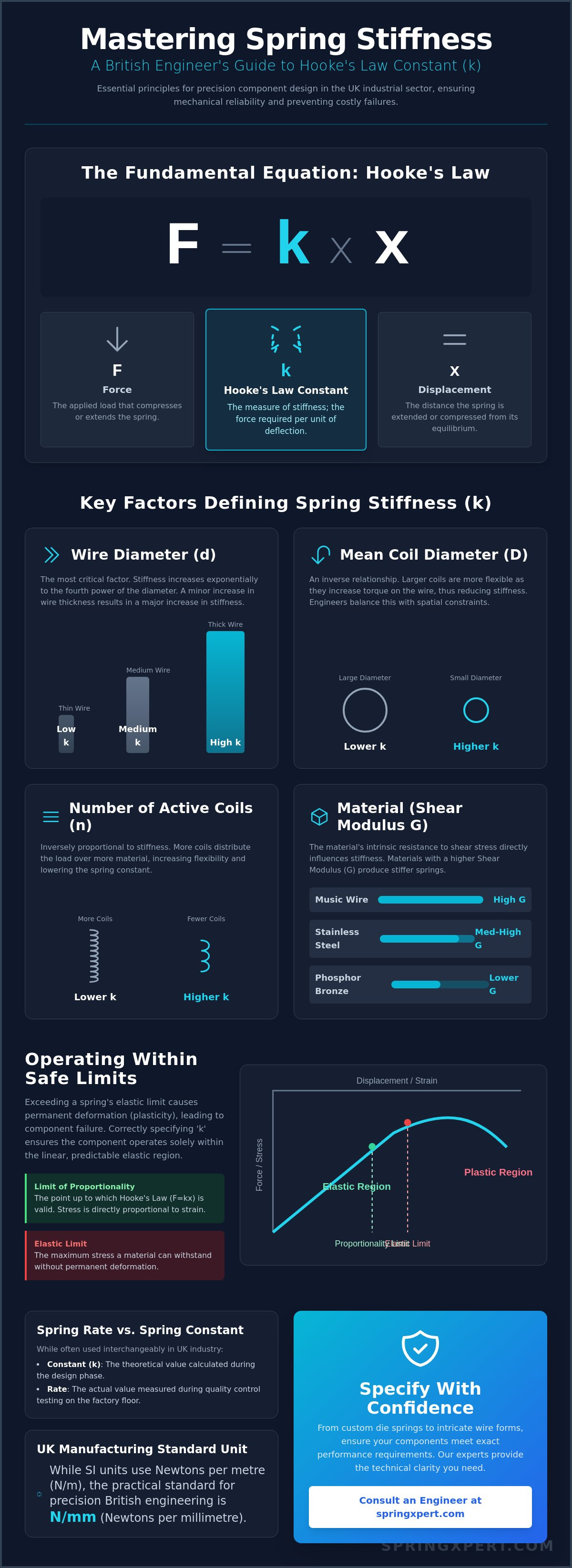
The mathematical foundation of this principle is found in Hooke's Law, which states that the force (F) needed to extend or compress a spring by some distance (x) scales linearly with that distance. The formula is expressed as F = kx. In this equation, the hooke's law constant acts as the coefficient of proportionality. This value isn't arbitrary; it's an intrinsic property of the spring's design. It depends on several physical factors, including the material's shear modulus, the wire diameter, and the number of active coils.
Precision is vital in British engineering. While SI units often use Newtons per metre, the standard for UK manufacturing is Newtons per millimetre (N/mm). This unit is far more practical for the small-scale, high-precision requirements of bespoke spring design and prototyping. It allows engineers to calculate exact load requirements for components that may only travel a few millimetres within a complex housing.
The Linear Relationship Explained
In a linear spring, the relationship between force and displacement remains steady. If you double the force, you double the extension. This predictability is why springs are used for precision timing and consistent load bearing. When the spring is compressed, it generates a restoring force. This force acts in the opposite direction of the displacement, always pushing back toward the equilibrium point. Maintaining this constant rate is essential for the reliability of industrial machinery.
Spring Rate vs. Spring Constant
Engineers across the UK frequently use "spring rate" and "spring constant" as synonyms. While they describe the same physical reality, the term "constant" often refers to the theoretical value established during the initial design phase. The "rate" is typically the value measured on the factory floor during quality control testing. This value also determines the elastic potential energy stored in the spring, which is calculated as half the constant multiplied by the square of the displacement. This energy capacity is a critical factor when specifying heavy-duty die springs or constant force springs for industrial use.
Factors Influencing the Constant in Spring Manufacturing
The hooke's law constant isn't a fixed value across all components; it's a direct result of the physical architecture and material composition of the spring. Manufacturers manipulate several specific variables to achieve the required stiffness for an industrial application. According to the law of elasticity, the shape and size of an object are as significant as the material itself when determining how it responds to applied stress.
Wire diameter has the most dramatic impact on the final stiffness. Stiffness increases to the fourth power of the wire's thickness. This means even a fractional increase in the gauge of the wire results in a significantly higher 'k' value. Conversely, the mean coil diameter has an inverse relationship with the constant. A larger coil diameter creates a longer lever arm, which increases the torque on the wire and reduces the force required for deflection. Engineers must balance these dimensions to fit within the spatial constraints of a housing while maintaining the desired performance profile.
Physical Dimensions and Geometry
Precision manufacturing requires a meticulous approach to geometry. For example, compression springs are engineered with specific coil counts to reach a target 'k' value. The relationship between the number of active coils and the spring rate is inversely proportional. More active coils provide more material to distribute the load, which increases the component's flexibility and lowers the hooke's law constant. Key geometric factors include:
- Wire Diameter: A fourth-power relationship that exponentially increases stiffness.
- Mean Coil Diameter: An inverse cube relationship where larger diameters result in lower constants.
- Active Coils: Increasing the coil count directly reduces the spring rate.
Material Properties and Elastic Modulus
Material selection establishes the baseline for the constant. The Shear Modulus (G) is the primary value used for helical springs, representing the material's resistance to twisting during compression or extension. In the UK industrial sector, music wire is a standard for high-tensile requirements, whereas 302 stainless steel is preferred for its corrosion resistance. These materials possess different elastic moduli; therefore, two springs with identical physical dimensions will exhibit different constants if they're manufactured from different alloys.
Post-coiling processes are also vital for stability. Heat treatment is applied to relieve internal stresses generated during the manufacturing process. This step ensures the constant remains consistent throughout the component's operational life. If your project requires specific performance metrics, you can consult with a specialist regarding our bespoke spring design and prototyping services to ensure the correct material is selected for your environment.
How to Calculate the Spring Constant: Formulas and Examples
Calculating the hooke's law constant is a critical step for ensuring mechanical integrity in industrial assemblies. Engineers typically approach this from two angles: experimental verification of an existing component or theoretical prediction during the design of a bespoke part. In both cases, maintaining consistent SI units is the primary safeguard against calculation errors. In British manufacturing, Newtons per millimetre (N/mm) is the standard unit of measurement, providing the necessary resolution for precision components.
Interpreting a force-extension graph is the most reliable way to identify the constant from test data. By plotting the applied force on the y-axis and the resulting displacement on the x-axis, the 'k' value is represented by the slope of the linear portion of the curve. Any deviation from a straight line indicates that the material has moved beyond its proportional limit. For a precise reading, engineers calculate the gradient (ΔF / Δx) across multiple data points within the linear range to account for minor measurement tolerances.
Rearranging the Hooke’s Law Equation
When the force and displacement are known, the basic formula (F = kx) is rearranged to k = F/x. For example, if an industrial load of 500N causes a compression of 10mm, the resulting constant is 50 N/mm. This straightforward calculation applies to most linear components, but extension springs require an additional step. These parts often feature "initial tension," which is the internal force holding the coils together. This force must be overcome before any measurable extension occurs, so the calculation must subtract the initial tension from the total force before dividing by the displacement.
The Manufacturing Formula for Helical Springs
Predicting the hooke's law constant before production requires the standard helical spring formula: k = (G * d^4) / (8 * D^3 * n). This equation allows designers to specify the exact physical dimensions needed to achieve a target stiffness. The variables include the shear modulus (G), the wire diameter (d), the mean coil diameter (D), and the number of active coils (n). The fourth power of the wire diameter exerts a dominant influence on the hooke's law constant, meaning even minor adjustments to wire thickness result in significant changes to total stiffness. Conversely, increasing the mean coil diameter or the number of active coils will reduce the constant, as these values appear in the denominator of the equation.
The Limit of Proportionality and Elastic Deformity
The hooke's law constant provides a reliable framework for mechanical design, but its application is bound by the physical limits of the material. In high-load industrial environments, engineers must identify the limit of proportionality. This is the specific stress level where the linear relationship between force and displacement ceases to be accurate. While it's often confused with the elastic limit, the limit of proportionality is reached first. Beyond this point, the material may still be elastically resilient, meaning it returns to its original shape, but the force required for further deflection doesn't follow the 'k' factor anymore.
Exceeding these thresholds leads to plastic deformation. For a precision component like a die spring or a wire form, entering the plastic zone results in a "permanent set." This effectively ruins the component's calibration. To mitigate this risk, UK industrial standards generally dictate that springs should be designed to operate within 80% of their maximum available travel. This safety margin accounts for manufacturing tolerances and unexpected load spikes, ensuring the spring never approaches its physical breaking point.
When Hooke’s Law Fails
Carbon steels and high-tensile alloys exhibit a distinct "knee" on the stress-strain curve. This visual marker represents the transition from elastic to plastic behaviour. Once a spring is pushed into this region, the metal's internal crystalline structure shifts permanently. The hooke's law constant becomes irrelevant because the material's response to force is no longer predictable. This failure often manifests as a loss of free length, where a compression spring becomes shorter after being fully loaded.
Designing for Longevity and Reliability
Stability is the hallmark of professional engineering. A spring must maintain its rate over millions of cycles without drifting. Fatigue is the primary enemy of a constant spring rate, as repetitive stress can cause micro-fractures that eventually lower the component's stiffness. Specifying materials with high fatigue resistance and ensuring the operating range stays well within the linear zone allows manufacturers to guarantee long-term reliability. If you're unsure about the stress limits of your assembly, our team provides bespoke spring design and prototyping to verify performance before full-scale production. This collaborative approach ensures your specifications align with the physical realities of the UK's most demanding industrial sectors.
Specifying the Ideal Constant for Your Application
Determining the correct hooke's law constant for a specific assembly requires a precise balance between spatial limitations and mechanical requirements. Space constraints often dictate the maximum outer diameter and solid height of a component. These physical boundaries directly limit the range of available stiffness options. An engineer must calculate the minimum force required at the start of the stroke and the maximum load at the end. The difference between these two points, divided by the total travel distance, defines the necessary spring rate for the application.
Balancing high load requirements with a long range of motion is a common challenge in industrial design. If an assembly has limited space but requires significant force, a high hooke's law constant is necessary. This often involves using thicker wire diameters or exotic alloys like chrome silicon. Conversely, applications requiring a long, consistent stroke benefit from a lower constant, which is achieved by increasing the number of active coils or the mean coil diameter. SpringXpert Ltd’s technical team works alongside British engineers to ensure these variables are optimised for durability and performance.
Bespoke Engineering vs. Standard Stock
Standard catalogued springs are suitable for general prototyping where tolerances are broader. However, specialised medical devices or high-torque construction tools often demand a non-standard stiffness that stock items cannot provide. Designing a custom constant allows for the integration of unique geometries, such as conical springs or wave spring washers, into tight mechanical envelopes. At our Redditch facility, SpringXpert Ltd maintains strict quality control over every batch. This ensures that the stiffness of each bespoke component remains consistent with the initial design specifications, providing reliability for critical UK industrial sectors.
Collaborating with SpringXpert Ltd
Our technical consultancy service helps you calculate the optimal constant for your specific load and environment. We utilise CAD and advanced simulation software to verify how a component will behave under stress before manufacturing begins. This process identifies potential issues like buckling or material fatigue early in the design cycle. Prototyping then allows for the physical validation of the spring rate in a real-world setting. This structured approach moves a project from a theoretical k-value to a high-performance reality. We invite you to partner with the specialist engineers at SpringXpert Ltd to develop the precise components required for your next mechanical project.
Optimising Mechanical Performance Through Precision Engineering
Mastering the hooke's law constant ensures that every mechanical assembly operates with predictable force and long-term stability. This guide has detailed how physical dimensions and material properties define stiffness and why staying within the limit of proportionality is vital for avoiding permanent deformation. Precision in these calculations remains a practical requirement for the integrity of British industrial systems, from heavy-duty construction tools to delicate medical instruments.
Our facility maintains over 20,000 standard products in stock to meet immediate requirements across the UK. For specialized applications that demand unique performance profiles, our ISO 9001 certified manufacturing site provides bespoke design and prototyping services. This rigorous approach allows you to verify performance metrics and material suitability before committing to full-scale production batches. Every component we produce is a result of meticulous technical collaboration and master craftsmanship.
Consult with our engineers to specify your custom spring constant and ensure your next project meets the highest standards of industrial reliability. We look forward to supporting your engineering requirements with components that deliver consistent, high-performance results over millions of cycles.
Frequently Asked Questions
What is the difference between a high and low Hooke's Law constant?
A high hooke's law constant indicates a stiffer spring that requires more force to achieve a specific displacement. Conversely, a low constant signifies a more flexible component that extends or compresses easily under minor loads. This distinction is critical when selecting between heavy-duty die springs for industrial tooling and lighter wire forms for precision electronics. The chosen value must align with the mechanical resistance required by the system's design.
Can the spring constant change over time with heavy use?
The constant itself is theoretically fixed, but the effective spring rate can degrade over time due to material fatigue or creep. Repetitive cycling near the limit of proportionality causes micro-structural changes in the alloy. This eventually leads to a loss of free length and a reduction in the load-bearing capacity. Regular inspection of industrial components like compression springs ensures they still meet the original performance specifications after extended service.
Does the temperature of the environment affect the Hooke's Law constant?
Temperature fluctuations directly impact the hooke's law constant by altering the material's shear modulus. As temperatures increase, most metals become more ductile, which effectively lowers the spring's stiffness. For applications in extreme environments, such as aerospace or high-heat manufacturing, engineers must specify alloys with high thermal stability. This ensures the 'k' factor remains within tolerance across the entire operating range.
How do I measure the spring constant without professional laboratory equipment?
You can measure the constant by applying a series of known weights to a spring and recording the resulting extension with a precision calliper. By dividing the applied force in Newtons by the displacement in millimetres, you determine the rate. For accuracy, take at least three separate readings and calculate the average. This method provides a reliable field estimate for standard extension or compression springs when laboratory testing equipment is unavailable.
Why is the spring constant negative in some physics textbooks?
The negative sign in textbooks represents the restoring force, indicating that the force exerted by the spring is in the opposite direction of the displacement. If you pull an extension spring, the restoring force pulls back toward the equilibrium point. In industrial manufacturing, engineers usually ignore the negative sign. They focus on the scalar magnitude of the constant to determine load-bearing capabilities and material stress levels.
Is Hooke's Law applicable to all types of industrial springs?
Hooke's Law only applies to springs with a linear force-extension relationship within their elastic range. While it's accurate for most helical compression and extension springs, it doesn't apply to constant force springs or certain conical designs. These non-linear components are engineered to provide a steady force regardless of the extension distance. This requires different mathematical models for performance prediction and specification.
What happens if I use a spring with a constant that is too low for my application?
Using a spring with an insufficient constant leads to bottoming out, where the coils touch before the required load is supported. This results in a sudden, infinite increase in stiffness and can cause mechanical shock or structural failure within the assembly. It also prevents the system from achieving its intended range of motion. This often leads to the premature failure of adjacent components like clips or washers.
How does the material choice specifically alter the k-value in manufacturing?
Material choice alters the 'k' value through the inherent shear modulus of the alloy. For example, carbon steel typically has a higher modulus than stainless steel; therefore, a carbon steel spring will be stiffer than an identical stainless steel version. This material property is a fundamental variable in the manufacturing formula. It allows designers to fine-tune stiffness without changing the physical dimensions of the component.