

Spring Design Mistakes to Avoid: An Engineer’s Guide to Industrial Reliability
A theoretical CAD model that fails to account for material fatigue or manufacturing tolerances isn't a design; it's a liability. In the UK industrial sector, precision is the difference between a reliable assembly and a catastrophic component failure. Identifying common spring design mistakes to avoid is essential for maintaining structural integrity, especially as nickel and other alloy prices show volatility up to 12% in early 2026. You likely understand the frustration of a prototype that looks perfect on a screen but fails under real world stress or doesn't fit the physical mating parts during assembly.
We agree that engineering efficiency shouldn't come at the cost of component reliability. This article provides a technical roadmap to rectify frequent oversights in spring specification, from improper material selection to ignoring the latest ISO 965-1:2026 screw thread tolerances. By refining these variables, you'll learn to optimize manufacturing costs and ensure your Compression Springs or Torsion Springs meet exact performance standards. We'll look at how integrating CAD with advanced finite element analysis can bridge the gap between design theory and the physical reality of the factory floor.
Key Takeaways
- Precision in initial specifications reduces the total cost of ownership by preventing component failure within complex mechanical systems.
- You'll learn to select application-specific alloys that resist environmental stressors, ensuring long-term durability beyond the capabilities of standard steel grades.
- Identify critical spring design mistakes to avoid, such as specifying tight tolerances that inflate manufacturing costs without providing functional benefits.
- Discover how to align theoretical CAD models with physical housing constraints and UK assembly line requirements for seamless component integration.
- Transition from standard stock to Bespoke Spring Design and Prototyping to meet the rigorous demands of high-performance industrial applications.
The Cost of Inaccuracy: Why Spring Design Mistakes Compromise Industrial Systems
In the UK manufacturing sector, the correlation between design precision and the total cost of ownership is direct and measurable. A spring isn't merely a commodity; it's a precision-engineered component that governs the performance of a larger system. When engineers fail to respect the Fundamentals of Spring Mechanics, the resulting inaccuracies manifest as systemic liabilities. Identifying the specific spring design mistakes to avoid is critical for engineers who must bridge the gap between a digital CAD environment and the physical realities of the factory floor.
The role of the British engineer involves more than just selecting a part from a catalogue. It requires a deep understanding of how a component interacts with its environment. In the medical sector, a spring failure can compromise life-critical equipment. In construction and heavy recycling, mechanical failure often leads to significant operational downtime and safety hazards. These sectors rely on components that can withstand high-stress cycles without deviating from their specified performance parameters. Minor specification errors, such as incorrect pitch or inadequate end-grinding, often lead to catastrophic failure in complex mechanical assemblies.
The Financial Impact of Production Recalls
The ripple effect of a single faulty batch of compression springs is often underestimated. A recall involves significant administrative costs, logistical challenges, and the potential for legal action. Technical collaboration at the initial design stage reduces these risks by ensuring that tooling and prototyping expenses are allocated efficiently. Choosing Bespoke Spring Design and Prototyping over off-the-shelf solutions provides a clear financial advantage. It ensures that the component is tailored to the exact load requirements of the application, preventing the "trial and error" approach that drains engineering budgets.
Structural Integrity and User Safety
Maintaining structural integrity across high-volume production runs is a hallmark of industrial reliability. UK safety regulations impose rigorous design protocols to ensure that mechanical systems don't pose a risk to users. A master technician approaches risk mitigation by scrutinising every variable, from material grain structure to surface finishes. By addressing spring design mistakes to avoid during the conceptual phase, manufacturers protect their workforce and their clients. This commitment to precision ensures that every component, whether it's a heavy-duty clamp or a precision washer, performs predictably under load.
Material Selection Errors: Navigating Environmental and Mechanical Stressors
Selecting the wrong alloy is one of the most frequent spring design mistakes to avoid. Engineers often default to standard carbon steel without accounting for the specific chemical or mechanical stressors of the application. At a molecular level, an inappropriate material choice leads to stress relaxation. This occurs when the spring loses its functional height or load capacity over time under a constant stress. In high-load industrial systems, this loss of force compromises the entire assembly's reliability. Failing to address these spring design mistakes to avoid during the alloy selection stage often results in premature component fatigue.
While exotic materials like Inconel or Elgiloy offer high resistance, over-specifying is a costly error. The most expensive material isn't always the optimal choice for a standard UK indoor facility. Precision engineering requires a balance between the material's elastic limit and the operating environment's demands. Referencing common design errors based on DIN 2095 demonstrates the necessity of aligning material choice with specific heat treatment protocols to ensure predictable performance. A British master technician knows that the inherent weight of engineering facts must guide the selection process, rather than a preference for the most expensive alloy available.
Corrosion and Environmental Degradation
The UK's industrial landscape varies from controlled indoor environments to harsh offshore conditions. Materials must be selected based on their specific resistance to oxidation and chemical exposure. For high-load applications, the role of specialised coatings and finishes is vital in extending the service life of die springs. Pitfalls often occur in food-grade or medical applications where material compatibility is strictly regulated to prevent contamination. Consulting with a specialist for Bespoke Spring Design and Prototyping ensures these environmental factors are addressed during the initial specification phase.
Temperature and Conductivity Considerations
Thermal fluctuations significantly alter the mechanical properties of high-carbon wire. As temperatures rise, the shear modulus of the material decreases, leading to a drop in the spring rate. Conversely, cryogenic environments can make standard steels brittle and prone to sudden fracture. Engineers must also consider electrical conductivity in specific electronic assemblies without sacrificing structural resilience. Verifying material certifications from UK suppliers is a mandatory step to ensure that the chemical composition matches the design requirements and safety standards. This systematic approach guarantees that every component, from wire forms to heavy-duty clamps, maintains its integrity throughout its intended lifecycle.
Dimensional and Mathematical Oversights: Tolerances, Rates, and Radii
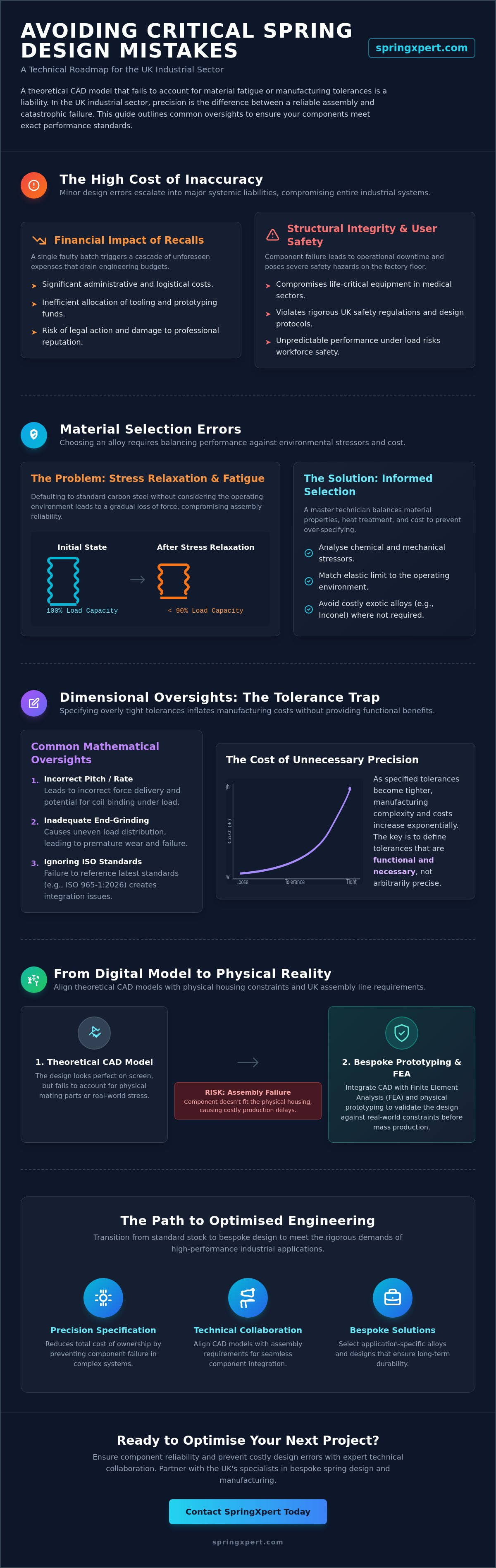
Theoretical models often fail to translate into functional components when engineers overlook the physical limitations of manufacturing. The "Tight Tolerance" trap is a frequent example. Specifying tolerances that are unnecessarily restrictive increases production costs and lead times without improving industrial reliability. In many cases, these rigid specifications exceed the capabilities of standard coiling machinery. This results in higher scrap rates and complex quality control procedures. Understanding the balance between functional necessity and manufacturing feasibility is a core component of identifying spring design mistakes to avoid.
Mathematical precision on a CAD screen does not always account for the variances inherent in raw material batches. Differences in wire diameter or tensile strength directly impact the final performance of the component. When these variables are ignored, the actual spring rate deviates from the calculated value. This deviation often leads to common causes of spring failure, such as early fatigue or inability to meet load requirements. A master technician ensures that dimensional specifications include a realistic range that accommodates these physical realities while maintaining the assembly's integrity.
Applying Hooke’s Law to Real-World Scenarios
While Hooke's Law suggests a perfectly linear relationship between force and displacement, real-world applications introduce non-linear variables. As a spring approaches its solid height, the coils begin to touch, causing the spring rate to rise sharply and potentially damaging the component. Designers must clearly distinguish between active coils, which contribute to the spring's elasticity, and total coils, which include the inactive end coils. Spring rate is defined as the constant $k$, representing the force required to compress or extend a spring by a unit of distance, calculated using the shear modulus $G$ of the material. Failing to account for these nuances leads to components that bottom out prematurely or fail to provide the required resistance.
Geometric Pitfalls in Custom Wire Forms
Complex 3D Wire Forms present unique challenges regarding material springback and bend radii. If the internal bend radius is too small, typically less than the wire diameter, the material undergoes excessive stress. This leads to micro-cracking and material tearing at a molecular level, significantly reducing the service life of the part. Predicting springback is essential to ensure that the finished part fits within the restricted assembly envelope of the mating industrial parts. Variations in wire diameter can also alter the final load performance, making it necessary to verify clearances for all moving components during the initial design phase. This proactive approach prevents costly redesigns and ensures seamless integration on the production line.
Operational and Assembly Failures: Mating Parts and Concept Proving
A British engineer reviewing a production line in the Midlands might find that a perfectly coiled spring fails because it snags on a mating shaft. Designing a component in isolation is a significant risk to industrial reliability. Even a mathematically perfect spring becomes a liability if it doesn't integrate with its housing or mating parts. For instance, compression springs increase in diameter when compressed; failing to account for this expansion within a tight bore is one of the most common spring design mistakes to avoid. Similarly, engineers often prioritise static load calculations while overlooking dynamic requirements. A spring that meets its load at a single point might fail prematurely when subjected to the high-frequency cycles typical of UK automotive or medical production lines. Dynamic stress limits are often lower than static ones, and neglecting this distinction leads to premature fatigue.
High-volume shipments of small components often face the risk of tangling. When springs arrive in a "nested" state, they require manual separation. This increases labour costs and risks deforming the wire during the untangling process. Addressing these operational hurdles during the design phase ensures that the final product is as practical to handle as it is technically sound. It's essential to consider the physical reality of the factory floor where parts must be sorted and installed quickly by assembly staff.
A Protocol for Concept Proving
A structured validation process prevents costly production recalls. Following a master technician's protocol ensures that every variable is accounted for before mass production.
- Step 1: Rapid prototyping and low-volume testing of extension springs or other critical variants to verify initial calculations in a physical environment.
- Step 2: Stress testing under simulated operational environments to monitor fatigue levels and identify potential stress relaxation.
- Step 3: Verification of dimensions using precision metrology to ensure the physical part matches the CAD model within specified tolerances.
Designing for Efficient Assembly
Labour costs represent a substantial portion of the total cost of ownership in UK manufacturing. Optimising spring end types for automated insertion is a direct way to improve production efficiency. For example, using squared and ground ends rather than open ends can prevent snagging on automated assembly lines. Collaborating with British manufacturing staff early in the process helps identify potential bottlenecks that a CAD simulation might miss. Avoiding "nested" springs through intelligent packaging or slight design tweaks, such as changing the pitch, keeps assembly lines moving without interruption. To ensure your designs are production-ready, consider our Bespoke Spring Design and Prototyping services for technical collaboration.
Optimising the Engineering Workflow: Bespoke Solutions and Technical Collaboration
Efficiency in industrial manufacturing is achieved when theoretical design aligns perfectly with production capabilities. Involving the manufacturer at the initial CAD stage is the most effective way to eliminate spring design mistakes to avoid. Early collaboration allows for the identification of potential manufacturing bottlenecks before they become costly liabilities. While modern software provides a baseline for simulation, it doesn't replace the nuanced understanding of a master technician who has managed thousands of production cycles. Integrating this expertise early ensures that every specification, from wire diameter to end-grinding, is optimised for the physical reality of the factory floor.
Transitioning from standard stock components to bespoke engineering is often necessary for high-performance industrial needs. A standard part might suffice for a basic assembly, but complex mechanical systems in the medical or construction sectors require precise load characteristics. We leverage a baseline of over 20,000 standard products, including Compression Springs and Torsion Springs, to facilitate rapid custom modification. This approach combines the speed of off-the-shelf sourcing with the precision of custom engineering. It allows engineers to refine their designs without starting from zero, which reduces both development time and prototyping costs.
The Role of Technical Consultancy
Automated design software often fails to account for the physical reality of material springback or the chemical variations in specific alloy batches. A master technician’s review provides a superior level of scrutiny, ensuring that the selected material and geometry meet the application's demands. This process includes rigorous quality control and material tracking to maintain long-term stability. Whether you are customising Wire Forms or pressed metal products, professional consultancy ensures that the final component adheres to strict UK industrial requirements. It’s this technical depth that separates a standard supplier from an active engineering partner.
Partnering for Precision
SpringXpert’s 20 years of expertise provides a stable foundation for complex B2B requirements. We facilitate a seamless transition from the initial prototype to high-volume bulk production, maintaining consistency across every batch. Maintaining a UK-based supply chain is essential for industrial reliability, as it reduces lead times and simplifies logistics. Our master technicians work directly with your team to ensure that every part, from Disc Springs to specialised hose clamps, integrates perfectly with your mating assemblies. To ensure your components meet the highest standards of durability and performance, consult with SpringXpert’s engineering team to audit your spring designs.
Securing Industrial Reliability through Precise Engineering
Achieving long-term durability in mechanical systems requires a shift from theoretical modeling to manufacturing reality. You've seen how identifying critical spring design mistakes to avoid, such as overlooking dynamic load requirements or miscalculating bend radii, protects your assembly from premature fatigue. Precision isn't an optional luxury in the UK industrial sector; it's the foundation of operational stability. By aligning your specifications with physical manufacturing limits, you reduce the risk of costly recalls and assembly bottlenecks.
SpringXpert supports your engineering workflow with over 20 years of UK engineering expertise and an extensive range of 20,000+ standard products. Our team understands that every millimetre of pitch and every degree of end-grind impacts the final performance of your Compression Springs or Torsion Springs. Whether you require a standard component or specialist bespoke design and prototyping services, our master technicians provide the technical depth needed for complex B2B requirements. Partner with SpringXpert for technical design audits and bespoke manufacturing to ensure your components perform reliably under load. We look forward to advancing your next industrial project with precision and stability.
Frequently Asked Questions
What is the most common material mistake in spring design?
The most common material mistake is the selection of general-purpose alloys for applications with specific environmental stressors. Engineers often overlook the chemical requirements of corrosive or high-temperature settings. This oversight causes the material to reach its elastic limit prematurely, leading to a loss of functional height. Addressing these spring design mistakes to avoid during the alloy specification phase ensures that the component maintains its structural integrity under constant load.
How does springback affect the manufacturing of custom wire forms?
Springback refers to the elastic recovery of the material after the forming force is removed during production. In custom Wire Forms, this geometric shift can cause the final part to deviate from the intended CAD dimensions. Manufacturers must over-bend the material to compensate for this reaction, which varies based on the alloy's tensile strength. Failing to predict springback results in components that don't fit within the restricted assembly envelope.
Why is it important to involve a manufacturer during the CAD phase?
Involving a manufacturer during the CAD phase ensures that the theoretical design is compatible with physical production capabilities. Master technicians identify potential bottlenecks, such as unrealistic tolerances or geometric configurations that lead to material tearing. This early collaboration reduces the need for costly redesigns and ensures that the component can be manufactured efficiently. It bridges the gap between digital modelling and the practical constraints of the factory floor.
Can I use a standard compression spring for high-load die applications?
Standard compression springs are generally unsuitable for high-load die applications because they lack the required fatigue resistance. Die Springs are specifically engineered with rectangular wire cross-sections to handle higher stress levels within a smaller footprint. Using a standard spring in these environments often leads to rapid failure and operational downtime. It's essential to select components designed for the specific load cycles of heavy industrial machinery.
What are the risks of specifying tolerances that are too tight?
Specifying tolerances that exceed functional requirements significantly increases manufacturing costs and scrap rates. These restrictive dimensions often surpass the capabilities of standard coiling machinery, requiring complex secondary operations. This "Tight Tolerance" trap is among the common spring design mistakes to avoid, as it inflates the total cost of ownership without providing a measurable benefit. Engineers should define realistic ranges that accommodate material variances while maintaining industrial reliability.
How do I calculate the fatigue life of a custom extension spring?
Fatigue life is determined by analysing the stress fluctuations between the minimum and maximum operating loads. Engineers use the material's S-N curve to predict the number of cycles the component can withstand before failure. Factors such as surface finish, wire diameter, and environmental conditions also influence this calculation. Verifying these variables through stress testing ensures that Extension Springs meet the long-term durability requirements of the specific application.
What is the difference between active and total coils in spring design?
Active coils are the coils that deflect under load to provide the spring's elastic force. Total coils include these active coils plus the inactive end coils used for seating and structural stability. In Compression Springs, the number of active coils directly dictates the spring rate. Miscalculating this distinction leads to components that either bottom out prematurely or fail to provide the calculated resistance during operation.
How can I prevent my springs from tangling during assembly?
Preventing tangling involves modifying the spring's geometry or utilising specialised packaging methods. Reducing the pitch or specifying closed ends can decrease the likelihood of components nesting together during transit. For high-volume assembly, individual bagging or the use of specialised trays ensures that parts remain separated. These adjustments reduce manual labour costs and prevent the deformation of the wire during the untangling process on the production line.