

Lead Time for Bespoke Springs: An Industrial Procurement Guide for 2026
Relying on a vague delivery estimate for precision components is no longer a viable procurement strategy for the modern UK factory floor. You've likely experienced the cost of a stalled assembly line when a batch of compression springs or wire forms fails to arrive, leaving your British engineering team in a difficult position. With UK steel prices projected to exceed €1,000 per tonne and new 50% import tariffs scheduled for July 1, 2026, accurately calculating the lead time for bespoke springs is essential for maintaining operational stability. Professional procurement requires more than just a quote; it demands a technical understanding of the manufacturing timeline.
We agree that engineering precision must apply to delivery schedules just as strictly as it does to wire diameters or load tolerances. This article provides the data necessary to master these variables, ensuring your production remains on track despite a tightening regulatory environment. We'll examine how material availability, the updated ISO 9001:2026 standards, and specific finishing requirements like powder coating dictate your final delivery date. By the end of this guide, you'll have the technical insight to streamline your RFQ process and secure a predictable supply chain with your UK manufacturing partner.
Key Takeaways
- Distinguish between pure manufacturing time and the total procurement cycle to establish accurate arrival dates for your UK production facility.
- Identify how specific material selections, ranging from standard carbon steel to exotic alloys, directly influence the lead time for bespoke springs.
- Analyse the impact of geometric complexity on production schedules, specifically comparing standard coils with intricate wire forms and extension springs.
- Implement strategic RFQ protocols, such as providing production-ready CAD files, to reduce administrative delays and accelerate the design approval phase.
- Master the transition from rapid prototyping to full-scale batch production to ensure technical specifications are met before committing to high-volume manufacturing.
Understanding Lead Time for Bespoke Springs in UK Manufacturing
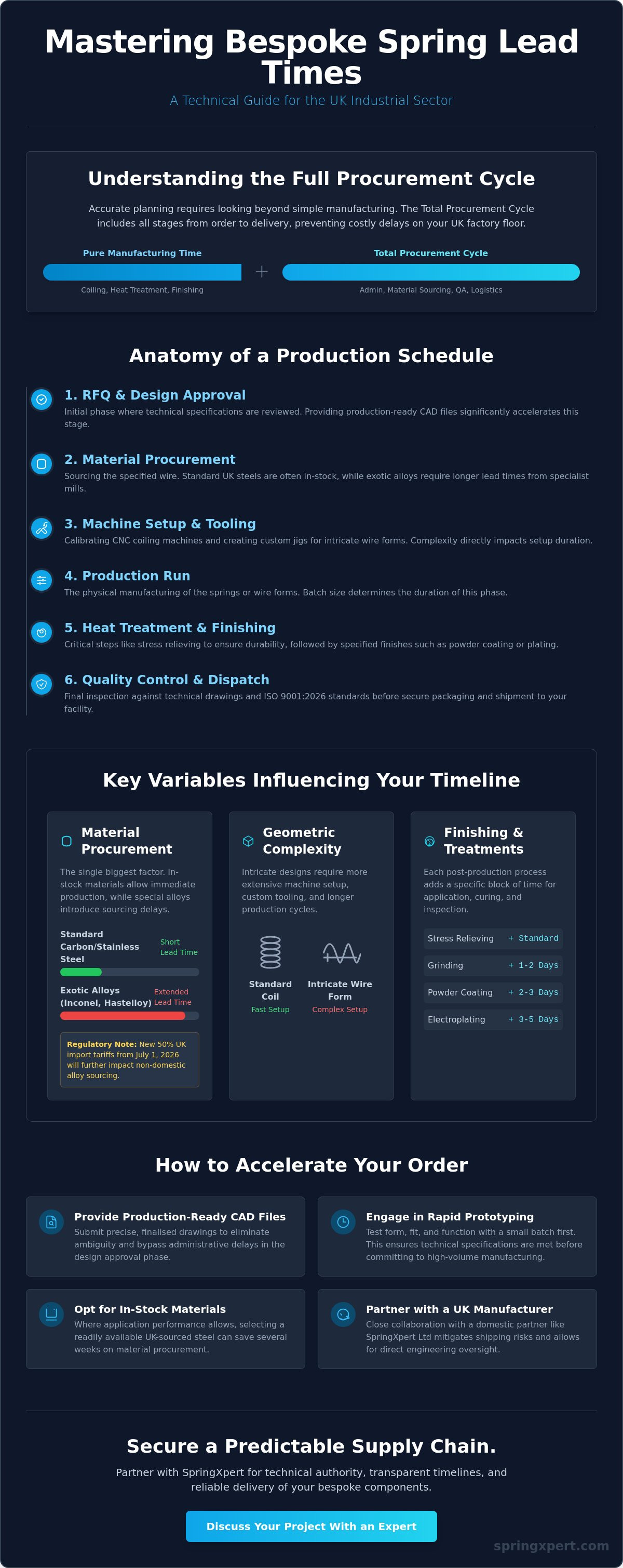
In the UK industrial sector, precision engineering begins long before the first coil is wound. For procurement officers, the lead time for bespoke springs is a critical metric that defines the gap between design finalisation and the arrival of components at the factory gate. It's essential to distinguish between manufacture time, which covers only the physical production, and the total procurement cycle, which includes material sourcing and quality assurance. Understanding Lead Time in this holistic sense prevents the production line stoppages that occur when logistics are overlooked.
Setting a realistic lead time for bespoke springs requires a master technician's perspective on material logistics and machine capacity. While overseas imports might offer lower unit costs, British manufacturers increasingly prioritise domestic supply chains to ensure technical authority and resilience. Proximity allows for direct engineering collaboration, ensuring that complex spring designs are vetted for manufacturability before production begins. Relying on a UK-based partner mitigates the risks of international shipping delays and provides a clear, accountable timeline that aligns with lean manufacturing principles.
The Anatomy of a Production Schedule
A structured production schedule begins with order processing and material verification. If a specific alloy isn't in stock, procurement adds a necessary buffer to the timeline. The next phase involves machine setup and coiling, particularly for compression springs, where precise pitch and diameter control are paramount. For high-performance applications, heat treatment and stress relieving are non-negotiable steps that ensure the longevity of the component. The cycle concludes with post-manufacturing quality control and dispatch logistics, ensuring every batch meets the defined structural integrity standards.
Why Bespoke Timelines Differ from Standard Stock
Standard stock items are ready for immediate dispatch, but bespoke components require a dedicated engineering window. The initial clock often accounts for unique tooling requirements that don't exist for off-the-shelf parts. For instance, intricate wire forms require more extensive setup and custom jigs compared to standard helical coils. This setup time is a necessary investment in custom performance. Individualized production options allow for precise load-bearing capabilities that stock items simply cannot replicate. While stock springs offer immediate availability, they rarely match the specific durability of a tailored solution designed for a precise industrial application.
Variables Affecting Custom Spring Production Timelines
The lead time for bespoke springs isn't a static estimate; it's a calculation based on material logistics, geometric complexity, and finishing requirements. In the UK industrial sector, identifying Variables Affecting Custom Production Timelines early is essential for preventing assembly line bottlenecks. While a standard helical coil follows a predictable path, specialized components for high-stress environments require a more detailed production schedule. Every technical specification, from the wire's chemical composition to the final coating, adds a specific block of time to the manufacturing clock.
Material Procurement and Special Alloys
Material availability remains the most significant front-end variable in any production schedule. Standard UK-sourced carbon and stainless steels are typically held in stock, allowing machine setup to begin shortly after design approval. However, exotic alloys like Inconel or Hastelloy often require sourcing from specialist global distributors. With the UK government reducing steel import quotas by 60% and applying a 50% tariff on over-quota imports as of July 1, 2026, material planning has become a high-priority task for procurement officers. SpringXpert Ltd manages this volatility by maintaining a robust stockholding strategy for common wire diameters, which can save several weeks of waiting for mill deliveries. If your project requires high-performance alloys, confirming current stock levels during the RFQ stage is critical.
The Impact of Finishing and Heat Treatment
Secondary processes are where many procurement schedules falter due to a lack of technical detail. Heat treatment is a non-negotiable step for die springs to ensure they maintain their structural integrity and elastic limits under heavy loads. If these services are performed in-house, the timeline remains tight; however, if they're outsourced within the UK manufacturing chain, you should account for an additional three to five working days for transit and processing. Geometric complexity also plays a role. Intricate extension springs or wire forms require custom jigs and manual adjustments that standard compression springs don't need.
Common industrial coatings add the following estimated durations to the lead time for bespoke springs:
- Zinc Plating: 2-3 working days for chemical baths and drying.
- Powder Coating: 3-4 working days for application and curing.
- Shot Peening: 1-2 working days to enhance fatigue life.
Early collaboration is the most effective way to manage these variables and ensure a predictable delivery date. Consulting with a specialist on bespoke spring design and prototyping during the R&D phase allows you to identify long-lead processes before they impact your final production schedule.
Comparing Prototyping vs. Batch Production Lead Times
The lead time for bespoke springs shifts significantly as a project moves from initial R&D to full-scale manufacturing. Prototyping prioritises speed and design validation, while batch production focuses on repeatability and cost-efficiency. Technical procurement officers must recognise that these two phases occupy different spaces in the production queue. A prototype is a proof of concept; a production batch is a logistical operation. Identifying the key factors that affect lead time at each stage allows for more accurate project forecasting. With UK manufacturing output increasing by 1.2% in early 2026, factory capacity is often at a premium, making it vital to understand where your order sits in the workflow.
Rapid Prototyping for Urgent Engineering
CNC coiling technology enables the production of a single sample without the extensive downtime associated with traditional mechanical setup. This 'sample of one' capability is essential for British engineering firms testing new assemblies. During the bespoke spring design phase, the focus remains on material performance and dimensional accuracy. For components using standard wire diameters held in UK stock, prototype turnaround is often measured in days. This speed-to-market is critical for R&D projects where iterative design cycles are expected. Once a physical sample is approved, it's converted into a production-ready CAD model, which serves as the master template for the next phase.
Scaling to Full Production Batches
Transitioning from a single sample to a multi-thousand unit run introduces new logistical variables. Batch production requires dedicated machine scheduling to ensure efficiency across the entire order. For high-volume components like disc springs, quality assurance benchmarks become more rigorous. Every unit must meet the same structural integrity standards, requiring periodic testing throughout the run. The anticipated ISO 9001:2026 revision, expected in September, emphasises greater supply chain resilience, which we integrate into our batch QA protocols.
To mitigate long-term lead time for bespoke springs, many industrial clients utilise call-off orders. By manufacturing the total requirement in one batch and scheduling deliveries over several months, factories maintain a consistent supply without the risk of production line stoppages. This strategy provides a predictable delivery schedule while locking in material costs before the 2026 tariff adjustments take full effect. It allows your engineering team to focus on assembly while we manage the inventory logistics from our UK facility.
Strategic Methods to Reduce Bespoke Spring Lead Times
Reducing the lead time for bespoke springs is often a matter of administrative efficiency rather than just mechanical throughput. Delays frequently occur during the initial enquiry phase due to incomplete technical data. If an engineering team provides a full specification from the outset, the manufacturer can bypass the clarification loops that typically add three to five days to the front end of a project. Precision is the priority. When procurement and engineering align early, the path from CAD to component becomes significantly shorter.
Optimising the Request for Quote (RFQ)
A precise RFQ allows for immediate material reservation and machine scheduling. Essential data points include wire diameter, material grade, free length, total coils, and specific end configurations. Vague specifications lead to back-and-forth communication that stalls the production queue. The Perfect RFQ consists of a comprehensive technical data packet including 3D CAD files, precise material specifications, and clearly defined tolerance limits to enable immediate production scheduling. Providing this level of detail ensures same-day processing and accurate scheduling within the UK manufacturing workflow.
Collaborative Engineering and DFM
Early engagement with a technical specialist often reveals "design for manufacture" (DFM) wins. For example, standardising wire diameters to match existing UK stock can eliminate the multi-week wait for mill deliveries. Small adjustments to the spring rate or end loops can also simplify the coiling process, reducing setup time on the CNC machines. Utilising the 20 years of expertise at SpringXpert Ltd allows your team to bypass common design pitfalls that often lead to manufacturing failures or extended timelines.
UK-based technical collaboration provides a distinct advantage for real-time problem solving. Instead of waiting for email responses across time zones, engineers can resolve design conflicts through direct communication. This industrious approach ensures that complex components move from the CAD screen to the production floor without unnecessary friction. To optimise your next project, you can request a technical consultation with our engineering team to identify potential DFM improvements.
Consolidating finishing requirements is another strategic lever. Multi-stage transport between different plating or coating facilities in the UK industrial chain can add significant logistical overhead. Selecting a manufacturer with integrated finishing capabilities or established local partnerships reduces these transit windows. By keeping the lead time for bespoke springs in mind during the design phase, you ensure your production schedules remain both predictable and efficient.
Partnering with SpringXpert Ltd for Reliable Production Schedules
SpringXpert Ltd operates with a level of industrial reliability that transforms lead time from an uncertainty into a managed variable. Our facility is engineered to handle over 20,000 standard products alongside complex custom requirements, ensuring that bespoke projects never compete for resources with our high-volume inventory. This dual-track manufacturing strategy is essential for maintaining a stable lead time for bespoke springs during periods of UK market volatility. By anchoring your supply chain within a domestic facility, you gain immediate access to technical authority and a transparent view of the production floor. We rely on the inherent weight of our manufacturing facts to build trust, providing delivery schedules based on actual machine capacity and verified material stocks.
Precision Manufacturing in the Heart of UK Industry
Our investment in modern CNC technology is balanced by a stable, expert workforce that understands the intricacies of British industrial requirements. We maintain rigorous ISO quality standards, including the newly published ISO 14001:2026 and the upcoming ISO 9001:2026 revision, to ensure every component meets structural integrity benchmarks on the first run. This meticulous focus on technical depth reduces the risk of rejection and the subsequent delays that often disrupt complex engineering projects. Our facility represents a commitment to durability and precision, grounded in the reality of modern manufacturing technologies and traditional craftsmanship. We prioritize a "right first time" approach to ensure your production remains efficient and uninterrupted.
Streamlined Logistics and National Delivery
Reliable dispatch is the final phase of our industrious production process. We've established a national delivery network that prioritizes critical industrial sectors, ensuring that once your batch is cleared by quality control, it reaches your gate without delay. Our logistics team provides clear, data-driven updates, allowing you to plan your assembly lines with certainty. We don't rely on vague estimates; we rely on a steady and highly structured communication rhythm that mirrors our production cycle. This transparency is vital for British manufacturers who must maintain lean operations despite a fragile economic outlook.
We invite you to treat our engineering department as an active partner in your next project. Whether you're developing a new wire form or requiring a large batch of compression springs, our team is ready to provide the technical collaboration necessary for success. Consult with our engineering team today to discuss your bespoke lead time requirements and secure a predictable supply chain for your 2026 production schedule.
Securing Your 2026 Production Timeline
Mastering the lead time for bespoke springs is a technical necessity for maintaining a resilient UK supply chain. Effective procurement relies on the clarity of your initial data packet and the manufacturing capacity of your chosen partner. By integrating design for manufacture principles early in the process, you eliminate the clarification loops that stall production. Domestic manufacturing provides the transparency needed to navigate the current industrial landscape with confidence. Each technical decision, from wire diameter to surface finish, serves as a building block for a predictable delivery schedule.
SpringXpert offers over 20 years of UK manufacturing expertise and ISO 9001 quality assured processes to support your engineering goals. Our facility is equipped for both rapid prototyping and high-volume production, ensuring your components meet exact structural integrity standards. We encourage you to Request a Technical Consultation for Your Bespoke Spring Project to align your design requirements with our current production capacity. Taking this step ensures your factory floor remains efficient and your delivery schedules remain on track.
Frequently Asked Questions
What is the typical lead time for a bespoke compression spring?
The standard lead time for bespoke springs, specifically compression variants, typically ranges from three to four weeks for manufacturing. If your specification requires secondary treatments like powder coating or plating, the timeline often extends to five or six weeks. These estimates account for machine scheduling, coiling, and rigorous quality control. We recommend checking current floor capacity during the RFQ stage to ensure alignment with your UK production schedule.
Can lead times be reduced for urgent prototype requirements?
Manufacturing timelines for urgent prototype requirements can be reduced through express production services. Many UK facilities offer turnarounds of one week or even two to three working days for critical R&D projects. This acceleration is possible when using standard wire diameters already held in stock. Providing production-ready CAD files immediately upon enquiry is the most effective way to facilitate these rapid development cycles and meet tight engineering deadlines.
How does material choice affect the manufacturing timeline?
Material selection directly dictates the front-end procurement window. Standard carbon and stainless steels are usually available for immediate coiling; however, exotic alloys like Inconel or Hastelloy may require sourcing from specialist distributors. With the 2026 steel import tariffs affecting global supply chains, choosing non-standard materials can add several weeks to the total procurement cycle. Consolidating your design around common UK wire stocks is a proven method for maintaining a predictable schedule.
Do secondary finishes like zinc plating add significant time to the order?
Secondary finishes such as zinc plating, shot peening, or powder coating add a specific block of time to the manufacturing cycle. Zinc plating typically requires an additional two to three working days, while more complex coatings may take up to five days. These durations include chemical processing and curing times. If these services are outsourced within the UK industrial chain, you should also account for the logistics of transit between facilities.
Is it faster to order standard springs or bespoke alternatives?
Ordering standard springs is consistently faster as these items are held in stock for immediate dispatch. Bespoke alternatives require a dedicated engineering window for machine setup, tooling, and first-off inspections. While stock components offer immediate availability, bespoke designs are necessary when standard parts cannot meet specific load-bearing or environmental requirements. The choice depends on whether your project prioritizes immediate delivery or individualized performance characteristics.
How can I speed up the quoting process for custom springs?
Providing a complete technical data packet at the point of enquiry is the most effective way to accelerate the quoting process. This packet should include 3D CAD files, exact material grades, and defined tolerance limits. Eliminating vague specifications prevents the clarification loops that often delay formal quotations by several days. A precise RFQ allows our engineering team to conduct a feasibility review and provide an accurate lead time estimate within 24 hours.
What happens if the material for my bespoke spring is not in stock?
If the specific wire diameter or alloy required for your project is not in stock, the lead time for bespoke springs increases by the duration of the material procurement phase. This can range from a few days for standard UK mill stock to several weeks for specialist imports. We actively manage stockholding to mitigate this risk. In cases of material scarcity, we may suggest alternative material grades that offer comparable structural integrity.
Does SpringXpert offer expedited shipping for bespoke orders?
SpringXpert utilizes a robust national distribution network to provide reliable dispatch for all bespoke orders. While manufacturing time is dictated by technical complexity, the final delivery window can be optimized through various national courier options. We coordinate closely with our logistics partners to ensure that critical components for industrial sectors reach their destination promptly. You should confirm your specific delivery requirements during the final order confirmation to ensure the fastest possible transit.