

The Industrial Extension Spring Maintenance Checklist for 2026
Unplanned downtime costs UK manufacturers up to £736 million per week as of April 2026. It's a staggering figure that highlights how easily a single component failure can compromise industrial output and erode profit margins. You're likely aware that maintaining consistent tension is vital for operational stability, but implementing a rigorous extension spring maintenance checklist is the only way to move from reactive repairs to predictive reliability.
This professional engineering guide provides the framework needed to monitor fatigue cycles and preserve load-bearing integrity. By following these steps, you'll ensure your facility remains compliant with the UK's updated machinery safety regulations coming in January 2027 while extending the service life of your custom-engineered components. We'll examine precise lubrication protocols, fatigue identification techniques, and the strategic impact of the July 2026 steel safeguard measures on your component replacement cycles.
Key Takeaways
- Learn why systematic maintenance is essential for maintaining precise load-rate consistency and preventing unscheduled downtime in high-output British manufacturing environments.
- Discover how to identify early-stage fatigue by inspecting hook geometry for necking and monitoring irregular coil spacing.
- Follow a structured extension spring maintenance checklist that prioritises cleaning and measuring free length against original engineering specifications.
- Understand the impact of UK environmental factors like humidity and temperature on material integrity and spring rate stability.
- Identify the technical indicators that signal the point of no return, ensuring you replace components before they compromise machinery safety under new UK regulations.
The Critical Role of Extension Spring Maintenance in Industrial Reliability
Extension spring maintenance is the systematic inspection of tension-bearing components to ensure load-rate consistency. In high-precision manufacturing, this process serves as the primary defence against mechanical fatigue. While domestic springs might undergo a few hundred cycles annually, industrial components often endure thousands of cycles per shift. This intensity accelerates material degradation, making a structured extension spring maintenance checklist an operational necessity rather than a recommendation.
Proactive maintenance prevents catastrophic failure by identifying microscopic structural changes before they manifest as a full break. When a spring fails under high load, the resulting kinetic release can damage surrounding machinery or cause serious injury. Understanding the underlying spring mechanics and physics allows maintenance teams to distinguish between normal wear and critical fatigue. For those requiring specific technical parameters, our guide on industrial extension springs outlines the engineering tolerances required for bespoke applications.
Understanding Initial Tension and Load Loss
Initial tension is the internal force that holds the coils together in a relaxed state. It's engineered into the component during the cold-winding process. If a spring shows visible gaps between coils when it's not under load, it has likely exceeded its elastic limit. This load loss indicates that the material can no longer return to its original length, which is a definitive sign of impending failure. Monitoring this metric is a core requirement of any robust extension spring maintenance checklist.
Safety Protocols for High-Tension Environments
Inspecting heavy-duty springs requires strict adherence to British safety standards. A maintenance engineer in a Redditch-style facility must wear high-visibility gear and impact-rated safety glasses to mitigate risks. Before physical handling, you must ensure the safe release of all stored energy. High-tension springs can retract with significant force if a hook fails or a mounting point shears during inspection. 68% of UK manufacturers experienced unplanned downtime in 2025; ensuring technician safety during routine checks prevents these incidents from becoming medical emergencies.
Identifying Fatigue: Key Indicators of Extension Spring Wear
Identifying fatigue requires a meticulous approach to visual inspection. It isn't enough to simply check if a spring is still in one piece. You must look for subtle physical changes that indicate the material is approaching its elastic limit. Your extension spring maintenance checklist should prioritise the detection of 'necking'. This is a visible thinning or elongation in the wire, typically found where the hook meets the first coil. When necking occurs, the cross-sectional area of the wire decreases, which significantly reduces its load-bearing capacity and increases local stress.
Irregular coil spacing, or pitch, is another critical indicator of over-extension. In a healthy extension spring, coils should be uniform. If you notice gaps that vary in width across the body of the spring, it's a sign that the component has been stretched beyond its design parameters. This often leads to 'set', where the spring fails to return to its original free length. According to the Institute of Spring Technology, once a spring has taken a permanent set, its rate stability is compromised. You can no longer rely on it to provide precise tension in high-speed industrial applications.
Hook and End-Loop Integrity
Data suggests that 90% of extension spring failures occur at the hook or within the transition radius. This area experiences the highest concentration of stress during every cycle. During your inspection, use high-magnification visual aids to check for microscopic stress cracks. Standard engineering tolerances usually allow for zero deformation in the hook geometry. If the opening of the hook has widened by even 5% from its original specification, the risk of sudden detachment becomes critical. If you observe these indicators, our team can provide bespoke engineering support to restore your line's efficiency.
Stress Corrosion Cracking (SCC) Indicators
Stress Corrosion Cracking (SCC) is a particularly dangerous form of fatigue because it's often invisible to the naked eye. It occurs when high-tensile spring steel is exposed to corrosive agents while under constant tension. Don't confuse surface oxidation with deep-seated corrosion. While light rust can often be cleaned, SCC creates micro-cracks that penetrate the wire's core. In British manufacturing plants, exposure to industrial cleaning chemicals or high humidity can accelerate this process. If the surface finish shows signs of pitting or uneven discolouration, the integrity of the alloy is likely compromised, creating stress risers that lead to rapid failure.
Environmental Factors and Material Integrity in UK Manufacturing
British industrial environments present specific challenges to component longevity. Variable humidity levels, particularly in coastal regions or older facilities across the West Midlands, significantly affect carbon steel integrity. When ambient humidity exceeds 60%, standard carbon steel is prone to rapid surface oxidation. This rust isn't merely a cosmetic concern; it creates friction between active coils, which alters the spring's load rate and introduces stress risers. Adhering to HSE guidance on work equipment maintenance is essential for ensuring these environmental factors don't lead to sudden mechanical failure.
In high-moisture or chemically aggressive zones, your extension spring maintenance checklist should specify the use of stainless steel or specialised plated finishes. While the initial procurement cost for 302 or 316 stainless steel is higher, it's a strategic investment. With the UK Carbon Border Adjustment Mechanism (CBAM) set to increase imported steel costs by up to £130 per tonne in January 2027, maintaining high-specification materials is more cost-effective than frequent replacements of low-grade carbon steel. You can consult our technical guide on choosing materials for springs to compare the corrosion resistance and tensile strength of various industrial alloys.
Lubrication Standards for Extension Coils
Selecting the correct lubricant is vital for maintaining the inner diameter (ID) of the coils. Avoid heavy greases, as they tend to trap abrasive dust and metal shavings, creating a grinding paste that wears down the wire. Instead, use light, penetrating oils or dry-film lubricants that saturate the contact points between coils. Frequency shouldn't be based on calendar months; it must be dictated by cycle counts. A spring performing 50,000 cycles per week requires significantly more attention than a component in a low-frequency application. This distinction is a cornerstone of any professional extension spring maintenance checklist.
Managing Heat Exposure
High ambient temperatures near furnaces, engines, or steam lines can cause 'relaxation', where the spring loses its ability to exert the designed force. Look for 'heat tint'—a yellowish or blueish discolouration on the coils. This indicates the steel's temper has been compromised, reducing its tensile strength. If your facility operates in high-heat conditions, identifying these thermal markers is a critical safety step. In such cases, bespoke material selection, such as Inconel or Chrome Silicon, may be necessary to maintain precise load tolerances under thermal stress.
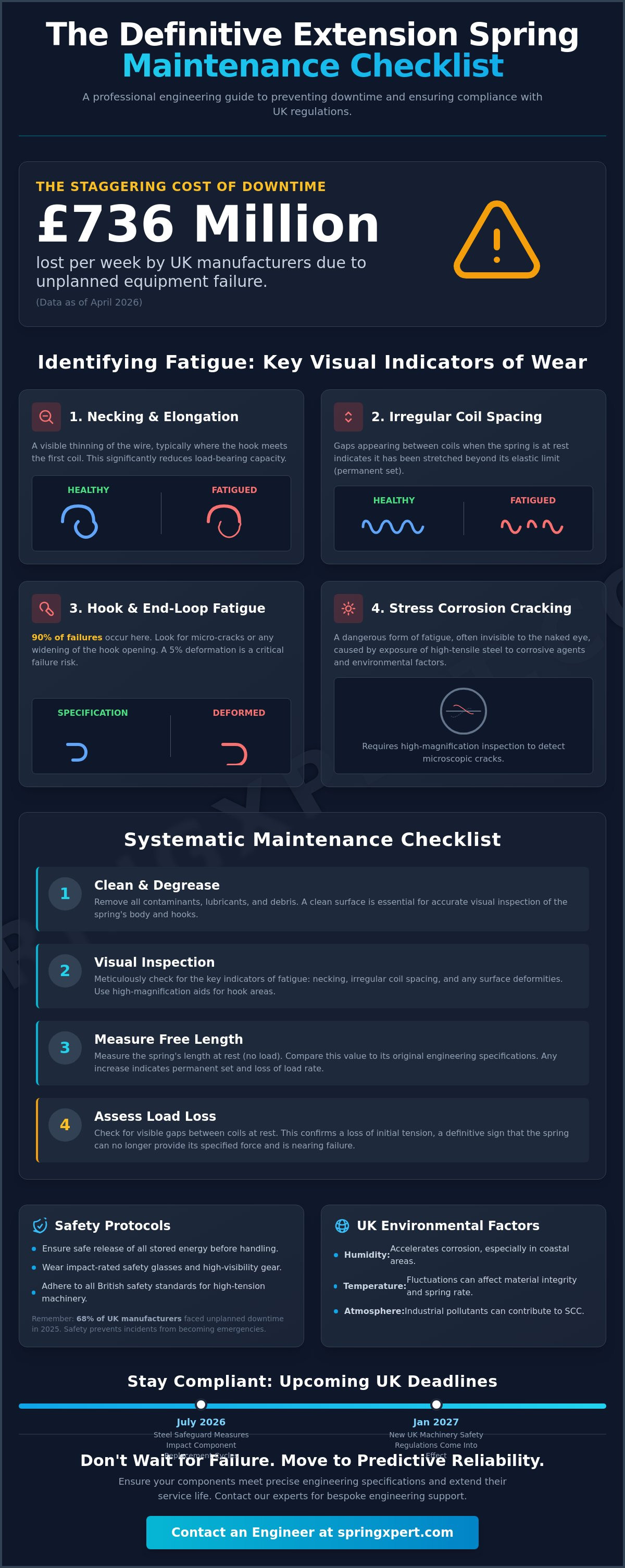
The Definitive Extension Spring Maintenance Checklist
Implementation of a technical extension spring maintenance checklist is the primary method for mitigating the £736 million weekly cost of unplanned downtime in the UK. This process must be systematic. It moves beyond simple observation to provide quantifiable data on component health. Use the following five steps to ensure your machinery maintains its design tolerances.
- Step 1: De-greasing and Surface Preparation. Remove all accumulated lubricants and industrial debris using a non-corrosive solvent. A clean surface is mandatory for identifying the microscopic stress cracks or pitting discussed in previous sections.
- Step 2: Free Length Verification. Measure the spring's free length using calibrated callipers. Compare this value against the original engineering drawing. Any permanent elongation exceeding 2% of the original specification indicates that the material has taken a set and requires immediate replacement.
- Step 3: Geometric Inspection of End-Loops. Examine the hooks for radius thinning or 'opening'. If the gap of the hook has increased from its manufactured state, the component is at high risk of sudden detachment.
- Step 4: Lateral Alignment Analysis. Observe the spring under load to check for 'snaking' or lateral bowing. This phenomenon suggests an internal structural imbalance or uneven winding that will lead to premature fatigue.
- Step 5: Environmental and Cycle Logging. Document the current cycle count and any changes in the facility's ambient conditions, such as increased humidity or thermal shifts.
Daily vs. Quarterly Inspection Tasks
Maintenance schedules must be stratified by intensity. Daily 'walk-by' inspections focus on auditory and visual anomalies, such as unusual metallic resonance or obvious coil deformities. Quarterly inspections require more rigour. During these sessions, technicians should use calibrated callipers to record precise dimensions. On an annual basis, conduct load-testing to verify that the spring constant (k) remains within the specified tolerances. This tiered approach ensures that minor wear doesn't escalate into a catastrophic failure.
Documentation and Compliance
Maintaining a technical logbook is a requirement for ISO 9001 compliance and robust quality management. Each entry should record the batch number and manufacturer to ensure full traceability throughout the component's lifecycle. In a modern UK factory, a senior British technician recording data into a digital maintenance system provides the transparency needed for audit trails. This level of detail is essential for identifying recurring failure patterns across different production lines. If your current data indicates frequent failures, you can request a technical consultation to review your spring specifications.
Beyond Maintenance: When to Specify Replacement Extension Springs
A rigorous extension spring maintenance checklist eventually identifies components that have reached the 'Point of No Return'. This stage occurs when the material's elastic limit is permanently exceeded. At this juncture, no amount of cleaning or lubrication can restore the required load-rate consistency. Continuing to operate with a compromised spring risks the integrity of the entire machine assembly and can lead to the unscheduled downtime that disrupts UK manufacturing output.
Specifying an exact replacement is critical for operational stability. Engineers often make the mistake of selecting 'near-match' springs from non-specialist suppliers to save time. A 5% variance in wire diameter or a slight difference in active coil count can drastically alter the spring's rate and fatigue life. This leads to imbalanced tension and accelerated wear on mechanical pivots. For complex requirements, understanding bespoke spring design and prototyping ensures that your replacement components meet the precise technical specifications of your original equipment.
The Dangers of Spring 'Splitting' and Patch Repairs
You should never attempt to re-bend a broken extension spring hook or 'split' a coil to create a new mounting point. Cold-working the wire in this manner introduces severe internal stresses that lead to immediate failure under load. Similarly, applying localised heat through welding or torching destroys the material's tempered state, rendering the spring brittle and unpredictable. In a professional UK industrial setting, these 'ad-hoc' repairs carry significant legal and safety implications. They bypass established engineering controls and can result in catastrophic kinetic release during operation, endangering technicians and equipment alike.
Partnering with SpringXpert Ltd for Bespoke Solutions
When standard components fail to meet the demands of your production environment, an upgrade to a custom-engineered solution is necessary. Our engineers utilise advanced CAD software and rapid prototyping to identify and eliminate recurring failure modes. We maintain an inventory of over 20,000 standard products for rapid UK delivery, ensuring your facility experiences minimal disruption. The Xpert identity means we don't just supply parts; we provide technical consultancy on material selection and precise load calculations to solve your most difficult engineering challenges. Every extension spring maintenance checklist should conclude with a clear protocol for when to transition from maintenance to technical collaboration with SpringXpert Ltd.
Optimising Component Reliability for 2026 and Beyond
Implementing a rigorous extension spring maintenance checklist is the definitive method for ensuring long-term industrial reliability. This systematic approach allows maintenance teams to transition from reactive repairs to a data-driven strategy; it prioritises component integrity and operational stability. By documenting the fatigue cycles and environmental stressors discussed in this guide, your facility remains prepared for the stricter machinery safety frameworks taking effect in January 2027.
When maintenance indicators suggest that standard components are no longer sufficient, technical collaboration is the most efficient path forward. SpringXpert Ltd provides over 20 years of UK manufacturing expertise and maintains an ISO 9001 compliant quality management system. With more than 20,000 standard products in stock for rapid national delivery, we offer the infrastructure required to support high-output production environments. Partner with SpringXpert Ltd for your bespoke industrial spring requirements to ensure your machinery continues to operate within its original engineering tolerances. Taking these proactive steps today secures the future stability and safety of your manufacturing operations.
Frequently Asked Questions
How often should industrial extension springs be inspected?
Inspection frequency is dictated by cycle counts rather than calendar months. High-output production lines performing 50,000 cycles weekly require daily visual 'walk-by' inspections to detect obvious deformities. You should conduct a more rigorous technical review using calibrated callipers every quarter. This structured approach ensures your extension spring maintenance checklist remains effective and compliant with ISO 9001 quality standards.
What is the most common cause of extension spring failure?
Fatigue at the hook or end-loop transition radius is the primary cause of failure in industrial settings. These specific points experience the highest concentration of stress during every extension cycle. Engineering data suggests that 90% of catastrophic breaks occur at these connection points rather than within the main body of the spring coils.
Can I lubricate extension springs with standard WD-40?
Standard WD-40 is unsuitable for industrial springs because it's a solvent and water displacer, not a high-pressure lubricant. It evaporates quickly and fails to provide the long-term film strength required between active coils. Use a high-quality penetrating oil or a dry-film lubricant. These products saturate the inner diameter without trapping the abrasive particles that lead to premature wear.
What are the signs that an extension spring is over-stretched?
A spring is over-stretched if its measured free length exceeds the original engineering specification by more than 2%. You should also look for visible gaps between coils when the component is in its relaxed state. These gaps indicate a permanent loss of initial tension, meaning the material has been stretched beyond its elastic limit and can no longer provide consistent load rates.
Is it safe to replace just one extension spring in a multi-spring system?
Replacing a single spring in a multi-component system is not recommended for industrial machinery. An older spring will have a different rate due to accumulated fatigue, which creates a load imbalance across the assembly. This imbalance puts undue stress on the new component and the machine's pivots. Always replace springs in pairs or complete sets to maintain mechanical symmetry.
How does temperature affect extension spring performance in a factory?
High ambient temperatures cause 'relaxation', where the steel loses its ability to exert the designed force. Heat near furnaces or steam lines can reduce tensile strength by 10% or more depending on the specific alloy used. Identifying 'heat tint' discolouration should be a priority in your extension spring maintenance checklist to prevent sudden failure in high-thermal environments.
What is the difference between initial tension and working load?
Initial tension is the internal force that holds the coils tightly together while the spring is at rest. Working load is the specific force the spring exerts when it's extended to its required operating length. Both metrics are essential for precise mechanical timing. If the initial tension is lost, the spring will fail to meet its working load requirements at every stage of the cycle.
When should I choose a bespoke extension spring over a stock item?
Choose a bespoke solution when standard stock items fail to meet your specific load tolerances or environmental challenges. If your maintenance logs show recurring failures in a particular application, a custom-engineered spring is often necessary. Bespoke designs allow for the use of specialized alloys and precise geometric adjustments that eliminate chronic fatigue issues in high-stress UK manufacturing environments.