

Gas Springs vs Mechanical Springs: An Engineering Comparison for 2026
The most sophisticated component isn't always the most reliable for a high-output production line. While gas springs offer superior damping for controlled motion, the traditional mechanical spring remains the superior choice for high-cycle reliability and environmental resilience in precision engineering. When comparing gas springs vs mechanical springs, engineers must look beyond initial performance to the long-term stability of the system. You likely understand the pressure of managing inconsistent force delivery over long strokes or the high maintenance costs associated with complex seal failures in harsh UK industrial environments.
This technical evaluation provides a precise analysis of force delivery, longevity, and environmental resilience to help you select the optimal spring component for 2026. With structural steel prices reaching £1,990 per ton this April, selecting the right material and mechanism is critical for maintaining predictable lifecycle costs. We'll examine how the ISO 9001:2026 quality standard impacts component selection and why bespoke mechanical solutions often outperform gas alternatives in high-stress settings. This guide ensures you achieve optimised machine performance and reduced downtime through data-driven engineering decisions.
Key Takeaways
- Understand the fundamental mechanical differences between physical wire deformation and compressed nitrogen to ensure precise energy storage in your machine designs.
- Compare gas springs vs mechanical springs to determine whether your application requires the controlled damping of gas or the high-cycle reliability of mechanical alloys.
- Assess operational resilience across extreme thermal ranges, specifically focusing on how mechanical springs maintain stability between -40°C and +200°C where gas pressure fluctuates.
- Calculate total cost of ownership by evaluating installation complexity and mounting requirements against long-term maintenance cycles in British manufacturing environments.
- Learn how custom-engineered solutions and technical consultancy can optimise load calculations and material selection for bespoke industrial requirements.
Fundamental Mechanics: How Gas and Mechanical Springs Store Energy
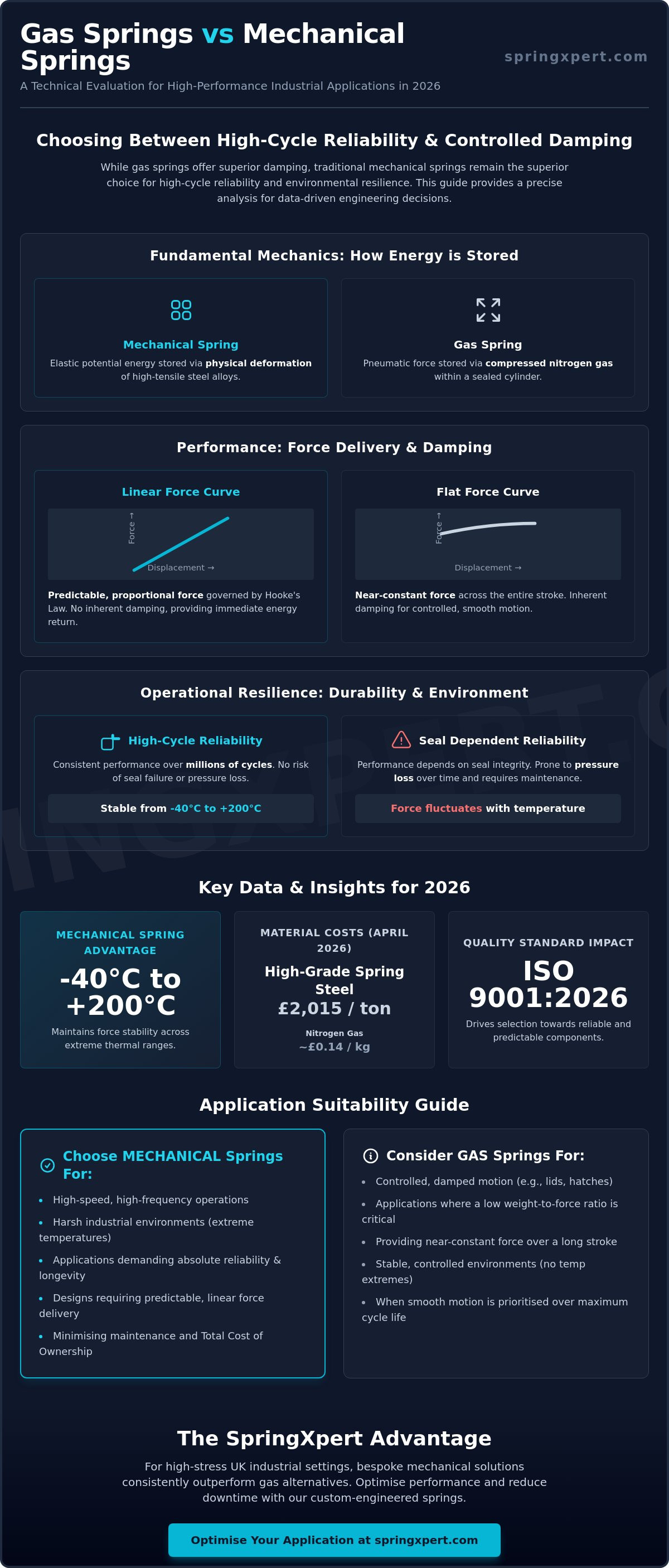
The choice between gas springs vs mechanical springs starts with the physics of the storage medium. Mechanical springs rely on the elastic potential energy of solids, typically high-tensile steel alloys. When a load is applied, the wire undergoes physical deformation. This energy is stored within the lattice structure of the metal and released as the spring returns to its original geometry. In contrast, gas springs utilise a volume of compressed nitrogen gas held within a precision-machined cylinder. The storage of energy occurs through the compression of this gas by a piston rod, creating a pressure differential that generates outward force.
The Physics of Mechanical Deformation
Mechanical spring performance is governed by Hooke’s Law, which states that the force exerted is directly proportional to the displacement. This linear relationship is defined by the spring constant, or 'k' value. For a British engineer designing a heavy-duty assembly in a West Midlands factory, calculating this constant requires precise data on wire diameter, coil mean diameter, and the shear modulus of the alloy. High-grade spring steel, which reached a market price of approximately £2,015 per ton in April 2026, provides the necessary tensile strength to ensure energy release consistency over millions of cycles. In standard mechanical assemblies, compression springs are the primary choice for energy storage because they offer predictable return cycles without the risk of seal failure. The physical dimensions of the wire and the heat treatment of the alloy dictate the component's ability to resist permanent set under high stress.
Pneumatic Force and Gas Compression
The Fundamental Mechanics of Gas Springs involve a more complex interaction of seals and fluid dynamics. Unlike the linear rate of a wire coil, gas springs provide a flatter force curve. This is because the internal pressure of the nitrogen gas, which cost roughly £0.14 per kilogram in April 2026, increases only slightly as the rod is pushed into the cylinder. An internal seal mechanism is critical; it must maintain a hermetic environment to prevent pressure loss. This design inherently includes a damping effect. As the piston moves, oil or gas can be metered through orifices to control the speed of extension. This makes gas springs ideal for applications requiring controlled motion, though they lack the absolute reliability of a physical alloy wire in extreme environments. When evaluating gas springs vs mechanical springs, the decision often rests on whether the application requires the simple, rugged durability of steel or the sophisticated, damped motion of pneumatic compression.
Performance Comparison: Force Delivery and Damping
The operational output of a spring component is defined by how it manages energy release over its stroke length. When comparing gas springs vs mechanical springs, the most critical performance differentiator is the force-to-displacement ratio. Mechanical springs exhibit a linear force curve where the resistance increases at a constant rate as the component is compressed or extended. This predictability is vital for high-speed, high-frequency oscillations found in automotive valvetrains or industrial vibratory feeders. In these environments, the immediate energy return of a steel alloy is required to maintain timing and prevent mechanical lag.
Gas springs operate with a significantly flatter force curve, often referred to as a low progression rate. This allows the component to provide nearly constant force throughout its entire stroke. In aerospace and heavy vehicle manufacturing, the weight-to-force ratio becomes a secondary performance metric. A gas spring can deliver substantial lifting force with a much lower mass than a mechanical equivalent capable of the same load. This weight efficiency is a primary reason for their adoption in hatch and lid counterbalancing, where maintaining a controlled, steady motion is more important than rapid cycle rates.
Force Curves and Stroke Length
A British quality control engineer in a precision workshop might measure these tolerances using a digital load tester to ensure compliance with bespoke specifications. With mechanical springs, the force increases significantly as the spring reaches its solid height. This can be a limitation in applications where a consistent force is required regardless of the rod's position. Gas springs solve this by using a small internal volume of nitrogen, which results in a pressure increase of only 20% to 40% during a full stroke. This characteristic ensures that the effort required to move a load remains uniform, reducing strain on both the machinery and the operator. For projects requiring specific load profiles, consulting with a technical specialist can help determine the exact K-factor needed for your application.
Damping and Velocity Control
Damping is an inherent feature of gas-actuated systems that mechanical springs cannot replicate without external hardware. Gas springs utilise internal oil and valve orifices to regulate the velocity of the rod, providing a smooth, cushioned stop at the end of the stroke. This prevents the "snap-back" effect common in extension springs, where stored energy is released instantly. While this immediate return is a functional requirement for many return-mechanism applications, it poses a safety risk in heavy access panels or delicate instrumentation. Mechanical springs are better suited for applications where the damping is provided by the surrounding system or where the speed of return is the priority over motion control.
Operational Resilience: Durability and Environmental Factors
Environmental stressors frequently dictate the service life of a component more than the load cycle itself. When evaluating gas springs vs mechanical springs for UK industrial applications, engineers must account for the specific atmospheric conditions of the facility. High-humidity environments, such as those found in food processing or chemical treatment plants, pose distinct challenges for both sealing mechanisms and exposed metal surfaces. Choosing the wrong component can lead to premature failure and costly line stoppages.
Mechanical springs are inherently more resilient to chemical exposure when specified with the correct protective coatings or manufactured from high-tensile stainless steel alloys. Gas springs, while robust, rely on internal seals that can degrade when exposed to aggressive cleaning agents or fine particulate matter. In a typical British manufacturing plant, the primary failure mode for a gas spring is gradual pressure loss through seal compromise. A mechanical spring is more likely to fail via surface corrosion or wire fatigue after exceeding its designed cycle life. This makes the mechanical option the standard for high-reliability systems where maintenance access is limited.
Thermal Stability and Performance
Temperature fluctuations significantly alter the performance of gas-actuated components. Due to the principles of Boyle’s Law, the internal nitrogen pressure in a gas spring increases as the temperature rises, leading to a higher output force that may exceed design tolerances. In a UK foundry or a high-heat processing environment, this force variance can disrupt delicate machine timing. Mechanical alloys are preferred for these high-heat applications because they maintain consistent energy storage properties across a broad thermal range of -40°C to +200°C. The elastic limit of spring steel defines the maximum stress the material can endure before permanent deformation occurs, and this limit remains stable under thermal conditions that would cause a gas spring to fail. This stability ensures that the machine's operating parameters remain within specification regardless of the ambient temperature.
Maintenance and Lifecycle Expectations
High-quality mechanical springs provide a "set-and-forget" utility that is essential for reducing long-term overheads. They don't require the periodic pressure checks or seal inspections associated with gas-filled cylinders. For heavy-duty industrial bolting or high-load clamping, the longevity of disc springs is often unmatched, as they provide high force in a compact space without the risk of sudden decompression. While gas springs offer sophisticated motion control, their lifecycle is finite and dependent on seal integrity. A British maintenance engineer overseeing a 24-hour production facility will often favour the predictable, fatigue-based lifecycle of a mechanical spring over the less predictable failure modes of pneumatic systems. Correct material selection at the design phase ensures that lifecycle costs remain predictable and downtime is minimised.
Total Cost of Ownership and Specification Criteria
Financial viability in machine design extends beyond the initial purchase price. When comparing gas springs vs mechanical springs, engineers must account for the full lifecycle, including mounting hardware, maintenance intervals, and eventual disposal. While a standard mechanical spring may have a lower unit cost, a gas spring provides integrated damping that might otherwise require additional hydraulic components. However, for a British manufacturer running high-volume automated lines, the reliability of a physical alloy component often results in a superior return on investment through reduced downtime.
In the UK recycling and construction sectors, mechanical springs are the established reliability standard. These environments are often saturated with abrasive dust and grit that compromise the seals of gas-actuated cylinders. With structural steel prices at approximately £2,015 per ton in April 2026, the cost of raw materials remains a significant factor in procurement. Despite these material costs, the "set-and-forget" nature of a mechanical system eliminates the labour costs associated with the periodic pressure testing required for gas systems. A bespoke mechanical design can also be engineered to seat directly into existing housings, removing the need for the specialised ball studs or brackets essential for gas spring installation.
Initial Investment vs Long-Term Value
Unit costs for bulk orders of mechanical springs are typically 30% to 50% lower than engineered gas components of similar force ratings. This gap widens when considering the complexity of the assembly. Gas springs are classified as pressure vessels; this status introduces specific end-of-life considerations. Under the updated 2026 EU REACH regulations, which influence UK manufacturing standards, the disposal of components containing certain oils or PFAS-related materials requires documented risk management. Mechanical springs, being solid metal, are 100% recyclable through standard scrap streams, making them the more sustainable choice for firms aligning with the ISO 9001:2026 focus on ethical conduct and environmental impact. For those looking to optimise their procurement strategy, requesting a bespoke engineering consultation can identify significant savings in assembly time.
Specification Checklist for Engineers
A senior design engineer in a Yorkshire-based workshop should follow a structured protocol to ensure the chosen component meets the technical depth required for modern industrial standards. Use the following criteria for your next specification:
- Force Requirements: Determine the exact force required at both the start and the end of the stroke. Mechanical springs will show a linear increase, while gas springs provide a more consistent force profile.
- Environmental Hazards: Assess the presence of oil, fine particulates, or extreme temperatures. Mechanical alloys are generally more tolerant of harsh UK industrial climates.
- Cycle Life: Calculate the required service life. If the application demands more than 1 million cycles, a high-grade mechanical spring is often the only viable solution to prevent fatigue-related failure.
By following these steps, you ensure that the chosen component aligns with both performance requirements and the long-term financial goals of the project. The Xpert approach prioritises these granular details to prevent the high costs of component failure in the field.
The SpringXpert Advantage: Bespoke Engineering for UK Industry
Selecting the correct component for a high-stress application involves more than browsing a standard catalogue. For 20 years, SpringXpert Ltd has supported the medical and construction sectors by providing the technical depth that generic suppliers cannot match. When engineers evaluate the merits of gas springs vs mechanical springs, the decision often hinges on specific tolerances and load calculations that requires a collaborative engineering approach. We move beyond passive supply by acting as an active partner in your design process, ensuring every component is optimised for its intended environment.
Our UK-based manufacturing capabilities allow us to respond rapidly to the volatile market conditions of 2026. With structural steel prices rising by 7.5% in the first quarter of this year, reaching approximately £2,015 per ton by April, material efficiency has never been more critical. We leverage our extensive experience to recommend the most cost-effective alloys that do not compromise on tensile strength or fatigue life. This expertise ensures that your machinery achieves maximum uptime while maintaining predictable procurement costs in a fluctuating economy.
Custom Design and Prototyping
The transition from a CAD drawing to a finished industrial component requires meticulous attention to detail. In our Redditch facility, we utilise advanced CNC coiling technology to manufacture bespoke solutions with absolute repeatability. This process is overseen by our master technicians who bring decades of British manufacturing heritage to the shop floor. A master technician, often seen meticulously inspecting a batch of bespoke compression springs with calibrated digital micrometers, ensures that every coil meets the exact spring rate specified in the initial design. This hands-on oversight in a UK setting guarantees that prototypes are delivered with the precision required for immediate integration into your assembly lines.
Why Choose a Specialist Manufacturer?
Direct technical collaboration provides a level of security that off-the-shelf components cannot offer. We ensure all our custom-engineered solutions comply with the latest British safety standards and the rigorous requirements of the ISO 9001:2026 quality management revision. This compliance is vital for firms in the aerospace and medical sectors where documentation and ethical conduct are as important as physical performance. By choosing a specialist, you gain access to expert material selection and load testing that accounts for the specific atmospheric challenges of UK manufacturing plants. Consult with our Xperts for your bespoke spring requirements to begin a technical partnership that prioritises precision, durability, and industrial reliability.
Advancing Industrial Efficiency through Precise Component Selection
The technical evaluation of gas springs vs mechanical springs confirms that the optimal choice depends on the specific force delivery and environmental resilience required by your application. Mechanical springs provide unmatched reliability in high-cycle, abrasive environments where seal failure is a constant risk. Gas-actuated systems remain the standard for applications requiring damped, constant force in the medical and aerospace sectors. As the September 2026 publication of ISO 9001:2026 approaches, aligning your component selection with updated quality and sustainability standards is essential for long-term compliance.
SpringXpert combines over 20 years of UK manufacturing expertise with ISO-standard precision engineering to deliver components that withstand the most demanding industrial cycles. Our bespoke design services ensure that every spring is custom-engineered to your exact load calculations and material requirements. Whether you're managing complex medical instrumentation or heavy-duty construction machinery, our master technicians provide the technical depth your project demands. Explore our range of over 20,000 standard and bespoke springs to find the precise specification for your next project. We look forward to collaborating on your engineering challenges.
Frequently Asked Questions
Can a gas spring be repaired if it loses pressure?
Gas springs are non-repairable components because they are hermetically sealed during the manufacturing process. If a seal fails or the internal pressure drops, the entire unit must be replaced to ensure safety and operational integrity. Attempting to puncture or refill a cylinder is extremely dangerous due to the high internal nitrogen pressure. Most industrial facilities in the UK treat these as consumable items with a predefined service life.
Are mechanical springs more reliable than gas springs in high-cycle applications?
Mechanical springs offer superior reliability in high-cycle applications because they lack the seals and moving internal parts found in pneumatic systems. While a gas spring may fail after 50,000 to 100,000 cycles, a correctly specified alloy spring can exceed 10 million cycles. When comparing gas springs vs mechanical springs for 24/7 automated production lines, the solid-state nature of metal wire provides a more predictable fatigue life.
How does temperature affect the force of a gas spring?
The output force of a gas spring changes by approximately 3.4% for every 10°C deviation from the standard 20°C ambient temperature. This occurs because the internal nitrogen gas expands or contracts according to thermodynamic laws. In a typical British workshop, a significant drop in winter temperatures will result in a noticeable loss of lifting force. Mechanical springs remain largely unaffected by these standard thermal fluctuations, maintaining consistent force across a wider range.
What is the typical lifespan of a high-quality mechanical compression spring?
The lifespan of a high-quality compression spring depends on its stress range and material grade, but it often reaches several million cycles. If the spring operates within its elastic limit and is protected from corrosion, it can last for decades without performance degradation. Engineers should consult the Goodman Diagram to predict fatigue life based on the mean stress and stroke frequency of the specific industrial application.
Can I replace a gas spring with a mechanical spring in my existing design?
You can replace a gas spring with a mechanical alternative, provided you account for the difference in force curves. Gas springs offer a nearly constant force, whereas mechanical springs increase in resistance as they compress. This transition usually requires a redesign of the mounting geometry or the use of a spring with a specific K-factor to ensure the load is managed safely throughout the entire stroke length.
What safety precautions are necessary when handling high-pressure gas springs?
High-pressure gas springs must never be heated, punctured, or subjected to lateral forces that could damage the rod. Puncturing a cylinder leads to an explosive release of nitrogen and internal oil. Always use the specified mounting points and ensure the rod is protected from scratches or weld spatter. Scratched rods will quickly destroy the internal seals, leading to sudden and unexpected pressure loss in the system.
How do I calculate the spring rate for a custom mechanical spring?
Calculate the spring rate by using the formula (G * d^4) / (8 * D^3 * n), where G is the shear modulus, d is the wire diameter, D is the mean coil diameter, and n is the number of active coils. Precise measurements are essential for accurate results. A technician in a UK testing lab will use these variables to ensure the custom component meets the exact tolerances required for the machine load profile.
Which spring type is better for corrosive industrial environments?
Mechanical springs manufactured from 316 stainless steel or specialised alloys are the superior choice for corrosive environments. These materials offer inherent resistance to oxidation and chemical attack without relying on external seals. When evaluating gas springs vs mechanical springs for marine or chemical processing plants, the risk of seal degradation in gas units makes them less suitable than a properly coated or high-alloy mechanical spring.