

The Definitive Guide to Choosing a Reliable Industrial Spring Company in the UK
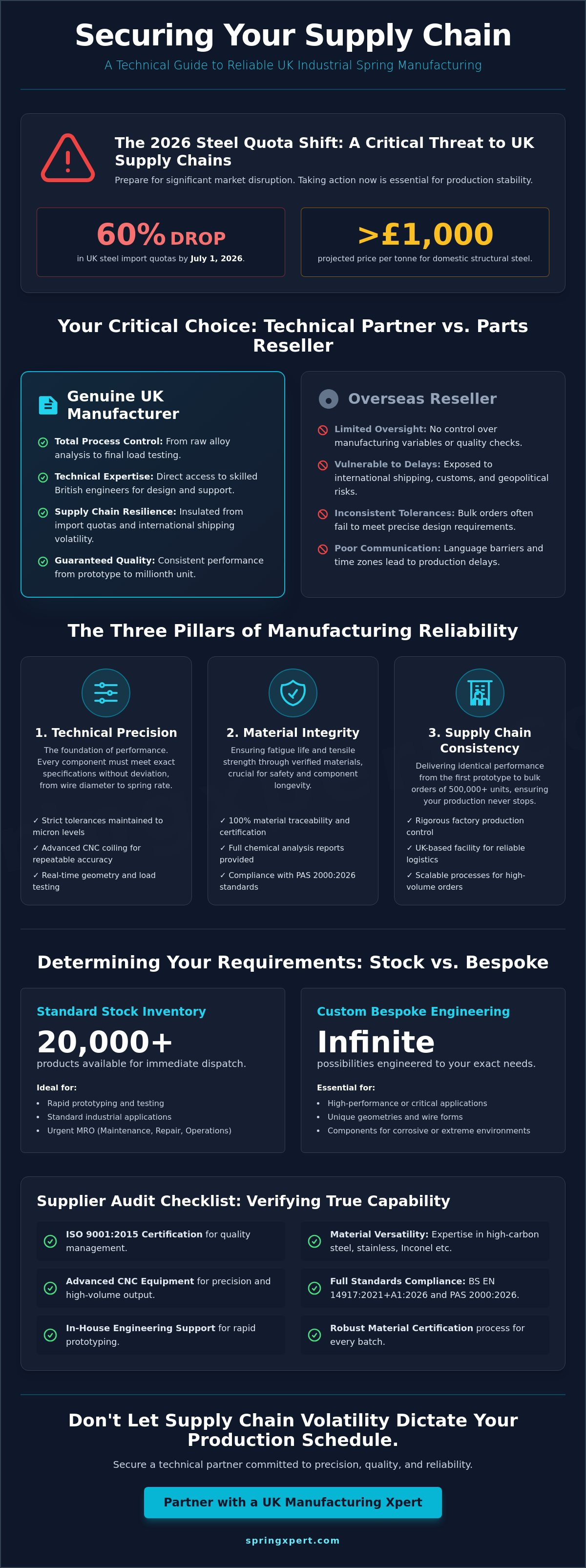
By July 1, 2026, UK steel import quotas will drop by 60%, potentially driving domestic structural steel prices above £1,000 per tonne. For procurement managers and engineers, this shift means that securing a reliable industrial spring company UK is no longer just about price; it’s about technical stability. You’ve likely faced the frustration of production delays caused by poor supplier communication or spring failure resulting from incorrect alloy specifications. It’s a common pain point when bulk orders arrive with inconsistent tolerances that don't meet your design requirements.
You’ll learn how to identify a manufacturing partner that delivers precision engineering and rigorous material traceability. We’ll discuss the impact of the new PAS 2000:2026 safety standards and how to evaluate a supplier’s capacity for bespoke spring design. This guide provides a structured framework for auditing technical expertise and supply chain resilience. We’ll cover everything from BS EN 14917:2021+A1:2026 compliance for pressure applications to the advantages of domestic sourcing in a volatile steel market. By prioritizing manufacturers who employ skilled British technicians and maintain strict quality controls, you can ensure your critical components meet every performance benchmark.
Key Takeaways
- Establish the three core pillars of manufacturing reliability: technical precision, material integrity, and supply chain consistency.
- Evaluate the technical capabilities of a reliable industrial spring company UK to ensure they provide robust engineering support and rapid prototyping.
- Determine when to utilize a standard inventory of 20,000+ products versus when a project demands a custom-engineered, bespoke solution.
- Verify supplier quality through mandatory material certification, chemical analysis reports, and precise tolerance monitoring.
- Leverage the benefits of domestic UK manufacturing for enhanced quality oversight and reduced logistical risk in a volatile global market.
Defining Reliability in the UK Industrial Spring Sector
Reliability in mechanical engineering isn't a vague sentiment; it's a measurable output. For procurement teams, a reliable industrial spring company UK must provide more than just a component. They must provide a technical guarantee. While many resellers merely move stock from overseas warehouses, a genuine manufacturer controls every variable from metallurgical analysis to final load testing. This distinction is vital for maintaining production schedules and preventing field failures in critical machinery.
The Three Pillars of Industrial Reliability
Industrial reliability rests on three non-negotiable standards. Technical precision is the first. This involves maintaining strict tolerances, often within microns, for wire diameter and spring rate. We utilize advanced CNC coiling technology to ensure every compression or torsion spring meets your exact specifications without deviation. Precision is the baseline for all high-performance components.
Material integrity is the second pillar. We prioritize 100% traceability for all high-performance alloys and spring steels. Understanding the Spring Steel Composition is vital for ensuring the fatigue life and tensile strength of a component. With the new PAS 2000:2026 standards introduced in March 2026, documentation for material safety and risk assessment has become a mandatory requirement for UK manufacturers. We provide full chemical analysis reports to verify that every batch of raw material meets these updated safety codes.
The final pillar is consistency. A partner must deliver the same performance from the initial prototype to a bulk order of 500,000 units. We achieve this through rigorous factory production control and real-time monitoring of spring geometry during the manufacturing process. This systematic approach ensures that the millionth unit performs identically to the first.
Why a UK Manufacturing Facility Matters
Sourcing from a domestic facility eliminates the volatility of international shipping and the 60% quota reductions on steel imports effective July 1, 2026. Inside a modern UK workshop, you'll find experienced British engineers overseeing high-speed CNC production lines. These technicians possess the specialized knowledge required to adjust tooling for complex wire forms or bespoke spring clips on the fly. This hands-on oversight is something a reseller simply can't offer.
Our workshop environment reflects a commitment to precision. It's an organized space where technical authority is the priority. Having a local engineering team means you get direct access to technical consultancy for new product development. This proximity reduces lead times for critical industrial components, often by several weeks compared to international alternatives. Every interaction is framed through our Xpert identity, ensuring we act as an active engineering partner rather than a passive supplier. This technical collaboration is the foundation of a stable industrial supply chain.
Essential Selection Criteria for High-Performance Spring Suppliers
Selecting a reliable industrial spring company UK requires a granular audit of their manufacturing infrastructure. It isn't enough to verify stock levels. You must assess their ability to maintain precision across diverse geometries, from standard compression springs to complex wire forms. A high-performance supplier operates as a technical extension of your own engineering team, providing the data necessary to justify material choices and ensure component longevity.
ISO 9001:2015 serves as the baseline for industrial trust. This certification ensures the manufacturer follows a documented process for quality management and continuous improvement. However, true reliability also stems from material versatility. A capable partner works with a broad spectrum of alloys, including high-carbon steel, stainless steel, and specialist materials like Inconel. This flexibility is critical when components must operate in corrosive environments or under extreme thermal stress.
Assessing Manufacturing Capabilities
Evaluating a supplier's hardware is essential for high-volume precision. Modern CNC coiling technology allows for the production of complex torsion and extension springs with repeatable accuracy. In a typical UK industrial workshop, you'll observe a senior British technician calibrating a high-precision testing rig. This process ensures the physical spring rate aligns perfectly with the theoretical design. Such hands-on expertise, combined with automated production, allows for wire diameter ranges spanning from 0.1mm to 26mm. This technical depth is what separates a dedicated manufacturer from a simple distributor.
Evaluating Technical Consultancy and Design Support
Reliability is often defined before a single coil is wound. You should ask if the manufacturer provides CAD support and load calculation services. These technical inputs are vital for mitigating the risk of mechanical failure in the field. For instance, selecting the correct material for a medical device or a heavy-duty recycling plant requires deep metallurgical knowledge. Compliance with UK Designated Standards, particularly the updates published on March 18, 2026, ensures your components meet the legal requirements for safety and performance in Great Britain.
When your project moves beyond standard specifications, you need a partner that offers bespoke spring design and prototyping to validate your concepts. This technical collaboration ensures every custom-engineered solution is optimized for its specific application. By integrating engineering support early in the development cycle, you reduce the likelihood of costly design revisions and production delays. A reliable industrial spring company UK doesn't just take orders; they provide the technical expertise to improve your product's performance.
Stock Inventory vs. Bespoke Engineering: Determining Your Requirements
Choosing between a catalog item and a custom-engineered component is a critical procurement decision. A reliable industrial spring company UK provides the technical data required to make this choice based on performance requirements and lead-time constraints. While stock inventory offers immediate availability for maintenance and repair operations (MRO), bespoke engineering solves specific mechanical challenges that standard parts cannot address. The decision often hinges on whether your assembly can accommodate standard dimensions or if the application demands a unique spring rate and material specification.
A cost-benefit analysis reveals that while bespoke production involves initial design fees, it often results in lower long-term costs by preventing premature component failure. Integrating standard components with custom-engineered wire forms allows for more efficient assemblies. This hybrid approach leverages the speed of stock inventory while maintaining the precision of custom design. Our engineering team provides the technical consultancy needed to determine which path offers the best stability for your specific supply chain.
Navigating the Standard Product Landscape
Standard catalogued products are ideal for high-volume applications where the mechanical parameters are well-defined. Our inventory includes over 20,000 options designed to meet a wide range of industrial needs. This includes compression springs for energy storage and extension springs for tension-based mechanical systems. Utilizing these off-the-shelf components significantly reduces initial design costs and ensures rapid delivery for urgent repairs. Tiered pricing models for bulk orders further enhance the cost-effectiveness of this approach, providing a predictable expenditure for procurement officers.
The Bespoke Design and Prototyping Process
The transition to bespoke engineering occurs when your project involves unique space constraints, non-standard load requirements, or extreme operating conditions. This process begins in a bright, professional design studio where British engineering experts collaborate on CAD drawings and load simulations. We move from these digital models to physical prototypes, allowing for iterative testing in real-world scenarios. This is particularly critical for die springs used in high-load environments where fatigue resistance is paramount. By working with a reliable industrial spring company UK, you gain access to this specialized design agility, ensuring your custom components are optimized for durability and performance before full-scale manufacturing begins.
Technical Standards, Material Traceability, and Quality Control
A reliable industrial spring company UK operates under a framework of rigorous technical standards. Precision manufacturing requires more than just coiling wire; it demands strict adherence to BS EN ISO 10243 for compression springs and DIN EN 13906-1 for torsion springs. These international benchmarks define the acceptable limits for tensile strength and dimensional tolerances. Without these metrics, components risk premature fatigue or catastrophic failure during operation. We employ advanced testing procedures, including load testing to verify spring rates and salt spray analysis to evaluate corrosion resistance. Each production batch undergoes these checks to ensure compliance with the technical specifications outlined in your original design.
Material Selection for Industrial Performance
The choice of alloy directly impacts the lifecycle of a mechanical system. While high-carbon spring steel is suitable for many standard applications, corrosive or high-temperature environments require phosphor bronze or specialist alloys like Inconel. For instance, selecting materials for disc springs in extreme temperature applications involves analyzing thermal expansion and relaxation rates. Surface finishes provide an additional layer of protection. Zinc plating or passivating can increase the lifespan of a component by 40% in outdoor settings. These treatments ensure the base alloy remains shielded from environmental degradation, maintaining structural integrity over thousands of cycles.
Quality Assurance and Document Control
Document control is the backbone of industrial procurement. Every order should include a Certificate of Conformity (CoC) to verify that the parts meet the agreed-upon standards. We maintain digital traceability for every production batch, tracking the material from the initial wire spool to the finished part. This system allows us to provide full chemical analysis reports upon request, ensuring 100% material transparency. It’s a level of detail that’s essential for sectors like medical manufacturing or heavy-duty engineering where safety is paramount.
Inside our quality control department, the atmosphere is focused and precise. A meticulous quality inspector, a British white male with decades of manufacturing experience, stands at a calibrated inspection station. He uses digital calipers to verify the tolerances of a custom wire form, cross-referencing the physical measurements with the original CAD drawing. This manual verification complements our automated systems, providing a final layer of human expertise. If your project requires this level of technical oversight, you can request a technical audit of our quality processes to see how we maintain these standards.
SpringXpert: Your Technical Partner for Precision UK Manufacturing
SpringXpert has operated at the intersection of traditional craftsmanship and modern CNC technology for over 20 years. This longevity provides a foundation of stability for our partners in an increasingly volatile market. As a reliable industrial spring company UK, we maintain a vast inventory of 20,000+ standard products. This stock is supported by our bespoke design agility, allowing us to pivot from high-volume catalog orders to custom-engineered solutions within a single production cycle. Our focus remains on British manufacturing excellence, ensuring that critical components are produced locally to mitigate the risks associated with global supply chain disruptions.
Our identity as a technical specialist is built on the physical reality of our products. We prioritize precision over persuasion, relying on the inherent weight of our engineering capabilities to build trust with our B2B clients. By maintaining a deep specialized lexicon and a meticulous approach to production, we position ourselves as a dependable partner for complex requirements. This atmosphere of competence is essential for businesses that cannot afford the risks of component failure or supply chain instability.
The Xpert Advantage in B2B Supply
B2B procurement requires more than just a product list; it requires a structured approach to supply chain management. We provide tiered pricing models designed to support bulk industrial orders, ensuring cost-predictability even as UK scrap steel prices reached £181.25 per tonne for heavy steel in May 2026. Long-term production contracts are managed by dedicated account managers who understand the specific technical requirements of your sector. Our national delivery capabilities are structured to support just-in-time manufacturing, ensuring your production line remains operational regardless of external market volatility. By maintaining high stock levels of raw materials, we insulate our clients from the 60% quota reductions on steel imports scheduled for July 1, 2026.
Partnering for Future Innovation
Innovation in sectors such as medical technology and heavy-duty recycling requires a partner who understands the physical reality of material performance. We act as an active engineering partner rather than a passive supplier. This involves providing technical consultancy on tensile strength, alloy selection, and fatigue life during the earliest stages of product development. Our engineers, a team of British specialists based in our UK facility, oversee every stage of the process to ensure that bespoke solutions are optimized for their intended environment.
Our team is available to review your technical specifications and provide engineering feedback. Whether you require standard compression springs or complex wire forms, we offer the technical depth and manufacturing capacity to support your requirements. We invite you to contact us for a collaborative review of your next project, ensuring your components meet the highest standards of British engineering and industrial reliability.
Securing Your Industrial Supply Chain for 2026 and Beyond
Selecting a reliable industrial spring company UK is a strategic decision that impacts the entire lifecycle of your machinery. We've established that technical precision, material traceability, and domestic manufacturing are the three pillars of a stable supply chain. With the upcoming steel import quota reductions on July 1, 2026, partnering with a local specialist ensures your production remains unhindered by global volatility. This proactive approach minimizes the risks of material failure and communication delays.
SpringXpert provides the technical depth required for complex B2B requirements. Our ISO 9001:2015 certified facility maintains a vast inventory of over 20,000 standard products, ranging from compression springs to wave washers. When standard components don't meet your tolerances, our UK-based engineers provide expert technical consultancy to develop bespoke solutions. Every production batch is tracked with digital traceability to guarantee performance from the initial prototype to final assembly.
Take the next step in optimizing your component procurement. You can Partner with SpringXpert for your next industrial project to ensure your engineering specifications are met with absolute precision. We look forward to supporting your next manufacturing challenge.
Frequently Asked Questions
How do I choose the right industrial spring company in the UK?
You should audit a manufacturer's technical depth and quality management systems. A reliable industrial spring company UK must provide more than stock; it must offer engineering evidence and compliance with updated March 18, 2026, designated standards. This ensures the supplier understands current legal requirements for pressure equipment and general safety within Great Britain. Verification of material traceability is essential for maintaining a stable supply chain.
What is the typical lead time for custom spring manufacturing?
Lead times for custom manufacturing typically range from 10 to 20 working days. This duration depends on the complexity of the coiling process and whether secondary operations like heat treatment or zinc plating are required. Standard catalog items are available for immediate dispatch from our UK facility. We prioritize clear communication to ensure your production schedule remains on track despite current market volatility.
Do you provide material traceability and ISO certifications?
We provide 100% material traceability and maintain ISO 9001:2015 certification for all manufacturing processes. Every order includes a Certificate of Conformity to verify compliance with your exact specifications. We also provide chemical analysis reports to meet the rigorous documentation standards of the PAS 2000:2026 code of practice. This ensures all components are fully documented for safety and audit purposes in regulated sectors.
Can you help with spring design and load calculations?
Our engineering team offers comprehensive CAD support and load calculation services for new and existing projects. We use specialized software to simulate spring behavior under specific stress conditions. This technical consultancy helps determine the optimal wire diameter and material grade for your application. By verifying the design early, we mitigate the risk of mechanical failure in high-load industrial environments.
What is the difference between stock springs and bespoke solutions?
Stock springs are standardized components ready for immediate use in common mechanical applications. Bespoke solutions are custom-engineered to meet specific space constraints or performance parameters that catalog parts can't fulfill. While stock inventory is cost-effective for maintenance and repairs, bespoke engineering is essential for new product development where unique spring rates or specialist alloys are required for long-term performance.
Which materials are best for high-corrosion industrial environments?
High-corrosion environments require specialist alloys like stainless steel 316, phosphor bronze, or Inconel. We also apply high-performance surface finishes including passivating and zinc plating to enhance durability. These materials are selected based on their resistance to oxidation and chemical exposure. Correct material selection is vital for maintaining component integrity in marine, medical, or chemical processing sectors where reliability is non-negotiable.
Do you offer prototyping services for new mechanical designs?
We offer dedicated prototyping services to support your research and development phase. Our British specialists work with you to produce small batches of custom wire forms or springs for mechanical testing. This iterative process allows for design adjustments before moving to full-scale production. Prototyping is a critical step for validating technical specifications and ensuring the final product meets your performance benchmarks.
Can you manufacture springs to non-standard tolerances?
Our CNC manufacturing capabilities allow us to meet non-standard tolerances for high-precision applications. We maintain strict control over wire diameter, coil pitch, and load requirements to ensure every part fits your assembly perfectly. This level of accuracy is achieved through real-time monitoring on our production lines. We can produce components that exceed standard commercial tolerances for critical industrial systems that require absolute precision.