

ISO 9001 Certified Spring Supplier: Ensuring Engineering Precision and Reliability
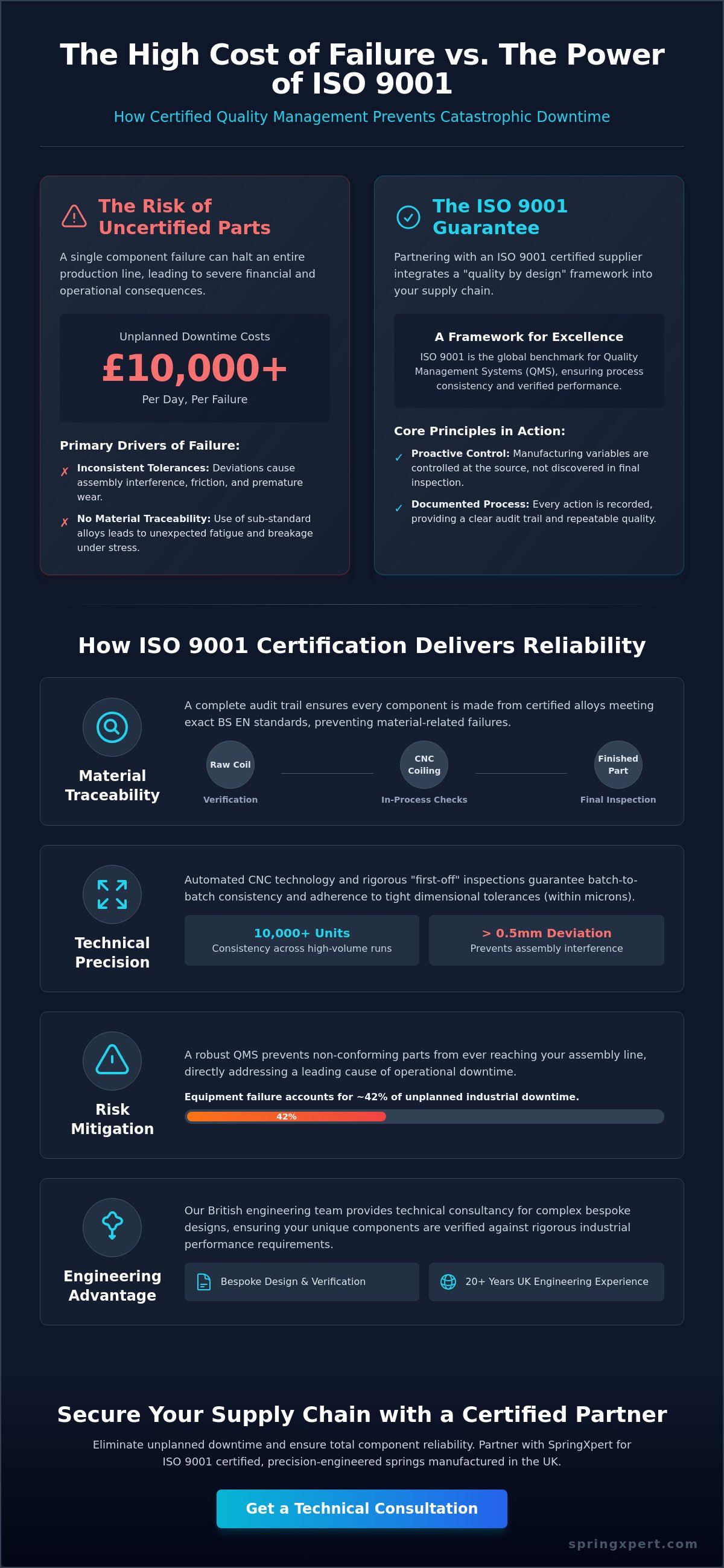
A single component failure on a UK production line can result in unplanned downtime costs exceeding £10,000 per day. When a critical spring fails, the financial impact isn't just the cost of the replacement part, but the halt of an entire industrial operation. You likely recognize that inconsistent tolerances and a lack of material traceability are the primary drivers of these avoidable mechanical breakdowns. As an established ISO 9001 certified spring supplier, we operate within a framework where precision isn't an aspiration but a documented requirement for every component that leaves our workshop.
This article explains how our ISO 9001 certification guarantees that every batch of wire forms or compression springs arrives with a full audit trail and rigorous adherence to your specifications. You'll discover how our British engineering team utilizes CNC technology to maintain batch-to-batch consistency and provides the technical consultancy needed for complex bespoke designs. We'll detail the specific quality control protocols that ensure your components perform reliably under industrial stress, providing a clear path to total supply chain compliance and reliability.
Key Takeaways
- Understand how full material traceability ensures every alloy used in your compression or torsion springs meets exact BS EN standards.
- Learn why partnering with an ISO 9001 certified spring supplier is critical for maintaining tight tolerances and batch-to-batch consistency in high-volume production.
- Discover how ISO-mandated quality management systems mitigate operational risk by providing a clear audit trail from the raw wire coil to the finished component.
- Explore the collaborative process where our British engineering team develops bespoke spring designs verified against rigorous industrial performance requirements.
- Identify the long-term reliability benefits of working with a UK-based manufacturer that applies 20 years of precision engineering experience to every project.
The Strategic Importance of an ISO 9001 Certified Spring Supplier
ISO 9001 represents the global benchmark for Quality Management Systems (QMS). It's the cornerstone of the ISO 9000 family of standards, providing a structured framework that prioritizes process consistency over reactive inspection. For a UK industrial partner, selecting an ISO 9001 certified spring supplier isn't just a matter of checking a box for procurement. It's a strategic decision to integrate a partner that utilizes "quality by design" principles. This approach ensures that manufacturing variables are controlled at the point of origin, rather than discovered during a final, costly testing phase.
In high-precision sectors such as aerospace or medical device manufacturing, the margin for error is effectively zero. A spring used in a surgical instrument or an aircraft valve must perform exactly to its design profile every single time it's compressed. Certification ensures that the supplier's internal processes meet rigorous international criteria, significantly reducing the likelihood of catastrophic failure in the field. It moves the relationship beyond a simple transaction and into a technical partnership built on verified performance data.
Risk Mitigation in High-Stakes Engineering
Operational risk is a primary concern for any British manufacturing facility. Industry data from 2023 indicates that equipment failure accounts for approximately 42% of unplanned downtime in heavy industrial environments. A robust QMS prevents non-conforming parts from ever reaching your assembly line. Our British engineers, working in modern UK facilities, oversee every stage of production to ensure that compression springs or wire forms adhere to specified tensile strengths. By identifying potential deviations during the coiling process, we eliminate the financial burden of part rejection and the subsequent delays in your production schedule.
The Audit Trail: Transparency from Wire to Finished Part
Procurement leads in 2024 require more than just verbal assurances; they demand documented evidence of process stability. ISO 9001 mandates a closed-loop quality system where every action is recorded and verified. This creates a complete audit trail that begins with the arrival of a wire coil and ends with the dispatch of the finished component. Utilizing BSI-registered systems provides the industrial credibility required for high-level UK contracts. It guarantees that we can trace the exact batch, material source, and production date of any component. This level of transparency is essential for maintaining a reliable supply chain and ensuring full compliance with modern safety regulations.
Technical Precision: How ISO Standards Govern Tolerances and Performance
Precision manufacturing requires a rigid adherence to technical specifications that go beyond surface-level aesthetics. As an ISO 9001 certified spring supplier, we utilize automated CNC coiling technology that maintains dimensional accuracy within microns. This high-speed equipment is integrated into our Quality Management System, ensuring that every movement of the forming slides is repeatable. Every production run begins with a "first-off" inspection. A skilled UK technician verifies the initial component against the engineering drawing using digital callipers and profile projectors. This protocol ensures that variables like material spring-back are accounted for before high-volume manufacturing commences.
The strategic importance of ISO 9001 lies in its ability to standardize these technical checks. We verify tensile strength and material diameter against specific BS EN standards, such as BS EN 10270 for high-carbon steel wire. This verification process prevents the use of sub-standard alloys that could lead to premature fatigue. By maintaining these strict controls, we provide industrial partners with components that perform exactly as intended under operational loads.
Managing Dimensional Tolerances in Coil Springs
Dimensional accuracy is critical for compression springs, where a deviation of 0.5mm can cause significant assembly interference or mechanical friction. ISO 9001 provides the framework to manage consistency across large production runs of 10,000 units or more. We utilize statistical process control to monitor dimensions throughout the shift. Tolerance drift is the gradual deviation from the nominal dimension caused by tool wear or thermal expansion, and it is monitored through scheduled interval sampling. This systematic approach ensures that the last spring in a batch is identical to the first.
Advanced Load Testing and Performance Verification
Performance verification relies on calibrated digital load testing equipment. We measure the spring rate, expressed in Newtons per millimetre (N/mm), at specified compressed lengths to confirm the component meets its required force profile. Every batch undergoes stress-relieving in temperature-controlled ovens. This process is overseen by our British master technicians to ensure the heat treatment stabilizes the atomic structure of the alloy. This prevents relaxation and ensures the spring maintains its height over millions of cycles. If you require validated performance data for your assembly, our technical specialists can provide detailed load test reports for your specific batch.
Material Traceability and Quality Assurance Protocols
The journey of a high-performance spring begins long before it reaches the coiling machine. It starts at the mill, where raw material is cast and drawn into wire. For a professional ISO 9001 certified spring supplier, every incoming coil must be accompanied by a Mill Test Certificate (MTC). This document provides a definitive record of the alloy's chemical composition and mechanical properties, such as tensile strength and elongation. We prioritize high-grade spring steel and specialized superalloys like Inconel or Hastelloy for environments involving extreme temperatures or corrosive chemicals. Without this initial verification, the integrity of the finished component can't be guaranteed.
Batch numbering is the backbone of our industrial accountability. Every order is assigned a unique tracking code that follows the material through each production stage. This system enables rapid investigation if a performance issue is reported. In the event of a quality query, we can identify the specific machine used, the operator on shift, and the exact heat number of the raw wire within minutes. This level of granularity is a standard requirement for UK industrial partners who operate under strict regulatory oversight and need to mitigate the risk of assembly-wide recalls.
The Material Audit Trail
Maintaining a clean material chain is essential in a busy UK workshop handling multiple alloy types simultaneously. ISO 9001 protocols prevent material mix-ups by mandating clear labeling and physical segregation of stock. Our British engineers verify that the mechanical properties of the wire align with the design requirements before production starts. We work closely with established UK-based material stockholders to ensure the supply chain remains transparent. This ensures that every meter of wire used for your wire forms or spring clips meets the exact industrial standards specified in your technical brief.
Non-Conformance Reporting (NCR) and Continuous Improvement
Quality management also dictates how we handle technical deviations. When a component falls outside the specified tolerance, it's immediately identified through our NCR process. These parts are quarantined to prevent them from entering the supply chain. We then conduct a Root Cause Analysis to determine why the deviation occurred. It's a diagnostic tool that identifies whether the issue was caused by tool wear, material inconsistency, or a programming error. By implementing these corrective actions, we improve the manufacturing process for all future batches. This feedback loop ensures that our production capabilities evolve alongside the increasing demands of modern engineering.
The Engineering Advantage: ISO 9001 for Bespoke Spring Design
ISO 9001 provides a rigorous framework for the design and development phase of bespoke components. While many associate quality systems with mass production, a professional ISO 9001 certified spring supplier applies these controls to the earliest prototyping stages. Our CAD/CAM integration allows for seamless data transfer with a 0.01mm precision threshold from technical drawings to CNC coiling machines. This digital continuity ensures that the physical part matches the engineering model without manual translation errors. For instance, extension springs are custom-engineered to meet specific tensile loads, where the initial design parameters are locked into the quality system before the first wire is drawn.
The collaboration between our UK engineering team and your design department is governed by documented review processes. We don't just take an order; we analyze the application environment to ensure the component's longevity. This structured interaction prevents "design-to-fail" scenarios often found with non-certified suppliers. Since 2015, our engineers have provided technical consultancy for over 2,000 unique bespoke projects. By documenting every design iteration, we maintain a clear history of the component's evolution, which is vital for long-term project management and future batch repeatability.
Bespoke Prototyping under Quality Control
Transitioning from a custom design to a production-ready part requires a validated prototyping phase. We produce initial samples that undergo the same rigorous load testing as our standard batches. These samples are verified by experienced British craftsmen who often hand-finish complex wire forms to ensure they meet the specific geometry required for tight housing clearances. This validation step is recorded in our QMS, providing the baseline for full-scale manufacturing. It's a method that ensures the 500th part is as accurate as the first prototype, maintaining a 99.8% first-time acceptance rate across our custom production lines in 2023.
Technical Consultancy and Material Selection
Selecting the correct alloy is fundamental to performance in corrosive or high-heat environments. Our engineers provide technical consultancy to identify the most cost-effective material that meets your durability requirements. For example, if a standard carbon steel is insufficient, we might suggest 17-7 PH stainless steel or Inconel 718. The role of ISO documentation here is to provide the data-driven justification for these material changes to your stakeholders. For applications requiring high loads in confined spaces, our Disc Springs offer a custom-engineered solution that maximizes force-to-volume ratios. If you are developing a new mechanical assembly and require technical input on component geometry, contact our bespoke design team for an engineering review.
Partnering with SpringXpert Ltd: Your Certified UK Manufacturing Ally
Selecting a domestic ISO 9001 certified spring supplier streamlines the logistical complexities inherent in modern precision engineering. SpringXpert Ltd operates from a UK facility with over 20 years of manufacturing history, maintaining a stock of 20,000 standard items including disc springs, circlips, and washers. This local proximity ensures that British industrial values of durability and meticulous quality are present in every component. By eliminating international shipping delays and customs variability, we provide a stable procurement route for critical mechanical components. Our infrastructure is designed to support the "just-in-time" requirements of UK assembly lines, where lead-time accuracy is as critical as dimensional tolerance.
Our facility serves as a hub for technical excellence, where the focus remains on the physical reality of the product. We prioritize the inherent weight of engineering facts over marketing claims, providing our partners with clear data on tensile strength, fatigue life, and alloy performance. This transparency is a hallmark of SpringXpert Ltd, positioning us as a stable and competent partner for complex B2B requirements. Whether you require standard compression springs or custom-engineered wire forms, our quality management system ensures that every part is verified against your specific industrial needs.
A Reliable Link in Your Supply Chain
Our UK-based production team focuses on industrious efficiency, ensuring that technical specifications are met without compromising delivery schedules. We understand that supply chain reliability is as vital as the tensile strength of the alloy itself. This commitment resulted in a 98% on-time delivery rate across our 2023 industrial contracts. We encourage technical collaboration on complex challenges, from high-cycle torsion springs to specialized tool clips and hose clamps. Our engineers work directly with your procurement team to ensure that the material audit trail remains unbroken from the point of order to final delivery.
Get a Technical Quote for Your Next Project
Initiating a project with SpringXpert Ltd is a straightforward technical process. You can submit CAD models or detailed specifications for an immediate engineering appraisal by our staff. We assist with material load requirement calculations and provide data-driven recommendations to optimize component performance in corrosive or high-heat environments. Our team is equipped to handle everything from initial prototyping to high-volume production runs. Partner with SpringXpert Ltd for certified industrial springs to secure a dependable engineering ally for your next manufacturing cycle.
Securing Your Industrial Supply Chain with Certified Precision
Operational stability in the UK industrial sector depends on the reliability of every individual component. By prioritizing material traceability and rigorous tolerance control, you eliminate the high costs associated with mechanical failure and unplanned downtime. Our ISO 9001:2015 certified quality system ensures that every batch of compression springs or wire forms arrives with full documentation, including Mill Test Certificates for complete material accountability. This prevents the integration of non-conforming parts into your critical assemblies.
Selecting an ISO 9001 certified spring supplier provides the technical assurance required for complex B2B applications. With over 20 years of British manufacturing expertise, we combine traditional engineering skills with modern CNC technology to deliver consistent results. This methodical approach to quality management transforms a standard component purchase into a strategic engineering partnership. We're ready to assist with your specific load requirements and material selections to ensure your project's success.
Request a Technical Quote from our UK Engineering Team to begin your next project with a partner committed to industrial-grade precision. We look forward to providing the durable solutions your assembly requires.
Frequently Asked Questions
What does it mean for a spring supplier to be ISO 9001 certified?
ISO 9001 certification indicates that a manufacturer operates a Quality Management System (QMS) audited by an accredited external body. This framework ensures that every production process, from wire procurement to final load testing, follows documented protocols. It provides a structured method for meeting customer specifications and regulatory requirements. This systematic approach reduces the likelihood of human error in the workshop and ensures process repeatability.
How does ISO 9001 certification affect the price of springs?
Certification involves costs for annual audits and calibrated measuring equipment. While these overheads exist, the ISO framework typically reduces the percentage of non-conforming parts. Industry reports from 2022 suggest that companies implementing ISO 9001 often see a 10% to 15% reduction in internal waste. These efficiencies help stabilize the unit price for high-volume orders by minimizing the financial impact of scrap and rework.
Can I request material certificates and COC with my order?
You can request full documentation with every batch. As an ISO 9001 certified spring supplier, we supply Mill Test Certificates (MTC) that detail the chemical analysis and tensile strength of the raw material. We also provide a Certificate of Conformity (COC) to verify the finished parts meet your engineering drawings. These documents are essential for maintaining a compliant UK supply chain and ensuring material integrity.
Does ISO 9001 guarantee that every spring will be identical?
ISO 9001 ensures that springs remain within the agreed engineering tolerances. It doesn't eliminate physical variation but controls it through statistical process monitoring. By performing "first-off" and "last-off" inspections, our technicians ensure that the final part of a 5,000 unit run meets the same standards as the first. This consistency is vital for automated assembly lines where dimensional drift can cause mechanical interference.
What is the difference between ISO 9001 and other industrial standards?
ISO 9001 is the foundational standard for quality management across all industries. Standards like AS9100 for aerospace or ISO 13485 for medical devices build upon the ISO 9001 framework with additional safety and risk management requirements. For most industrial applications, ISO 9001 provides sufficient assurance of process stability and material traceability without the excessive administrative costs of sector-specific certifications.
How often is a spring manufacturer audited for ISO compliance?
Manufacturers undergo external surveillance audits once every 12 months to maintain their certification. Every three years, a comprehensive recertification audit is performed by an accredited body like BSI or UKAS. These audits verify that the quality manual is being followed and that all measuring tools, such as digital load testers and callipers, are correctly calibrated to national standards.
Why is material traceability important for my engineering project?
Traceability allows for a definitive link between the finished component and the original wire melt. If a mechanical failure occurs in the field, this data enables an engineer to identify whether the issue originated from the material's chemical composition or the manufacturing process. This is a critical requirement for safety-sensitive projects in the UK energy and transport sectors where failure analysis is mandatory.
How do I verify if a spring supplier’s ISO certificate is current?
You should request a copy of the supplier's current certificate and check the accreditation mark. A valid certificate will feature a UKAS logo and a unique certificate number. You can verify this number directly on the registrar's website to ensure the expiry date hasn't passed. It's also important to check that the scope of the certificate covers the specific manufacturing processes, such as coiling or heat treatment, that you require.