

Technical Specifications for Medical Device Spring Manufacturing: A 2026 Reference Guide
As of February 2, 2026, the transition to the FDA’s Quality Management System Regulation (QMSR) means that technical compliance is no longer a goal but a baseline for every medical device spring manufacturer. You're likely aware that inconsistent quality from overseas suppliers often results in material fatigue and unacceptable device failure rates. Relying on vague specifications is a risk that modern surgical applications simply can't afford.
This reference guide delivers a comprehensive technical framework for specifying precision springs within the UK industrial sector. You'll find specific data on material traceability, ISO 13485:2016 alignment, and the sub-micron tolerances required for the $14.4 billion surgical robotics market. We've structured this guide to address the new FDA inspection approach detailed in the CP 7382.850 manual, effective January 30, 2026. It provides the clarity needed to collaborate with our specialist British engineering team on the shop floor to ensure every component meets the most rigorous performance standards. We'll examine how bespoke spring design and local manufacturing expertise can eliminate the risks associated with global supply chain instability.
Key Takeaways
- Understand the critical distinction between standard industrial tolerances and the sub-micron precision required for life-critical surgical and diagnostic equipment.
- Select the optimal metallurgical profile for biocompatibility by evaluating the properties of 316 Stainless Steel, 17-7 PH, and high-performance alloys like Elgiloy.
- Learn how to partner with a UK-based medical device spring manufacturer to secure full material traceability and alignment with the latest FDA QMSR mandates.
- Compare mechanical configurations to determine when to specify disc springs for high-load applications in space-constrained medical device housings.
- Follow a systematic engineering checklist to calculate load, deflection, and sterilisation requirements during the initial design and prototyping phases.
The Critical Role of Precision in Medical Device Spring Manufacturing
Medical-grade springs are precision-engineered components designed for use in surgical, diagnostic, and drug-delivery equipment. Unlike standard industrial components where tolerances might be measured in millimetres, medical applications require sub-micron precision. As a specialized medical device spring manufacturer, we recognize that even a 1% deviation in tensile strength can compromise the efficacy of an auto-injector or the safety of a surgical tool. The UK medical device sector in 2026 demands a "failure-is-not-an-option" mindset. This isn't marketing hyperbole; it's a structural requirement for risk management in life-critical systems. Every component must be verifiable, traceable, and capable of performing under extreme physiological or mechanical stress.
Defining Medical-Grade Precision Standards
Load consistency and dimensional stability are the primary benchmarks for small-diameter springs. When engineers evaluate spring mechanics and materials, they must account for the high-cycle fatigue life of implantable devices. A spring inside a pacemaker or a wearable insulin pump may need to perform millions of cycles without a 0.5% drop in its constant rate. Partnering with a reliable medical device spring manufacturer ensures that these technical benchmarks are met through rigorous testing. British manufacturing standards, specifically BS EN ISO 13485:2016, provide the framework for this reliability. Our master technicians, typically hailing from local engineering communities in the UK heartlands, bring a meticulous eye to the CNC workstations. They ensure that every batch is identical to the approved prototype, maintaining the integrity of the design throughout the production run.
Applications Across the Medical Landscape
Precision springs facilitate critical functions across three main categories in the modern clinical environment. Each application demands a specific metallurgical approach and mechanical configuration. Our facility focuses on these core areas:
- Surgical Instrumentation: High tensile strength springs power staple guns, retractable scalpels, and orthopaedic tools. These instruments require immediate, reliable activation during procedures.
- Drug Delivery Systems: Inhalers and auto-injectors rely on a consistent spring rate to ensure accurate dosage. A variation in force could lead to under-dosing or device failure.
- Patient Handling: Heavy-duty compression springs are essential for hospital beds and mobility aids. These components support high loads while maintaining smooth, controlled movement for patient safety.
Risk management in this field involves a deep understanding of how alloys behave during repeated sterilisation cycles. In 2026, UK manufacturers are increasingly focused on onshoring to ensure that every stage of production is verifiable. This transparency is vital for maintaining the integrity of the medical supply chain and ensuring patient outcomes remain the priority.
Material Science: Metallurgical Requirements for Medical Compliance
Metallurgical selection is the primary determinant of a device's biocompatibility and mechanical longevity. For most 2026 engineering specifications, Stainless Steel 316 and 17-7 PH serve as the industry standards. 316 offers superior corrosion resistance in saline environments due to its molybdenum content, while 17-7 PH provides the high tensile strength required for compact, high-force applications. As an established medical device spring manufacturer, we ensure every alloy meets the updated ASTM consensus standards, such as ASTM F1058–25, which were modified by the FDA on February 19, 2026. These updates reflect a tighter control over material impurities that could compromise patient safety.
Specialised alloys are required when standard steels can't meet environmental demands. Elgiloy is frequently specified for its exceptional fatigue resistance and non-magnetic properties in MRI-compatible tools. Inconel alloys maintain structural integrity during high-temperature sterilisation, and Beryllium Copper is selected for diagnostic sensors requiring high electrical conductivity. To achieve clinical-grade hygiene, every component undergoes rigorous surface finishing. We use nitric or citric acid passivation to remove free iron and electropolishing to achieve a sub-micron, mirror-like finish. This smoothness isn't aesthetic; it's a functional requirement to prevent biological material adhesion and facilitate effective cleaning. For a detailed look at how we manage these high-performance materials, you can consult our technical engineering team.
Corrosion Resistance and Sterilisation Compatibility
Engineers must evaluate how spring materials withstand repeated exposure to autoclave cycles, gamma radiation, and aggressive chemical sterilants. Austenitic 300-series steels offer excellent general corrosion resistance but can be susceptible to stress corrosion cracking under certain conditions. In contrast, martensitic steels provide higher hardness for cutting edges but require careful processing to maintain their protective oxide layer. We provide full material traceability and a Certificate of Conformity (CoC) for every batch, ensuring that the chemical composition of the wire matches the original mill certification exactly.
ISO 13485 and Quality Management Systems
Since the FDA's Quality Management System Regulation (QMSR) came into effect on February 2, 2026, the alignment with ISO 13485:2016 is now a mandatory baseline for global market access. This harmonisation reduces the compliance burden but increases the need for robust internal audits. Our facility utilises Clean Environment Rooms (CER) to prevent particulate contamination during the winding and finishing stages. You'll find our British technical staff, many with decades of experience in the UK industrial sector, monitoring these controlled environments to ensure that no foreign debris enters the production flow. These protocols are essential for maintaining the sub-micron tolerances required by the $735.12 billion global medical market.
- Full heat-treatment charts for every production run.
- Ultrasonic cleaning to remove all manufacturing oils and particulates.
- Digital traceability linked to the unique Device Identifier (UDI) systems.
Comparing Spring Configurations for Critical Medical Applications
Selecting the correct mechanical configuration is a balance between spatial constraints and the required force profile. As a specialized medical device spring manufacturer, we work with engineers to determine which geometry provides the highest reliability for a specific clinical outcome. While compression springs are the most common choice, disc springs offer a superior solution for high-load diagnostic equipment where vertical space is limited. These components allow for modular stacking to achieve precise load-deflection curves in imaging systems and laboratory centrifuges. Every choice is governed by Hooke's Law, where the spring rate (k) must be calculated to ensure consistent drug dosage delivery. In an auto-injector, the spring must deliver enough force to penetrate the septum and tissue, yet remain controlled enough to prevent patient discomfort.
Prosthetics and surgical retractor systems often require bespoke wire forms rather than standard coils. These complex 3D shapes are custom-engineered to fit specific anatomical requirements or to integrate with robotic surgical arms. Our shop floor technicians in our UK-based facility use multi-axis CNC forming centres to maintain the integrity of these shapes. This ensures that every bend is accurate to within 0.5 degrees, providing the predictable mechanical response that surgeons rely on during delicate procedures.
Compression and Extension Springs in Patient Care
In respiratory equipment and ventilators, extension springs manage the critical tension required for valve actuation. These springs must maintain a constant rate over millions of cycles to ensure patient oxygenation remains steady. For catheter valves, we produce miniaturised compression springs with wire diameters as small as 0.08mm. Calculating the spring constant for these micro-components requires an understanding of how metallurgical grain structures behave at a microscopic level. This level of detail prevents the spring from "settling" or losing its load capacity during prolonged use in a clinical setting.
Specialised Torsion and Flat Spring Solutions
Torsion springs provide the counterbalancing force necessary for medical monitors and articulated boom arms in UK operating theatres. These springs allow heavy equipment to be positioned with minimal effort by the surgical team. Flat springs and bespoke clips are equally essential for securing diagnostic sensors and medical PPE. In orthopaedic implants, custom wire forms act as stabilising elements that must withstand the body's internal environment. By partnering with an expert medical device spring manufacturer, engineers can access the technical support needed to prototype these complex components. This collaboration ensures the final product meets both the mechanical requirements and the strict safety standards expected in modern British healthcare.
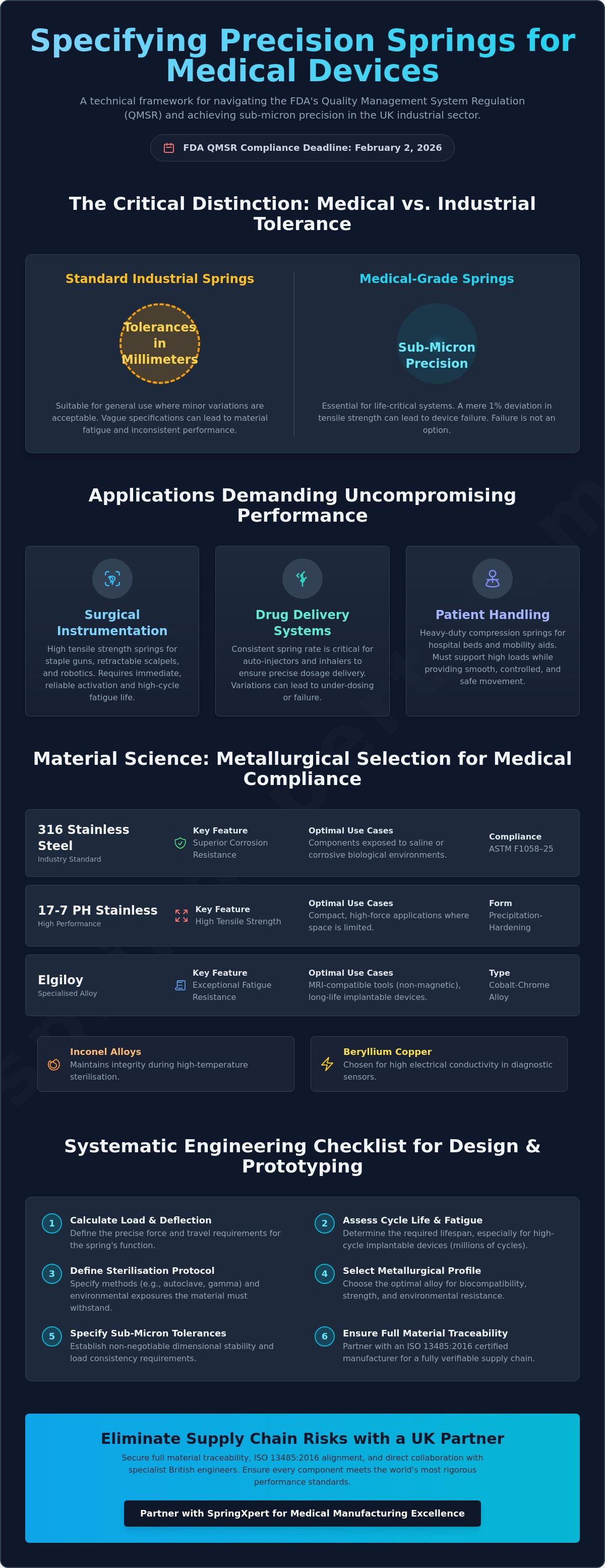
The Engineering Checklist: Specifying Your Medical Spring
Specifying a component for a life-critical application requires a systematic approach to risk mitigation. Most off-the-shelf catalogues fail to account for the unique mechanical stresses of the clinical environment. To ensure your design meets the rigorous standards of the 2026 global medical market, follow this technical checklist during the specification phase. Choosing a specialized medical device spring manufacturer early in the process allows for the integration of manufacturing feasibility into your initial CAD models, reducing the likelihood of costly design revisions later.
- Step 1: Define the Operating Environment. Identify exposure to bodily fluids, saline, or harsh chemicals. Specify the sterilization method, such as autoclave at 121°C or gamma radiation, as this dictates the metallurgical requirements.
- Step 2: Calculate Load and Deflection. Determine the exact force required at specific points of the stroke. Establish the spring rate (k) to ensure consistent performance, particularly for drug delivery mechanisms where dosage accuracy is paramount.
- Step 3: Select Wire Diameter and Material Grade. Balance the need for miniaturisation with the required fatigue life. Use the data from our material science analysis to choose between 316 Stainless Steel for corrosion resistance or 17-7 PH for high-load applications.
- Step 4: Establish Tolerance Levels. Distinguish between standard industrial tolerances and the precision levels required for critical dimensions. For surgical robotics, sub-micron tolerances may be necessary to ensure axial alignment.
- Step 5: UK Engineering Collaboration. Partner with a domestic manufacturer to facilitate rapid prototyping and direct technical consultation.
Prototyping and Technical Consultation
Early-stage involvement from our engineering team prevents the common pitfalls of over-specification or unmanufacturable designs. At our UK facility, a senior British engineer meticulously reviews every custom specification to ensure mechanical feasibility. We utilise modern CNC technology to produce rapid iterations, allowing you to test physical prototypes in your device housing within days. This industrious approach is essential for meeting the compressed development timelines of the $735.12 billion medical device industry. You can request a technical consultation to begin the prototyping process with our specialist team.
Testing and Validation Protocols
Validation is the cornerstone of the FDA’s new Quality Management System Regulation (QMSR) that took effect on February 2, 2026. Our quality control protocols include automated force testing and lifecycle fatigue analysis to verify that the spring meets your device's specific requirements. We conduct salt spray testing to validate corrosion resistance in harsh environments. UK specialists use digital measurement systems to verify sub-micron tolerances, providing a data-driven guarantee of quality. This level of transparency ensures that every batch is accompanied by a full Certificate of Conformity, maintaining the integrity of your medical supply chain.
SpringXpert: Your UK Partner for Medical Manufacturing Excellence
SpringXpert operates as a dedicated UK-based medical device spring manufacturer, focusing on the complex requirements of the modern clinical sector. Our facility is situated within the traditional industrial heartlands of the United Kingdom, where we maintain a team of senior British engineers and master technicians. This proximity offers medical OEMs a distinct advantage in a global market projected to reach $735.12 billion in 2026. By onshoring production, clients eliminate the risks of geopolitical supply chain disruptions and inconsistent quality from overseas suppliers. Our shop floor reflects the reality of British industry: a place where traditional craftsmanship meets high-speed CNC technology.
The transition to the FDA’s QMSR on February 2, 2026, has increased the demand for verifiable, high-precision components. We meet this demand by providing direct access to technical expertise on-site. When you partner with a domestic manufacturer, you remove the barriers of time zones and language, allowing for real-time collaboration on sub-micron tolerances. This industrious approach ensures that every bespoke spring is a physical manifestation of your CAD specifications. Our commitment to the UK industrial sector means we maintain high-quality engineering jobs while delivering the reliability required for life-critical applications.
- Direct access to senior British engineering staff for design consultation.
- Reduced lead times through localized UK supply chain management.
- Full compliance with 2026 ISO 13485:2016 and FDA QMSR standards.
- Bespoke manufacturing processes for custom-engineered components.
Bespoke Design and Engineering Services
Our engineering services are tailored to the specific metallurgical and mechanical demands of the 2026 medical market. Technical specialists in our facility oversee the entire production cycle, from the initial wire selection to the final automated inspection. The Xpert identity is built on over 20 years of experience in high-stakes precision manufacturing. This depth of knowledge is critical when developing components for surgical robotics or connected digital drug-delivery systems. We don't just supply parts; we act as an active engineering partner, ensuring that every custom-engineered solution is optimized for both performance and manufacturability.
Seamless Procurement for Medical OEMs
Procurement for medical devices requires a balance of volume flexibility and regulatory rigour. We provide tiered pricing for large-scale production runs while maintaining the agility needed for low-volume prototypes. Our quality management systems are fully aligned with ISO 13485:2016 and the latest UK medical device regulations. This ensures that every batch arrives with the necessary documentation for full traceability. We invite you to partner with SpringXpert for your next medical project to experience the stability and precision of a leading British industrial specialist.
Securing Technical Excellence for the 2026 Medical Landscape
The shift toward the FDA’s QMSR and the expansion of the $14.4 billion surgical robotics market necessitate a partnership grounded in verifiable data. Selecting a specialized medical device spring manufacturer within the UK ensures that your components meet the sub-micron tolerances and material traceability required for life-critical applications. By following a structured engineering checklist and prioritizing local metallurgical expertise, you mitigate the risks of fatigue-related failures. It's essential to partner with a specialist who understands that failure isn't an option in clinical environments.
SpringXpert provides a stable foundation for your B2B requirements through our ISO 9001 compliant manufacturing processes and over 20 years of precision engineering experience. Our dedicated UK-based technical support team is available to oversee your project from the initial CAD integration to final batch validation. This level of industrious collaboration transforms complex design challenges into reliable physical realities. We look forward to supporting your next engineering breakthrough with the precision and stability your project demands.
Request a Technical Consultation for Your Medical Spring Project
Frequently Asked Questions
What are the most common materials used by a medical device spring manufacturer?
Stainless Steel 316 and 17-7 PH are the primary materials used by a medical device spring manufacturer due to their high biocompatibility and tensile strength. We also process specialized alloys like Elgiloy for MRI-compatible instruments and Beryllium Copper for conductive sensors. All materials comply with the updated ASTM F1058–25 and F1854–25 standards recognized by the FDA as of February 19, 2026.
Why is ISO 13485 certification important for medical spring suppliers?
ISO 13485:2016 is the foundational quality standard that ensures a manufacturer's processes align with international safety requirements. Since the FDA’s Quality Management System Regulation (QMSR) took effect on February 2, 2026, this certification has become the mandatory baseline for U.S. and global market access. It guarantees that every production stage is documented and verifiable for patient safety.
Can you provide full material traceability for medical-grade components?
We provide 100% material traceability and a Certificate of Conformity (CoC) for every production batch. This documentation links each component back to its original mill heat number, ensuring metallurgical integrity. Our digital tracking systems are designed to integrate with the Unique Device Identifier (UDI) requirements mandated for 2026 medical supply chains, ensuring transparency throughout the product lifecycle.
How do you ensure the precision of miniaturised springs for medical devices?
We achieve precision in miniaturised springs through the use of multi-axis CNC wire forming centres and high-resolution digital measurement systems. These technologies allow us to maintain sub-micron tolerances on wire diameters as small as 0.08mm. Our British technicians monitor these processes in real-time to prevent dimensional drift during high-volume production runs, ensuring every part meets the exact CAD specification.
What is the typical lead time for custom medical spring prototypes in the UK?
Typical lead times for custom medical spring prototypes at our UK facility range from 5 to 10 working days. This rapid turnaround is made possible by our on-site engineering team and extensive domestic material stocks. Local manufacturing eliminates the 4-week transit delays often associated with overseas suppliers, allowing for faster design validation and more agile development cycles.
Do you offer specialised cleaning and passivation for surgical springs?
Specialized nitric and citric acid passivation is standard for all surgical springs to ensure a corrosion-resistant, iron-free surface. We also perform multi-stage ultrasonic cleaning in Clean Environment Rooms to remove manufacturing oils and microscopic particulates. These processes meet the stringent hygiene standards required for components used in invasive surgical procedures and implantable devices.
Can SpringXpert assist with the technical design and spring rate calculations?
Our senior British engineers provide comprehensive technical support, including spring rate calculations based on Hooke's Law and detailed CAD model reviews. We assist in determining the optimal load-deflection characteristics for your specific device requirements. This early-stage collaboration helps prevent mechanical failures and ensures the component performs reliably over its intended lifecycle within the clinical environment.
What types of testing do you perform on springs intended for life-critical devices?
We perform automated force testing, lifecycle fatigue analysis, and salt spray corrosion testing on all springs intended for life-critical applications. These protocols verify that the component can withstand the mechanical stresses and sterilization cycles typical in modern hospitals. Every test result is recorded and included in the final technical data package to support your regulatory compliance filings.