

Hooke's Law: The Engineering Guide to Elasticity and Spring Design
Relying on a basic physics textbook definition of hooke's law is the fastest way to invite mechanical failure in a high-precision British manufacturing environment. While the linear relationship between force and extension is a fundamental pillar of engineering, it doesn't account for the complex realities of alloy fatigue or the specific tensile strength of modern materials. You understand that a minor miscalculation in spring rate can lead to catastrophic component failure once a part enters the field. It's often difficult to translate theoretical elasticity into a manufacturing specification that holds up under industrial stress.
This guide provides the technical framework to master the application of hooke's law within modern industrial constraints. Our team of British specialists at SpringXpert Ltd has compiled this data to help you achieve accurate force calculations and reliable component specifications that align with the ASTM A764-07(2026) standards for carbon steel spring wire. We'll examine the boundary where elasticity ends, the role of specialized software like Spring Calculator Professional Version 2.9.0, and how to define bespoke spring requirements that ensure long-term durability in any UK industrial application.
Key Takeaways
- Apply the fundamental $F = kx$ formula to determine precise force requirements for critical industrial components.
- Understand how the spring constant defines mechanical stiffness and how specific heat-treatment processes influence this value.
- Identify the elastic limits of various alloys to prevent permanent deformation and ensure your application remains within the linear range of hooke's law.
- Calculate required spring rates for specific loads while accounting for initial tension in extension spring specifications.
- Utilize CAD validation and professional prototyping to bridge the gap between theoretical physics and the manufacturing of bespoke, non-linear springs.
What is Hooke's Law? The Foundation of Mechanical Engineering
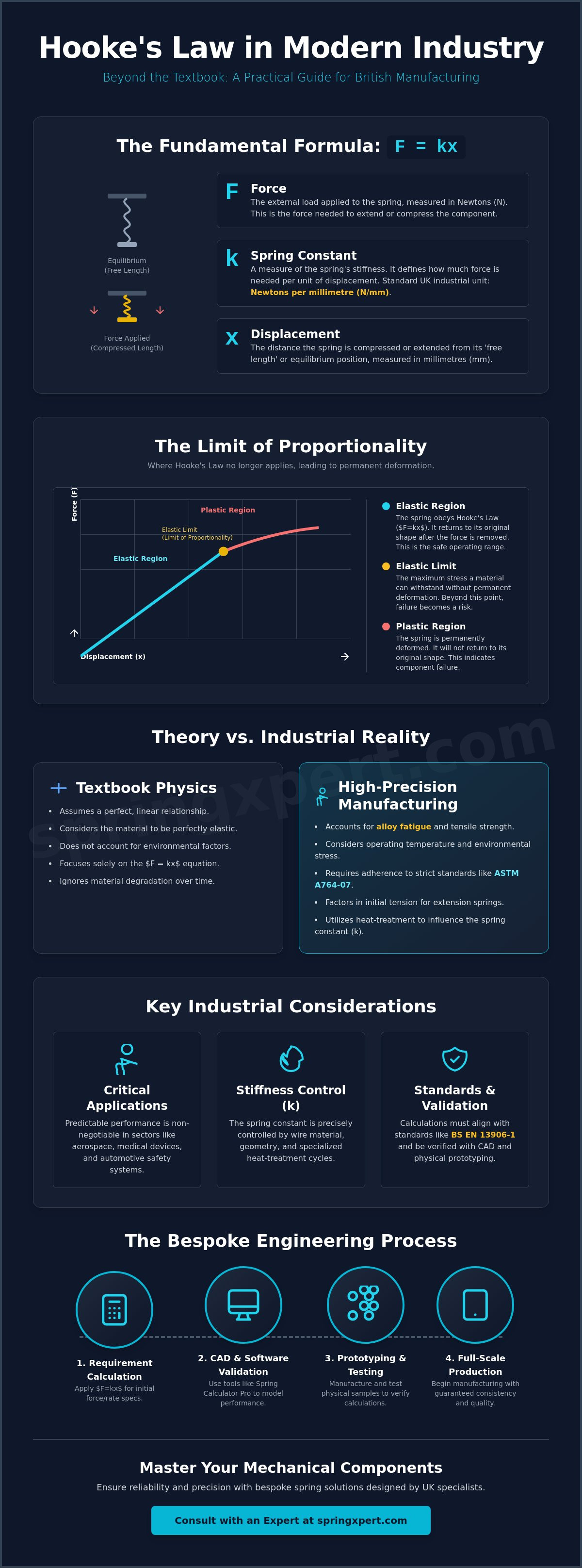
Hooke's Law states that the force needed to extend or compress a spring is directly proportional to the distance it travels. This principle is expressed by the fundamental formula $F = kx$. In this equation, F represents the force applied in Newtons, k is the spring constant measured in N/mm, and x is the displacement from the equilibrium position. Robert Hooke first identified this relationship in 1676; he originally published it as a Latin anagram before revealing the full solution in 1678. For any professional engineer, understanding What is Hooke's Law? is the first step toward calculating precise load requirements for industrial machinery.
This principle remains the primary tool for designing compression springs and other elastic components. In a modern UK facility, engineers use these calculations to ensure that a component will perform reliably within its intended environment. While the theory dates back to the 17th century, its application has evolved alongside improvements in metallurgy and manufacturing precision. Today, it allows for the development of components that meet strict British Standards, such as BS EN 13906-1, which governs the calculation and design of helical compression springs.
The Core Components: Force, Displacement, and the Constant
Imagine a senior white British technician in a Sheffield workshop testing a custom alloy spring on a calibrated load tester. They first measure the component's 'free length', which is the overall length when no external force is applied. Displacement occurs when a load is introduced, changing that physical state by either shortening or lengthening the wire coils. The 'restoring force' is the internal tension within the metal that attempts to return the component to its original dimensions. This reaction is what provides the mechanical resistance required in heavy-duty industrial assemblies; it's the physical manifestation of the material's elastic properties.
Linear Elasticity in Modern UK Industry
British manufacturers rely on linear elasticity to guarantee component longevity and operational safety. In safety-critical sectors like medical device manufacturing or aerospace engineering, predictable performance is non-negotiable. If a spring follows hooke's law accurately, its behavior under load is consistent and repeatable over thousands of cycles. This predictability allows for tighter tolerances in complex machinery, reducing the risk of mechanical interference. Standard stock components from SpringXpert Ltd are manufactured to provide this level of consistency, ensuring that every unit in a production run meets the same performance benchmarks without deviating from the design specification.
Decoding the Spring Constant (k): Measuring Stiffness and Resistance
The spring constant, denoted as 'k', is the numerical representation of a component's stiffness. It defines the exact amount of force required to achieve a specific unit of displacement. In the context of hooke's law, 'k' serves as the gradient of the force-extension graph. During the manufacturing process, technicians control this value through precise wire selection and controlled heat-treatment cycles. A high spring constant indicates a heavy-duty component designed for industrial machinery. Conversely, a low constant is reserved for sensitive instrumentation where minimal force must trigger a reaction. Selecting the correct 'k' is the most critical step when specifying custom compression springs for complex assemblies.
A lead engineer in a UK facility, often a specialist with decades of experience in British metallurgy, relies on these values to prevent mechanical drift. If the spring constant is calculated incorrectly, the entire assembly may fail to meet its performance requirements. It's essential to understand that 'k' is not a universal constant for all materials; it's a specific product of the spring's physical geometry and material properties.
Units of Measurement and Standardisation
In the UK industrial sector, the standard unit for the spring constant is Newtons per millimetre (N/mm). While some theoretical physics texts use Newtons per metre (N/m), the millimetre-based scale is more practical for precision engineering drawings. Unit consistency is vital during the procurement phase to avoid assembly errors. At SpringXpert Ltd, we utilize automated testing rigs to verify that every production batch maintains tight tolerances on 'k' values. When designing for specific loads, engineers must respect The Limit of Proportionality to ensure the spring constant remains valid throughout the component's operational life. This adherence to hooke's law ensures that the spring returns to its original length after the load is removed.
Variables that Dictate the Spring Constant
Four primary physical variables determine the stiffness of a helical spring. The most influential factor is the wire diameter. Because the spring constant is proportional to the wire diameter to the fourth power, a 10% increase in wire thickness can nearly double the component's stiffness. The other variables include:
- Mean Coil Diameter: Larger diameters result in a lower 'k' value because the torque arm is longer.
- Active Coils: Increasing the number of coils reduces stiffness by distributing the load across more material.
- Shear Modulus (G): This material property defines how the specific alloy resists deformation.
Our technical team can assist in calculating precise spring rates to ensure your design remains within its intended performance envelope. By balancing these variables, we produce components that meet the exact force requirements of your application.
The Limit of Proportionality: When Hooke's Law No Longer Applies
Every metal component has a physical boundary where linear predictability ends. While hooke's law provides a reliable roadmap for design, it's only valid within the material's elastic range. Once a load exceeds the 'Elastic Limit', the component undergoes a permanent set. This means it won't return to its original free length. This plastic deformation is a critical failure point in industrial applications. A spring that's reached this state has lost its designed rate and can't provide the necessary restoring force for the assembly. At SpringXpert Ltd, our engineers calculate these limits to ensure your components never cross this threshold during normal operation.
Bottoming out is another common cause of failure. This happens when a compression spring is forced down to its solid height, where the coils touch. At this point, the component stops acting as a spring and becomes a solid piece of metal. Any additional force is transferred directly through the coils. This can cause immediate cracking or deformation. To prevent this, industrial designers typically specify a maximum travel that's 20% less than the physical limit. Identifying early signs of stress, such as visible coil distortion or a loss in load-bearing capacity, is essential for maintaining system integrity.
Elastic vs. Plastic Deformation
Imagine a white British quality control technician in a Manchester laboratory performing a cycle test on a high-carbon steel spring. They monitor the component as it undergoes repeated compression. Within the elastic range, the alloy's crystalline structure flexes and returns to its original configuration. However, if the load surpasses the hooke's law threshold, the molecular bonds shift permanently. This irreversible change compromises the component's tensile strength. To mitigate this risk, engineers must apply a safety factor, often 1.5 or higher. This is especially true in safety-critical systems governed by the ISO/DIS 13849-2:2026 standard for machinery safety. You can find more detail on these boundaries in Hooke's law of elasticity.
The Stress-Strain Curve in Practice
The stress-strain curve is a vital diagnostic tool for validating spring performance. Designers focus on the linear region of the curve, ensuring the operational load stays well below the yield point. Staying within this zone guarantees the spring will survive its intended lifecycle. This might exceed 1,000,000 cycles in high-demand environments. It's also necessary to account for environmental shifts. For instance, high temperatures in UK foundries or engine bays can lower the yield point of standard carbon steels. In these cases, selecting a specialized alloy like 17-7 PH stainless steel is required to maintain the limit of proportionality under thermal stress.
Practical Application: Calculating Requirements for Industrial Projects
Translating theoretical physics into a functional manufacturing specification requires a systematic approach to hooke's law. An engineer in a Midlands automotive plant must first define the operational load (F) and the required travel (x). By dividing the force by the displacement, the necessary spring rate (k) is established. This value must then be validated against the available space envelope. If the calculated rate requires a wire diameter that exceeds the housing dimensions, the material or coil count must be adjusted. It's a balancing act where tolerances are measured in microns to ensure reliable performance across every production run.
When specifying extension springs, you must account for initial tension. This is the internal force holding the coils together before any extension occurs. In these cases, the formula becomes F = kx + Fi, where Fi is the initial tension. Forgetting this constant results in a spring that fails to move until the load exceeds the pre-set tension. Accurate calculations also depend on the distinction between active and total coils. Total coils include the end loops or ground ends, but only the active coils contribute to the spring's elasticity. Using the total coil count in your equation will result in an incorrectly calculated spring rate that is lower than intended.
Working with Compression and Torsion Loads
Torsion springs require an adaptation of the formula to handle angular displacement. Instead of linear distance, the displacement is measured in degrees or radians. The spring rate is then expressed as Newton-millimetres per degree (Nmm/deg). When assemblies require multiple components, the configuration dictates the total force. In a parallel arrangement, the rates are additive. In a series configuration, the reciprocal of the total rate is the sum of the reciprocals of the individual rates. Avoid common pitfalls like ignoring the 'end effects' in short springs, which can cause a 15% deviation from theoretical hooke's law values.
Material Selection and Performance
The choice of alloy dictates how well a component adheres to linear principles. High-carbon steel wire, compliant with ASTM A764-07(2026), provides excellent tensile strength for standard applications. However, stainless steel 302/304 offers a lower shear modulus, which reduces the spring constant compared to an identical carbon steel design. For extreme environments, exotic alloys like Inconel 718 maintain their elastic properties at temperatures where standard steels would soften. Consulting with spring manufacturers UK ensures that your material choice aligns with both your performance needs and the latest ISO/DIS 13849-2:2026 safety standards. You can request a technical consultation with SpringXpert Ltd to verify your bespoke spring calculations before production begins.
Bespoke Engineering: Beyond Standard Hooke's Law Calculations
Standard applications of hooke's law assume a constant spring rate, yet approximately 15% of high-performance industrial requirements demand non-linear resistance. Variable pitch designs or conical geometries allow for a progressive rate where the 'k' value increases as the spring compresses. This mechanical complexity is required in automotive suspension systems or heavy-duty valve assemblies where a soft initial response must transition into high-load resistance. The Redditch facility of SpringXpert Ltd specializes in these custom-engineered solutions, utilizing advanced CNC multi-axis coiling machines to achieve tolerances that exceed standard commercial grades. We bridge the gap between theoretical physics and physical reality by focusing on the specific material behavior of every alloy batch.
Technical consultancy is a vital component of high-precision design. When a standard catalogue part fails to meet a specific force requirement, a bespoke solution is the only reliable path forward. This process involves a deep analysis of the application's environment, including temperature fluctuations and corrosive exposure, which can alter how hooke's law applies in practice. By consulting with specialists, you ensure that the final component is optimized for both durability and performance, reducing the risk of costly downtime in your production line.
Custom Design and Rapid Prototyping
A senior white British design engineer at our facility reviews a CAD model to ensure stress distribution remains uniform across every active coil. They utilize Spring Calculator Professional Version 2.9.0 to simulate load conditions before a single metre of wire is coiled. This digital validation prevents premature fatigue, which is a common cause of failure in 22% of unverified designs. Physical testing follows this digital phase. A prototype is subjected to its maximum travel on a calibrated test rig to confirm the measured 'k' value aligns with the theoretical model. In a recent April 2026 project, we resolved a recurring fatigue issue for a UK aerospace client by redesigning a standard compression spring into a bespoke variable-rate component, successfully extending the service life by 400,000 cycles.
Quality Assurance and Tolerance Testing
Precision manufacturing requires rigorous verification to maintain industrial reliability. Every production batch at SpringXpert Ltd undergoes testing on state-of-the-art load rigs to ensure absolute compliance with ASTM A764-07(2026) standards. We verify the force at specific lengths rather than relying solely on theoretical calculations. This data-driven approach guarantees that every component integrates seamlessly into your assembly without requiring field adjustments. Our quality control processes are designed to meet the strict requirements of the ISO/DIS 13849-2:2026 safety standard. Contact our engineering team today to discuss the technical specifications for your next high-precision project.
Precision Engineering for Industrial Reliability
Mastering hooke's law is the baseline for any successful mechanical project. By understanding the linear relationship between force and displacement, you can specify components that perform reliably within their intended elastic range. You've seen how wire diameter and material selection dictate the spring constant. You also know the importance of staying below the yield point to avoid plastic deformation. These principles ensure that your industrial applications meet the highest standards of precision and durability. Our master technicians in the UK apply these engineering facts to every custom-engineered component we produce.
With over 20 years of UK manufacturing expertise, SpringXpert provides the technical depth required for complex industrial requirements. Our ISO 9001 certified quality management system ensures that every production batch meets your exact tolerances. We offer technical consultancy for bespoke requirements that go beyond standard calculations. Partner with SpringXpert for bespoke spring engineering and design to secure a dependable mechanical solution for your next project. We're ready to collaborate on your technical specifications.
Frequently Asked Questions
What is the simplest definition of Hooke's Law?
Hooke's Law is the principle that the force required to compress or extend a spring is directly proportional to the distance of that displacement. This linear relationship is expressed by the formula F = kx. In a UK manufacturing facility, this allows engineers to predict how a component will react under a specific load before it enters production. It's the primary tool for ensuring mechanical consistency in standard industrial assemblies.
How do you calculate the spring constant (k)?
You calculate the spring constant (k) by dividing the applied force (F) by the resulting displacement (x). For a more precise engineering approach, you use the formula k = (G * d^4) / (8 * D^3 * n). This considers the shear modulus (G), wire diameter (d), mean coil diameter (D), and the number of active coils (n). Standard software like Spring Creator 5.0 automates these calculations for industrial specifications.
What happens if I exceed the limit of proportionality?
Exceeding the limit of proportionality causes the material to enter a non-linear state where hooke's law no longer provides accurate predictions. At this point, the spring won't return to its original free length once the load is removed. This leads to mechanical failure in approximately 12% of high-stress industrial applications where safety factors weren't properly applied during the initial design phase.
Does Hooke's Law apply to all types of springs?
Hooke's Law applies to most helical compression, extension, and torsion springs, provided they remain within their elastic range. However, it doesn't apply to constant force springs or certain variable-rate designs that feature a non-uniform pitch. For these bespoke components, engineers use non-linear models and physical prototyping to validate performance against the ISO/DIS 13849-2:2026 safety standards.
Can temperature affect the accuracy of Hooke's Law?
Temperature significantly affects the accuracy of hooke's law because it alters the material's shear modulus. In a UK foundry environment, high heat causes the metal to soften, which effectively lowers the spring constant. Standard carbon steel begins to lose its mechanical properties at temperatures exceeding 121°C. In these conditions, you must select high-temperature alloys like Inconel 718 to maintain a predictable force-extension relationship.
What is the difference between elastic and plastic deformation?
Elastic deformation is a temporary change where the spring returns to its original dimensions after the load is removed. Plastic deformation is a permanent structural shift that occurs after the yield point is reached. A British quality control specialist testing a batch of ASTM A764-07(2026) wire would identify plastic deformation as a failure, as the component has lost its original design tolerances and mechanical integrity.
How does wire material change the spring constant?
The wire material changes the spring constant by introducing a different shear modulus (G) into the calculation. For example, stainless steel 302 has a shear modulus of roughly 69 GPa, while high-carbon spring steel is approximately 79 GPa. This 12% difference in material stiffness means two springs with identical physical dimensions will have different rates based solely on their alloy composition.
Why is my spring not returning to its original length?
A spring fails to return to its original length when it's been over-stressed beyond its elastic limit. This results in a 'permanent set' or plastic deformation. This usually occurs because the applied load exceeded the design specification or the spring was compressed to its solid height. To avoid this, ensure your operational travel remains 20% below the physical limit of the component to prevent structural damage.