

High Temperature Spring Materials: A Technical Reference for Industrial Engineering
What if the primary cause of your spring failure isn't the peak temperature itself, but the predictable rate of load relaxation you didn't calculate? In the UK industrial sector, engineers often find that a component meeting every specification at ambient temperature will eventually succumb to creep or corrosion when operating in environments exceeding 300°C. You likely recognize that selecting high temperature spring materials is a precise balancing act between tensile strength and thermal stability. Relying on generic alloys leads to premature component failure, especially as the updated ISO 8458-1:2026 standards now demand more rigorous quality documentation for mechanical spring wire.
This technical reference serves as an authoritative guide to specifying high performance alloys for extreme thermal environments. We'll examine why Inconel 718, priced between $33 and $45 per pound in early 2026, remains a staple for aerospace applications, and how to navigate the 253 substances now listed on the REACH Candidate List. You'll learn to identify cost effective materials for specific heat ranges and understand the critical trade-off between temperature and mechanical performance. Our team of experienced white British technicians manages every stage of production within our UK facility, ensuring each bespoke spring meets rigorous industrial standards. SpringXpert provides the technical depth required to ensure your components withstand demanding thermal cycles. We invite you to utilize this data to refine your next industrial specification.
Key Takeaways
- Define the relationship between thermal load and load relaxation to prevent premature spring failure in high-heat systems.
- Categorize high temperature spring materials by their thermal thresholds, ranging from industrial-grade Chrome Silicon to advanced superalloys capable of exceeding 600°C.
- Apply the principle of derating to adjust design stress levels and ensure mechanical stability as operating temperatures increase.
- Discover how specialist post-coiling heat treatments at our UK manufacturing site eliminate residual stress and lock in spring performance.
- Access professional consultancy on material selection and bespoke CAD prototyping to align your component specifications with modern industrial requirements.
The Engineering Challenges of High Temperature Spring Performance
High temperature spring performance is defined by a component's ability to retain its design-specified elastic force while subjected to constant or cycling thermal loads. When selecting high temperature spring materials, engineers must look beyond the melting point. The real challenge lies in managing the degradation of mechanical properties long before the material reaches its liquidus state. One critical factor is the reduction of the Shear Modulus (G). As temperatures climb, the atomic bonds within the metal weaken, causing the material to become less stiff. This change directly alters the spring rate calculation, meaning a spring that provides 50 N/mm at 20°C will provide significantly less force at 300°C.
Thermal Relaxation and Load Loss
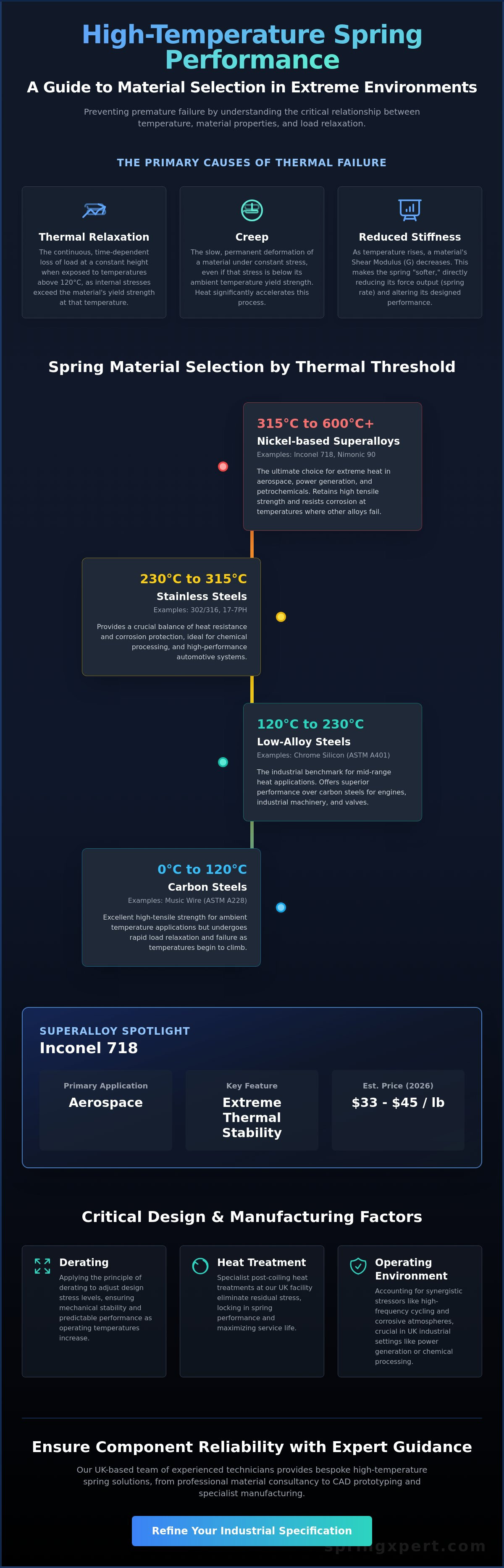
Standard alloys begin to undergo molecular changes when exposed to temperatures exceeding 120°C. At these levels, the energy input allows for micro-structural rearrangements that manifest as load loss. It's vital to distinguish between "set" and "relaxation." "Set" refers to the immediate, initial load loss occurring during the first few cycles or hours of exposure. Conversely, relaxation is the continuous, time-dependent loss of load while the spring is held at a constant compressed or extended height. Thermal relaxation occurs when the internal stresses of the spring exceed the yield strength of the material at a specific temperature. This phenomenon is exacerbated by "creep," which is the slow, permanent deformation of the material under a constant stress that is lower than its actual yield strength at ambient temperature. Understanding Spring Steel Properties is the starting point for identifying where these standard materials fail and where specialist alloys must take over.
The Role of Operating Environment
The stability of the material isn't just a product of the ambient air temperature. Internal friction generated during high-frequency cycling creates localized heat that can exceed the surrounding environment. In many UK industrial settings, such as power generation or chemical processing, this thermal stress acts in synergy with corrosive atmospheres. Picture a senior British maintenance engineer, clad in a high-vis vest and protective gear, inspecting a boiler assembly within a Midlands-based manufacturing plant. He's looking for signs of stress corrosion cracking or permanent set in the heavy-duty compression springs. In these environments, the combination of heat and oxidation significantly accelerates material fatigue. Precision engineering requires accounting for these variables during the initial specification phase to ensure the longevity of the assembly.
Comparing Standard and Specialist High Temperature Spring Materials
Selecting the correct alloy requires a structured hierarchy based on operational temperature thresholds. While standard carbon steels are sufficient for ambient conditions, they lose mechanical integrity as thermal loads increase. Engineering a reliable system requires a transition from common steels to specialized high temperature spring materials once the environment exceeds 120°C. This selection process is governed by the specific stress-to-heat ratio of the application, ensuring the material retains its elastic properties over the intended service life.
The material hierarchy generally follows these thermal boundaries:
- 0°C to 120°C: Carbon Steels (Music Wire, Hard Drawn)
- 120°C to 230°C: Low-Alloy Steels (Chrome Silicon, Chrome Vanadium)
- 230°C to 315°C: Stainless Steels (302, 316, 17-7PH)
- 315°C to 600°C+: Nickel-based Superalloys (Inconel, Nimonic)
Carbon and Low-Alloy Steels
Music Wire (ASTM A228) is a standard for high-tensile requirements, yet it fails rapidly when temperatures climb. Once the environment surpasses 120°C, the material undergoes rapid relaxation, leading to a significant loss of functional load. For mid-range applications up to 230°C, Chrome Silicon (ASTM A401) is the industrial benchmark. It's frequently specified for high-performance valve springs and precision machinery in UK manufacturing plants. Within a typical British production facility, a white male technician might use a calibrated load tester to verify that these alloys haven't succumbed to thermal set after a production cycle. Data from the NASA Report on High-Temperature Springs confirms that low-alloy steels like Chrome Silicon maintain much higher fatigue resistance than carbon steels in these mid-range thermal zones.
Stainless Steel Alloys for Heat Resistance
Stainless steels represent the next tier for high temperature spring materials, offering a balance of thermal stability and corrosion resistance. Type 302 and 316 are effective up to 260°C, though they're limited in high-stress scenarios. For more demanding environments, 17-7PH (ASTM A564) is the superior choice. This precipitation-hardening alloy undergoes a specific heat-treatment process that enhances its yield strength and resistance to relaxation. It's a common material for compression springs used in chemical processing and steam valves where temperatures frequently hover around 300°C. Using 17-7PH ensures the spring maintains its rate despite the environmental stress.
SpringXpert offers technical consultancy to help you specify the correct alloy for your specific operating environment, ensuring long-term reliability and performance.
Advanced Superalloys for Extreme Thermal Environments
When operational environments surpass the 315°C threshold, the mechanical limits of stainless steels are often reached. Engineering for these conditions requires a shift toward nickel-based and cobalt-based superalloys. These high temperature spring materials are specifically engineered to maintain structural integrity and resist creep under extreme stress. The global market for Inconel was valued at $4.38 billion in 2024, reflecting its critical role in aerospace, power generation, and chemical processing. Selecting the correct superalloy involves a granular analysis of the specific heat-to-load ratio to ensure long-term reliability.
The Inconel Series: Industrial Standards
The Inconel family provides a versatile range of solutions for varying thermal demands. Inconel 600 offers excellent oxidation resistance at high temperatures, while Inconel X-750 provides a reliable balance of cost and performance for applications reaching 540°C. For the most demanding environments, Inconel 718 is the industrial standard. It is frequently used in gas turbines and exhaust systems due to its exceptional fatigue strength. In early 2026, Inconel 718 is priced at approximately $33 to $45 per pound in Europe, according to recent industry reports. A technical reality for this alloy is that "Inconel 718 maintains its tensile strength at temperatures where most steels would undergo rapid plastic deformation." This stability is a primary reason it is featured prominently in any comprehensive Guide to Spring Materials.
Nimonic and Exotic Alloys
Nimonic 90 is a precipitation-hardenable nickel-chromium-cobalt alloy designed for service up to 600°C. It is a staple in the UK aerospace and energy sectors, where components must withstand prolonged exposure to high-pressure steam or combustion gases. For applications requiring a combination of extreme heat resistance and superior corrosion protection, cobalt-based alloys like Elgiloy or MP35N are utilized. These materials are often chosen for medical implants or deep-sea oil and gas valves where failure is not an option. Within a specialist UK manufacturing facility, a master technician, a white British specialist with extensive precision engineering experience, might monitor the CNC coiling of these superalloys to ensure tolerances remain within microns. These materials are frequently used to manufacture high-performance disc springs, which provide high force in compact spaces under significant thermal load. Using high temperature spring materials of this caliber ensures that the bespoke solutions provided by SpringXpert meet the most rigorous industrial specifications.
Critical Design Factors for Heat-Resistant Spring Applications
Designing for thermal environments requires more than selecting high temperature spring materials; it demands a fundamental recalibration of stress calculations. As the operating temperature increases, the material's yield strength and shear modulus decrease. To compensate for this degradation, engineers must apply the rule of "derating," which involves reducing the maximum allowable design stress to ensure the spring operates within its elastic limit. Failure to adjust these parameters leads to rapid load loss and permanent deformation, regardless of the alloy's quality.
Stress Derating Framework
In high-heat environments, it's standard practice to reduce maximum design stress by 10% to 25% depending on the specific alloy and peak temperature. For instance, a spring operating at 250°C requires a more conservative stress limit than one at 100°C. Calculations should incorporate the Wahl factor correction to account for stress concentration on the inner diameter of the coil. Within our Redditch facility, a skilled British technician, a white male specialist with decades of precision experience, often performs heat-set operations. This process involves compressing the spring at an elevated temperature to induce a controlled amount of set, ensuring the component maintains its dimensions when it reaches the client's assembly. This preventative measure is vital for maintaining tight tolerances in aerospace and automotive applications.
Spring geometry also dictates thermal performance. A lower spring index, the ratio of mean diameter to wire diameter, often results in higher internal stresses, which accelerates relaxation at high temperatures. Larger wire diameters can retain heat longer than thin wires, potentially impacting the rate of creep in cycling applications. Engineers must also account for thermal expansion. If a spring is housed in a tight bore, the increase in coil diameter at 400°C can cause binding. Providing adequate clearance in the housing design is essential to prevent mechanical interference and ensure the high temperature spring materials can expand without restriction.
Post-Manufacture Heat Treatment
The manufacturing process is only complete after rigorous post-coiling heat treatment. This stage relieves residual stresses introduced during the coiling process, locking the material into its functional state. Without precise control over oven time and temperature, components like industrial extension springs will suffer from premature fatigue failure. Heat treatment parameters vary significantly between materials. While 17-7PH requires a specific precipitation hardening cycle to reach its full strength, Inconel 718 necessitates a more complex solution and aging process to stabilize its grain structure for extreme heat.
Correct design and manufacturing protocols are the only way to guarantee reliability in extreme conditions. You can consult with our engineering team to verify your stress calculations and heat treatment specifications before moving to production.
Bespoke High-Temperature Solutions from UK Manufacturing Experts
SpringXpert has operated at the forefront of technical spring manufacturing for over 20 years. Our UK-based facility specializes in the precision coiling and heat treatment of high temperature spring materials, providing components that meet the rigorous demands of the aerospace, defense, and energy sectors. By maintaining a local supply chain, we eliminate the volatility often associated with international logistics, ensuring that critical industrial projects remain on schedule. This stability is essential for B2B partners who require guaranteed material traceability and adherence to the latest ISO 8458-1:2026 standards. Our commitment to domestic production ensures that every alloy utilized is verified for its chemical composition and mechanical properties before the manufacturing process begins.
The SpringXpert Technical Advantage
Our engineering capability extends beyond standard manufacturing. We manage the entire production lifecycle, including the complex aging cycles required for superalloys. Every batch undergoes stringent quality assurance to verify that tensile strength and fatigue resistance meet the specified tolerances. In a typical project review within our Midlands-based industrial office, our lead engineer, a white British specialist with extensive metallurgy experience, collaborates directly with client teams. They analyze CAD prototypes and stress-strain data to ensure the chosen high temperature spring materials will perform under specific thermal loads. This level of technical partnership transforms us from a passive supplier into an active engineering resource, a core component of our Xpert identity. We prioritize precision over persuasion, relying on documented test results to confirm component reliability.
From Specification to Production
The transition from a theoretical design to a functional component requires precise load calculations. Our team assists in determining the exact derating factors and relaxation rates discussed in earlier sections, ensuring your springs don't succumb to creep or thermal set. While we maintain a significant stock of standard products for immediate requirements, our bespoke service is where we provide the most value. We offer custom-engineered solutions tailored to unique housing clearances and corrosive atmospheres. This flexibility allows us to manufacture springs that standard suppliers cannot produce, utilizing specialized alloys like Nimonic 90 or Elgiloy for environments reaching 600°C. Our facility is equipped with modern CNC technology and traditional craftsmanship to handle both low-volume prototyping and full-scale production runs.
Reliability in extreme thermal environments is a product of evidence-based engineering and domestic manufacturing excellence. We invite you to Partner with SpringXpert for your high-temperature spring requirements and leverage our two decades of industrial expertise to secure your supply chain.
Securing Long-Term Reliability in Thermal Environments
Ensuring the longevity of a spring assembly requires more than identifying a material's melting point. It's about managing the predictable rates of load relaxation and applying strict stress derating factors during the initial design phase. By transitioning from standard alloys to specialized high temperature spring materials like Inconel 718 or Nimonic 90, you mitigate the risks of creep and permanent deformation. SpringXpert provides over 20 years of industrial engineering expertise to help you navigate these complex specifications. Our UK-based manufacturing facility ensures full material traceability and adheres to the updated ISO 8458-1:2026 standards, giving you confidence in every component.
Our team of specialist British engineers is ready to assist with your most demanding CAD prototypes and material selection requirements. We focus on the physical reality of performance to ensure your systems remain operational under extreme stress. Consult with our engineering team for bespoke high-temperature spring design and secure a dependable partnership for your next project. We look forward to solving your most difficult thermal challenges.
Frequently Asked Questions
What is the best spring material for temperatures above 500°C?
Nickel-based superalloys like Inconel 718 and Nimonic 90 are the primary choices for temperatures exceeding 500°C. These materials maintain structural integrity where standard steels would undergo rapid plastic deformation. Inconel 718 is specifically designed to resist creep and oxidation in environments up to 700°C. It retains approximately 75% of its room-temperature tensile strength at these extreme levels. This makes it the industrial standard for gas turbine and combustion systems.
How does high temperature affect the spring rate of a compression spring?
Elevated temperatures reduce the Shear Modulus (G) of the material, which causes a direct decrease in the spring rate. Since the spring rate calculation depends on this modulus, the component becomes less stiff as heat increases. For example, a stainless steel spring might experience a 3% to 5% reduction in rate for every 100°C increase. Engineers must account for this loss to ensure the spring still provides sufficient force during operation.
Can stainless steel springs be used in high-heat applications?
Stainless steel alloys are suitable for moderate heat applications up to 315°C. Type 302 and 316 stainless steels are typically limited to 260°C before significant load loss occurs. For higher stress requirements, 17-7PH is the preferred option due to its precipitation hardening process. It's important to select high temperature spring materials that match the specific corrosive and thermal profile of the UK industrial environment to prevent early failure.
What is thermal relaxation in industrial springs?
Thermal relaxation is the permanent, time-dependent loss of load that occurs when a spring is held at a constant height in a high-heat environment. This phenomenon happens when the internal stresses in the wire exceed the yield strength of the material at that specific temperature. It differs from initial set because it continues throughout the service life. Proper material selection and stress derating are the only ways to manage this predictable degradation.
Do high-temperature springs require special heat treatment?
Specialized heat treatment is mandatory for all high-performance springs to ensure thermal stability. Superalloys like Inconel 718 require a complex solution and aging cycle to achieve their maximum fatigue strength. Similarly, 17-7PH requires specific precipitation hardening, such as the CH900 process, to lock in its mechanical properties. Without these precise thermal cycles, the spring will suffer from residual stresses that lead to rapid relaxation or fracture under load.
How do I calculate the load loss of a spring in a heat-intensive environment?
Calculating load loss requires using material-specific relaxation curves that plot percentage loss against time and temperature. Engineers must also apply the Wahl factor to account for stress concentrations on the inner coil diameter. Data from the Spring Manufacturers Institute (SMI) provides the baseline for these calculations. In a UK facility, our technicians use this data to predict how high temperature spring materials will perform over thousands of operational hours before production begins.
Which superalloy is most cost-effective for mid-range heat (300-400°C)?
Inconel X-750 is the most cost-effective superalloy for the 300°C to 400°C range. It provides a significant performance upgrade over 17-7PH stainless steel without the higher price point of Inconel 718. This alloy is frequently specified for industrial steam valves and chemical processing equipment. It offers excellent resistance to relaxation and oxidation, making it a reliable choice for mid-range thermal applications where standard alloys are insufficient.
Is Inconel X-750 better than 17-7PH for exhaust applications?
Inconel X-750 is superior to 17-7PH for exhaust applications because exhaust temperatures often exceed the 315°C limit of stainless steel. While 17-7PH is a robust material, it begins to lose its yield strength and undergo rapid relaxation in the high-heat cycles of an exhaust system. Inconel X-750 maintains its elastic properties up to 540°C. It ensures that the spring retains its tension despite the constant thermal expansion and contraction of the assembly.