

Spring Steel Material Specifications: A Technical Reference for UK Engineering
Selecting a general steel grade is a risk that UK precision engineering can no longer afford, especially when a minor deviation in chemical composition leads to catastrophic component failure. You're likely aware that the reliability of a high-performance compression spring depends entirely on the exact tolerances of its raw material. This technical reference clarifies complex spring steel material specifications to ensure your designs meet the rigorous demands of modern manufacturing.
We provide a comprehensive breakdown of chemical limits and mechanical properties according to the latest standards, including the BS EN 10270-1:2024 update published on March 31, 2024. As UK hot-rolled coil prices surged by 45 percent in March 2026, identifying the correct BS EN grade is now a financial necessity as well as a technical one. This guide covers how to navigate the transition from BS 1449 to current EN standards and explains how the July 1, 2026, import regulations impact your sourcing strategy for bespoke spring design within the British industrial sector.
Key Takeaways
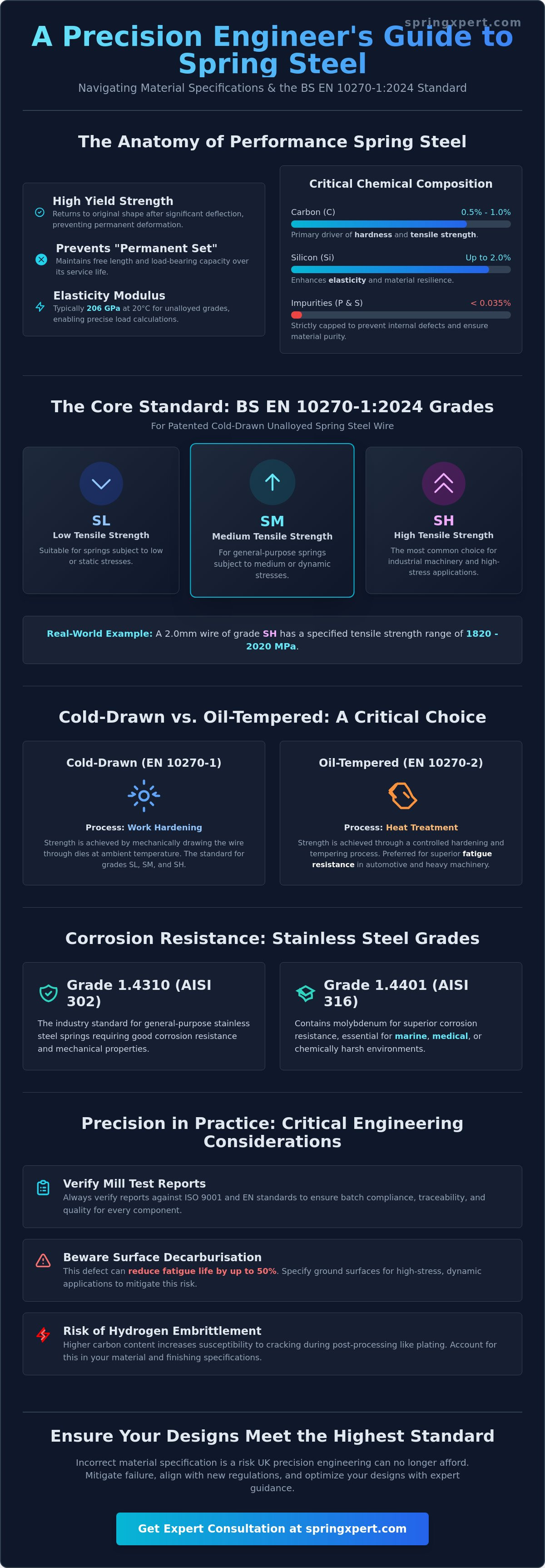
- Identify how carbon percentages between 0.5% and 1.0% dictate the hardness and tensile strength of high-yield alloys.
- Distinguish between SL, SM, and SH grades within the BS EN 10270-1 standard to ensure your components handle specific mechanical loads.
- Compare spring steel material specifications for stainless grades 1.4310 and 1.4401 to prevent corrosion in marine or medical applications.
- Master accurate material call-outs for technical drawings to maintain strict tolerances and fatigue limits during precision manufacturing.
- Align bespoke spring design with domestic material availability to mitigate the impact of shifting UK steel import regulations.
Fundamentals of Spring Steel Material Specifications
Spring steel is defined by its high yield strength. It's a category of alloy that allows components to return to their original shape after significant deflection. The alloy known as spring steel is characterized by its ability to withstand significant twisting or pulling forces without suffering permanent deformation. This resilience is a direct result of specific chemical compositions and targeted heat treatment processes.
The carbon content, ranging from 0.5% to 1.0%, is the primary driver of hardness and tensile strength. However, carbon alone doesn't provide the necessary performance for high-stress applications. Silicon is a critical additive, often present at levels up to 2.0%, which enhances the material's elasticity. It prevents "permanent set," a condition where a spring loses its free length or load-bearing capacity over time. For engineers in the United Kingdom, the BS EN 10270 standard provides the essential framework for these spring steel material specifications. Specifically, the BS EN 10270-1:2024 update, published on March 31, 2024, ensures consistency across various industrial grades of unalloyed wire.
Yield Strength and Elasticity: The Core Requirements
The yield point is the threshold where a material shifts from elastic to plastic deformation. In spring manufacturing, staying below this limit is vital for component longevity. While tensile strength represents the maximum stress a material can withstand before breaking, the elastic limit defines the maximum stress it can endure while still returning to its original form. Precision is required here. For standard unalloyed spring steel, the modulus of elasticity is typically defined as 206 GPa at 20 degrees Celsius. Understanding this value allows designers to calculate exact load rates for compression or torsion springs without risking component failure.
The UK Industrial Context: Quality Standards
In a professional UK workshop, a senior British engineer will verify mill test reports to ensure every batch of wire complies with ISO 9001 standards. This meticulous approach is central to the UK's industrial heritage, where experienced technical staff maintain the high standards expected in precision manufacturing. Modern material selection processes are deeply influenced by this legacy, ensuring that spring steel material specifications aren't just met, but are documented for full traceability. Sourcing materials that meet verified standards protects the integrity of the final product, whether it's a heavy-duty die spring or a bespoke wire form designed for a complex B2B requirement.
Carbon Spring Steel: BS EN 10270-1 Specifications
The BS EN 10270-1 standard governs patented cold-drawn unalloyed spring steel wire. It's the foundational specification for components that don't require the corrosion resistance of stainless alloys. Grades are divided by tensile strength: SL for low, SM for medium, and SH for high tensile requirements. For industrial machinery, SH is the most frequent choice due to its high yield point. Material purity is strictly controlled, with phosphorus and sulphur levels capped at 0.035% to prevent internal defects. These spring steel material specifications ensure that every batch of wire performs consistently under load.
Cold-Drawn vs. Oil-Tempered Carbon Steel
Mechanical differences between EN 10270-1 and EN 10270-2 are significant. Cold-drawn wire (EN 10270-1) achieves its strength through work hardening during the drawing process. In contrast, oil-tempered wire (EN 10270-2) relies on a hardening and tempering heat treatment. You'll find oil-tempered steel is preferred for superior fatigue resistance in compression springs used in automotive or heavy machinery. While the ASTM A125 specification is a common international reference, UK engineers prioritize the BS EN standards for local compliance. High-stress applications often require ground surfaces to eliminate surface decarburisation, which can reduce fatigue life by as much as 50%.
Grade Selection for Standard Components
Choosing grades for high-volume clips or washers involves balancing strength with post-processing needs. Higher carbon content improves the spring rate but makes the material more susceptible to hydrogen embrittlement during plating. For a 2.0mm SH wire, the tensile strength range is 1820 to 2020 MPa. In a South Yorkshire workshop, a British technician will verify these tensile values against mill certificates before production begins. Getting the spring steel material specifications right at the drawing stage prevents costly failures during the assembly of your products. If your application involves complex load cycles, SpringXpert Ltd offers bespoke spring design services to help you select the optimal grade for your specific requirements.
Stainless and Alloy Spring Steel Material Specs
Standard carbon steel is insufficient for environments involving corrosive agents or extreme temperatures. In these scenarios, engineers must specify alloys that offer chemical stability alongside mechanical resilience. The primary framework for stainless spring steel material specifications in the UK remains BS EN 10270-3. This standard focuses heavily on Grade 1.4310 (AISI 301), which is the workhorse of the stainless spring world. It achieves high tensile strength through cold reduction, making it ideal for standard industrial applications where moisture or light chemicals are present.
For more demanding environments, such as marine hardware or chemical processing plants, Grade 1.4401 (AISI 316) is the superior choice. The inclusion of 2% to 3% molybdenum provides essential protection against pitting and crevice corrosion. These material choices are often validated by British metallurgical technicians in domestic laboratories to ensure compliance with international steel standards before a production run begins. Using the correct alloy prevents the premature failure of components in high-salinity or acidic conditions.
Corrosion Resistance and Sanitary Standards
The UK food and medical sectors require materials that don't contaminate the production environment. Grade 1.4401 is frequently specified for its sanitary properties and lack of reactivity. Magnetic permeability is another critical factor. While 1.4310 becomes noticeably magnetic after the cold-drawing process, other austenitic grades maintain lower permeability. This distinction is vital for components used near sensitive electronic sensors or in MRI environments. When designing extension springs for outdoor infrastructure, selecting a stainless grade with high nickel content ensures the component doesn't succumb to the British weather.
High-Temperature Performance Specs
Temperature significantly alters the performance of spring alloys. Carbon steel begins to soften at 120 degrees Celsius, which leads to a rapid loss of spring force. Chrome Silicon (CrSi) and Chrome Vanadium (CrV) alloys extend this operating range to 250 degrees Celsius by improving the material's resistance to tempering. For extreme conditions, such as engine valves or aerospace components, superalloys like Inconel are necessary. These materials resist thermal relaxation, which is the loss of load over time when a spring is held at a constant height in a high-heat environment. Die springs used in plastic injection moulding must adhere to these strict spring steel material specifications to prevent production downtime caused by spring fatigue in heated moulds.
Mechanical Properties and Tolerance Standards
Tensile strength (Rm) in spring steel material specifications isn't a fixed constant. It varies inversely with the wire diameter. For example, a 0.5mm SH grade wire can reach an Rm of 2600 MPa, whereas a 10mm wire of the same grade might only achieve 1400 MPa. This inverse relationship is fundamental to accurate spring design. Alongside tensile strength, engineers must account for the modulus of shear (G). For unalloyed carbon steel, this value is typically 79,000 MPa. It's essential for calculating the torque of torsion springs or the initial tension in extension springs.
Surface integrity directly dictates component longevity. Even minor surface defects or decarburisation layers act as stress raisers that initiate premature fatigue failure. BS EN 10218-2 provides the standard tolerances for wire diameter, ensuring raw materials meet the precision required for automated manufacturing. Adhering to these tight tolerances prevents inconsistent performance across production batches and ensures the material behaves predictably during the coiling process.
Fatigue Life and Stress Cycles
Designing for "infinite life" requires the stress levels to remain below the endurance limit on the Wohler curve. For high-cycle applications like engine valve springs, the material must be free from non-metallic inclusions. Shot peening is a critical secondary process here. It induces compressive residual stresses on the spring surface, which can improve fatigue life by up to 30%. This process effectively shifts the fatigue limit higher, allowing for more aggressive stress cycles without the risk of sudden fracture.
Dimensional and Load Tolerances
Precision in spring steel material specifications extends to finished component dimensions. For disc springs, the BS EN ISO 10243 standard defines the allowable load and height variations. The spring rate (k) is exceptionally sensitive to material gauge. Because the diameter (d) is calculated to the power of four in standard rate formulas, a minor 2% gauge variation can result in an 8% deviation in load. In a typical West Midlands manufacturing facility, a British technician will use CNC-controlled laser micrometers to verify these dimensions. This level of scrutiny ensures that bespoke components fit perfectly into their intended assemblies. If your project requires tight load tolerances, you can request a technical consultation to discuss specific material requirements.
Engineering Best Practices for Material Specification
A precise technical drawing is the final bridge between design theory and industrial reality. When defining spring steel material specifications, engineers must move beyond generic labels and provide a comprehensive material call-out. This documentation should include the specific BS EN grade, the required tensile strength range, and any necessary surface treatments like passivating or zinc plating. Clear documentation prevents the use of sub-optimal alloys that could compromise the assembly's safety or operational performance.
Effective specification balances mechanical limits with commercial reality. While previous sections detailed the mechanical properties of SH or stainless grades, the final specification must also weigh these against supply chain factors. For instance, the UK Carbon Border Adjustment Mechanism (CBAM) effective January 1, 2027, will influence the cost-effectiveness of imported versus domestic alloys. Sourcing from a domestic manufacturer with 20+ years of expertise ensures your designs remain technically sound and economically viable within the shifting UK industrial landscape.
Creating a Robust Technical Specification
A robust specification considers the total lifecycle of the component. Engineers should use a standardized checklist to define their requirements:
- Environmental Exposure: Identifying high-salinity or acidic conditions that necessitate 1.4401 over 1.4310.
- Load Dynamics: Distinguishing between static holding forces and high-frequency stress cycles.
- Dimensional Envelope: Ensuring the material gauge provides the necessary rate (k) within the available space.
- Post-Processing: Specifying if the material must withstand high-temperature coating cycles.
Partnering with SpringXpert Ltd for Custom Solutions
Transitioning from standard stock to custom-engineered solutions requires a collaborative approach. At our Redditch facility, we specialize in bespoke spring design and prototyping for complex B2B requirements. Our technical staff, including experienced British master technicians, analyze your specific load cases to identify the most efficient material path. Whether you require non-standard wire forms or high-precision pressed metal components, we provide the technical depth required for successful implementation. You can Contact our technical team for a comprehensive material analysis to ensure your project adheres to the most current spring steel material specifications.
Optimising Material Selection for Performance and Longevity
Precision engineering isn't just about the manufacturing process; it's about the data-driven selection of alloys. Correctly applying spring steel material specifications ensures that every component, from a standard washer to a complex torsion spring, functions within its elastic limit throughout its service life. This technical rigour prevents the premature fatigue that often stems from using non-standard or generic grades in high-stress environments. By prioritising verified BS EN standards, you protect the structural integrity of your assemblies and reduce the risk of catastrophic field failures.
SpringXpert Ltd supports your production with a massive inventory of over 20,000 standard products and specialized engineering for bespoke requirements. Our UK-based manufacturing operations draw on 20+ years of experience to solve complex B2B challenges. In our Redditch facility, British master technicians oversee the production of precision-engineered components that meet the highest industrial standards. Request a Technical Quote for Bespoke Springs today to ensure your designs are backed by industrial reliability and technical authority. We look forward to partnering with you on your next engineering project.
Frequently Asked Questions
What is the most common spring steel grade used in the UK?
BS EN 10270-1 Grade SH is the most prevalent grade in the UK for general industrial applications. It's an unalloyed carbon steel wire that provides a high yield point for compression and extension springs. While SL and SM grades exist for lower stresses, SH is the standard for 85% of domestic mechanical engineering requirements due to its reliability and widespread availability.
How does carbon content affect the performance of spring steel?
Carbon content directly determines the material's ability to be hardened through heat treatment or cold drawing. Percentages between 0.5% and 1.0% increase the hardness and tensile strength, which are vital for energy storage. While higher carbon levels improve the spring rate, they also make the steel more brittle and sensitive to surface defects during the manufacturing process.
Can stainless steel be used for high-load spring applications?
Stainless steel is suitable for high-load applications when the correct grade, such as 1.4310 (AISI 301), is specified. This grade achieves high tensile strength via cold reduction during the drawing process. It's important to note that stainless alloys have a lower modulus of elasticity than carbon steel, so your spring steel material specifications must account for a 10% reduction in stiffness.
What is the difference between EN 10270-1 and EN 10270-2?
The primary difference lies in the strengthening process used during wire production. EN 10270-1 refers to wire that's cold-drawn to reach its final tensile strength. EN 10270-2 is oil-hardened and tempered, a process that provides a more uniform grain structure. This makes EN 10270-2 superior for high-cycle dynamic applications where fatigue resistance is the primary design concern.
How do I calculate the tensile strength required for my spring design?
You determine the required tensile strength (Rm) by referencing the BS EN 10270-1:2024 tables for your specific wire diameter. For a safe design, the maximum operating stress shouldn't exceed 50% to 60% of the minimum tensile strength. Our technical team uses these spring steel material specifications to verify that bespoke designs won't suffer from plastic deformation under their intended maximum load.
What environmental factors dictate the need for alloy spring steels?
Extreme temperatures and chemical exposure are the main drivers for selecting alloyed steels. Standard carbon steel loses its mechanical properties in environments exceeding 120 degrees Celsius. If your application involves high-heat manufacturing or exposure to marine salt spray, you must specify alloys like Chrome Silicon or Stainless 1.4401 to maintain structural integrity and prevent corrosion-induced failure.
Are there specific British Standards for spring steel wire tolerances?
Yes, BS EN 10218-2 defines the dimensional tolerances for all spring steel wire used in the UK. This standard ensures that wire diameter deviations remain within strict limits, which is critical for maintaining a consistent spring rate. Precision CNC equipment used by British technicians relies on these tolerances to produce batches of components that are identical in performance and fit.
What is the maximum operating temperature for standard carbon spring steel?
The maximum reliable operating temperature for standard carbon spring steel is 120 degrees Celsius. Operating at temperatures above this limit causes the material to undergo thermal relaxation, which results in a permanent loss of load-bearing capacity. For applications reaching 250 degrees Celsius, engineers should transition to Chrome Vanadium or Chrome Silicon alloys to ensure the spring maintains its original free length.