

Spring Manufacturers UK: A Technical Guide to Selecting Industrial Partners
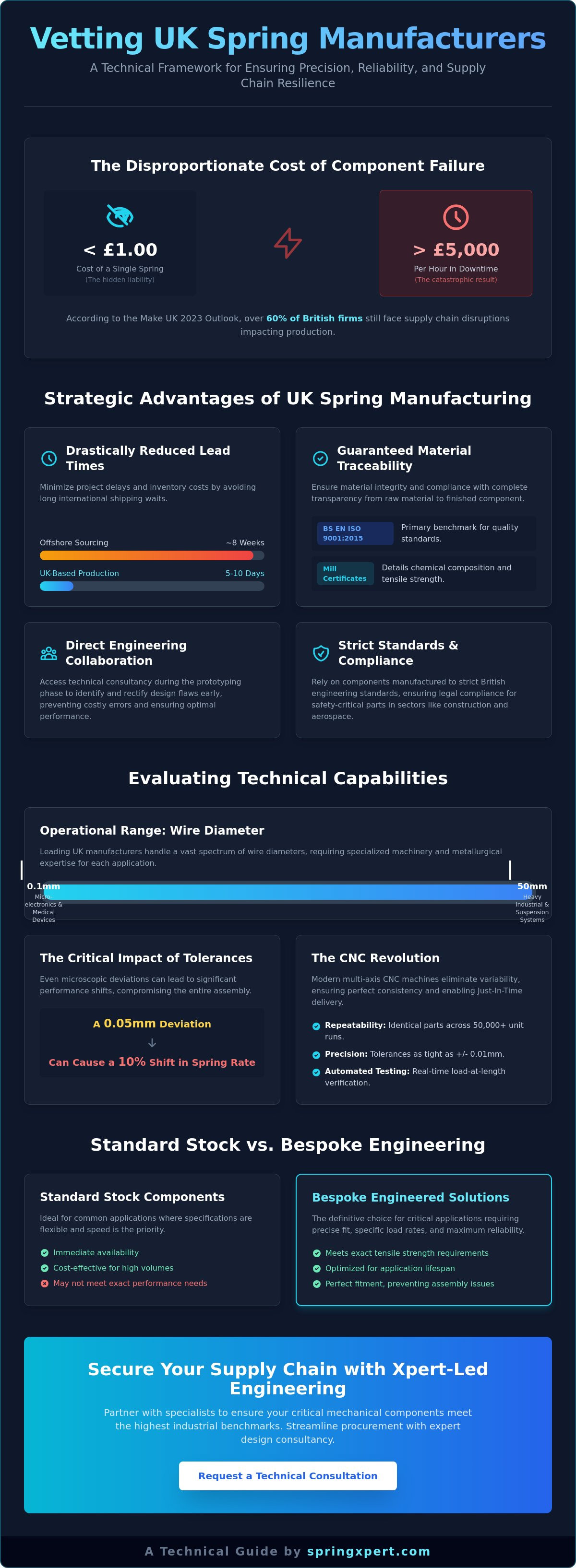
A single mechanical failure in a component costing less than £1 often results in industrial downtime exceeding £5,000 per hour. When vetting spring manufacturers UK engineering firms frequently find that the hidden costs of offshore variability far outweigh initial unit savings. You understand that precision isn't a luxury; it's a fundamental requirement for operational stability. Relying on inconsistent material grades or loose tolerances leads to assembly issues and delayed project milestones. According to the Make UK 2023 Manufacturing Outlook, supply chain disruptions continue to impact production schedules for over 60% of British firms.
This guide provides a professional framework for evaluating your manufacturing partners through the lens of technical precision and material standards. We'll examine how to verify ISO-certified production processes and secure technical consultancy for complex alloy selection. You'll learn to identify partners capable of delivering bespoke engineering solutions that meet exact tensile strength requirements. This Xpert-led approach ensures your supply chain remains resilient and your critical mechanical components meet the highest industrial benchmarks.
Key Takeaways
- Understand the strategic advantages of domestic sourcing, focusing on material traceability and high-precision quality control within the UK industrial landscape.
- Evaluate critical technical parameters, including wire diameter ranges from 0.1mm to 50mm and the impact of manufacturing tolerances on assembly performance.
- Learn how to vet leading spring manufacturers UK by assessing their compliance with material certification standards and industrial audit requirements.
- Determine the optimal path between standard stock components and bespoke engineering solutions to meet specific application requirements.
- Access a professional framework for streamlining procurement through specialized knowledge in disc, extension, and compression spring design.
The Landscape of Industrial Spring Manufacturing in the UK
High-precision spring manufacturers UK serve as the mechanical backbone for the nation's high-value engineering sectors. These facilities don't just supply parts; they manage the technical risks inherent in mechanical tension and compression. Domestic production remains the primary choice for tier-one suppliers because it guarantees material traceability. Every coil of wire used in a British factory comes with a mill certificate that details its chemical composition and precise tensile strength. This level of transparency is vital for industries where a single component failure leads to catastrophic system downtime or safety breaches.
The BS EN ISO 9001:2015 certification acts as the primary benchmark for verifying these manufacturing standards. It mandates a rigorous audit trail for every production step, from initial wire drawing to final heat treatment. Understanding the mechanics of spring technology allows engineers to specify the exact alloys needed for specialized environments. For example, medical equipment requires non-corrosive stainless steels with high fatigue resistance. Conversely, recycling technology demands heavy-duty alloys capable of withstanding 24-hour vibration cycles in abrasive conditions. Selecting reputable spring manufacturers UK ensures that the final assembly meets the design intent without compromising on material integrity.
Key Advantages of UK-Based Production
UK-based production cuts lead times from the 8-week average often seen with international shipping to as little as 5 to 10 working days for standard materials. Direct access to engineering consultancy means design flaws are caught during the prototyping phase. This prevents the costly mistake of importing thousands of units that don't fit the application. Manufacturers follow strict British engineering standards, ensuring that components used in construction machinery or safety valves meet legal compliance for safety-critical parts. This proximity allows for a level of technical collaboration that distant suppliers cannot replicate.
The Evolution of Spring Engineering
The industry has transitioned from manual coiling on lathes to high-speed CNC (Computer Numerical Control) technology. Modern multi-axis machines ensure that dimensions remain consistent across batches of 50,000 units or more, holding tolerances as tight as +/- 0.01mm. Automated testing rigs now measure load-at-length parameters in real-time. These systems reject any part that deviates from the specified Newton-meter requirements. This technological integration supports Just-in-Time (JIT) delivery models. Precise batches arrive at the assembly plant exactly when needed, which reduces warehouse overheads and streamlines the entire supply chain. Our Xpert approach treats every custom-engineered component as a critical link in this industrial chain.
Evaluating Technical Capabilities: Precision Engineering and Tolerances
Spring performance depends on the exact control of wire diameter and geometry. Leading spring manufacturers UK operate across a broad spectrum of specifications, typically ranging from 0.1mm for micro-electronics to 50mm for heavy industrial suspension systems. This range requires distinct machinery and specialized metallurgical expertise. High-precision mechanical assemblies rely on tight manufacturing tolerances to ensure predictable load rates and seamless fitment within housing units. Even a 0.05mm deviation in wire diameter can result in a 10% shift in the spring rate, which compromises the reliability of the entire assembly.
CNC coiling machines eliminate the variability inherent in manual processes. These automated systems utilize multi-axis control to maintain consistency across production runs exceeding 50,000 units. Repeatability is the cornerstone of industrial supply; it ensures that the first component off the line is identical to the last. Durability is further enhanced through secondary processes. Heat treatment and stress relieving stabilize the molecular structure of the metal. These steps prevent premature fatigue and ensure the component doesn't take a permanent set when compressed to its maximum design limit.
Material Science in Spring Manufacturing
Selecting the correct substrate is a critical engineering decision that dictates the lifespan of the component. High-carbon spring steel offers cost-effective strength for dry, controlled environments. Stainless steel grades, such as 302 or 316, provide essential corrosion resistance for marine or medical applications. For extreme environments, specialist alloys like Inconel or Hastelloy maintain structural integrity at temperatures exceeding 550°C. Tensile strength is the maximum stress a material can withstand while being stretched before breaking. These material choices allow spring manufacturers UK to meet specific UK designated manufacturing standards for safety and operational performance.
Advanced Manufacturing Workflows
Modern production relies on the seamless integration of CAD/CAM systems. These digital tools allow for rapid prototyping and the refinement of complex designs before mass production begins. Technical authority is established through rigorous material testing and precise load calculations to verify that every component meets the required specifications. Surface finishes add a final layer of protection and functionality. Options include powder coating for aesthetics, zinc plating for sacrificial corrosion protection, and passivating for stainless steel longevity. If your project requires this level of technical rigour, consult with our team for bespoke spring engineering solutions tailored to your specific industrial requirements. Our approach prioritizes data-driven results over generic manufacturing methods.
Standard Stock vs. Bespoke Spring Design: Which Path to Choose?
Selecting the right component involves balancing lead times against technical precision. Standard components offer immediate availability. Bespoke designs solve unique engineering challenges. Professional spring manufacturers UK provide both paths to ensure operational continuity and mechanical integrity. The decision hinges on whether your application fits within standard geometric parameters or requires a specialised solution for extreme environments.
When to Utilise Standard Stock Components
Standard stock lines are the most efficient choice for applications where dimensions and loads align with industry norms. Procurement speed is the primary advantage. Most leading suppliers maintain over 20,000 standard lines, enabling same-day or next-day delivery. This rapid turnaround is essential for maintenance, repair, and overhaul (MRO) operations. Cost-efficiency is higher because these parts are mass-produced. They're ideal for early-stage prototyping where high-precision tolerances aren't yet critical. If a standard compression spring meets the required rate and diameter, it's the most logical choice for reducing inventory costs.
The Value of Bespoke Engineering Services
Custom engineering becomes necessary when a standard component cannot meet specific load, space, or environmental constraints. Tailoring custom compression springs allows for the optimisation of spring rates and forces within a defined mechanical footprint. This process often involves collaborative prototyping. Engineers move from a concept drawing to a functional metal component through iterative testing. Technical guidance from the Institute of Spring Technology ensures that these bespoke designs adhere to rigorous safety and performance standards. Custom solutions are vital for high-cycle industrial applications where fatigue life is a critical variable. Expert spring manufacturers UK use CNC technology to maintain tight tolerances that stock items cannot guarantee.
Financial structures differ between these two paths. Stock items typically follow tiered pricing models. Unit costs decrease as volume increases, starting from small batch orders. Bespoke projects involve initial engineering fees and tooling costs. These upfront investments cover the technical expertise required to develop a unique specification. While the initial outlay is higher, the long-term value lies in reduced component failure and optimised machine performance. We invite technical collaboration at the design stage to ensure the selected path aligns with your specific performance requirements.
Quality Standards and Compliance in UK Manufacturing
Investing in domestic production is a strategic decision based on risk mitigation. While offshore sourcing might offer lower unit costs, the reliability of spring manufacturers UK justifies the initial expenditure. A failed spring in an industrial assembly can lead to downtime costing upwards of £2,000 per hour. UK partners provide the technical assurance needed to prevent these failures. This reliability is backed by ISO 9001:2015 quality management systems that prioritise repeatable accuracy.
Material certification is a fundamental requirement for industrial audits. Every batch should be accompanied by a Certificate of Conformity (CoC) and, where required, BS EN 10204 3.1 material certificates. These documents prove that the alloy meets specific tensile strength requirements and chemical compositions. Without this traceability, a business risks using components that may fatigue prematurely or fail under standard operating pressures.
Manufacturers perform rigorous load testing to verify compliance with Hooke’s Law. This ensures the spring rate remains within the specified tolerances, typically ±5% or ±10% depending on the application. Longevity in demanding environments is guaranteed through fatigue testing and stress analysis. By simulating millions of cycles, engineers can predict the exact lifespan of a component before it enters a high-stakes environment like a subsea valve or an aerospace actuator.
Testing and Verification Protocols
Digital load testing measures the force at specific compressed or extended lengths with 0.1% accuracy. This data confirms that the spring will perform as intended within the final assembly. Dimensional inspection uses high-resolution optical measurement systems to verify wire diameter and pitch without physical contact. For components exposed to moisture, salt spray testing to ASTM B117 standards verifies the effectiveness of anti-corrosive coatings over 240 or 480-hour durations.
Supply Chain Reliability and Traceability
Maintaining a robust manufacturing chain is essential to prevent project delays. Full material traceability links every finished product back to its specific wire mill heat number. This level of transparency is mandatory for safety-critical sectors. To mitigate global material shortages, many spring manufacturers UK utilise strategic stockholding. By maintaining 3 to 6 months of raw alloy wire on-site, they protected clients from the 15% price volatility seen in high-carbon steel markets during 2022 and 2023.
Ensure your project meets the highest engineering standards by partnering with a specialist. Request a technical consultation to review your compliance requirements.
Partnering with SpringXpert for Industrial Solutions
SpringXpert has operated within the UK engineering sector for over 20 years. This longevity provides a foundation of reliability for Tier 1 and Tier 2 suppliers requiring consistent component quality. As one of the established spring manufacturers UK, the company focuses on the physical realities of manufacturing, ensuring every component meets strict ISO standards and material tolerances. We don't just supply parts; we provide the technical infrastructure necessary for complex mechanical assemblies.Comprehensive Product Range
The inventory includes over 20,000 individual product lines ready for immediate national distribution from our UK facility. This range encompasses standard compression and torsion springs alongside complex wire forms and pressed metal products. For specialized applications, the catalog features disc springs, also known as Belleville washers, which are essential for high-load, small-space environments. Our product depth includes:- Compression, torsion, and tension components.
- Specialist circlips and bespoke clips for automotive and aerospace use.
- Custom-engineered wire forms and pressed metal components.
- Heavy-duty industrial fasteners and retaining rings.
The Technical Xpert Advantage
Technical authority is the core of the SpringXpert identity. Clients gain direct access to master technicians who understand the nuances of tensile strength, fatigue life, and alloy selection. This expertise is critical when designing extension springs for heavy-duty machinery or developing bespoke prototypes for new mechanical projects. Our approach is solution-oriented. We prioritize precision and durability over generic output. When you engage with our team, the focus remains on your specific engineering challenges. We provide:- Detailed analysis of material specifications and load requirements.
- Support for both high-volume bulk orders and low-volume bespoke prototypes.
- Guidance on finishing processes to enhance corrosion resistance and longevity.
Securing Precision in Your Industrial Supply Chain
Selecting the right partner among spring manufacturers UK requires a thorough evaluation of technical depth and certified quality systems. Precision engineering depends on strict adherence to tolerances and specific material properties. Whether your project demands immediate access to our inventory of 20,000+ standard products for national delivery or a custom solution tailored for the medical, construction, or recycling sectors, the focus must remain on durability. Our ISO 9001:2015 certified manufacturing process ensures every component meets rigorous industrial standards. We leverage modern CNC technology to bridge the gap between traditional craftsmanship and high-volume production. It's about finding a specialist who understands the physical reality of your application and can deliver consistent tensile strength across every batch. We provide the technical stability needed for complex B2B requirements. Our team is ready to apply this expertise to your specific mechanical challenges.
Maintaining this level of operational stability is essential for long-term business growth; for those looking to scale their engineering firm through strategic acquisitions, check out PP-X for expert advisory services.
Consult with our engineering team for your bespoke spring requirements
We look forward to engineering a reliable solution for your next project.
Frequently Asked Questions
How do I choose the right spring manufacturer in the UK?
Focus on technical capability and sector-specific experience. Look for facilities with CNC multi-axis coiling machines and in-house heat treatment. A reliable spring manufacturer UK partner should demonstrate a track record in your specific industry, such as automotive or aerospace, where tolerances often sit within +/- 0.01mm. Verify their ability to handle both prototyping and full-scale production to ensure continuity throughout your product's lifecycle.
What information is required to specify a custom spring?
You'll need to provide the material grade, wire diameter, free length, and total coil count. Specify the required spring rate in N/mm and the maximum solid height to ensure the component fits within your assembly's physical constraints. Engineering drawings should include specific tolerances and any required surface finishes, such as zinc plating or powder coating, to meet ISO 9001:2015 standards for precision.
What are the typical lead times for UK-manufactured springs?
Standard lead times range from 5 to 15 working days depending on material availability and finishing requirements. Rapid prototyping can often be completed within 48 hours for simple geometries. For high-volume orders requiring specialized alloys like Inconel or Monel, procurement of raw materials can extend schedules by 3 to 4 weeks. We recommend early technical collaboration to lock in production slots and minimize project delays.
Can UK spring manufacturers handle high-volume production runs?
Modern UK facilities utilize automated CNC coiling and grinding equipment capable of producing over 100,000 units per week. These systems integrate real-time camera inspection to maintain consistent dimensions across large batches. High-speed manufacturing ensures that unit costs remain competitive while adhering to the strict quality demands of high-output sectors. It's a scalable process that supports everything from small batches to millions of units.
What quality certifications should I look for in a spring supplier?
ISO 9001:2015 is the baseline requirement for quality management in the UK. For safety-critical applications, look for IATF 16949 for automotive or AS9100 for aerospace certifications. These standards ensure the spring manufacturers UK you partner with follow rigorous testing protocols. Compliance with REACH and RoHS regulations is also essential to ensure materials meet environmental and chemical safety standards for the British market.
Do UK manufacturers provide material traceability for safety-critical parts?
Professional manufacturers provide full 3.1 material certification and lot traceability for every production batch. This documentation tracks the wire back to the original melt at the steel mill, including chemical composition and mechanical properties. In safety-critical sectors like medical or oil and gas, this level of transparency is mandatory to mitigate risk. It ensures the component performs exactly as expected under its specified tensile strength.
What is the difference between a standard stock spring and a bespoke design?
Stock springs are pre-manufactured to generic dimensions, whereas bespoke designs are engineered for specific load requirements and space constraints. While stock items offer immediate delivery, they often result in compromised performance or reduced fatigue life. Custom-engineered solutions allow for precise control over the spring rate and material selection. This ensures the part survives its 1,000,000-cycle design life without a premature failure.
How does wire diameter affect the performance of an industrial spring?
Wire diameter is the most critical factor in determining the spring's stiffness and load capacity. Because the spring rate is proportional to the fourth power of the wire diameter, a small increase of 10% in thickness can increase the stiffness by nearly 46%. Engineers must balance this with the mean coil diameter to keep the spring index between 4 and 12 for optimal manufacturing and long-term durability.