

Flat Springs UK Supplier: A Technical Guide to Industrial Applications (2026)
With 86% of UK manufacturers expecting rising employment and material costs in 2026, the margin for error when selecting a flat springs UK supplier has effectively vanished. You've likely experienced the frustration of vague lead times from overseas vendors or material performance that fails to meet your specific environmental requirements. It's a common challenge for engineers who need high-force solutions in constrained spaces but can't risk production delays.
This guide to Precision Flat Spring Engineering ensures you master the specifications and material selection necessary to move your project from initial CAD models into full-scale production. We provide the engineering facts required to navigate the complexities of modern industrial standards. You'll learn how to evaluate material trade-offs, understand the impact of current steel price trends, and ensure your components meet the permanent UKCA marking requirements that came into force on January 1, 2026. We invite you to treat this guide as a foundation for technical collaboration on your next precision manufacturing requirement.
Key Takeaways
- Understand why flat springs are the preferred mechanical solution for delivering high force within restricted axial or radial footprints.
- Learn the technical importance of material grain direction and temper selection in ensuring long-term fatigue resistance and structural integrity.
- Discover how to transition from CAD specifications to physical components through bespoke prototyping and low-volume tooling methods.
- Identify the strategic advantages of partnering with a flat springs UK supplier for rapid technical collaboration and ISO 9001 quality assurance.
- Evaluate the mechanical trade-offs between linear and non-linear load characteristics to determine the optimal spring configuration for your assembly.
What are Flat Springs and Why are They Essential in Modern Engineering?
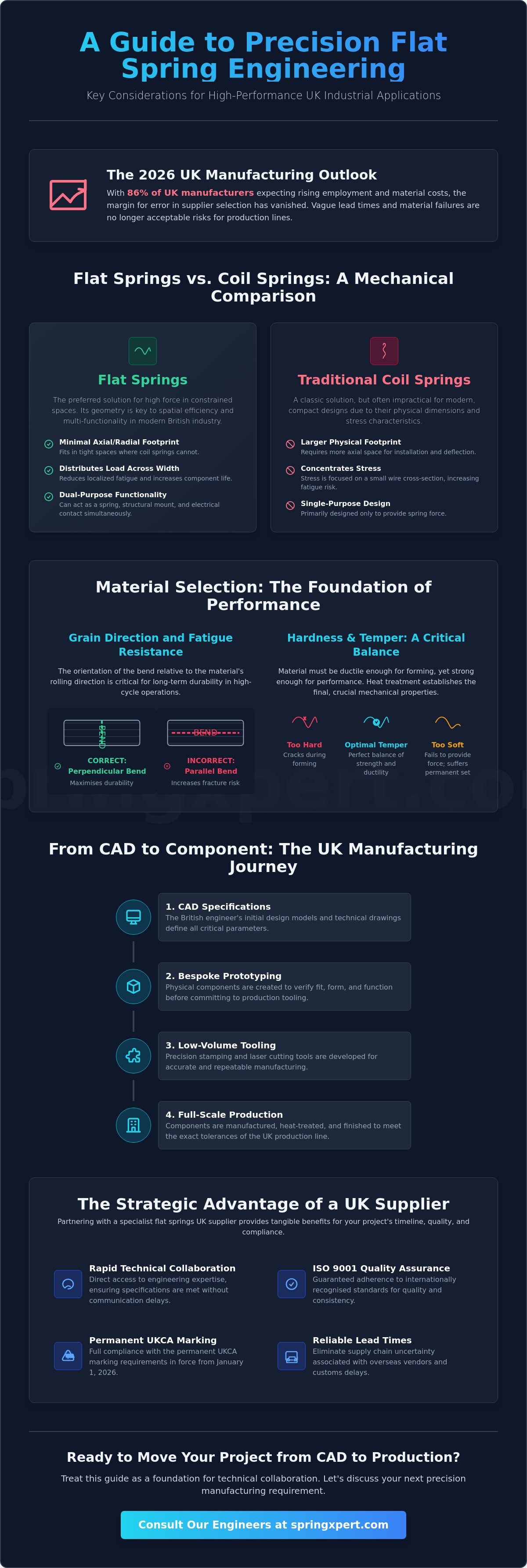
Understanding What are Flat Springs requires an analysis of how geometry influences energy storage. Unlike helical springs, flat springs are manufactured from flat strip material, designed to store and release energy through deflection. This specific form factor allows them to function in environments where traditional wire-formed components would be physically impossible to install. As a specialist flat springs UK supplier, we focus on the mechanical reality that these components must deliver high force within a minimal axial or radial footprint. It's a solution that prioritizes spatial efficiency without compromising on the required load capacity.
The mechanical advantage of a flat profile is found in its load distribution. While a wire spring concentrates stress on a circular cross-section, a flat spring spreads the load across the entire width of the material. This reduces localized fatigue and allows for a significantly lower profile. It's common for an experienced engineer to specify these components for a dual purpose; they act as the spring force while simultaneously functioning as a structural mounting point or an electrical conductor. This versatility simplifies assembly and improves the overall reliability of the mechanical system, which is why they remain a staple in British precision manufacturing.
Common Variants: From Cantilever to Leaf Springs
Engineering requirements often dictate the use of cantilever springs. These are fixed at one end and provide force through a defined arc, making them ideal for battery contacts or switch mechanisms where a technician needs to ensure consistent electrical continuity. In heavy industrial transport and machinery, multi-layered leaf springs are the standard for managing significant loads and dampening vibration. Beyond these standard forms, bespoke profiles are created through precision stamping or laser cutting. This process allows for the integration of custom clips, shims, and intricate geometries that meet the exact tolerances of a UK production line, ensuring every part fits the first time.
Primary Industrial Roles
In the power sector, flat springs are critical for energy storage and return within switchgear and motor assemblies. They ensure that electrical connections are made and broken with the necessary speed and force to prevent arcing. In heavy machinery, such as industrial generators, they serve as counterbalancing mechanisms to stabilize moving parts. For high-precision sectors like aerospace and medical device manufacturing, these springs provide the exact tensioning required for delicate instrumentation. Each application relies on the spring's ability to maintain its structural integrity over millions of cycles in demanding environments. This performance is what defines the output of a competent flat springs UK supplier.
Material Selection and Technical Specifications for Flat Spring Manufacturing
Selecting the correct material for a flat spring is a decision grounded in mechanical physics rather than simple procurement. The structural integrity of the final component depends heavily on the grain direction of the raw strip material. When a flat spring is formed, the orientation of the bend relative to the rolling direction of the steel determines its long-term fatigue resistance. Bending perpendicular to the grain maximizes durability, while bending parallel to it increases the risk of fracture during high-cycle operations. As a technical flat springs UK supplier, we evaluate these metallurgical factors during the initial design phase to ensure the component survives its intended service life.
Hardness and temper requirements represent a critical balance between ductility for forming and the strength required for performance. Material that is too hard will crack during the manufacturing process; material that is too soft will fail to provide the necessary spring force or suffer from permanent set. Controlled heat treatment cycles are used to lock in specific mechanical properties after forming. This process relieves internal stresses and establishes the final elastic limit of the spring. For specialized technical guidance on these processes, engineers often consult the Institute of Spring Technology to verify that their specifications align with current industry standards.
High-Performance Alloys and Their Applications
Carbon spring steel remains the industrial standard for high-cycle applications due to its excellent fatigue properties and cost-effectiveness. However, environments involving moisture or chemical exposure require stainless steel alloys such as 301, 304, or 316. These grades provide varying levels of corrosion resistance and are essential for medical or food-grade applications. When electrical conductivity is a primary requirement, specialist alloys like Beryllium Copper or Phosphor Bronze are specified. These materials combine spring functionality with low electrical resistance, making them ideal for switchgear and connector assemblies.
Understanding Spring Rate and Load Deflection
The spring rate for flat geometries is calculated differently than for helical designs. Thickness (t) is the most influential variable in the load equation. A 10% increase in material thickness does not result in a linear 10% increase in force; rather, the load increases by the cube of the thickness change. This mathematical reality means that even minor variations in raw material gauge can significantly alter the performance of the spring. Engineers must design within the elastic limit of the chosen alloy to prevent permanent deformation. Surface finishes, such as zinc plating or passivation, are then applied to provide the necessary environmental protection without altering these core mechanical properties.
Flat Springs vs. Traditional Coil Springs: A Comparison of Mechanical Utility
The choice between a flat spring and a helical coil spring is determined by the specific spatial and mechanical constraints of the assembly. Traditional coil springs require significant axial depth to allow for wire diameter and pitch, which often creates "dead space" within a housing. In contrast, flat springs occupy a minimal axial profile, enabling "pancake" style assemblies where height is at a premium. As a technical flat springs UK supplier, we often observe that while coil springs provide a predictable linear rate, flat springs offer the ability to engineer non-linear load characteristics through varying widths or tapered geometries. This allows for precise control over the force-deflection curve in specialized industrial equipment.
Integrating multiple functions into a single component is a primary advantage of the flat profile. A single stamped part can serve as a spring, a structural bracket, and an electrical ground path simultaneously. This reduction in part count directly impacts assembly time and reduces the number of potential failure points within a system. However, the decision to move from a standard wire form to a flat design requires an analysis of tooling investment versus unit price. High-volume production typically justifies the cost of progressive die tooling, whereas low-volume projects might remain more cost-effective using standard wire components depending on the complexity of the required geometry.
When to Choose a Flat Spring
Flat springs are the superior choice when axial space is restricted but radial space is available for the component to expand or deflect. They're particularly effective in applications requiring multi-functional parts, such as a spring that also functions as a mechanical latch or a battery contact. If your design requires specific mounting holes, integrated shims, or complex profiles that must be keyed into a housing, a flat spring allows these features to be incorporated directly into the blanking process. This level of customization isn't achievable with traditional wire-forming technologies, which are limited by the uniform cross-section of the wire.
Limitations and Design Constraints
Engineers must account for the higher initial tooling costs associated with complex stamped components. While a flat springs UK supplier can provide rapid prototyping, full-scale production often involves specialized dies that represent an upfront capital expenditure. Additionally, designers must manage stress concentrations at bends and around mounting holes. Sharp internal radii can lead to premature fatigue failure if they aren't properly radiused to distribute the load. For applications requiring high-travel or long-stroke compression, traditional compression springs remain the industry standard, as the flat strip material is physically limited by its own geometry in how far it can deflect before reaching its elastic limit.
The Prototyping and Manufacturing Process for Custom Flat Springs
The journey from a digital CAD file to a functional industrial component requires a structured and transparent engineering workflow. As an industrious flat springs UK supplier, we begin every project with a rigorous feasibility review of the provided technical drawings. This phase ensures that the specified radii and tolerances are achievable given the chosen material's mechanical properties. Identifying these constraints early prevents production delays and ensures that the final component performs reliably within its intended assembly. It's a meticulous approach that prioritizes precision over speed during the critical design stage.
From CAD to Component: The Engineering Workflow
Initial technical consultations define the core operational parameters, including the working load, environmental exposure, and the anticipated cycle life. These factors dictate whether a standard carbon steel or a specialist alloy is required for the application. 3D modelling serves as the primary validation tool for simulating stress distribution and spring rate before committing to physical material. Following digital validation, we produce physical prototypes through hand-forming or low-volume tooling. This allows engineers to conduct real-world testing and refine the design based on empirical data before we finalize the production-scale tooling.
Manufacturing Technologies: Multi-Slide vs. Power Press
The choice of manufacturing technology is driven by part complexity and total volume requirements. Multi-slide forming is highly cost-effective for complex, multi-bend components at high volumes, as it allows for simultaneous forming from multiple directions. For simpler profiles that require high-speed throughput, power press stamping remains the standard industrial solution. We also offer bespoke tooling options for lower volume industrial runs. This flexibility addresses the common difficulty of finding suppliers with bespoke prototyping capabilities within a rigid industrial framework.
Quality assurance ensures that every batch maintains the structural integrity required for industrial use. Our quality control protocols include dimensional verification, load-deflection testing, and material hardness certification. This systematic approach is supported by our adherence to ISO 9001:2015 standards, providing the reliability expected from a professional flat springs UK supplier. This process ensures compliance with the UKCA marking requirements that became mandatory for permanent product affixing on January 1, 2026. Every component is inspected to ensure it meets the technical depth required for complex B2B requirements.
If you're ready to move from design to production, our team provides expert Bespoke Spring Design and Prototyping to ensure your components meet exact industrial specifications.
Partnering with a Specialist Flat Springs UK Supplier
Selecting a flat springs UK supplier is a strategic decision that directly impacts the technical success of an assembly and the resilience of the production schedule. In 2026, the British manufacturing sector faces persistent pressure from rising material costs and shifting import quotas. Partnering with a national manufacturer like SpringXpert Ltd mitigates these logistics risks and provides a stable pricing structure for high-volume requirements. SpringXpert Ltd has established a 20-year legacy in the UK, providing precision engineering solutions that adhere to strict ISO 9001:2015 quality standards. This long-term presence ensures a deep understanding of the British industrial landscape, from aerospace hubs to automotive production lines. By sourcing locally, you bypass the uncertainty of overseas lead times and the complexities of international shipping regulations.
Technical collaboration is the foundation of a successful industrial partnership. Instead of managing the communication barriers of a distant vendor, engineers benefit from direct access to specialist support for rapid design iterations. This proximity allows for immediate adjustments to prototyping tooling and face-to-face reviews of complex CAD files. It's a level of responsiveness that overseas vendors simply can't replicate. By acting as an active engineering partner, we ensure that every flat spring or pressed metal component is optimized for both mechanical performance and manufacturing efficiency. This collaborative approach reduces the risk of costly design revisions after the production tooling has been finalized.
Technical Authority and Reliability
Access to experienced British engineers is critical when you're navigating the nuances of industrial mechanical design. Our facility utilizes advanced metrology equipment to verify the dimensional accuracy and load characteristics of every batch. This commitment to precision ensures that your components arrive ready for immediate integration into your assembly. Whether you're designing for high-cycle switchgear or medical instrumentation, the technical depth of SpringXpert Ltd provides the evidence required for complex B2B procurement. We maintain a focus on structural integrity and durability, ensuring every part meets the UKCA marking requirements that became mandatory for permanent affixing on January 1, 2026.
Comprehensive Range and Custom Capability
Our inventory includes a comprehensive range of over 20,000 standard products, including disc springs and standard washers. This extensive catalogue allows for rapid sourcing of off-the-shelf components while our custom facility handles bespoke wire forms and tailored flat spring profiles. We leverage modern production technologies to maintain high-speed throughput without sacrificing the technical depth of our products. This combination of standard availability and custom flexibility provides a complete solution for the modern UK industrial sector. Our team is prepared to assist with material trade-offs to ensure your components perform reliably in their specific operating environments.
Contact our technical team for a flat spring quotation to discuss your specific requirements and learn how our engineering partnership can support your 2026 production targets.
Optimising Industrial Performance Through Technical Collaboration
Successful industrial spring design requires a rigorous balance of metallurgical knowledge and mechanical precision. You've seen how material grain direction influences fatigue resistance and why the cube of thickness dictates load performance. Moving from a digital CAD model to a verified physical component requires a partner that understands these technical nuances. As an established flat springs UK supplier, we provide the stability of a 20-year British manufacturing legacy. Our facility maintains ISO 9001 certified quality management to ensure batch consistency across our inventory of 20,000+ standard products.
We invite you to leverage our technical depth to solve your most complex B2B requirements. Whether you're refining a bespoke prototype or scaling for mass production, our team provides the engineering facts necessary for informed decision-making. Discuss your flat spring requirements with our UK engineering team to ensure your next project benefits from precision-engineered reliability. We look forward to advancing your industrial capabilities through meticulous technical collaboration and industrious manufacturing support.
Frequently Asked Questions
What information is required to get a quote for a custom flat spring?
To provide an accurate quotation, we require technical drawings in DXF, DWG, or STEP formats alongside material specifications including alloy grade and thickness. You should also define the required load at a specific deflection point and the anticipated operating environment. Specifying the annual volume and batch sizes allows us to determine the most cost-effective manufacturing process, whether that involves laser cutting or high-speed power press stamping.
Can flat springs be used in high-temperature industrial environments?
Flat springs can be engineered for high-temperature environments by selecting alloys that resist thermal relaxation. While standard carbon steels degrade in performance above 120 degrees Celsius, materials like Inconel or 17-7 PH stainless steel maintain their mechanical properties at much higher temperatures. It's advisable to discuss these thermal constraints with your flat springs UK supplier to ensure the material choice aligns with the long-term fatigue requirements of your application.
What is the typical lead time for a custom flat spring prototype in the UK?
Lead times for custom prototypes depend on the complexity of the profile and the current availability of the specified raw material. Components produced via laser cutting or manual forming are often dispatched within several working days following CAD approval. If your design requires the development of bespoke low-volume tooling, the timeline will extend to accommodate the tool-making process. We recommend checking current operational capacity during the initial design consultation.
How do you prevent hydrogen embrittlement in high-carbon flat springs?
Hydrogen embrittlement is prevented through a controlled baking process conducted immediately after electroplating or chemical cleaning. This heat treatment is critical for high-carbon steel components, as it drives out hydrogen atoms that would otherwise cause the material to become brittle and fail under stress. The baking must occur within a strict timeframe, usually four hours post-plating, at temperatures specifically calibrated to the material's temper and hardness specifications.
Are flat springs more durable than standard coil springs?
Durability is determined by how effectively the design manages stress distribution rather than the spring's physical form. Flat springs provide a significant advantage in constrained spaces by spreading the load across a wider surface area, which can reduce localized fatigue compared to circular wire. However, ensuring long-term durability requires that the spring operates within its elastic limit and incorporates generous bend radii to prevent stress concentrations that lead to premature fracture.
What are the most common finishes for industrial flat springs?
Industrial flat springs are commonly finished with zinc plating, passivation, or phosphate coatings to provide environmental protection and corrosion resistance. For components used in electrical switchgear, silver or tin plating is often specified to maintain low contact resistance. As a specialist flat springs UK supplier, we also offer plastic dipping and powder coating for applications that require electrical insulation or specific aesthetic finishes in a British industrial context.
Do you offer small batch production for flat springs?
We provide small batch production services to accommodate technical projects that don't require high-volume mass manufacturing. Our facility utilizes flexible technologies like laser cutting and modular forming to produce limited quantities without the upfront capital expenditure of complex progressive dies. This approach is ideal for specialized industrial machinery or initial field testing where only a few hundred components are needed to validate a specific mechanical design.