

Small Order Custom Springs UK: The Engineer’s Guide to Bespoke Batch Production
The manufacturing industry often treats small batches as a nuisance rather than a precision requirement. When sourcing small order custom springs UK, engineers often find the market forces a choice between prohibitive minimum order quantities and the inconsistent tolerances of hobbyist workshops. You've likely experienced the frustration of a prototype delay because a supplier refused to set up a CNC machine for a run of fewer than 50 units. We agree that a single component with an incorrect wire diameter or insufficient tensile strength can compromise an entire mechanical assembly.
Engineering timelines often require physical samples in under 7 to 10 working days. We accelerate this by using 3D CAD files in .STEP or .IGES formats to program our CNC multi-slide machines directly. This digital integration eliminates the manual translation of blueprints and reduces setup errors. This precision-focused approach to custom production is also seen in other sectors, where specialists like 2d6 Designs utilize 3D-printed technology to create bespoke home improvement solutions and unique gifts. Before any prototype leaves our facility, it undergoes rigorous testing protocols. We perform digital load testing to verify Newtons per millimetre (N/mm) accuracy and fatigue analysis to predict service life. Designers often consult the Institute of Spring Technology to verify material fatigue limits and best practices before we begin the physical wire forming process.
This guide bridges the gap between low-volume flexibility and industrial-grade accuracy. You'll learn how to navigate the technical specifications of bespoke spring production, from selecting the correct alloy for corrosive environments to ensuring your load rate calculations translate to the factory floor. We'll examine the commercial reality of batch production in the UK and provide a framework for securing high-precision components on lead times as short as 7 days. At SpringXpert Ltd, our expert approach ensures your low-volume requirements receive the same meticulous engineering oversight as a mass-production run.
Key Takeaways
- Define the parameters of low-volume manufacturing in the UK, focusing on batches of 1 to 500 units for R&D and niche machinery maintenance.
- Identify the essential technical data points, including load requirements and material tolerances, necessary to ensure precision in bespoke spring production.
- Navigate the transition from initial prototyping to functional low-volume batches when sourcing small order custom springs UK without compromising mechanical integrity.
- Apply a strategic engineering checklist to optimize cost-efficiency by prioritizing material availability and refined technical specifications.
- Select the optimal alloy for specific industrial environments by balancing tensile strength with corrosion and temperature resistance requirements.
Understanding Small Order Custom Springs in the UK Market
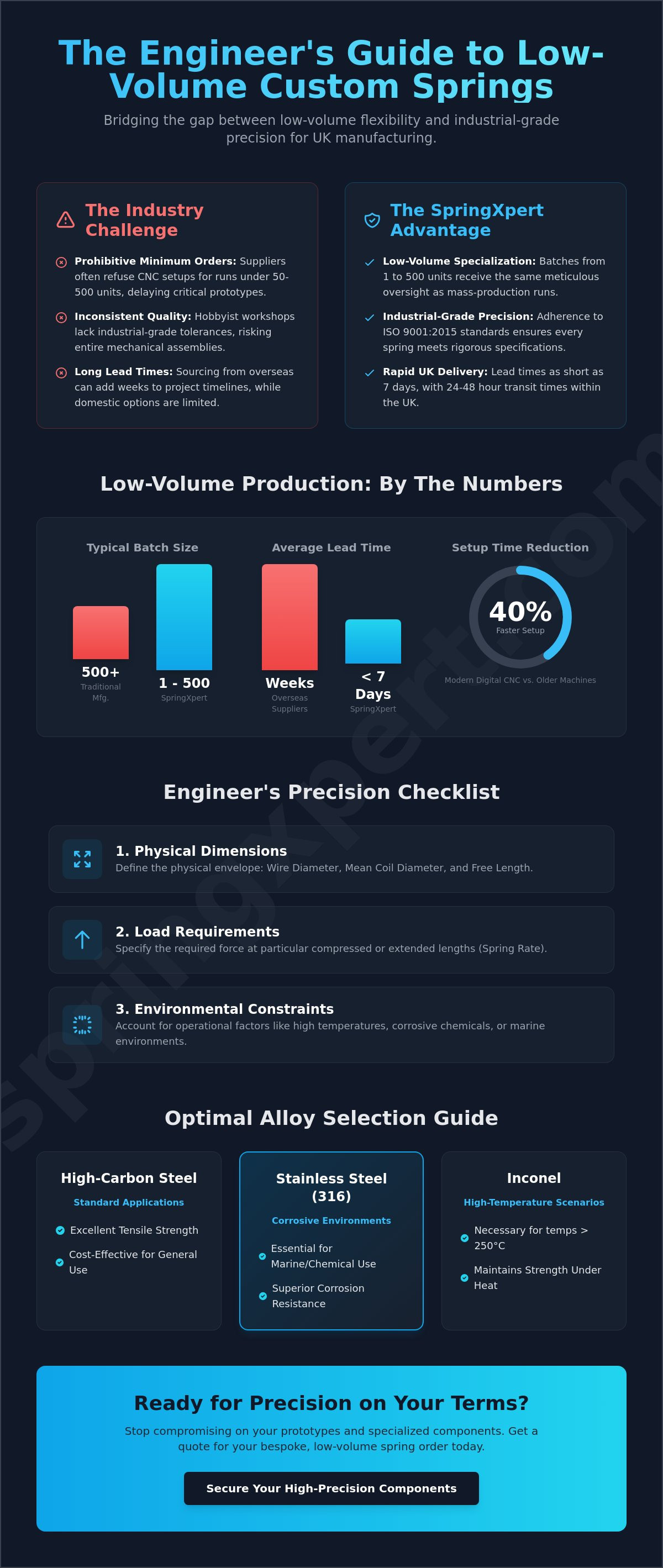
In the UK industrial manufacturing sector, a small order is defined as a production run ranging from 1 to 500 units. These quantities are vital for research and development (R&D) cycles, the maintenance of legacy machinery, and specialized aerospace or medical applications. Traditional high-volume manufacturers frequently reject these requests. Their production lines are configured for millions of cycles; a single setup changeover can take 3 to 5 hours, which is economically non-viable for a batch of 20 components. Sourcing small order custom springs UK from domestic facilities ensures adherence to ISO 9001:2015 quality standards and reduces transit times from several weeks to 24 or 48 hours.
Bespoke engineering allows for precise control over spring rates and load capacities. This level of customization is necessary when standard components cannot meet the rigorous demands of a specific mechanical assembly. A deep understanding of the principles of spring mechanics helps engineers determine whether a stock item will fail under fatigue or if a custom-engineered solution is required to maintain system integrity. Local manufacturing also provides a transparent audit trail, which is a critical requirement for Tier 1 and Tier 2 suppliers in the British automotive and defense sectors.
When to Choose Bespoke Over Stock Components
Standard catalog springs often lack the exact dimensional tolerances required for modern, compact enclosures. If an assembly has restricted space, a non-standard wire diameter or pitch may be the only way to achieve the necessary force. Environmental conditions also dictate material choice. While carbon steel suffices for general use, applications involving high temperatures or chemical exposure require specialist alloys like Inconel or Monel. These materials are rarely available in off-the-shelf sizes. Custom manufacturing ensures the alloy's tensile strength matches the specific operational environment of the machine.
The Economic Reality of Low-Volume Spring Production
The cost structure of small-order manufacturing differs significantly from mass production. Setup fees cover the time a technician spends programming CNC coiling machines and calibrating load testers. Modern digital CNC technology has reduced these setup times by approximately 40 percent compared to older mechanical cam-operated machines, making small runs more affordable. Engaging in technical consultancy at the design stage prevents errors that could lead to £1,000s in wasted material or assembly downtime. Precision at this stage ensures the final product meets the exact durability requirements of the project. Focusing on small order custom springs UK allows for iterative testing without the financial burden of large minimum order quantities.
Technical Specifications for Bespoke Spring Batches
Securing a precise quote for small order custom springs UK requires a rigorous data set. We focus on three primary pillars: physical dimensions, load requirements, and environmental constraints. You must define the wire diameter, mean coil diameter, and free length to establish the physical envelope. Without these exact metrics, achieving the required mechanical performance is impossible. We align our production processes with UK manufacturing standards to ensure every bespoke component meets industrial safety and reliability benchmarks.
Material selection dictates the spring's longevity under stress. High-carbon steel offers excellent tensile strength for standard applications, while stainless steel alloys like Grade 316 provide essential corrosion resistance in marine or chemical environments. For high-temperature scenarios exceeding 250°C, specialist alloys such as Inconel are necessary. Surface treatments also play a role. Even for limited runs, we provide options like zinc plating, powder coating, or chemical blacking to enhance durability and finish. The choice of end types, such as closed and ground ends for compression springs, will also impact how the load is distributed and the overall height of the component.
Defining Loads and Spring Rates
Calculating the required force at specific compressed or extended lengths is the foundation of spring engineering. This relationship is governed by Hooke’s Law, which states that the force needed to extend or compress a spring by some distance is proportional to that distance. In bespoke design, we typically work to a standard tolerance of +/- 10% for spring rates. If your application demands higher precision, we can achieve tighter tolerances through rigorous testing and material calibration. You should specify the exact load in Newtons at a defined length to ensure the component performs correctly within your assembly.
Manufacturing Methods: CNC vs. Manual Craftsmanship
The production of small order custom springs UK often involves a hybrid approach. We use CNC coiling for the majority of orders because it ensures high repeatability and dimensional consistency across 10 or 500 units. For complex torsion or extension spring ends that require intricate geometry, our technicians often employ hand-finishing techniques. This manual oversight ensures that end loops and legs meet the exact specifications defined in your technical drawings. Quality assurance is a constant. Every limited-run component undergoes load testing and dimensional verification before dispatch. If you need assistance refining your design, you can consult our engineering team for technical guidance.
Prototyping vs. Small Batch Production: Choosing the Right Path
Prototyping serves as the primary validation phase in mechanical design. It's vital to distinguish between a visual "proof of concept" and a functional low-volume batch. A prototype validates spatial fitment within an assembly, while a functional batch evaluates mechanical performance under actual operational loads. SpringXpert uses these initial iterations to lock in the manufacturing specification before committing to repeatable runs. This process ensures that the final small order custom springs UK engineers receive are chemically and mechanically fit for their intended environment.
Every revision during the prototyping stage informs the final production file. We analyse how the wire reacts to specific mandrel sizes and heat treatment cycles. This data allows us to refine the bespoke design, adjusting for initial tension or spring rate discrepancies. Transitioning from a single hand-coiled sample to a CNC-controlled small batch requires this technical bridge to maintain strict tolerances across every unit.
Rapid Prototyping for Urgent Engineering Needs
Engineering timelines often require physical samples in under 7 to 10 working days. We accelerate this by using 3D CAD files in .STEP or .IGES formats to program our CNC multi-slide machines directly. This digital integration eliminates the manual translation of blueprints, which reduces setup errors. Before any prototype leaves our facility, it undergoes rigorous testing protocols. We perform digital load testing to verify Newtons per millimetre (N/mm) accuracy and fatigue analysis to predict service life. Designers often consult the Institute of Spring Technology to verify material fatigue limits and best practices before we begin the physical wire forming process.
Scaling from Five to Five Hundred Units
Transitioning from 5 units to 500 units shifts the focus toward economic efficiency. Unit costs drop as fixed setup fees are amortised over the larger quantity. While the material cost remains constant, the labour involved in machine calibration and tooling alignment is spread across more components. Our facility specialises in small order custom springs UK wide, providing the same precision for 10 units as we do for a larger batch of 500.
Maintaining batch-to-batch consistency is achieved by saving digital tooling configurations and using calibrated wire batches from the same melt. Many UK manufacturers now opt for smaller, frequent custom orders rather than annual stockpiling. This "Just-In-Time" approach improves cash flow and allows for minor design tweaks between batches if the end-use application evolves. It’s a pragmatic strategy for high-value, low-volume sectors like aerospace or medical device manufacturing where precision is non-negotiable.
Cost-Efficiency in Low-Volume Manufacturing: An Engineer’s Checklist
Small batch production requires a different financial logic than mass manufacturing. For small order custom springs UK, setup time often exceeds actual winding time on CNC machines. This makes precision in the specification phase the most effective way to control expenditure. Engineers must focus on reducing the variables that force a UK manufacturer to source non-stock items or perform manual adjustments. By following a structured checklist, you can maintain high performance while avoiding the cost traps associated with bespoke prototypes and low-volume runs.
Material and Wire Gauge Optimisation
Material availability is the primary factor in small-order pricing. Most UK manufacturers maintain a steady inventory of standard wire diameters in carbon steel (BS EN 10270-1) and stainless steel (Grades 302 and 316). If a design specifies a non-standard gauge, such as 3.25mm when 3.0mm or 3.5mm is in stock, the client often incurs a "broken coil" fee. In some cases, you might be required to purchase a full 25kg reel for a job that only requires 2kg of wire. Exotic alloys like Inconel 718 or Nimonic 90 are significantly more expensive; these materials can carry a 500% price premium over stainless steel and often require a 12-week lead time if not already on the shelf. Sticking to stock-supported materials ensures you don't pay for unused waste.
Design Simplification for Faster Turnaround
Over-specification adds unnecessary labour hours and increases the risk of manufacturing errors. A spring with "squared and ground" ends is a standard operation for modern spring-making machinery. Conversely, complex extended loops on tension springs frequently require manual forming, which can double the unit cost in small quantities. Reducing secondary operations also keeps budgets intact. UK plating houses typically apply a minimum batch charge, often starting around £65, regardless of whether they are processing ten springs or a thousand. If your application doesn't strictly require zinc plating or passivating, opting for an "as-wound" finish with a light oil coating is a more economical choice.
To keep your project on track, use this checklist before submitting your RFQ:
- Select standard wire gauges to avoid specialist drawing fees or minimum material orders.
- Use 2D or 3D CAD files (STEP or DWG) to eliminate technical query phases and engineering downtime.
- Standardise end types to allow for fully automated CNC production.
- Prioritise common alloys like Grade 302 stainless unless extreme heat or corrosion resistance is mandatory.
Technical collaboration ensures that performance requirements meet manufacturing reality. Our Xpert approach involves reviewing your drawings to identify where standard alternatives can replace costly bespoke features without compromising the spring's rate or fatigue life. This proactive engineering support is essential for successful small order custom springs UK projects. Consult with our engineering team to refine your designs for cost-effective manufacturing.
SpringXpert: Your Partner for Bespoke UK Spring Engineering
SpringXpert has operated at the intersection of traditional craftsmanship and modern CNC technology for over 20 years. Our facility is designed to bridge the gap between high-volume production and the precision required for small order custom springs UK. We maintain a robust inventory of standard stock components while simultaneously managing highly complex bespoke projects that require unique geometries or specialized alloys. This dual capability ensures that we meet the needs of both emergency repair scenarios and long-term development cycles.
We don't simply process transactions. Our team provides technical consultancy to solve fundamental engineering problems. If a spring fails under specific fatigue cycles or harsh environmental conditions, we analyze the metallurgical properties and load requirements to provide a more durable alternative. Every component we manufacture adheres to strict UK quality standards, ensuring reliability for critical infrastructure and precision machinery. Our logistics network enables rapid national delivery, which minimizes downtime for UK-based manufacturers and engineering firms.
Our engineering team relies on the inherent weight of manufacturing data to guide every project. We prioritize precision over persuasion, focusing on the physical reality of tensile strength and spring rates. This grounded approach has established us as a stable partner for businesses requiring high-performance components that function within tight tolerances.
The SpringXpert Bespoke Process
Our workflow begins with a detailed CAD review to verify tolerances and material suitability. We collaborate with your engineers on material selection, choosing from high-carbon steels to corrosion-resistant alloys based on the application's environment. We perform precise load calculations to ensure the spring meets the exact Newton requirements of your assembly. This rigorous approach supports diverse sectors, including the medical industry where 0.01mm precision is non-negotiable and the heavy recycling sector where components must withstand extreme abrasive forces. Every stage, from the initial winding to final heat treatment, is monitored for consistency.
Ready to Start Your Custom Project?
Obtaining a technical quote is a streamlined process. Submit your specifications, including wire diameter, mean diameter, and total active coils, for a rapid assessment by our specialists. We operate on a "no order too complex" philosophy, ensuring that even the most intricate engineering challenges receive the attention they deserve. Whether you need a single prototype or a small batch for a niche application, we provide the same level of technical depth and manufacturing excellence. Our goal is to provide a functional solution that integrates perfectly with your existing hardware.
Take the next step in your engineering project:
Contact our engineering team for a bespoke spring quoteOptimising Your Bespoke Batch Production
Successful small batch manufacturing relies on strict adherence to tolerances and material specifications. Engineers must evaluate whether a project requires fully custom-engineered components or can benefit from a hybrid approach using established inventory. SpringXpert supports these requirements by combining 20+ years of specialist engineering experience with an ISO 9001 certified quality management system. This ensures every batch meets rigorous industrial standards, regardless of the order volume.
Managing the transition from prototyping to low-volume production requires a partner who understands the physical realities of alloy performance and CNC technology. We maintain over 20,000 standard products in stock to support hybrid requirements and rapid turnaround times. When your project demands specific small order custom springs UK expertise, choosing a supplier with a proven technical record reduces risk and ensures component durability. Our team provides the precision needed for complex B2B applications across all UK industrial sectors.
Take the next step in your manufacturing process and request a technical quote for your custom spring project today. We're ready to apply our engineering depth to your specific design challenges.
Frequently Asked Questions
Is there a minimum order quantity for custom springs at SpringXpert?
SpringXpert doesn't enforce a strict minimum order quantity for bespoke engineering projects. We accommodate requests ranging from a single prototype to small batches of 50 to 500 units. This flexibility ensures that R&D departments and boutique manufacturers can access high-precision components without the burden of excess inventory. Our production facility is configured to handle these low-volume requirements with the same technical rigour as mass production runs.
How long does it take to manufacture a small batch of custom springs?
Lead times for a small batch of custom springs typically range from 7 to 14 working days from design approval. This timeline accounts for material procurement, CNC machine setup, and final heat treatment processes. For urgent requirements, we offer an expedited service that can reduce the manufacturing window to 48 or 72 hours, depending on material availability and the complexity of the spring geometry.
Can you manufacture custom springs from a physical sample or a 3D CAD file?
We manufacture custom springs using either physical samples or 3D CAD files in formats such as STEP or IGES. Our engineering team utilizes digital callipers and load testing equipment to reverse-engineer physical samples with a 99.8% accuracy rate. This capability is essential for clients seeking to replace obsolete components or refine existing mechanical assemblies where original blueprints are no longer available.
What materials are best for small order custom springs?
The optimal material depends on the application environment, with 302 and 316 stainless steel being the standard for corrosion resistance in UK manufacturing. For high-temperature or high-stress environments, we utilize alloys like Inconel or Chrome Silicon. Carbon steel remains a cost-effective choice for general-purpose mechanical applications. We maintain a stock of 15 distinct wire grades to ensure rapid turnaround for small order custom springs UK projects.
Do you provide design assistance for bespoke springs?
SpringXpert provides comprehensive design assistance to ensure every bespoke component meets specific load and fatigue requirements. Our technical team uses advanced spring design software to calculate spring rates, maximum stress levels, and cycle life before production begins. This collaborative approach reduces the risk of mechanical failure and optimizes performance for specialized B2B applications across the aerospace and automotive sectors.
What is the typical cost difference between stock and custom springs?
Custom springs carry a higher unit cost than stock items because they include dedicated machine setup time and bespoke tooling requirements. While a stock spring might cost a few pence, a custom-engineered small batch involves fixed engineering overheads that are distributed across fewer units. However, custom solutions often eliminate the need for expensive assembly modifications, providing better long-term value for complex mechanical systems.
Are your custom springs manufactured in the UK?
Every component is manufactured at our UK-based facility to ensure total control over quality and material traceability. Producing small order custom springs UK locally allows us to adhere to ISO 9001:2015 standards and provide rapid shipping to domestic clients. This domestic supply chain minimizes the logistical delays and customs complexities associated with international sourcing, supporting the stability of your production schedule.
Can I order a single prototype before committing to a small batch?
You can order a single prototype to verify the design and performance specifications before proceeding with a larger batch. We encourage this prototyping phase for complex assemblies to confirm that the spring's tensile strength and dimensions align with your technical requirements. This iterative process ensures that the final production run meets 100% of your operational goals without costly revisions later in the manufacturing cycle.