

Small Order Custom Springs UK: A Guide to Bespoke Engineering & Low-Volume Production
The assumption that precision engineering requires a thousand-unit commitment is a fundamental barrier to UK industrial innovation. Engineering firms often find themselves stalled by manufacturers who refuse to adjust their CNC setups for anything less than a high-volume run. If you are seeking a small order custom springs UK partner, you shouldn't have to settle for off-the-shelf components that fail to meet your specific tensile strength or tolerance requirements.
We understand that prototyping and niche machinery maintenance require the same level of technical rigor as mass production. It's frustrating when excessive tooling charges for a single batch of custom-engineered alloy springs make a project unviable. This guide demonstrates how to source bespoke, high-precision components in low volumes while maintaining strict adherence to technical standards. You'll learn how to leverage our Xpert engineering advice for material selection and secure fast UK-based delivery to keep your production timelines on track. We'll examine the transition from initial design to low-volume manufacturing without the typical barriers of high minimum order quantities.
Key Takeaways
- Understand why traditional high-volume manufacturers often exclude low-quantity runs and how to bridge this gap for specific industrial requirements.
- Master the essential technical specifications, such as wire diameter and load tolerances, necessary for accurate bespoke spring design and simulation.
- Evaluate the cost factors unique to small order custom springs UK, including minimum order charges and the impact of machine setup times on unit pricing in £.
- Explore the engineering workflow from initial CAD simulation to final component production to ensure every custom spring meets rigorous mechanical objectives.
- Learn how to leverage over 20 years of technical expertise and CNC technology to secure precision-engineered components regardless of order size.
Understanding the Market for Small Order Custom Springs in the UK
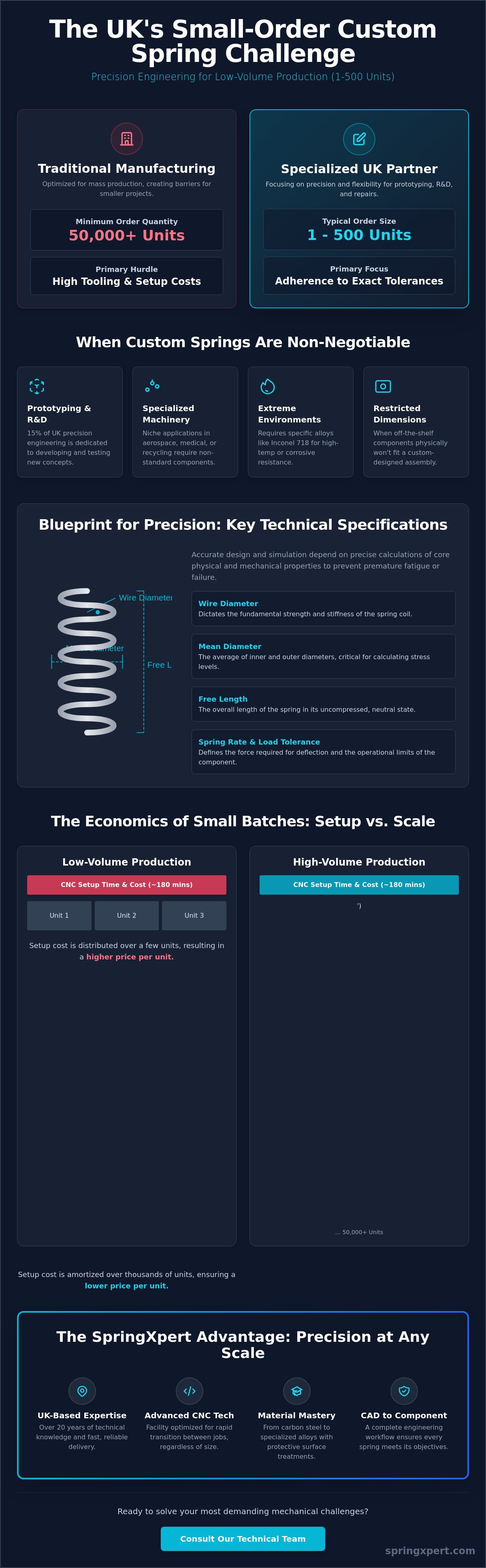
Industrial manufacturing in Britain requires a flexible approach to volume. A small order typically defines any production run between 1 and 500 units. Large-scale facilities often reject these requests because their overheads demand continuous high-speed output. Specialized manufacturers fill this gap, providing the agility needed for R&D and emergency repairs. Small order custom springs UK providers focus on precision rather than mass-market saturation.
Sectors like aerospace and medical engineering depend on these low-volume runs. A 2023 industry report highlighted that 15% of UK precision engineering output is dedicated specifically to prototyping and specialized maintenance. These components require exact tolerances that mass-produced stock cannot provide. Whether it's a unique actuator for a satellite or a specialized tension component for a recycling plant, the requirement for bespoke engineering remains high.
The Challenges of Low-Volume Spring Production
Setup times represent the primary hurdle in manufacturing small order custom springs UK. Calibrating a CNC coiler for a specific pitch and diameter can take 180 minutes even for a single unit. This process ensures the component adheres to strict tensile strength requirements. Unlike mass production, where setup costs are amortized over 50,000 units, low-volume runs prioritize precision over sheer speed. Engineers must balance the unit price against the technical necessity of bespoke geometry. It's a calculation that favors quality over quantity.
When to Choose Custom Over Standard Stock
Off-the-shelf springs are designed for general applications. They often fail when subjected to non-standard loads or extreme environments. Custom solutions become necessary when an assembly has restricted housing dimensions or requires specialized alloys like Inconel 718 for high-temperature resistance. Understanding fundamental spring design principles helps engineers identify when standard components will likely suffer from premature fatigue. Custom manufacturing allows for specific wire cross-sections and coatings that protect against corrosion in recycling or chemical processing plants. These bespoke choices ensure the longevity of the entire mechanical system.
SpringXpert operates as a dedicated technical partner for these complex requirements. We understand that a single failed component can halt an entire production line. Our facility is optimized for rapid transition between different wire types and geometries, ensuring that your small-batch requirements receive the same level of engineering scrutiny as a major production run. We invite technical collaboration to solve your most demanding mechanical challenges.
Technical Specifications for Bespoke Spring Design
Engineering a high-performance spring begins with a rigorous focus on three primary data points: wire diameter, mean diameter, and free length. These dimensions define the physical boundaries of the component. However, the true utility of small order custom springs UK lies in the precise calculation of spring rate and load tolerances. Spring rate, the force required to compress or extend the spring by one millimetre, must be calculated accurately to ensure the component functions correctly within its assembly. Inaccurate calculations lead to premature fatigue or mechanical failure.
- Wire Diameter: This dictates the strength and stiffness of the coil.
- Mean Diameter: The average of the outer and inner diameters, essential for calculating stress levels.
- Free Length: The overall length of the spring in an uncompressed state.
Material selection is equally critical to the design process. We process everything from standard carbon steel to high-performance alloys. Surface treatments like zinc plating, passivating, and powder coating are applied to enhance durability. Zinc plating provides a sacrificial layer to prevent oxidation, while passivating removes surface contaminants from stainless steel to maximise corrosion resistance. For clients requiring specific aesthetics or high-impact protection, powder coating offers a robust finish that withstands harsh industrial environments. If you have specific environmental requirements, you can consult our technical team for material guidance.
Material Precision and Performance
Evaluating tensile strength is a mandatory step when designing extension and torsion springs. These components face different stress profiles than standard compression springs, which are often used as the baseline for industrial specifications. Environmental factors heavily dictate material choice. For example, stainless steel grades like 302 or 316 are selected for their resistance to moisture and chemicals. High-nickel alloys are reserved for aerospace or oil and gas applications where temperatures regularly exceed 300°C.
Defining Tolerances for Small Batches
Manufacturing small batches requires a deep understanding of British Standards for spring manufacturing, such as BS EN 15800. These standards define the acceptable deviations in dimensions and loads. It's vital to recognise that tighter tolerances often increase costs in low-volume production. This happens because precision setups for small order custom springs UK require more time relative to the total output. Additionally, the choice of end types, such as squared and ground ends, significantly affects how the spring sits under load. Ground ends provide a flat surface for even force distribution, which is vital for the stability of bespoke compression components in precision machinery.
The Engineering Process: From CAD to Component
Manufacturing begins with a technical consultation to define mechanical objectives and physical constraints. We analyze wire diameter, material grade, and required spring rate to ensure the final product integrates seamlessly into its intended assembly. This initial stage is critical for small order custom springs UK projects, where precision in low volumes prevents costly redesigns later in the production cycle. We focus on the physical reality of the application to determine if a standard alloy or a high-performance superalloy is necessary for the environment.
Digital Design and Simulation
Engineers utilize specialized spring design software to transform customer sketches or basic concepts into manufacturing-ready blueprints. 3D modeling allows us to identify potential failure points and stress concentrations before any wire is bent. We validate spring constants and cycle life expectations digitally to ensure performance targets are met. This rigorous approach aligns with the standards set by the Institute of Spring Technology, which provides the technical foundation for modern spring engineering and material performance. Digital simulation reduces material waste and ensures the first physical prototype is as close to the final specification as possible. It's a method that prioritizes data over guesswork.
Manufacturing Techniques for Small Orders
The choice of manufacturing method depends on the geometric complexity and total quantity of the order. CNC multi-axis wire forming offers the flexibility needed for complex shapes while maintaining high repeatability. For ultra-low volume orders or highly intricate designs, our technicians use traditional hand-making skills. This ensures that even a single bespoke component receives the same level of attention as a larger run. Quality control protocols are central to our workflow. We employ specific verification steps, including:
- Force Testing: Verifying that the spring meets specified load requirements at given heights.
- Dimensional Verification: Using digital calipers and optical comparators to maintain tolerances as tight as +/- 0.05mm.
- Material Certification: Ensuring the alloy's tensile strength matches the design requirements.
Prototyping and iterative testing follow the design phase. We often produce a single unit for physical evaluation before proceeding to final small-batch production. This methodology guarantees that small order custom springs UK clients receive components that perform reliably under operational stress. It's a systematic process designed to bridge the gap between theoretical design and physical reality. We don't move to the final production stage until the prototype passes every dimensional and functional check.
Cost Factors and Lead Times in Small Batch Production
Procuring small order custom springs UK requires an understanding of the fixed costs associated with precision engineering. Most UK manufacturers apply a Minimum Order Charge (MOC) to cover the essential overheads of a bespoke run. This fee isn't an arbitrary penalty; it accounts for machine downtime, calibration, and the initial material waste generated during the setup phase. When a CNC coiler is configured for a specific wire diameter and pitch, the first few components often serve as sacrificial test pieces to ensure the final product meets exact tolerances.
Setup time is the primary driver of unit pricing in small batch production. It takes the same amount of time to program a machine for 10 springs as it does for 1,000. For a custom-engineered component, engineering hours for design verification and machine programming can account for 70% of the total invoice value on a small run. Choosing a partner with advanced CNC multi-axis capability reduces manual intervention, which helps stabilize costs for limited quantities.
Lead times are heavily influenced by material availability. Standard alloys like carbon steel and 302 stainless steel are typically held in stock, allowing for production to commence within 48 hours of design approval. Specialist materials, such as Inconel or beryllium copper, may require sourcing from dedicated stockholders, adding 5 to 7 working days to the timeline. In contrast to overseas sourcing, which often involves 8 to 12 weeks of sea freight and customs clearance, UK-based manufacturing typically delivers completed batches within 10 to 15 working days.
Optimising Your Order for Better Value
Small adjustments to your procurement strategy can yield significant savings. Increasing a batch size from 10 units to 50 units often results in a 30% to 50% reduction in unit cost, as the initial setup fee is amortized over more components. Using standard metric wire sizes instead of niche gauges avoids the premium costs of specialist wire drawing. Providing technical documentation in DXF or STEP file formats also accelerates the transition from design to production, reducing the engineering time billed to the project.
Tooling and Setup: A Transparent Look
Bespoke designs may require custom tooling, particularly for complex end configurations or non-standard diameters. While coiled wire forms are shaped by CNC fingers, components like disc springs might require specific stamping dies or machining setups. Implementing Design for Manufacture (DfM) principles early in the process ensures that the spring's geometry doesn't necessitate expensive, one-off tooling. A simplified hook design on a tension spring, for instance, can often be achieved with standard tooling, keeping the project within the initial budget.
SpringXpert Ltd provides technical consultancy to help you balance performance requirements with production costs. Contact our engineering team to discuss your specific small-batch requirements.
Partnering with SpringXpert for Bespoke UK Manufacturing
SpringXpert brings over 20 years of specialized precision engineering to the British industrial sector. Our operations focus on providing a stable supply chain for small order custom springs UK, ensuring that low-volume requirements receive the same technical scrutiny as mass-production runs. We maintain a dedicated production facility where our engineers manage every stage of the manufacturing process, from initial material selection to final quality testing. This localized control allows us to maintain the high tolerances required for critical mechanical applications.
Our commitment to the "no order is too small" philosophy serves a vital need in R&D, maintenance, and niche manufacturing sectors. We don't impose restrictive minimum order quantities that often hinder innovation or emergency repair schedules. Instead, we offer direct access to technical consultancy services. This allows your team to collaborate with our engineers on complex mechanical challenges, utilizing our in-house design capabilities to refine specifications before production begins. Fast, reliable nationwide delivery from our UK base ensures that your components arrive within tight project timelines, reducing downtime for your facility.
The SpringXpert Advantage
Choosing SpringXpert provides access to a comprehensive inventory of over 20,000 standard products, which often serve as a baseline for bespoke modifications. Our solution-oriented approach prioritizes the physical reality of your application. We analyze factors such as operating temperature, corrosive environments, and cycle life to recommend the optimal alloy and tensile strength. Every custom component undergoes rigorous quality assurance following ISO standards. This systematic operation ensures that tolerances remain consistent, whether you require five springs or five hundred. Our expertise in small order custom springs UK enables us to deliver high-performance components that meet exact engineering specifications without the overhead of large-scale manufacturing.
How to Start Your Custom Order
Initiating a bespoke project requires clear technical data to ensure the final product performs as expected. You can request a technical quote through our online portal by following these steps:
- Define the primary spring type: compression, tension, torsion, or wire form.
- Provide critical dimensions: include wire diameter, outside diameter, and free length.
- Specify material requirements: such as carbon steel, stainless steel, or specialized alloys.
- Outline performance loads: define the required force at specific compressed or extended lengths.
Our engineering team reviews these specifications to identify potential design improvements or material efficiencies. This collaborative process ensures the final component integrates seamlessly into your assembly. If you lack a full technical drawing, our Xperts can work from physical samples or functional descriptions to recreate the necessary part. We prioritize clarity and precision in every quote, providing a firm foundation for your procurement process.
Contact our Xperts for your custom spring requirement
Advancing Your Engineering Project with Precision Manufacturing
Securing high-quality components shouldn't be a barrier to industrial innovation or maintenance. Navigating the requirements for small order custom springs UK requires a focus on material tolerances and exact design specifications. We've detailed how the transition from CAD models to physical components relies on rigorous testing and a transparent understanding of lead times. Our team brings 20+ years of industrial engineering experience to every project, ensuring that low-volume production meets the same quality standards as large-scale runs.
SpringXpert operates an in-house UK manufacturing facility designed for agility. This setup allows for bespoke design and prototyping services that align with specific mechanical loads and environmental conditions. By removing the complexity of international logistics and high minimum order quantities, we provide a stable supply chain for your critical components. For those in the health and food sectors looking to further streamline their operations, Simplepack Ltd provides expert contract packing services to ensure your finished products reach the market efficiently. Our process is built on technical accuracy and reliable delivery schedules.
Furthermore, for engineering firms looking to secure their physical assets and workshop premises, you can learn more about specialized locksmith and security solutions for commercial properties.
Ready to finalise your component design? Request a Technical Quote for Custom Springs and leverage our engineering expertise for your next project. We're ready to help you achieve the exact performance your application demands.
Frequently Asked Questions
Can I order just one custom spring for a prototype?
Yes, we manufacture single units for prototyping and R&D purposes. Our facility handles one-off requirements for engineers needing to validate a design before committing to a larger production run. We apply the same CNC precision to a single unit as we do to thousands. This allows for rigorous testing of spring rates and dimensions in real-world applications. It's a vital step for verifying mechanical assemblies.
What is the typical lead time for a small order of custom springs in the UK?
Standard lead times for a small order of custom springs UK wide typically range from 5 to 10 working days. This timeframe depends on material availability and the complexity of the spring geometry. We offer expedited services for urgent engineering requirements, often reducing the turnaround to 48 hours when using stocked wire. Our production schedule is managed to ensure reliable delivery dates for every client.
Do I need a CAD drawing to place an order?
You don't require a formal CAD drawing to initiate a production order. While .DXF or .STEP files are preferred for precision, we accept physical samples, hand-drawn sketches with dimensions, or a detailed specification sheet. Our engineers translate these inputs into manufacturing data. We ensure all critical parameters, such as wire diameter and free length, are verified before the winding process begins. It's our standard procedure.
What materials are available for small-batch custom springs?
We maintain a stock of diverse materials including carbon steel, 302 and 316 stainless steel, and phosphor bronze. For specialized environments, we work with Inconel or Nimonic alloys. All materials comply with BS EN 10270 standards. This variety ensures your small order custom springs UK manufactured meet specific corrosion resistance or high-temperature requirements. We provide material certificates for full traceability upon request for any batch size.
How much do custom springs cost for low-volume orders?
Pricing for low-volume orders is determined by the machine setup time and the specific material grade required. Small batches involve fixed costs for programming CNC equipment and tool configuration. Since these costs are spread over fewer units, the price per item is higher than in mass production. We provide transparent quotes based on your specific technical requirements and the current market rate for raw wire materials.
Are small orders of custom springs subject to the same quality standards as large runs?
Every spring we produce undergoes the same rigorous quality control process regardless of the batch size. We operate under ISO 9001 quality management systems to ensure dimensional accuracy and performance consistency. Our inspection department uses digital load testers and profile projectors to verify that each component meets your specified tolerances. Reliability remains our primary objective for both prototypes and full production cycles. We don't compromise on precision.
Can you help me design a spring if I only have the space measurements?
Our technical team provides design assistance based on your available installation space and required load. You provide the hole diameter, rod diameter, and the working stroke; we calculate the necessary wire gauge and coil count. This collaborative approach ensures the spring operates within safe stress limits. We use specialized software to predict fatigue life and performance before manufacturing starts. It's a core part of our service.
What is the difference between a custom spring and a modified stock spring?
A custom spring is engineered from raw wire to meet exact specifications, whereas a modified stock spring involves altering an existing off-the-shelf component. Custom manufacturing allows for precise control over the spring rate, end configurations, and material properties. Modifications are often limited by the original heat treatment or dimensions. Choosing a bespoke solution eliminates the performance compromises often found with modified standard parts. It's the superior engineering choice.