

Custom Spring Prototyping Service: From Engineering Theory to Physical Reality
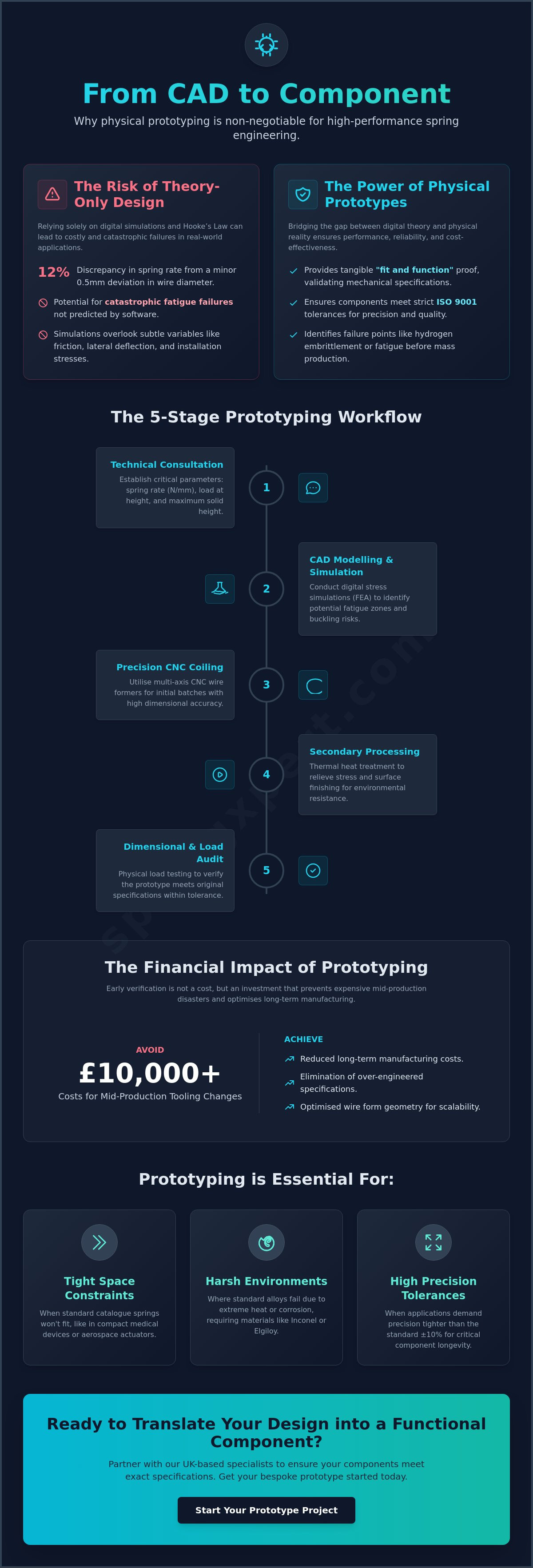
A theoretical CAD model is not a functional component until it survives a physical load test under actual operating conditions. British engineering firms frequently find that a 0.5mm deviation in wire diameter or a minor variance in alloy temper can result in a 12% discrepancy in spring rate during assembly. Utilising a professional custom spring prototyping service ensures that these theoretical figures translate into physical performance. You likely recognise that relying on software simulations alone can lead to catastrophic fatigue failures once a component enters service.
This process bridges the gap between digital theory and physical reality by delivering samples that meet strict ISO 9001 tolerances. It ensures your load calculations are accurate and your material selection is fit for purpose. You'll discover how to refine designs to withstand specific environmental stressors and avoid the £10,000 plus costs often associated with mid-production tooling changes. We will outline the exact steps required to transform a bespoke prototype into a scalable, high-volume manufacturing solution.
Key Takeaways
- Learn why physical verification is essential to bridge the gap between theoretical Hooke’s Law calculations and real-world mechanical performance in complex assemblies.
- Understand the technical workflow of a professional custom spring prototyping service, from initial CAD modelling to digital stress simulation of potential failure points.
- Discover how to select the optimal spring steel grades and wire cross-sections to meet specific tensile strength and durability requirements for your application.
- Identify strategies to reduce long-term manufacturing costs by refining wire form geometry and eliminating over-engineered specifications during the prototype phase.
- Explore the benefits of partnering with UK-based manufacturing specialists to maintain tight tolerances and ensure precision for critical industrial components.
The Strategic Role of Custom Spring Prototyping in Engineering
Custom spring prototyping is the iterative engineering process of manufacturing physical samples to validate mechanical specifications before full-scale production begins. While theoretical calculations based on the engineering principles of springs provide a baseline, they often fail to account for the non-linear variables present in complex mechanical assemblies. A dedicated custom spring prototyping service bridges the gap between digital design and industrial application. It ensures that variables like material fatigue and load-deflection curves align with the intended performance parameters.
Reliance on Hooke’s Law is sufficient for basic applications; however, physical verification becomes mandatory when dealing with high-stress environments. Engaging a custom spring prototyping service early in the design phase mitigates the risk of systemic failure. Early-stage sampling allows engineers to identify risks such as hydrogen embrittlement in plated high-carbon steels or premature fatigue failure in dynamic loads. By testing physical units, SpringXpert identifies these failure points before they manifest in the final product line.
Standard vs. Bespoke: Identifying the Need for Prototyping
The transition from standard stock components to a bespoke solution typically occurs when space constraints limit the physical dimensions of the spring. Catalogued springs often lack the specific load-bearing capacity required for compact medical devices or aerospace actuators. Environmental factors also dictate this shift. Standard alloys may fail in the presence of extreme heat or corrosive chemicals, necessitating the use of Inconel or Elgiloy. When an application requires precision tolerances tighter than the standard ±10%, custom engineering is the only viable path to ensure component longevity.
Proof of Concept: Beyond the Digital Model
Digital simulations and Finite Element Analysis (FEA) are powerful tools, yet they frequently overlook subtle physical interactions in multi-component wire forms. Friction, lateral deflection, and installation stresses are difficult to model with absolute accuracy. Physical prototypes provide a tangible "fit and function" test, which is critical for securing stakeholder approval for large-scale manufacturing budgets. In the UK aerospace sector, where safety margins are non-negotiable, physical samples serve as the definitive proof of concept. This hands-on approach allows for rapid design adjustments, reducing the total development time and preventing costly re-tooling later in the production cycle.
From CAD to Component: The Technical Prototyping Workflow
Moving from a theoretical design to a functional mechanical part requires a disciplined, five-stage methodology. Our custom spring prototyping service follows a structured engineering path to ensure that every physical sample aligns with its digital twin. This process eliminates guesswork and reduces the risk of component failure during the later stages of product development.
- Technical consultation: We establish critical performance parameters including the spring rate (measured in N/mm), required load at specific heights, and the maximum allowable solid height.
- CAD modelling and simulation: Engineers use software to conduct digital stress simulations. This identifies potential fatigue zones or buckling risks before any material is consumed.
- Precision CNC coiling: We utilise multi-axis CNC wire forming machines to produce initial test batches with high dimensional accuracy.
- Secondary processing: Components undergo thermal heat treatment to relieve internal stresses and surface finishing to meet environmental resistance requirements.
- Dimensional and load audit: Every prototype is subjected to physical load testing to verify it meets the original specification within established tolerances.
The Role of Computer-Aided Design (CAD) in Spring Engineering
SpringXpert uses CAD to refine wire diameters and coil counts before the first cut is made. This digital environment allows us to simulate "worst-case" load scenarios, predicting the spring's life expectancy across millions of cycles. We integrate your existing blueprints directly into our manufacturing chain, which maintains data integrity throughout the process. This technical alignment ensures that the digital model and the physical component remain identical. If your project requires high-precision verification, you can consult with a specialist spring engineer to review your current specifications.
Rapid Iteration: The Advantage of CNC Technology
Modern CNC coiling technology enables micro-adjustments between prototype versions without the need for expensive, dedicated tooling. This flexibility significantly reduces development costs for complex wire forms and bespoke compression springs. Our machines maintain tolerances as tight as +/- 0.01mm, ensuring the performance of the first prototype is repeated exactly in the final production run. This level of repeatability is essential for B2B partners in the aerospace and automotive sectors who require absolute consistency. By using versatile wire forming capabilities, we can produce small batches for testing in as little as 48 hours, allowing for rapid design cycles and faster time-to-market.
Material Selection and Stress Testing in Prototype Development
Material integrity dictates the success of a custom spring prototyping service. Engineers must match theoretical load requirements with the physical properties of specific spring steel grades to ensure the component survives its operational environment. High-carbon steels, such as BS 5216 (Music Wire), offer high tensile strength for standard mechanical applications. For corrosive environments or high-temperature aerospace components, specialists often select stainless steel 316 or superalloys like Inconel 718 and Elgiloy. These materials maintain structural stability at temperatures exceeding 500°C where standard steels would fail.
Material choice directly influences the achievable manufacturing tolerances during the prototyping phase. While standard carbon steels allow for consistent forming, specialist alloys might require complex heat treatment cycles to reach desired hardness levels. The wire cross-section also impacts performance. Rectangular or square wire provides higher energy storage in a smaller footprint compared to traditional round wire, though it introduces different stress concentrations that technicians must account for during the design phase. Identifying the elastic limit early prevents a permanent set, which occurs when a spring is compressed beyond its material's ability to recover its original free length.
Alloy Specifications for High-Performance Prototypes
Selecting the correct alloy ensures the prototype survives its intended duty cycle without premature fatigue. Carbon steels provide cost-effective strength for general industrial use, whereas stainless steels offer essential corrosion resistance for medical or marine applications. Specialist alloys like Inconel are reserved for environments where thermal expansion must be minimised and high-strength retention is mandatory. Tensile strength in bespoke springs typically increases as the wire gauge diameter decreases due to the intensive cold-drawing process required for finer filaments.
Validating Performance through Rigorous Load Testing
Physical validation begins with measuring the spring constant (k) using calibrated digital load testers. This process generates precise load-deflection curves to confirm the prototype matches the initial engineering calculations within a 0.5% margin of error. Technicians also assess the impact of end configurations on performance. Ground ends ensure the axial load remains aligned, which reduces the risk of buckling under compression compared to unground ends.
Rigorous fatigue testing involves cycling the spring through its working range to establish durability benchmarks, often reaching 10 million cycles for high-performance automotive components. All testing protocols adhere to ISO 9001 quality management systems and BS EN 13906-1 standards to ensure every custom-engineered component meets UK safety and performance regulations. This systematic approach to testing provides the empirical data required to move from a single prototype to full-scale production with confidence.
Optimising for Production: Why Prototyping Reduces Long-Term Costs
A professional custom spring prototyping service identifies fiscal inefficiencies before they enter the supply chain. Theoretical designs often include over-engineered specifications that provide no functional benefit but increase unit costs by 15% or more in high-volume runs. By refining wire form geometry during the physical testing phase, engineers can eliminate unnecessary complexity that slows down production machinery. This process ensures the component is fit for purpose without being unnecessarily expensive to manufacture.
Prototyping also serves as a critical stage for resolving dimensional conflicts. When a spring interacts with other components in an assembly, minor miscalculations lead to high scrap rates. Identifying these issues at the pre-production phase prevents the waste of raw materials and machining time. This stage allows for the rigorous testing of alternative materials. Switching from a high-cost specialised alloy to a more standard grade that meets the same fatigue requirements can result in significant savings across a 50,000-unit production cycle. This shift doesn't compromise quality; it aligns material properties with actual operational demands.
Design for Manufacturing (DfM) Principles
Efficient manufacturing relies on simplifying wire forms to reduce CNC cycle times. Every additional bend or tight tolerance adds seconds to the machine's operation. These seconds accumulate into hours of wasted production time across large batches. We focus on standardising wire diameters where possible to leverage bulk material pricing. Sourcing non-standard gauges often incurs a 20% premium from UK steel stockholders, which can be avoided through early design intervention. For deeper technical insights, see our guide on compression springs for DfM insights.
Scaling from Prototype to Mass Production
Transitioning from a single unit to thousands requires consistent quality. We establish Quality Control (QC) benchmarks based on the performance data gathered during the custom spring prototyping service phase. These benchmarks include precise load-at-height measurements and specific tensile strength requirements. It's far more cost-effective to resolve a design flaw at the 1-unit stage than to discover a failure after 10,000 units have been coiled and heat-treated. This proactive approach ensures that the final product maintains its integrity throughout the entire production run without requiring expensive mid-stream adjustments. Getting it right at the start protects the project budget and the final product's reliability.
If you're ready to refine your design for industrial-scale manufacturing, partner with our technical team to ensure production efficiency.
Partnering with SpringXpert for Bespoke Spring Prototyping
SpringXpert brings over two decades of technical expertise to the UK manufacturing sector. We provide a comprehensive custom spring prototyping service that bridges the gap between theoretical design and physical performance. Our facility handles every stage of the lifecycle; we manage everything from initial CAD verification to high-volume production runs. This end-to-end capability ensures that the design intent remains intact throughout the manufacturing process.
Precision is the cornerstone of our operations. We maintain exceptionally tight tolerances for critical industrial applications in sectors like aerospace and medical device manufacturing. Our engineers understand that a variation of 0.05mm can compromise an entire mechanical assembly. By focusing on the physical reality of metallurgy and mechanical stress, we deliver prototypes that perform reliably under specified loads. The Xpert identity reflects our solution-oriented approach, where we treat every engineering challenge as an opportunity to optimise performance through rigorous testing and material science.
The SpringXpert Advantage: Technical Authority
Our technical authority stems from a vast database of over 20,000 standard products. This repository allows us to inform custom designs with proven performance data from thousands of successful applications. We operate a facility capable of processing wire sizes from fine gauge filaments used in electronics to heavy industrial diameters for mining equipment. Our machinery is calibrated to handle various alloys, ensuring material integrity is never sacrificed for speed.
Specialist requirements often demand unique geometries. Whether you require compression, tension, or torsion variants, our team applies rigorous testing protocols to every unit. You can also explore our expertise in disc springs for specialist applications requiring high force in limited spaces. This breadth of capability makes us a versatile partner for UK businesses seeking reliable mechanical components that meet strict British standards.
Begin Your Prototyping Project Today
Initiating a custom spring prototyping service project requires detailed load requirements and environmental data. We need to understand the operating temperature, potential corrosive elements, and the required cycle life of the component. Providing these specifics allows our engineers to select the correct material and heat treatment process from the outset. Our engineers collaborate directly with your design team to refine these specifications for optimal results.
We invite you to request a technical consultation to kickstart your bespoke spring development. We don't just supply parts; we provide engineering solutions for complex mechanical problems. Contact our UK-based team to discuss your project parameters and move your design from a digital concept into physical reality. Our structured process ensures your project remains on schedule and within technical specifications from the first sample to the final delivery.
Bridging the Gap Between Engineering Theory and Industrial Application
Moving a spring design from a CAD model to a functional component requires precise technical validation. Utilizing a professional custom spring prototyping service allows engineers to verify tensile strength and fatigue life before committing to large-scale manufacturing. This process identifies potential failure points early; it ensures that material selection and tolerances align with specific UK industrial standards. By testing physical prototypes under real-world stress conditions, you eliminate the risks associated with theoretical calculations and avoid costly redesigns during the production phase.
SpringXpert brings over 20 years of industrial manufacturing experience to every project. Our ISO 9001 certified quality management systems ensure that every prototype meets rigorous safety and performance criteria. We provide the infrastructure for both rapid prototyping and seamless high-volume production, supporting your project from the initial concept through to the final assembly line. Our team focuses on delivering components that maintain structural integrity in demanding environments.
Refining your design today prevents operational delays tomorrow. Request a Technical Consultation for Your Custom Spring Prototype to access our engineering expertise and manufacturing capacity. We're ready to help you transform your technical specifications into high-performance hardware.
Frequently Asked Questions
What information do I need to provide for a custom spring prototype?
Provide a technical drawing or a detailed specification sheet including wire diameter, outside diameter, free length, and total coils. Material choice and load requirements at specific heights are also critical for our custom spring prototyping service. If a drawing isn't available, our engineers can work from a physical sample or a 3D CAD model in STEP or IGES format to ensure 0.05mm precision. This data allows us to calculate the exact spring rate and stress levels before winding begins.
How long does the spring prototyping process typically take?
Lead times for prototypes generally range from 3 to 10 working days depending on material availability and secondary processes. Standard carbon steel or stainless steel 302 components often ship within 72 hours. Complex designs requiring heat treatment, stress relieving, or specialised finishes like zinc plating may extend the timeline to 15 days to meet UK industrial standards. We prioritise speed without compromising the metallurgical integrity of the component.
Can you prototype springs for high-temperature or corrosive environments?
We manufacture prototypes using high-performance alloys such as Inconel 718, Monel, and Elgiloy for extreme operating conditions. These materials maintain mechanical integrity at temperatures exceeding 500°C or in corrosive environments typical of North Sea offshore applications. Our facility stocks 12 distinct high-grade alloys to ensure rapid turnaround for specialised engineering requirements. This expertise ensures your component survives where standard materials would fail.
Is there a minimum order quantity for custom spring prototypes?
There's no minimum order quantity for our prototyping service; we frequently produce single units for R&D validation. This allows engineers to test physical iterations without the financial commitment of a full production run. Whether you require 1 sample or a small batch of 25 for field testing, we apply the same CNC precision to every component. It's a cost-effective way to mitigate risk during the early stages of product development.
Can you provide load-test data with my prototype samples?
Yes, every prototype can be supplied with a detailed digital test report including load-deflection curves and spring rate calculations. We utilise calibrated testing equipment to measure forces to within 0.5% accuracy. This data confirms that the physical part aligns with the theoretical engineering model before you proceed to high-volume manufacturing. Providing this empirical evidence is a standard part of our technical commitment to quality and reliability.
What is the difference between a prototype and a first-article inspection (FAI)?
A prototype is a functional sample used to validate a design during the R&D phase, while a First Article Inspection (FAI) is a formal quality control process for the first batch of a production run. FAIs follow ISO 9001 standards to verify that tooling and processes consistently meet every specification on the engineering drawing. Prototypes focus on iterative development. FAIs focus on manufacturing repeatability and long-term production stability.
Do you offer prototyping for wire forms and flat springs as well?
Our custom spring prototyping service covers a broad range of components including complex wire forms, flat springs, and clock springs. We utilise multi-axis CNC forming machines to produce intricate geometries from wire diameters ranging from 0.1mm to 20mm. This versatility ensures that your entire assembly's tension and compression needs are met by a single technical partner. We handle everything from simple clips to complex, multi-stage leaf springs.
How do I know if I need a custom spring instead of a stock item?
You require a custom spring when standard catalogue items fail to meet specific spatial constraints, precise load tolerances, or environmental resistance needs. If your assembly has a non-standard footprint or requires a non-linear spring rate, a bespoke solution is necessary. Approximately 80% of our industrial clients opt for custom designs to maximise the longevity and efficiency of their mechanical systems. Customisation eliminates the need for design compromises.