

Procuring Bulk Compression Springs: A Strategic Quote & Specification Guide
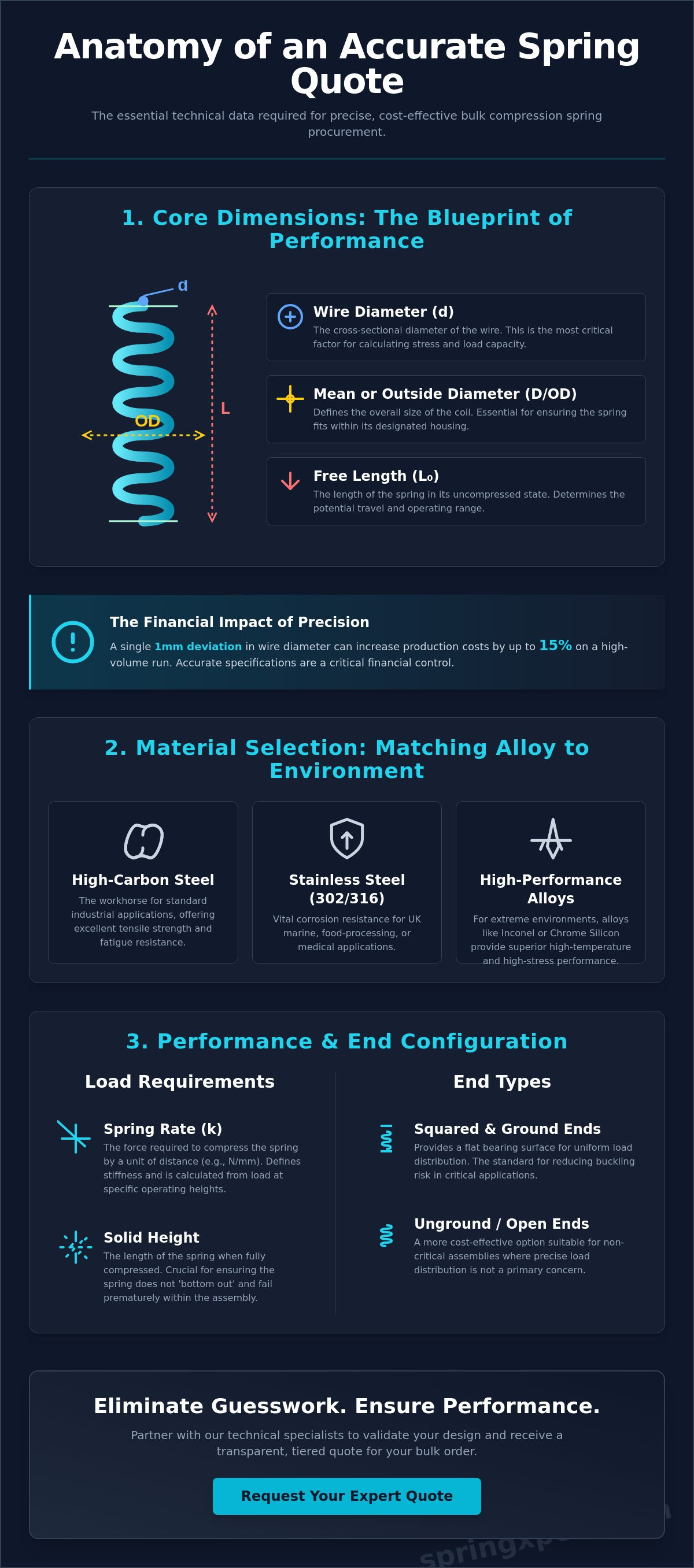
A single millimetre of deviation in wire diameter can increase production costs by up to 15% across a high-volume industrial run. You likely understand that precision isn't just an engineering requirement; it's a significant financial one. When technical specifications are vague, the resulting quotes often fluctuate wildly. This leads to quality inconsistencies that might only surface after 5,000 units are already integrated into your assembly line. It's a risk that most procurement teams can't afford to take when managing tight project timelines.
Securing an accurate bulk compression springs quote requires more than just a basic CAD drawing. It demands a rigorous approach to material tolerances and specific load requirements. This guide provides the technical framework you need to validate your spring designs and leverage economies of scale effectively. We'll examine how to define spring rates, select alloys suitable for UK manufacturing standards, and structure your RFQ to reveal transparent, tiered pricing without hidden finishing costs. By following this structured process, you can ensure your components meet exact performance benchmarks while maintaining a predictable budget for your entire production cycle.
Key Takeaways
- Define essential dimensional data and material grades to eliminate specification errors during the procurement process.
- Learn how formal procurement processes provide a more precise bulk compression springs quote compared to standard e-commerce alternatives.
- Evaluate the economic impact of CNC "set-up vs. run" ratios to maximise the cost-efficiency of tiered volume pricing.
- Identify strategies to optimise unit costs by aligning material selection with current UK supply chain availability and standard manufacturing tooling.
- Gain insights into partnering with technical specialists to ensure custom wire forms meet rigorous industrial tolerances and performance standards.
The Fundamentals of Industrial Bulk Spring Procurement
In the context of modern CNC spring coiling, "bulk" is defined by production volumes where automated setup costs are amortized across the entire run. Typically, this threshold begins at 1,000 units, though high-speed machinery can efficiently process orders exceeding 100,000 components with minimal variance. Procuring these volumes requires a departure from standard retail transactions. Requesting a bulk compression springs quote allows engineers to access tiered pricing that reflects manufacturing efficiencies rather than fixed list prices. This process ensures that the unit cost aligns with the physical reality of material consumption and machine run-times.
Relying on formal quotes instead of e-commerce checkouts provides a necessary layer of financial and technical verification. Industrial procurement involves complex variables such as wire grade, coil pitch, and surface finishes that standard web stores cannot accurately calculate at scale. UK manufacturing standards, specifically BS EN ISO 9001, serve as the baseline for this process. These standards dictate the tolerances and quality control measures required for high-volume batches. Understanding the fundamentals of spring mechanics is essential during this phase. It ensures that the requested specifications will maintain structural integrity under repeated stress cycles without premature fatigue.
Stock vs. Custom: Identifying the Right Path
Engineers must choose between utilizing existing inventory or commissioning a bespoke production run. A stock catalogue containing 20,000+ standard products is ideal for rapid prototyping or applications where dimensions are flexible. However, when an assembly requires a specific spring rate or must fit within a restricted housing, custom manufacturing becomes the logical choice. Transitioning to a custom bulk compression springs quote is necessary when standard alloys don't meet environmental requirements, such as high-temperature or corrosive conditions. While bespoke solutions may extend lead times to 14 or 21 days, they eliminate the need for costly assembly modifications that often arise from using "close-enough" stock parts.
The Value of Technical Authority in Quoting
A quote is more than a price estimate; it's a technical validation of the component's design. Effective procurement moves beyond simple part numbers to focus on functional performance requirements. When you engage with an engineering specialist during the quoting phase, you're verifying that the spring's load-bearing capacity and solid height are compatible with the intended application. This consultancy prevents common failure points like buckling or set. Integrating compression springs into a broader assembly requires precise data on wire diameter and mean coil diameter to ensure long-term reliability. This technical oversight transforms the supplier from a passive vendor into an active partner in the engineering process.
Technical Data Requirements for an Accurate Quote
Precision in the initial design phase prevents costly manufacturing delays and ensures component longevity. To provide a precise bulk compression springs quote, our engineering team requires three fundamental dimensions: wire diameter, mean diameter (or outside diameter), and free length. These metrics define the physical envelope and determine the stress capacity of the spring under load. We use these figures to calculate the solid height, ensuring the spring doesn't bottom out prematurely in your assembly.
Material selection is equally critical and depends on the operating environment. High-carbon steel provides excellent tensile strength for standard industrial applications. Stainless steel grades like 302 or 316 offer vital corrosion resistance for UK marine or food-processing sectors. For high-temperature or high-stress environments, we work with high-performance alloys such as Inconel or Chrome Silicon. Defining the load requirements at specific operating heights allows us to calculate the spring rate, typically measured in Newtons per millimetre (N/mm).
End configurations dictate how the spring interacts with mating components. Squared and ground ends provide a flat bearing surface, which is essential for uniform load distribution and reducing the risk of buckling. Unground ends are often suitable for non-critical assemblies where cost-efficiency is the priority. If your application involves high-frequency cycling, the effects of shot peening can be integrated into the production process to enhance fatigue life by up to 200%.
Defining Tolerances and Standards
Precision is governed by established industrial benchmarks. Most bulk orders adhere to DIN 2095 or BS 1726 Class B specifications. Requesting tolerances tighter than the standard +/- 5% can increase scrap rates by 12% or more, which impacts the final bulk compression springs quote. You must also specify the direction of the helix; right-hand or left-hand coiling is vital for nested assemblies to prevent coils from interlocking during operation.
Finishing and Surface Treatments
Surface integrity extends the service life of carbon steel components. Bulk orders frequently include zinc plating, passivating, or powder coating to meet specific salt-spray resistance requirements. While a self-finish leaves carbon steel in its raw, untreated state, an oiled finish applies a thin layer of protective lubricant to prevent flash rusting during transit. For aesthetic or high-visibility requirements, powder coating offers a durable, colour-coded solution. If you're unsure which coating suits your environment, you can consult our technical team for a material compatibility review.
Analysing Tiered Pricing and Volume Economics
Manufacturing costs for precision springs divide into two primary categories: set-up and run time. CNC coiling machines require specific physical tooling and complex programming to meet exact specifications. These fixed costs remain identical whether the production run is for 50 units or 50,000 units. When you request a bulk compression springs quote, the total price reflects how effectively these initial costs are spread across the volume. In a run of 500 springs, the set-up fee might account for 40% of the unit cost; at 10,000 units, that figure often drops below 2%.
There is a point of diminishing returns in volume-based pricing. Once the set-up cost is fully amortised, the unit price is dictated by raw material costs and machine cycle time. For standard carbon steel or stainless steel alloys, price breaks typically occur at the 1,000, 5,000, and 25,000 unit marks. Beyond 100,000 units, further discounts usually depend on raw material procurement strategies rather than manufacturing efficiencies.
Evaluating the total cost of ownership (TCO) requires looking beyond the initial unit price. Factors that influence TCO include:
- Quality assurance protocols such as 100% optical sorting for high-speed assembly lines.
- Protective packaging to prevent tangling during transit.
- Inventory holding costs for large batches.
- Administrative costs associated with multiple small purchase orders versus a single bulk contract.
Economies of Scale in Spring Manufacturing
Large-scale production benefits from material stability. Purchasing wire in multi-tonne quantities allows manufacturers to secure fixed rates from UK mills, protecting the project from fluctuations in global steel prices. For high-volume requirements, we often utilise scheduled delivery agreements. This allows you to lock in the 10,000-unit price break while receiving smaller batches monthly, which optimises your warehouse space and cash flow.
Custom Engineering Fees and Prototyping
Complex industrial applications often require bespoke spring design to ensure longevity under cyclic loading. The transition from CAD modelling to physical prototyping is a critical risk-mitigation step. Initial engineering fees cover the technical validation of spring rates and stress levels. Investing in a small prototype batch before a million-unit run prevents costly assembly failures and ensures the component integrates perfectly with your hardware. This technical groundwork is essential for maintaining tight tolerances in high-stakes environments. We provide a detailed bulk compression springs quote that separates these engineering investments from the recurring production costs, providing full transparency for your procurement team.
Cost-Optimisation Strategies for Bulk Orders
Achieving a competitive bulk compression springs quote requires a balance between engineering requirements and manufacturing efficiency. High-volume production allows for economies of scale, but these savings are only realised when the design aligns with standard CNC coiling capabilities. Standardising dimensions to match existing manufacturing tooling eliminates the need for custom setup charges, which typically range from £150 to £500 per production run in the UK market. Data from the 2023 UK Manufacturing Census indicates that 18% of production delays stem from non-standard material specifications that require specialised sourcing.
Material Selection and Performance
Material costs represent approximately 40% to 60% of the total unit price in bulk manufacturing. Music Wire (DIN 17223) provides superior tensile strength and fatigue resistance for dry environments, making it the most cost-effective choice for high-cycle applications. For projects requiring corrosion resistance, Stainless Steel (302S26) is the industry standard, though it carries a 15% to 25% price premium over carbon steel depending on current nickel surcharges. Tensile strength requirements dictate the wire diameter; selecting a higher-grade alloy often allows for a reduction in wire gauge, which lowers the overall material weight and cost per thousand units. Standard alloys provide a significant cost advantage over exotic materials like Inconel or Monel, which are reserved for extreme temperature or chemical environments.
Optimising Design for Manufacturability (DfM)
The spring index, which is the ratio of the mean coil diameter to the wire diameter, significantly impacts production speed. Maintaining a spring index between 4 and 12 ensures compatibility with high-speed automated coiling machines, reducing the cycle time per part. Variability in "free length" can complicate automated assembly lines and packaging. If a project allows for wider tolerances on non-critical specs, such as the total number of coils or exact free length, production yields increase and scrap rates drop below 1%.
To further streamline the production chain, consider the following technical adjustments:
- End Configuration: Ground ends provide a flat bearing surface but add a secondary grinding process that increases costs by 10% to 20% compared to squared-only ends.
- Secondary Operations: Reducing requirements for heat setting or specialised plating can shave days off lead times and reduce the total bulk compression springs quote.
- Wire Gauges: Utilising standard Metric or SWG wire sizes ensures immediate material availability and avoids the premium costs of custom-drawn wire.
- Tolerances: Relaxing tolerances on non-functional dimensions allows for faster machine speeds without compromising the spring's mechanical integrity.
By addressing these variables during the design phase, engineers can secure the most favourable pricing for high-volume requirements. Our technical team assists in identifying these cost-drivers to ensure your components meet performance targets without unnecessary expenditure. Request a technical consultation to review your specifications for high-volume production.
Partnering with SpringXpert for Industrial Supply
SpringXpert Ltd leverages more than 20 years of precision manufacturing experience to support your procurement needs. We've refined our production processes since 2004, ensuring every bulk compression springs quote reflects an accurate assessment of material costs and production cycles. Our engineering team prioritises technical depth, focusing on the physical properties of each component. We evaluate tensile strength, wire diameter tolerances, and surface finish requirements to meet stringent British Standards.
The "Xpert" advantage relies on technical collaboration. We act as an extension of your design team, identifying potential stress points or material efficiencies before production begins. This partnership reduces waste and ensures the final product performs under specific industrial loads. We don't just supply parts; we provide engineered solutions that stabilise your supply chain. If you are interested in how digital tools can enhance these types of industrial partnerships, you can find out more about cloud-based supplier management systems.
Our Manufacturing Capabilities
Our facility utilises advanced CNC coiling technology alongside comprehensive secondary processing equipment. This setup allows for tight tolerances and repeatable accuracy across high-volume runs. We currently serve over 500 active industrial clients across diverse sectors:
- Medical: Producing non-corrosive components for surgical instruments and diagnostic devices where precision is non-negotiable.
- Construction: Supplying heavy-duty springs for structural dampening and heavy machinery applications.
- Recycling: Engineering high-tensile components capable of withstanding the abrasive environments of waste processing and sorting systems.
Reliability is maintained through rigorous quality control systems. We perform batch testing and dimensional verification at our facility to ensure every delivery meets the agreed technical specifications. This meticulous approach minimises the risk of component failure in the field.
Requesting Your Bespoke Quote
To begin the process, submit your technical drawings or CAD files through our secure portal. We prefer STEP, DXF, or PDF formats for initial reviews. Our engineers analyse these documents to assess manufacturability, alloy suitability, and production lead times. Most technical reviews are completed within 24 to 48 hours, providing you with a formal, fixed-price quotation based on current UK market rates.
Industrial timelines are often rigid, so we prioritise clear communication regarding delivery windows. Our logistics team coordinates shipments across the United Kingdom to align with your specific production schedules. You can Request a bulk compression spring quote from our engineering team to start your technical consultation. Our specialists are ready to discuss alloy selection, load rates, and spring geometry to ensure your project meets its performance targets.
Securing Precision for Large-Scale Production
Securing a reliable supply chain for precision components requires a rigorous balance of technical accuracy and commercial foresight. Successful procurement hinges on providing exact tolerances and material specifications to ensure consistent performance under industrial loads. By leveraging tiered pricing structures and volume economics, UK manufacturers can significantly reduce the total cost of ownership without compromising on component integrity or tensile strength.
SpringXpert supports your production requirements through a combination of manufacturing depth and logistical speed. We maintain over 20,000 standard products in stock for immediate dispatch to sites across the United Kingdom. Our accredited quality management systems provide the reliability required for high-stakes applications, particularly within the medical and construction sectors where precision is non-negotiable. When you're ready to proceed, obtaining a bulk compression springs quote allows our engineering team to align our production capabilities with your specific assembly needs. Request a Technical Quote for Bulk Compression Springs. We're here to help you achieve a more efficient and durable manufacturing process.
Frequently Asked Questions
What is the typical lead time for a bulk compression spring order?
Lead times for bulk compression spring orders typically range from 10 to 20 working days depending on material availability. Standard carbon steel orders often ship within 14 days. If your project requires specialized surface treatments like powder coating or zinc plating, add 3 to 5 working days to the schedule. We maintain a stock of common wire gauges to ensure these timelines remain consistent for every bulk compression springs quote we provide.
How do I determine if my application requires a custom spring or a stock component?
You require a custom spring when standard stock components fail to meet your precise load, rate, or dimensional tolerances. Stock springs follow fixed increments that might not align with a 0.5mm clearance requirement or a specific 15% safety margin in high-cycle applications. Custom engineering ensures the component survives 1,000,000 cycles or more. If your assembly has unique spatial constraints, bespoke manufacturing is the only way to guarantee mechanical reliability.
Can SpringXpert manufacture springs to specific international standards like DIN or BS?
SpringXpert manufactures all components to rigorous international standards including DIN 2095, DIN 2098, and BS 1726 Class 1 or 2. Our CNC coiling technology maintains tolerances within the strict limits defined by these European and British specifications. We provide full material certification and certificates of conformity upon request. This ensures every batch meets the 100% inspection criteria required for aerospace or medical applications within the UK market.
What is the minimum order quantity (MOQ) for a custom compression spring quote?
The minimum order quantity for a custom bulk compression springs quote is 10 units for initial prototyping and 500 units for production runs. While we can manufacture single units for R&D, production efficiency increases significantly at the 1,000 unit mark. This volume allows us to optimize machine setup times and material usage. Our team evaluates each request based on wire diameter and complexity to provide the most cost-effective volume threshold.
How does material selection affect the final price of a bulk order?
Material selection impacts the final price through raw material market rates and the tool wear associated with high-tensile alloys. Standard music wire (BS 5216) is the most economical choice for general applications. In contrast, 316 stainless steel or exotic alloys like Inconel 718 increase costs due to higher base prices and slower machining speeds. We calculate these variables into your quote to ensure transparent pricing based on current London Metal Exchange data.
Can I request a prototype before committing to a full production run?
We provide prototype samples for technical validation before you commit to a full production run. This allows your engineering team to test the spring's performance in a real-world assembly to verify load at height and fatigue life. Most prototypes are delivered within 7 to 10 days of design approval. Testing a physical sample reduces the risk of costly modifications once the 10,000-unit production phase begins.
What information is absolutely critical for a quote if I don’t have a full drawing?
If a technical drawing isn't available, we require four critical measurements: wire diameter, outside diameter, free length, and the total number of coils. You should also specify the material type and whether the ends need to be squared and ground. Providing the required load at a specific compressed height allows our Xperts to calculate the necessary spring rate. These five data points are sufficient to generate an accurate technical specification and price.
Does SpringXpert offer tiered pricing for scheduled or call-off orders?
SpringXpert offers tiered pricing structures for scheduled call-off orders spanning 6 to 12 months. This arrangement allows you to benefit from the unit cost of a 50,000-piece run while receiving smaller monthly deliveries of 4,000 units. It stabilizes your supply chain and protects your budget against material price fluctuations. We manage the inventory in our UK facility to ensure next-day dispatch for your scheduled requirements.