

Conical Springs: A Technical Guide to Tapered Compression Components
The most efficient way to reduce the footprint of a mechanical assembly isn't always to shrink the components, but to change the geometry of the force they provide. While standard cylindrical springs are the industry default, they often fail when vertical space is at a premium or when lateral stability becomes a liability in long-travel applications. You've likely encountered the frustration of a spring buckling under load or reaching its solid height before the required travel is achieved. These limitations create significant bottlenecks in precision engineering, especially as the demand for miniaturization drives a 5.8% annual growth in the use of conical springs across the UK automotive and electronics sectors.
We understand that calculating variable spring rates and managing tighter tolerances requires a high degree of technical precision. This guide explains how conical springs solve these specific space constraints and stability issues in complex mechanical assemblies. You'll discover the technical advantages of nesting coils to achieve a near-flat solid height and how lateral stability is maintained without internal guides. We also preview the impact of the July 1, 2026, UK steel trade measures on material sourcing and how our bespoke manufacturing ensures your components meet EN 10270 standards for industrial reliability.
Key Takeaways
- Understand the fundamental geometric differences between tapered and constant-diameter designs to determine the correct component for your specific mechanical application.
- Learn how conical springs utilize nesting coils to minimize solid height and improve lateral stability without the need for additional internal guides.
- Evaluate the transition from constant to variable spring rates to achieve a progressive load-deflection profile in high-precision assemblies.
- Identify specific UK industrial use cases, such as battery contacts and fluid control valves, where tapered geometry provides superior vibration resistance.
- Master the specification process by selecting appropriate materials and end types to ensure long-term durability and vertical alignment in demanding environments.
What is a Conical Spring? Mechanical Principles and Geometry
A conical spring is a specialized compression component characterized by a diameter that changes along its longitudinal axis. Unlike the uniform profile of standard cylindrical springs, these tapered components feature a wide base that narrows toward a smaller apex. This geometry isn't merely aesthetic; it fundamentally alters the mechanical response of the component under load. In a professional British engineering context, these are frequently specified for assemblies where the physical envelope for a spring is limited or where specific load-deflection characteristics are required.
The primary mechanical distinction lies in how the coils interact during compression. In a standard cylindrical design, every coil has an identical diameter and contributes equally to the spring rate until the coils touch. With conical springs, the varying diameters mean each coil reacts to the applied force at a different stage. This leads to a non-linear performance profile that is highly advantageous in precision machinery. You'll often see these springs used in high-vibration environments where a standard spring might resonate or fail due to a lack of lateral stability.
The Geometry of the Taper
The taper geometry directly influences the torsional stress experienced by the wire. As the diameter decreases toward the apex, the stress distribution changes, requiring careful calculation during the design phase. Most industrial applications utilize a uniform taper, where the diameter decreases at a constant rate. However, some complex UK automotive requirements necessitate parabolic profiles, where the taper follows a curved path to fine-tune the spring's resistance. During production in a UK facility, skilled British technicians monitor the CNC coiling process to ensure the wire maintains its structural integrity as it transitions through these varying radii. This level of precision is essential for maintaining the reliability of the component under cyclic loading.
Nesting and Telescoping Capabilities
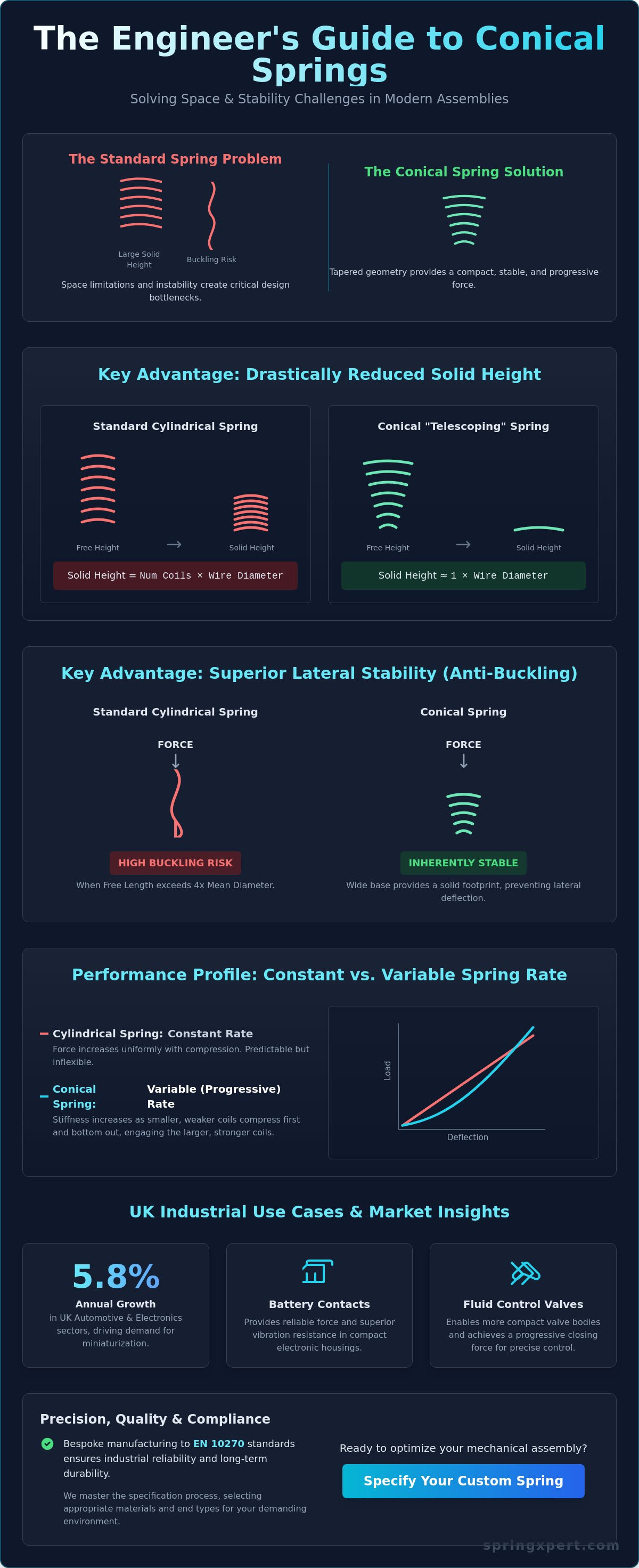
Nesting, or telescoping, is the defining characteristic of a tapered spring. This occurs when the smaller coils pass inside the larger coils during compression. In a perfectly designed telescoping spring, the coils occupy the same horizontal plane. This results in a solid height that is essentially equal to the wire diameter itself. This is a significant departure from standard compression springs, where the solid height is the sum of all wire diameters stacked vertically. By reducing the solid height, engineers can design more compact housings without sacrificing travel distance. This capability is vital for modern UK manufacturing where miniaturization is a primary design goal.
Key Advantages of Tapered Geometry in Industrial Design
The selection of conical springs over standard cylindrical designs is driven by specific mechanical requirements that traditional components cannot meet. Tapered geometry offers unique structural benefits. These include a significantly reduced solid height and superior resistance to lateral deflection. By utilizing a variable coil diameter, engineers gain greater control over the spring's behavior under load. This geometry allows for a more sophisticated response to compression, making it a staple in precision-engineered UK systems.
One of the most critical advantages is the reduction of solid height. As established by technical data from IDC Spring, the nesting capability allows the spring to compress into a space often no thicker than the wire itself. This is a primary driver for choosing these components in compact electronic housings or automotive clutch assemblies where vertical clearance is nearly non-existent. The ability to achieve full travel within a minimal envelope is a distinct advantage for modern industrial designers.
Solving the Buckling Problem
Standard cylindrical springs often suffer from buckling when the free length exceeds four times the mean diameter. This bowing effect occurs because the narrow footprint cannot maintain vertical alignment under high compression. Conical designs mitigate this by providing a wide base that acts as a self-centring foundation. The increasing diameter toward the bottom provides a larger surface area, which naturally resists lateral shifts. While die springs are often used for high-load stability, they require significant vertical space. Conical alternatives offer a comparable level of stability in a much smaller profile, eliminating the need for internal guide rods in many applications.
Space Optimisation in Modern Machinery
In a typical British industrial setting, such as a precision tool manufacturing plant in the West Midlands, component size is a constant constraint. Imagine a scenario where a senior engineer, a British specialist with decades of experience in UK manufacturing, needs to replace a bulky damping system. By integrating a conical spring, the assembly footprint can be reduced significantly compared to a traditional stack. This allows for more streamlined machine profiles and better use of internal housing space.
This space optimisation also leads to weight reduction. In portable industrial tools used across the UK construction sector, every gram matters for operator ergonomics. Tapered springs provide the necessary force without the mass of a longer cylindrical component. If you are currently designing a compact assembly, our team can provide bespoke spring prototyping to ensure the geometry fits your specific housing.
The varying coil diameters also introduce natural vibration dampening. Because each coil has a different resonant frequency, the spring does not amplify vibrations in the same way a uniform spring does. This makes them ideal for high-speed machinery where harmonic resonance could lead to premature component failure. This inherent dampening reduces the need for secondary isolation materials, further simplifying the design process.
Understanding Spring Rates: Constant vs. Variable Performance
The physics of conical springs requires a departure from the linear calculations used for standard components. In a typical cylindrical spring, the spring rate is constant because the mean diameter of every coil is identical. Tapered designs introduce a variable rate because the spring rate is inversely proportional to the cube of the mean coil diameter. As the diameter decreases from the base to the apex, the resistance of the wire increases. While Hooke’s Law provides the foundational formula (F = kx), the value of 'k' is no longer a single constant but a progressive variable that changes throughout the stroke.
As the spring undergoes compression, the larger coils with the lowest spring rate deflect first. Once these larger coils reach their travel limit or nest against the seating surface, they are removed from the active coil count. This reduction in active coils significantly increases the stiffness of the remaining assembly. This progressive performance is ideal for applications requiring sensitive initial movement followed by high resistance to prevent bottoming out. It provides a mechanical safeguard that standard springs cannot replicate without secondary damping components.
The Load-Deflection Curve
The non-linear load-deflection curve is a defining characteristic of tapered geometry. As more coils bottom out, the remaining active coils become progressively stiffer, resulting in an exponential increase in force. This allows for soft initial contact, which is essential for delicate electronic sensors or tactile switches. This performance profile is the opposite of standard extension springs, which operate on a linear scale where force increases at a steady, predictable rate. By utilizing this curve, engineers can manage high-energy damping within a restricted stroke length.
Calculating Force in Tapered Springs
Determining the exact force at any given point in the stroke requires precise data on the wire diameter, the large outside diameter, and the small outside diameter. Because the rate changes dynamically once nesting begins, simple manual estimations are rarely sufficient for high-precision UK manufacturing requirements. Imagine a British engineer in a specialized laboratory using a load-testing rig to calibrate a custom batch for an aerospace application. To ensure your assembly meets these rigid tolerances, SpringXpert Ltd provides technical consultancy for load requirement calculations and bespoke rate specifications. This collaborative approach ensures that the physical reality of the component matches the theoretical design parameters.
Common Applications in the UK Industrial Sector
The adoption of conical springs across the UK industrial landscape is driven by their ability to maintain performance in environments where standard components fail. According to 2025 market data, the automotive sector remains the largest end-user, accounting for 32.4% of the market. This is followed by industrial machinery at 22.1%. These figures reflect the reliance on tapered geometry for critical fail-safe mechanisms and high-cycle applications where standard cylindrical designs would buckle or lack the necessary lateral stability.
In electronics, these components are the standard for battery contacts. The wide base ensures a secure seat against the housing; the tapered coils provide constant pressure even under high vibration. This prevents power interruptions in portable diagnostic tools and handheld industrial scanners. Similarly, in fluid control, compact industrial valves utilize the reduced solid height to manage sealing forces within restricted envelopes. The medical sector also utilizes these springs in diagnostic equipment where precision tension is required for moving parts that must operate silently and reliably over long service lives.
Heavy Industry and Manufacturing
Safety valves in large-scale UK manufacturing plants rely on the stability of tapered designs to ensure precise opening pressures. In heavy-duty switchgear, these springs manage the high-velocity contact movements required for electrical isolation. While disc springs provide immense force in very short strokes, conical designs are preferred when a longer, more controlled stroke is necessary without the risk of buckling. This makes them essential for heavy-duty machinery where lateral space is abundant but vertical height is restricted.
Consumer and Commercial Products
Tactile interfaces and push-buttons frequently employ small-scale tapered springs to provide a specific "click" feel. Imagine a British engineer at a facility in the North East reviewing a prototype for a commercial appliance. They might specify a conical profile to ensure the button returns to its original position consistently over thousands of cycles. These are often integrated into complex clock springs assemblies to manage secondary tension requirements. The versatility of the tapered design allows it to be used in everything from high-end domestic appliances to specialized aerospace controls.
If your current application requires high-cycle reliability within a compact footprint, you can order custom conical springs directly from our UK manufacturing facility to meet your exact load specifications.
Specifying Custom Conical Springs: Materials and Finishes
The final phase of integrating conical springs into an industrial assembly is the technical specification of materials and finishes. This step is critical for ensuring the component survives its intended operating environment without loss of structural integrity. With new UK trade defense measures for steel taking effect on July 1, 2026, sourcing strategies must prioritize material reliability and compliance with updated domestic standards. These measures are designed to tighten the market, making the selection of high-specification materials a key factor in long-term supply chain stability.
Carbon steel (EN 10270-1-SM) remains the primary choice for high-tensile requirements in non-corrosive environments. As of May 2026, heavy melting steel (HMS 1) prices in UK yards are approximately £0.300 per kg. For assemblies exposed to moisture or corrosive agents, stainless steel (EN 10270-3-1.4310) is the mandatory specification. While 304-grade stainless is priced at £1.15 per kg, it provides the necessary oxidation resistance to prevent the premature failure that can occur in standard carbon components. The choice between these materials often dictates the maintenance cycle of the entire mechanical system.
Beyond the base alloy, the physical finish and end type dictate how the spring interacts with the housing. Ground ends are essential for applications requiring strict vertical alignment; they provide a flat bearing surface that ensures even load distribution. Surface treatments like zinc plating or powder coating offer additional durability for carbon steel, while passivation remains the standard for maximizing the protective chromium oxide layer on stainless components. These finishes are not merely aesthetic; they are functional barriers against environmental degradation.
Material Properties for Precision Engineering
Temperature resistance is a vital variable in material selection. Standard spring steels typically maintain their mechanical properties up to 120°C. However, in chemical processing or marine environments where 304-grade is insufficient, 316 stainless steel should be specified for its superior resistance to chloride-induced corrosion. Consistency in wire diameter is a non-negotiable requirement in bespoke orders. Even a 0.01mm variance can significantly alter the progressive rate calculated during the design phase, leading to performance deviations in the final assembly.
Working with a UK Manufacturer
Technical collaboration with a SpringXpert Ltd engineer ensures that the transition from a CAD model to a physical prototype is seamless and accurate. Our British specialists review your design for nesting clearances and load-bearing requirements before the coiling process begins. This meticulous prototyping phase minimizes the risk of failure in high-volume industrial orders and ensures every component meets ISO quality standards. With the UK Carbon Border Adjustment Mechanism (CBAM) arriving in January 2027, our focus on domestic manufacturing and national UK delivery provides a stable, compliant supply chain for your precision components. We invite you to discuss your technical requirements with our team to ensure your specifications align with the latest industrial standards.
Optimising Mechanical Performance with Precision Tapered Components
Integrating conical springs into your assembly addresses the fundamental challenges of buckling and excessive solid height. By utilizing the progressive rate of a tapered design, you ensure stability in high-vibration environments while meeting the strict miniaturization requirements of modern electronics and automotive systems. As discussed, the precise selection of materials and end types remains a critical step in ensuring long-term reliability within the UK industrial sector. Whether you're managing space constraints in a compact valve or seeking lateral stability for long-travel applications, the geometric advantages of tapered components are clear.
With over 20 years of UK manufacturing expertise, we provide the technical depth required for high-stakes industrial applications. Our inventory includes 20,000+ standard products in stock for immediate dispatch; however, we also offer bespoke CAD design and prototyping services to meet unique geometry requirements. This hands-on approach ensures your components perform exactly as specified under real-world loads. Consult with our engineering team for bespoke conical spring design to ensure your next project benefits from precision-engineered stability. We're ready to assist with your technical collaboration.
Frequently Asked Questions
What is the main advantage of a conical spring over a standard compression spring?
The primary advantage is the ability to achieve a significantly reduced solid height through nesting. Unlike cylindrical springs, conical springs allow coils to telescope into one another during compression. This provides a compact profile and prevents lateral buckling in long-travel applications. The wider base also offers a self-centring footprint that eliminates the need for internal guide rods in many mechanical assemblies.
Can conical springs be compressed to a truly flat solid height?
A truly flat solid height is achievable if the spring is designed so each coil nests completely within the next. In this specific configuration, the solid height is approximately equal to the wire diameter. This requires precise geometric calculations during the design phase to ensure the inner diameter of one coil is larger than the outer diameter of the subsequent coil. Not all tapered designs are flat; it depends on the degree of the taper.
How do you calculate the spring rate for a tapered design?
Calculating the spring rate for a tapered design is complex because the rate changes as coils begin to nest. While the standard formula for cylindrical springs applies to each individual coil, the overall rate is non-linear. Engineers typically use specialized software to model the load-deflection curve. This accounts for the reduction in active coils as the spring compresses and the mean diameter changes at every point of the stroke.
Are conical springs more expensive to manufacture than cylindrical ones?
Manufacturing costs are typically higher for tapered designs compared to standard cylindrical components. The coiling process requires more sophisticated CNC programming and monitoring to manage the varying diameters accurately. However, the total system cost often decreases because conical springs eliminate the need for secondary components like guide rods or larger housings. The efficiency gained in assembly often offsets the higher unit price.
What materials are best suited for conical springs in corrosive environments?
Stainless steel grades such as 302 or 316 are best suited for corrosive industrial environments. These materials offer high resistance to oxidation and chemical exposure. For extreme conditions, such as marine or chemical processing plants, 316 stainless steel provides superior protection against pitting. Surface treatments like passivation can further enhance these properties and extend the component's service life in harsh UK climates.
Can I get a constant spring rate with a conical design?
It is possible to achieve a constant spring rate by varying the pitch of the coils to compensate for the changing diameter. This requires meticulous design where the pitch increases as the coil diameter decreases. While most tapered designs are naturally progressive, this tailored approach allows for linear performance in a space-saving package. It's a common requirement for precision instruments where a predictable force is necessary.
What information do I need to provide for a custom conical spring quote?
A custom quote requires specific technical data including the wire diameter, the large outside diameter, and the small outside diameter. You should also provide the free length, the number of total coils, and the required load at a specific compressed height. Specifying the material grade and end type, such as ground or plain, ensures the quote reflects your exact performance needs and manufacturing standards.
How does the "nesting" feature affect the lifespan of the spring?
The nesting feature can influence the lifespan of the spring by reducing the risk of buckling and the associated stress concentrations. However, if the coils rub against each other during telescoping, friction can lead to surface wear or noise. Proper design and the application of surface coatings or lubricants help mitigate these issues; ensuring a long service life in high-cycle industrial applications across the UK manufacturing sector.