
Industrial Disc Springs Supplier: A Guide to Selecting the Right Engineering Partner
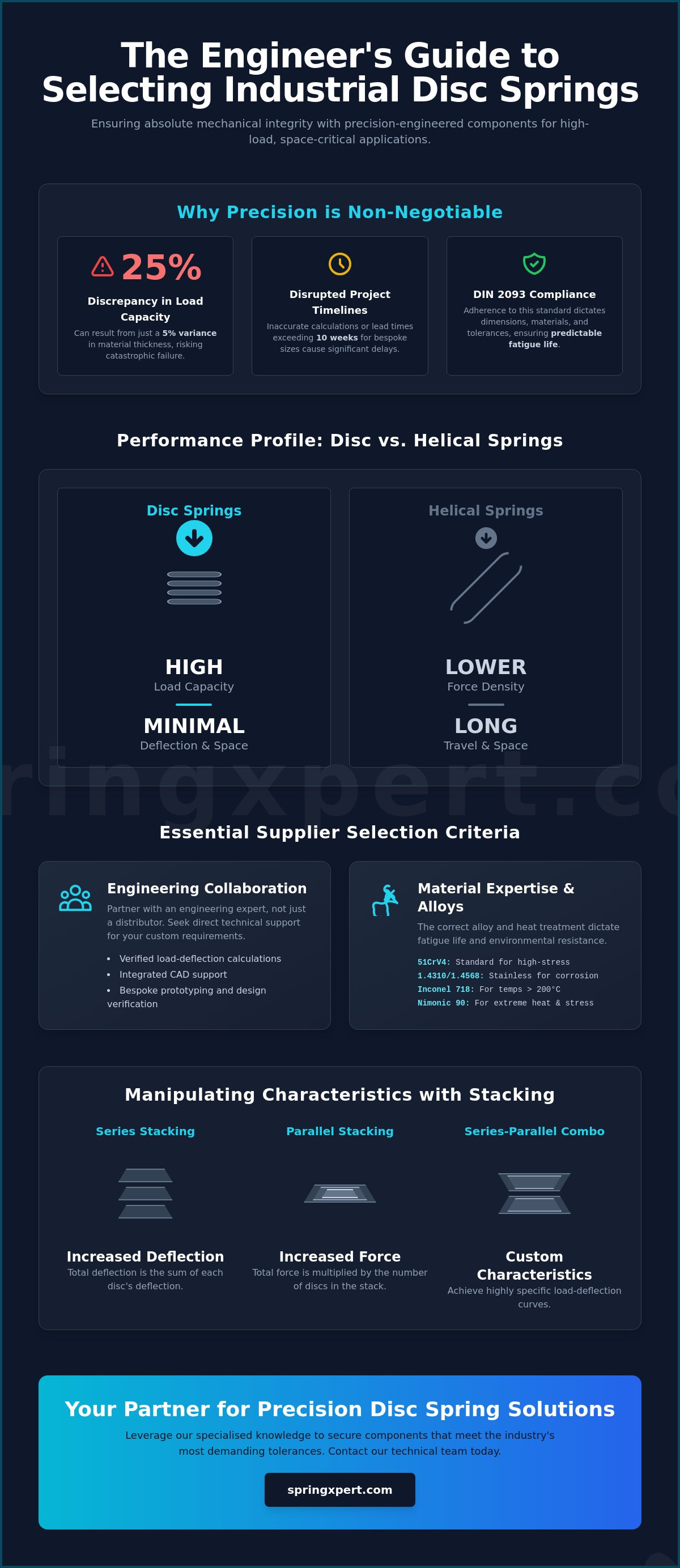
A 5% variance in material thickness can result in a 25% discrepancy in load-bearing capacity, often causing catastrophic failure in critical industrial assemblies. You recognise that choosing an industrial disc springs supplier is about more than just filling a purchase order; it's about ensuring absolute mechanical integrity. It's difficult to manage projects when inaccurate load-deflection calculations or lead times exceeding 10 weeks for bespoke sizes disrupt your timeline. You require a partner who understands the physical reality of high-load performance.
This guide provides the technical criteria needed to select a supplier that delivers precision and reliability. You'll learn how to evaluate bespoke engineering capabilities and ensure full compliance with DIN 2093 standards. We'll preview the benefits of a robust UK-based supply chain and the necessity of direct technical collaboration for custom requirements. By applying the SpringXpert lens of specialised knowledge, you can secure components that meet the most demanding tolerances in the industry.
Key Takeaways
- Understand why the unique conical geometry of disc springs provides superior performance in high-load, space-restricted industrial applications.
- Identify the essential criteria for selecting an industrial disc springs supplier, focusing on technical support depth and the availability of high-performance alloys.
- Learn how to manipulate spring characteristics through series and parallel stacking configurations to meet specific deflection and force requirements.
- Establish a robust procurement checklist that accounts for critical environmental factors, including temperature extremes and chemical exposure.
- Discover the advantages of bespoke engineering and technical consultancy in delivering durable, precision-manufactured solutions for complex mechanical systems.
The Critical Role of Disc Springs in Industrial Performance
A disc spring is a conical component designed for axial loading. These precision-engineered parts, frequently identified as a Belleville washer, provide a reliable solution for high-load applications where installation space is severely restricted. The unique conical geometry allows the spring to offer a high load-bearing capacity with minimal deflection. Selecting a qualified industrial disc springs supplier ensures that these components meet the exacting demands of heavy machinery and precision instrumentation while maintaining structural integrity under stress.
Manufacturing consistency and safety depend on adherence to the DIN 2093 standard. This specification dictates the dimensions, materials, and load tolerances required for reliable performance, ensuring that components meet predictable fatigue life cycles. Beyond simple force application, disc springs are vital for managing vibration and compensating for thermal expansion in bolted assemblies. They maintain constant tension even as temperatures fluctuate, which prevents mechanical loosening in high-heat environments. Their capacity for energy storage within a compact volume makes them a primary choice for fail-safe systems and damping mechanisms in industrial plants across the UK.
When to Specify Disc Springs Over Helical Alternatives
Physical space constraints are the primary driver for choosing disc springs. In valve actuators and heavy braking systems, the axial depth available for a spring is often limited to a few millimetres. While standard compression springs are effective for applications requiring long travel, they lack the force density of a disc spring. A single disc can produce thousands of Newtons of force within a height that would require a significantly larger helical coil. This high force-to-space ratio allows for more compact mechanical assemblies, reducing the overall weight and footprint of industrial equipment.
Common Industrial Applications and Sector Requirements
The utility of these components extends across diverse sectors with specific performance mandates. In the medical field, they provide the consistent, minute pressure required for precision surgical instruments. Aerospace fasteners rely on them to maintain bolt preload during the extreme pressure and temperature shifts encountered during flight. Construction machinery and the recycling sector utilize disc springs for their extreme durability, often employing them in hydraulic breakers and heavy-duty shredders to absorb repetitive shock loads. To learn more about RSS Parts and their expertise in replacement components for the recycling and material handling industries, you can explore their specialized range. A specialized industrial disc springs supplier can provide the necessary alloy expertise, such as using stainless steel or Inconel, to ensure resistance to corrosion and fatigue in these demanding environments.
Essential Criteria for Selecting an Industrial Disc Springs Supplier
Selecting an industrial disc springs supplier is a strategic decision that affects the long-term viability of mechanical assemblies. Reliability in heavy-duty applications depends on manufacturing control and technical depth. A supplier acting as a simple distributor often lacks the granular data needed for critical failure analysis. In contrast, an engineering partner maintains oversight of the entire production cycle, from raw material sourcing to final testing. This ensures that the components don't just meet the dimensions on a drawing, but perform consistently under operational stress.
Material Expertise and Alloy Selection
Material selection dictates the fatigue life and environmental resistance of the component. While 51CrV4 (AISI 6150) serves as the standard for high-stress applications, specific UK industrial sectors require more resilient options. Suppliers must demonstrate proficiency in handling stainless steel grades like 1.4310 or 1.4568 for corrosive environments. For extreme temperatures exceeding 200°C, high-performance alloys such as Inconel 718 or Nimonic 90 are necessary. The heat treatment process is equally vital; it ensures the correct martensitic structure, which directly impacts the spring's ability to withstand millions of cycles without settling or cracking.
Engineering Collaboration and Design Verification
A capable supplier provides more than a catalogue number. They offer verified load-deflection curve calculations and integrated CAD support to streamline the design phase. This technical engagement allows for bespoke prototyping, which is essential when standard sizes don't meet specific space or load constraints. Identifying "Xpert" guidance involves looking for partners who can simulate spring stack behaviour under dynamic loads. This level of collaboration reduces the risk of premature component failure in the field. When a project requires non-standard tolerances, the supplier’s ability to provide custom-engineered solutions becomes the primary differentiator.
Verifying quality management systems is a prerequisite for any procurement process. In-house manufacturing provides a level of traceability that third-party distribution cannot match. It allows for direct control over industrial tolerances and surface finishing processes like phosphating or mechanical zinc plating. Adherence to established DIN standards, specifically DIN EN 16983 (formerly DIN 2093), ensures that every batch meets rigorous geometric and performance requirements. At SpringXpert, we prioritise these technical benchmarks to provide components that excel in demanding British manufacturing environments. This rigorous oversight prevents the 15% to 20% variance in load performance often seen in non-standardised imports. If you require assistance with complex stack calculations, our team can provide the necessary technical data to validate your design.
Maximising Utility: Stacking Configurations and Bespoke Design
The versatility of a Belleville washer is found in its modularity. A professional industrial disc springs supplier provides more than a simple component; they offer a scalable system for force management. By altering the stacking sequence, engineers can manipulate the spring rate, load capacity, and deflection characteristics without changing the housing dimensions. This flexibility is essential for heavy machinery where space is a fixed constraint.
Stacking in series involves placing springs face-to-face or back-to-back. This configuration increases the total deflection in direct proportion to the number of discs used. For example, a stack of four springs in series provides four times the deflection of a single disc while the load remains constant. This is ideal for applications requiring a soft spring rate over a longer travel distance.
Stacking in parallel involves nesting springs in the same direction. This method multiplies the load capacity. A stack of three nested springs handles three times the load of a single unit, though the deflection remains identical to a single disc. Within these configurations, friction becomes a primary technical factor. Parallel stacks generate internal friction as the surfaces slide against one another. This creates a damping effect, or hysteresis, which is useful for absorbing shock but requires precise lubrication to prevent premature wear.
Bespoke Disc Spring Design and Prototyping
Standard catalogues cover approximately 85% of industrial applications. However, bespoke engineering is required when standard DIN 2093 sizes fail to meet specific force requirements or fit within unique geometric envelopes. We specialise in custom-engineered solutions using high-performance alloys such as 17-7 PH stainless steel or Inconel for cryogenic or high-heat environments. The prototyping process involves rigorous FEA (Finite Element Analysis) to ensure the design meets the fatigue life requirements of the project. For specific technical formulas and design tolerances, engineers should consult our disc springs engineering guide.
Stacking Patterns for Custom Load Curves
Complex industrial systems often require progressive load curves. You can achieve this by mixing discs of different thicknesses or combining different stacking sequences within a single column. This allows the spring assembly to offer a light initial resistance that increases significantly as the stack compresses. Maintaining alignment is critical for these assemblies. When a stack length exceeds three times the outside diameter, the risk of buckling increases. We recommend using hardened internal guide rods or external sleeves with a surface finish of Ra 0.8 microns to ensure stability. As an experienced industrial disc springs supplier, we assist in calculating these complex interactions to ensure the self-damping properties of parallel stacks don't lead to excessive heat build-up during high-frequency cycles. We invite technical collaboration to refine these specifications for your specific assembly.
Specifying Your Requirements: A Procurement Checklist
Effective procurement begins with a rigid set of technical parameters. When you partner with an industrial disc springs supplier, the accuracy of your initial data directly impacts the performance of the final assembly. You must determine the exact force required at a specific deflection point. Vague requirements lead to over-engineered costs or under-performing components. You should also account for the physical envelope, measuring the outside diameter (De), inside diameter (Di), and the total available stack height within the housing.
Environmental factors are equally critical. Operating temperatures exceeding 150°C or exposure to corrosive chemicals in UK chemical processing plants necessitate specific alloys like Inconel or stainless steel. Consult with the supplier's engineering team early in the design phase. They'll provide material and finish recommendations based on your specific duty cycle. Always request technical drawings and verified load-deflection data before finalising a purchase order. Selecting a reliable industrial disc springs supplier involves verifying their ability to provide this data for every batch.
Technical Data Needed for Accurate Quoting
A comprehensive quote requires more than just basic dimensions. You must specify the required number of cycles, as fatigue life calculations change based on whether the spring needs to survive 100,000 or 2 million cycles. Surface finish requirements also influence the quote. Common industrial options include phosphating for basic corrosion resistance or zinc plating for enhanced durability. Mechanical cleaning is often specified for precision applications where surface integrity is paramount. Providing these details ensures the quote reflects the true cost of production and meets your performance benchmarks.
Supply Chain and Volume Considerations
Volume significantly dictates the procurement strategy. Stock items are ideal for prototyping or immediate maintenance needs, but bulk manufacturing offers tiered pricing that reduces unit costs for large-scale production. In the UK market, bespoke manufacturing lead times often sit between 6 and 10 weeks. Evaluating these lead times against your project timeline is essential for maintaining assembly schedules. Ensure your supplier can scale from unit-based sales to high-volume manufacturing without compromising on the tight tolerances required by standards such as DIN 2093. This scalability is vital for long-term industrial projects where consistency across thousands of units is a requirement.
Ready to finalise your technical specifications? Contact our engineering team for a detailed review of your requirements.
SpringXpert: Your Partner for Precision Disc Spring Solutions
SpringXpert has operated at the forefront of the UK manufacturing sector for over 20 years. As a specialist industrial disc springs supplier, we provide the technical depth required for high-stakes engineering projects. Our facility integrates modern CNC technology with traditional craftsmanship to maintain tight tolerances and consistent tensile strength across every production batch. This dual approach ensures that every component meets the exact mechanical properties defined in your specifications.
Our inventory includes over 20,000 standard products, which allows for rapid procurement of common industrial components. However, we recognize that standard dimensions don't always meet the needs of complex machinery. We offer bespoke engineering for custom wire forms and specialized disc springs tailored to unique environmental stressors. Producing our components in the UK ensures direct oversight of quality control and eliminates the logistical delays associated with international shipping. This localized control is why many leading engineering firms rely on us for critical supply chain stability.
The SpringXpert Advantage in Industrial Engineering
We prioritize a solution-oriented approach to mechanical challenges. Our engineers work with high-grade alloys designed for longevity and performance under load. In the medical sector, we've delivered high-precision components for surgical equipment where failure isn't an option. For the construction and recycling industries, we manufacture heavy-duty springs that withstand extreme vibration and abrasive debris. These real-world applications demonstrate our ability to adapt manufacturing processes to specific industrial demands. We don't just supply parts; we provide the technical consultancy necessary to optimize spring performance within your specific assembly.
Start Your Technical Collaboration Today
Technical collaboration starts with a clear understanding of your load requirements and spatial constraints. Our design and prototyping services allow you to test custom-engineered solutions before committing to full-scale production. This methodology reduces mechanical risk and ensures the final product integrates seamlessly into your hardware. You can access our consultancy team to discuss material selection, corrosion resistance, or expected cycle life for any application. As a dedicated industrial disc springs supplier, we focus on delivering data-backed results that enhance the durability of your machinery.
Optimising Mechanical Reliability with Technical Engineering Support
Selecting the right industrial disc springs supplier is a decision that dictates the operational lifespan of your critical machinery. High-performance applications require more than just off-the-shelf components; they demand precise tolerances and verified material integrity. Effective procurement focuses on the engineering depth behind the product. This ensures every stacking configuration and bespoke design meets exact load requirements for your specific application.
SpringXpert brings over 20 years of engineering experience to every project. We operate an ISO-compliant UK manufacturing facility where precision is the baseline for all production. With an inventory exceeding 20,000 standard products, we provide the technical infrastructure needed to support complex industrial systems. We don't just supply parts; we offer the technical authority required to solve difficult force and deflection challenges. Our team is ready to assist with your assembly requirements through data-driven insights and proven manufacturing capabilities.
Request a Technical Consultation for Industrial Disc Springs to ensure your next project benefits from our specialized engineering support. We look forward to helping you achieve the mechanical reliability your operations demand.
Frequently Asked Questions
What is the difference between a disc spring and a Belleville washer?
Disc springs and Belleville washers share the same conical geometry, but they differ in precision and intended application. A disc spring is a high-performance component manufactured to DIN 2093 standards for dynamic loads and predictable fatigue life. Belleville washers are typically used for static bolting applications where precise load-deflection characteristics aren't the primary engineering requirement.
Can disc springs be used in high-temperature industrial environments?
Disc springs operate effectively in high temperatures if you select the correct alloy for the thermal load. Standard 50CrV4 steel performs reliably up to 150°C, but performance degrades quickly beyond this point. For extreme conditions, we use Inconel X-750 to maintain mechanical properties at temperatures reaching 700°C, ensuring the spring doesn't lose its set or tensile strength during operation.
How do I calculate the load capacity of a stacked disc spring?
Load capacity depends on whether you stack the springs in series or parallel. In a parallel stack, where springs are nested in the same direction, the total load capacity increases by the number of springs used. For example, a stack of three springs triples the force. When stacked in series, or back-to-back, the load remains equal to a single spring while the total deflection increases proportionally.
What are the standard materials used by an industrial disc spring supplier?
The most common material for an industrial disc spring supplier is 50CrV4 chrome vanadium steel, which offers excellent fatigue resistance for thicknesses above 1.25mm. For applications requiring corrosion resistance in UK manufacturing environments, 1.4310 stainless steel is a frequent choice. We also utilise specialised alloys like 1.4568 (17-7 PH) when high strength and corrosion resistance must be balanced in a single component.
Is it better to buy stock disc springs or order a bespoke design?
Stock springs are the most efficient choice for 85% of engineering projects because they adhere to established DIN 2093 dimensions and are ready for immediate dispatch. You should choose a bespoke design when your application has unique space constraints or requires specific load profiles that standard sizes can't meet. Custom engineering allows us to adjust the thickness and cone height to achieve your exact force requirements.
How does DIN 2093 affect the quality of industrial disc springs?
DIN 2093 is the primary quality benchmark that governs tolerances, material specifications, and testing methods. The standard ensures that a spring will achieve a predictable fatigue life of over 2 million cycles when operated within recommended stress limits. By following these rigorous manufacturing groups, your industrial disc springs supplier guarantees consistency across every batch, which is vital for maintaining the reliability of heavy machinery.
What surface finishes are available for corrosion protection?
Phosphating is the standard finish for basic protection, but harsher environments require more robust coatings. Zinc flake coatings, such as Geomet 321, provide over 480 hours of salt spray resistance without the risk of hydrogen embrittlement. For extreme offshore or chemical processing applications, we often recommend mechanical galvanising or using high-grade stainless steel alloys to ensure long-term durability and structural integrity.