

High Quality Circlips UK: The Industrial Buyer’s Guide to Retaining Rings
A single circlip failure in a high-speed UK assembly line can result in over £5,000 of lost productivity per hour of downtime. You likely recognize that mechanical reliability depends on these small components maintaining exact tolerances under extreme axial loads. Sourcing high quality circlips UK requires more than just finding a part number; it demands a deep understanding of tensile strength and alloy fatigue. When a retaining ring fails to meet its specified DIN 471 or DIN 472 requirements, the resulting component displacement often leads to catastrophic system failure.
This guide provides the technical framework you need to master the specifications and selection criteria for industrial retaining rings. You'll learn how to ensure full compliance with UK engineering standards and reduce assembly errors caused by poor material tolerances. We'll examine specific DIN-compliant rings, axial load capacities, and the custom-engineered solutions necessary for precision manufacturing projects. By applying these engineering principles, you can secure the mechanical precision your operations demand and eliminate the uncertainty of component sourcing.
Key Takeaways
- Understand how precision-engineered retaining rings provide critical axial positioning to prevent assembly failure in complex UK manufacturing environments.
- Differentiate between Carbon Spring Steel and Stainless Steel material grades according to established DIN standards for optimal corrosion resistance and tensile strength.
- Master the specific selection criteria for internal, external, and e-clip variants based on the required direction of tension and mechanical application.
- Learn the technical process of measuring tolerances and load capacities to ensure the correct specification of high quality circlips UK for your project.
- Discover how to leverage SpringXpert Ltd’s technical authority and inventory of 20,000+ standard components to streamline your industrial procurement process.
Table of Contents
- The Role of High-Quality Circlips in UK Precision Engineering
- Understanding Material Grades and DIN Standards for Retaining Rings
- Selecting the Correct Circlip: Internal, External, and E-Clips
- Critical Specifications: Measuring Tolerances and Load Capacities
- Sourcing Premium Circlips in the UK: The SpringXpert Advantage
The Role of High-Quality Circlips in UK Precision Engineering
A Circlip serves as a critical semi-flexible retaining ring designed for precise axial positioning on shafts or within bores. Unlike generic fasteners, high quality circlips UK manufacturers produce are engineered to exact tolerances to ensure they don't deform under operational load. Precision manufacturing is the primary defense against catastrophic assembly failure in high-speed machinery. When a retaining ring fails, the resulting axial movement can lead to the total destruction of bearings, gears, and housings. This makes the selection of high-tolerance components a safety requirement rather than a mere preference.
UK industrial sectors including medical technology, construction, and recycling demand fasteners that exceed standard commercial specifications. In medical imaging equipment, components must remain secure during rapid rotation without the slightest deviation. Recycling plants utilize heavy-duty shredders where high-vibration environments test the limits of tensile strength. Standard fasteners often lack the metallurgical consistency required for these applications. High-performance retaining rings are defined by their alloy composition and specific heat-treatment processes. These factors provide the necessary spring tension to remain seated even under extreme centrifugal force.
Fundamental Mechanics of Retaining Rings
Circlips function by exerting constant radial pressure against the walls of a machined groove. This interference fit creates a physical shoulder that prevents axial movement of the retained component. The distinctive "lug" or "ear" design features small holes that allow for the insertion of specialized pliers. This design allows the ring to be compressed or expanded during installation without causing permanent metal fatigue. The total retaining force is mathematically dependent on the ratio between the groove depth and the radial wall thickness of the circlip.
The Economic Impact of Fastener Quality
Investing in high-grade components reduces long-term maintenance costs by extending service intervals. Low-grade imports often suffer from hydrogen embrittlement or inconsistent thickness, which leads to premature snapping in high-vibration environments. These failures result in expensive downtime and potential safety hazards. For engineers managing complex assemblies, understanding the interplay between different mechanical components is vital. Just as compression springs manage axial loads in many systems, circlips provide the structural boundary that keeps those loads contained. Choosing a bespoke or custom-engineered solution ensures that the alloy and tensile strength match the specific demands of the UK's most rigorous engineering projects. This systematic approach to component selection minimizes the risk of component migration and ensures the stability of the entire mechanical system.
Understanding Material Grades and DIN Standards for Retaining Rings
The UK manufacturing sector relies on the DIN (Deutsches Institut für Normung) system to maintain strict tolerances across mechanical assemblies. This framework ensures that high quality circlips UK suppliers provide are compatible with global engineering specifications. Most standard applications use Carbon Spring Steel, typically hardened to a range of 470 to 580 HV. This material provides the necessary elastic limit to expand or contract during installation without permanent deformation. For environments exposed to moisture or chemicals, Stainless Steel grades like 1.4310 or 1.4401 offer essential oxidation resistance. Precise heat treatment cycles determine the final tensile strength of the component. A well-tempered ring maintains its grip under constant axial load. To further protect these parts, engineers specify finishes such as black phosphate and oil, which provide basic shelf-life protection. Zinc plating is a common alternative for better atmospheric protection, though it requires careful de-embrittlement processing to prevent hydrogen embrittlement in high-carbon steels.Key Standards: DIN 471 and DIN 472
DIN 471 governs external retaining rings designed for use on shafts. These rings exert inward pressure to sit securely in a machined groove. Conversely, DIN 472 specifies internal rings for bores, where the spring force acts outwards. Each standard defines critical dimensions, including ring thickness (ranging from 0.4mm to over 10mm) and the required groove depth. Precision here is vital; if a groove is too shallow or the thickness is off by even 0.05mm, the assembly won't withstand the design load. These standards ensure that high quality circlips UK engineers select will fit standard grooves without modification.Heavy Duty and Specialist Standards
Standard rings don't always suffice for high-stress environments. DIN 1460 specifies heavy-duty external circlips with increased thickness for applications facing significant shock loads. When dealing with components that have large radii or chamfers, DIN 983 and DIN 984 provide multi-lug designs for increased abutment. Engineering teams must also calculate the rotational capacity for a retaining ring in high-speed machinery. Centrifugal forces can cause a ring to lift out of its groove at high RPMs, leading to catastrophic failure. For bespoke requirements involving extreme temperatures above 300°C, specialist alloys like Inconel are utilized. If you're unsure which grade fits your project, our team can help you specify the correct material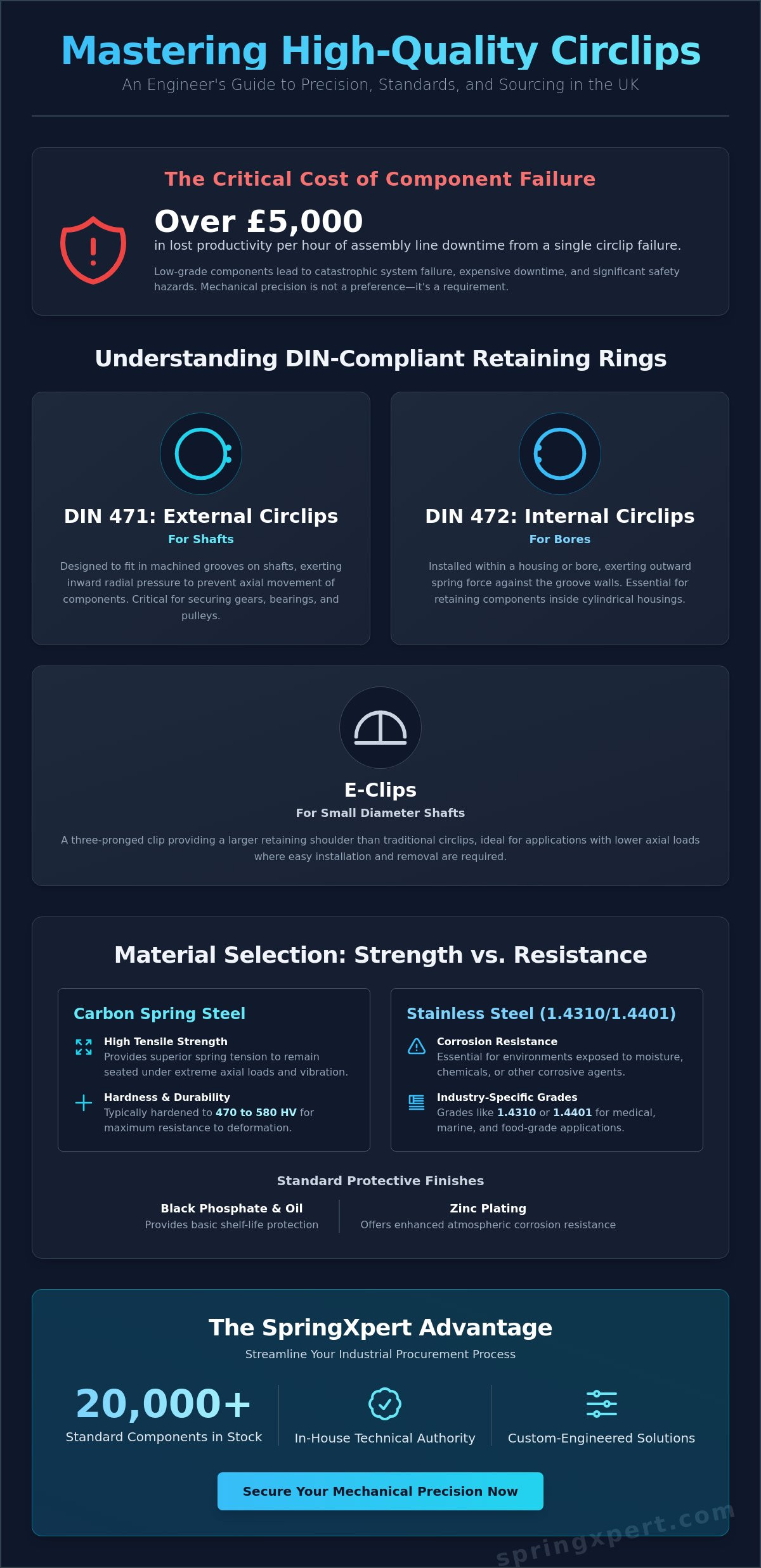
Selecting the Correct Circlip: Internal, External, and E-Clips
Identifying the right retaining ring involves evaluating whether the component must be secured onto a shaft or within a housing. For engineers sourcing high quality circlips UK suppliers provide, the decision hinges on the direction of tension and the physical access points of the assembly. You must choose between axial installation, which requires end-of-shaft access, and radial installation, which allows for side-entry in constrained environments. Permanent solutions are rarely ideal in machinery requiring periodic maintenance; therefore, selecting a removable fastener that maintains its elastic memory after multiple cycles is a priority for long-term reliability.
External Circlips (Shaft Mounted)
External circlips exert inward pressure to grip the outside diameter of a shaft. They're ubiquitous in automotive gearboxes and rotating machinery where they prevent lateral movement of gears and pulleys. When shafts exceed 3,000 RPM, calculating centrifugal force limits is vital. At high speeds, the ring's own mass can cause it to expand and lose its grip on the groove. To maintain assembly integrity, installers must use specialized pliers to avoid over-stretching the ring beyond its elastic limit. Over-stretched rings fail to snap back into the groove, which compromises the safety of the entire rotating mass.
Internal Circlips (Bore Mounted)
Internal circlips are designed for bore mounting, where they expand outward to lock into a groove within a housing. These are essential for securing bearings or pins. Precision in bore diameter tolerances is mandatory; even a 0.1mm deviation can compromise the seating and lead to component failure. Unlike disc springs, which provide high-force axial tension in compact spaces, internal circlips focus on preventing lateral displacement. Adhering to the British Standard for carbon steel circlips ensures the material properties meet the necessary tensile requirements for industrial housing applications. The lugs on these rings are designed to point inward, allowing for easy extraction with internal pliers during maintenance intervals.
E-Clips and Radial Retaining Rings
E-clips, or DIN 6799 rings, provide a radial solution for shafts where end access is blocked by other components. They're pushed onto the groove from the side rather than slid over the end. This ease of installation comes with a trade-off; they generally offer lower load capacity than standard axial rings because they don't wrap as far around the shaft circumference. You'll find these in small appliances, office equipment, and light industrial machinery. When choosing between an E-clip and a standard external circlip, consider these factors:
- Access: Use E-clips if the shaft ends are inaccessible.
- Load: Use standard external circlips for high-thrust applications.
- Groove Depth: E-clips require deeper grooves relative to the shaft diameter to ensure a secure fit.
Selecting high quality circlips UK manufactured components ensures that the steel grade and heat treatment processes provide the durability needed for these specific mechanical stresses. Whether your project requires the radial convenience of an E-clip or the robust axial security of a standard internal ring, matching the fastener to the specific load profile of your assembly is the only way to ensure operational stability.
Critical Specifications: Measuring Tolerances and Load Capacities
Precision in mechanical fastening starts with exact measurement. When sourcing high quality circlips UK, engineers must distinguish between the nominal size of the application and the physical dimensions of the fastener. A nominal size of 25mm refers to the shaft or bore diameter, not the ring itself. To verify a component, always use calibrated vernier calipers. An external ring will measure smaller than its nominal size when uncompressed, while an internal ring will measure larger. This difference provides the radial tension required to grip the groove once installed.
Measuring Internal vs. External Rings
- Internal Rings: Measure the maximum outside diameter (OD) across the lugs. This diameter must exceed the bore size to ensure the ring expands into the groove correctly.
- External Rings: Measure the minimum inside diameter (ID). This must be smaller than the shaft diameter to provide a secure interference fit.
Don't rely on measurements from used or deformed circlips. Repeated installation cycles can lead to permanent set, where the metal loses its elastic memory. A ring that has exceeded its elastic limit won't exert sufficient pressure, leading to assembly failure. For critical aerospace or automotive applications, verify the thickness against the manufacturer's specification sheet, typically within a tolerance of +/- 0.05mm. Any deviation beyond these limits suggests the component is compromised and should be replaced to maintain system integrity.
Axial and Shock Load Considerations
Calculating the axial load capacity (kN) is essential for safety. This value depends on the shear strength of the ring material and the thickness of the component. Static loads represent a constant force, while dynamic or shock loads involve sudden impacts that can exceed the tensile strength of the alloy. High-performance rings often utilise carbon spring steel with a hardness of 44 to 54 HRC to resist these forces. The groove material hardness also dictates performance; if the housing is softer than the ring, the groove wall will deform before the circlip fails. Groove depth determines the shear area of the housing, making it just as vital as ring thickness for total assembly security.
Effective force distribution relies on proper abutment. This is the contact surface where the ring meets the groove edge. If the radius on the retained part is too large, it can create a "ramping" effect that forces the ring out of its seat. Maintaining sharp edges on the groove is a standard requirement for high quality circlips UK to prevent premature ejection under load. Every assembly must be evaluated for the specific kilonewton requirements of the application to ensure the fastener doesn't dish or shear under maximum operating pressure.
For technical assistance with your specific load requirements and material tolerances, contact our engineering team at springxpert.com to discuss custom solutions.
Sourcing Premium Circlips in the UK: The SpringXpert Advantage
SpringXpert serves as a primary resource for industrial partners seeking high quality circlips UK wide. Our technical foundation is built on 20 years of expertise in the production and distribution of precision fasteners. We manage an extensive inventory of over 20,000 standard stock components, which allows for immediate dispatch to meet urgent manufacturing schedules. This range includes internal and external retaining rings designed to ISO and DIN standards, ensuring compatibility with existing mechanical designs across various sectors.
Our logistical infrastructure supports UK-wide delivery, providing a stable supply chain for industries ranging from heavy plant machinery to delicate medical instrumentation. We don't just supply parts; we provide technical support that helps engineers select the right fastener for their specific application. This involves analyzing shaft diameters, groove depths, and expected centrifugal forces to prevent component migration during operation. Our team focuses on the physical reality of your assembly to ensure long-term durability.
Bespoke Engineering and Prototyping
Standard fasteners aren't suitable for every application. We manufacture custom wire forms and bespoke retaining rings to meet unique geometric requirements that off-the-shelf products can't satisfy. Our material consultancy identifies the most effective alloy for your environment, whether you need 304 stainless steel for corrosion resistance or high-carbon steel for maximum tensile strength. We offer rapid prototyping to validate your design specifications. This process allows engineers to test physical samples in their assemblies, ensuring that tolerances and fitment are exact before committing to a large production run.
Quality Assurance and Reliability
Reliability is non-negotiable when sourcing high quality circlips UK engineers trust for safety-critical applications. Our commitment to quality is backed by rigorous testing protocols and comprehensive material traceability. We track every batch from the raw material stage to the finished product, providing the documentation required for high-stakes industrial projects. The Xpert approach focuses on technical collaboration. We work directly with your design team to solve complex assembly challenges, ensuring that each circlip can withstand the specific stresses of your application.
This methodical strategy eliminates guesswork and reduces the risk of mechanical failure in the field. If your project demands specific performance characteristics or non-standard dimensions, consult with our engineering team for bespoke circlip solutions. Our specialists provide the data and manufacturing capability needed to support your most demanding engineering requirements with precision and stability.
Optimising Your Retaining Ring Procurement
Selecting the right retaining ring requires a strict focus on material grades and precise DIN standards. Whether your application calls for internal, external, or E-clips, the integrity of your assembly depends on accurate load capacity measurements and tight tolerance control. Sourcing high quality circlips UK engineers can trust is essential for maintaining mechanical stability in high-stress environments. SpringXpert Ltd leverages over 20 years of UK manufacturing expertise to deliver components that meet these rigorous technical requirements.
Our UK-based facility provides efficient national distribution, ensuring your production lines remain operational without delay. We maintain access to over 20,000 standard stock products, providing the scale needed for any industrial project regardless of complexity. If standard specifications don't meet your needs, our team provides custom-engineered solutions tailored to your specific tensile strength and alloy requirements. We're ready to support your next precision engineering project with reliable, data-backed components that perform under pressure. It's our goal to provide the technical depth your business requires for long-term success.
Explore our full range of high-quality industrial circlips
Frequently Asked Questions
What is the difference between an internal and external circlip?
Internal circlips are designed for installation inside a bore or housing, while external circlips fit over the outside of a shaft or pin. An internal circlip (DIN 472) exerts outward radial pressure to stay secure within its groove. Conversely, an external circlip (DIN 471) applies inward pressure to grip the shaft. Using the incorrect type leads to immediate mechanical failure and potential assembly damage.
How do I know which DIN standard circlip I need?
You identify the required DIN standard by determining if the application involves a shaft or a housing bore. DIN 471 defines the specifications for external retaining rings used on shafts. DIN 472 covers internal rings for bores. For heavy-duty requirements, engineers often specify DIN 430 or DIN 431. These standards ensure that 100% of the components meet rigorous dimensional and material hardness requirements for industrial use.
Can I reuse a circlip once it has been removed?
You shouldn't reuse a circlip in critical load-bearing assemblies because the initial installation causes elastic deformation. This stretching reduces the ring's radial tension and its ability to remain seated under vibration. Research indicates that reused fasteners can lose up to 15% of their original gripping force. For safety, always fit a new high quality circlip UK manufactured to maintain the structural integrity of the joint.
What materials are best for circlips used in marine environments?
Stainless steel Grade 316 is the most effective material for circlips in marine or highly corrosive environments. This alloy contains 2% to 3% molybdenum, which prevents pitting and crevice corrosion in saltwater. While Grade 304 is suitable for general use, it lacks the chemical resistance needed for offshore applications. For extreme conditions, phosphor bronze or Inconel alloys provide the necessary longevity in harsh climates.
How do I calculate the correct groove size for a DIN 471 circlip?
To calculate the groove size for a DIN 471 circlip, you must subtract the standard groove depth from the nominal shaft diameter. For a 40mm shaft, the groove diameter is typically 37.5mm with a h12 tolerance. The groove width must be 1.85mm to accommodate a 1.75mm thick ring. Precise calculations prevent axial play and ensure the ring withstands its rated thrust load of 35kN or higher.
What tools are required for the safe installation of industrial circlips?
Safe installation of industrial circlips requires dedicated internal or external circlip pliers that match the ring's lug hole diameter. Internal pliers compress the ring for bore insertion, whereas external pliers expand it for shaft fitment. Using incorrect tools like pliers or screwdrivers accounts for 75% of component damage during assembly. High-quality tools feature tips angled at 45 or 90 degrees to access restricted spaces in complex machinery.
Is there a difference between a circlip and a retaining ring?
A circlip is a specific sub-category of retaining ring defined by its stamped construction and lug holes for plier insertion. The term "retaining ring" is a broader classification that includes spiral rings, E-clips, and wire-formed rings. While many engineers use the terms interchangeably, circlips are specifically designed for high-load applications. They provide a more secure 360-degree shoulder than basic snap rings or crescent-shaped fasteners.
Can SpringXpert manufacture circlips to custom dimensions?
Yes, SpringXpert manufactures circlips to custom dimensions when standard DIN 471 or 472 specifications don't meet your project's unique requirements. The facility produces bespoke components with wire diameters ranging from 0.5mm to 12.0mm. This custom engineering capability ensures that high quality circlips UK clients receive are tailored to specific tensile strengths and tolerances. We invite technical collaboration to verify your design's structural performance before production begins.