

Technical Guide to Spring Manufacturing: Engineering Precision and Performance
A 0.05mm deviation in wire diameter or a 15-degree variance during stress-relieving heat treatment can reduce a spring's fatigue life by more than 35%. In high-precision environments, these minute errors represent the difference between industrial reliability and costly component failure. You understand that specifying components for demanding applications involves navigating complex metallurgical variables and strict performance criteria. It's often difficult to balance tensile strength requirements with the practical limitations of CNC coiling machines or specific environmental constraints.
This technical guide to spring manufacturing provides the engineering depth needed to master industrial production, from initial alloy selection to precision finishing. We'll show you how to specify materials accurately and optimize your designs for maximum manufacturing efficiency. This technical overview covers the mechanics of coiling, the necessity of controlled heat treatment, and the rigorous testing protocols required to meet UK industrial standards. Our focus remains on providing the data-driven insights you need to ensure every custom-engineered component performs to its exact specification.
Key Takeaways
- Understand how to select high-performance alloys like ASTM A228 to achieve maximum elastic deformation without permanent set in high-cycle applications.
- Consult this technical guide to spring manufacturing to determine the mechanical advantages of CNC multi-axis cold coiling for high-precision components up to 25mm.
- Identify the specific thermal cycles required for stress relieving to neutralise internal stresses and ensure long-term dimensional stability.
- Apply BS EN 15800 standards to define critical tolerances and calculate accurate spring rates (k) for consistent performance in demanding industrial environments.
- Optimise production efficiency and reduce costs by implementing Design for Manufacturability (DFM) principles that prioritise functional tolerances over unnecessary complexity.
Metallurgical Foundations: Selecting Industrial Spring Materials
Precision spring manufacturing begins with the selection of alloys that sustain high elastic deformation without suffering a permanent set. This initial material choice dictates the operational lifespan and reliability of the final component. Engineers must balance mechanical properties with environmental factors to ensure the component survives its intended duty cycle. This technical guide to spring manufacturing prioritises the metallurgical data required to make these critical decisions.
Carbon spring steels, specifically ASTM A228 (Music Wire), are the industry standard for high-cycle applications. These materials offer high tensile strength and uniform properties. They're ideal for springs that undergo frequent compression and extension. For environments where moisture or chemicals are present, stainless steel is a technical necessity. Grade 302 provides excellent corrosion resistance for general industrial use, while Grade 316 is preferred for medical or marine environments because its molybdenum content resists chloride-induced pitting.
High-performance alloys like Chrome Silicon (ASTM A401) and Chrome Vanadium (ASTM A231) are selected for high-stress scenarios. These materials are essential for automotive valve springs or heavy-duty die springs. They handle shock loads and elevated temperatures more effectively than standard carbon steels, maintaining their integrity under extreme mechanical pressure.
Tensile Strength and Elastic Limits
In standard spring steels, wire diameter inversely affects tensile strength. As the wire diameter decreases, the tensile strength increases because the material undergoes more intensive cold-working during the drawing process. Understanding Spring mechanics and history is vital when calculating these limits. The elastic limit defines the point where a material ceases to return to its original shape. If a spring is stressed beyond this limit, it takes a permanent 'set', which degrades its performance. The specific ratio of carbon and alloying elements directly determines the fatigue resistance and the total number of cycles a spring can endure before failure.
Specialty Alloys for Extreme Environments
When standard steels fail to meet requirements, specialised alloys are used. Phosphor Bronze (PB102) and Beryllium Copper (CuBe2) are selected for their electrical conductivity and non-magnetic properties. While they offer lower mechanical strength than steel, they're indispensable for electrical switchgear. For high-temperature applications, Inconel and Nimonic alloys are required. These superalloys maintain a consistent spring rate even at temperatures exceeding 500°C, where carbon steels would lose their temper and fail.
Within this technical guide to spring manufacturing, we emphasise that material certification is non-negotiable. High-stakes industrial sectors require full traceability to BS EN 10204 3.1 standards. This documentation ensures that every batch of wire meets the chemical and physical specifications required for precision engineering. Our Xpert approach ensures that every custom-engineered solution starts with a verified metallurgical foundation.
The Primary Manufacturing Process: Cold vs. Hot Coiling
This technical guide to spring manufacturing identifies two fundamental methods for forming wire: cold and hot coiling. The selection depends primarily on the wire diameter and the required load capacity of the final component. Cold coiling remains the industry standard for precision applications where wire diameters range from 0.2mm up to 16mm, though advanced facilities often extend this capability to 25mm for specific alloys. The process relies on CNC multi-axis machines that use a series of precision rollers to feed wire against deflection tools, forcing the material into a precise helix. This mechanical deflection is managed by sophisticated software that calculates the specific bend radius needed to achieve exact dimensions for compression springs and other complex forms.
CNC Coiling Technology and Precision
Modern CNC machines incorporate automated sensors that monitor coil diameter and pitch in real-time. If the wire diameter fluctuates by even 0.01mm, the machine adjusts the tool position instantly to maintain the required tolerance. These systems handle complex geometries such as conical, barrel, or variable pitch designs with high repeatability. Managing coiling speed is critical; excessive speeds can damage the wire surface or introduce internal stresses that lead to premature fatigue. High-precision manufacturing requires controlled feed rates to preserve the integrity of high-tensile alloys. For specialised heavy-duty requirements, research into Composite leaf spring manufacturing demonstrates how alternative materials and forming processes are evolving alongside traditional steel winding techniques to meet extreme performance standards.
Hot Winding for Heavy Industrial Loads
When wire diameters exceed 25mm, cold forming becomes impractical due to the extreme force required to deflect the material. Hot winding involves heating the steel alloy to temperatures typically exceeding 800°C, making the material malleable enough to be formed around a mandrel. Precision is maintained through strict thermal control; if the temperature drops too quickly during the winding process, the material may suffer from fracturing or inconsistent grain structure. Immediate quenching and tempering must follow the hot winding process to restore the steel's metallurgical properties and ensure it meets specified tensile strengths. These heavy-duty components are essential in UK construction equipment, rail infrastructure, and large-scale industrial machinery. Following a strict technical guide to spring manufacturing ensures that even these massive components adhere to tight tolerances. If you require assistance with high-load specifications, our team can provide a bespoke engineering consultation to determine the optimal coiling method for your project.
Post-Coiling Operations: Stress Relieving and Surface Engineering
The coiling process induces significant plastic deformation in the wire. This mechanical manipulation creates trapped internal stresses that compromise dimensional stability. If these stresses aren't neutralised, the component will suffer from premature relaxation or "set" during service. This technical overview of the spring manufacturing process confirms that thermal management is the most critical step following initial shaping. Secondary forming defines the spring's interface with the assembly. For extension springs, this involves creating precise hooks or loops. Torsion springs require custom-engineered legs bent to specific angles to meet torque requirements. In compression models, end grinding is often necessary to ensure the spring ends are square to the axis. This precision grinding ensures load linearity and prevents the spring from buckling when compressed to its solid height.Thermal Processing and Molecular Stability
Heat treatment sets the spring's "memory" by allowing the grain structure to realign. This isn't a full hardening cycle but a targeted stress relief. The process typically involves heating the material to a sub-critical temperature for a specific duration. For standard carbon steels, this might involve a 30-minute cycle at 250°C, whereas stainless steel alloys require higher temperatures to achieve stability. During the tempering stage, the body-centred tetragonal structure of untempered martensite transforms into a stable dispersion of iron carbides within a ferrite matrix, reducing brittleness while maintaining high yield strength. This molecular adjustment ensures the spring maintains its loaded height throughout millions of cycles. It's a fundamental requirement in any technical guide to spring manufacturing.Shot Peening and Fatigue Life Enhancement
Shot peening is a specialized cold working process that significantly enhances the fatigue life and strength of springs. It involves bombarding the spring's surface with high-velocity spherical media, creating small indentations. This bombardment induces beneficial compressive residual stresses on the surface, which counteract the tensile stresses that typically initiate fatigue cracks. This process also refines the surface microstructure, making the spring more resistant to stress corrosion cracking and wear. For applications demanding extreme durability and millions of cycles, such as those engineered by SpringXpert Ltd, shot peening is a critical post-coiling operation, ensuring optimal long-term performance and reliability.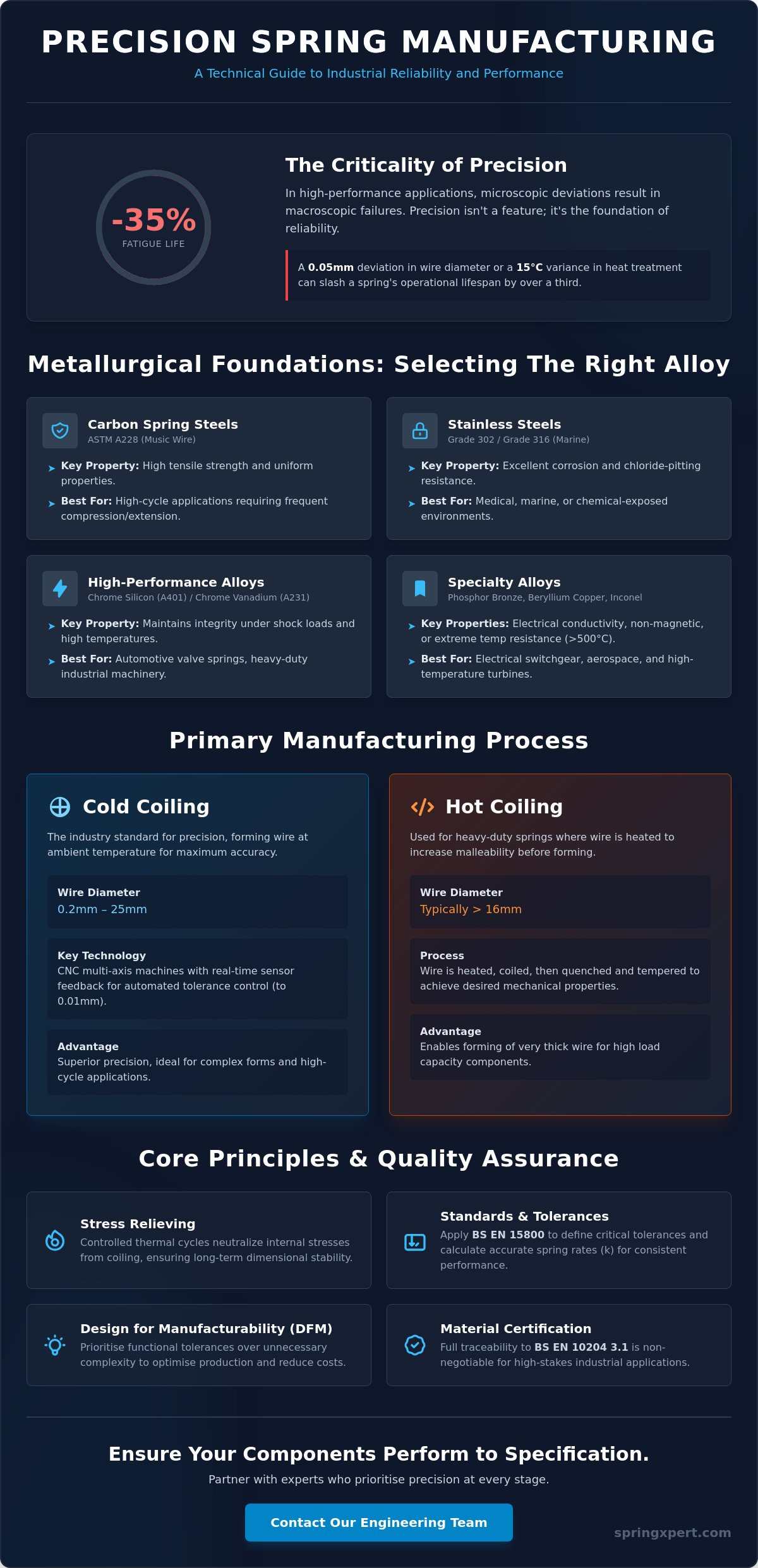
Technical Specifications: Tolerances, Loads, and Formulas
Precision engineering hinges on the accurate calculation of the spring rate (k), which represents the constant ratio of force to deflection. In any technical guide to spring manufacturing, this value is the baseline for performance. We determine the rate using the formula k = (Gd^4) / (8D^3n). Here, G is the shear modulus of the material, d is the wire diameter, D is the mean coil diameter, and n represents the number of active coils. A 5% variance in wire diameter can result in a 20% change in spring rate, highlighting the need for strict material controls.
Manufacturing to BS EN 15800 standards ensures that tolerances for free length, wire diameter, and squareness remain within predictable limits. For industrial applications, Grade 1 tolerances are often necessary. Squareness of the ends is particularly critical; a deviation of more than 2 degrees can lead to eccentric loading. This misalignment increases the risk of fatigue failure by concentrating stress on one side of the coil.
Stress distribution isn't uniform across the wire cross-section. The Wahl Factor (K) is a curvature correction factor used to calculate the maximum shear stress on the inside of the coil. It's expressed as K = ((4C-1)/(4C-4)) + (0.615/C), where C is the spring index (D/d). Without this correction, engineers risk underestimating peak stress by up to 15%. For specialised high-load applications, such as heavy machinery valve sets, disc springs offer a reliable alternative to helical coils by providing high force in restricted axial spaces.
Calculating Load and Deflection
Hooke's Law provides the foundation for load calculations, but multi-stage designs require more complex analysis. You've got to distinguish between active and total coils. While total coils dictate the solid height, only active coils store energy. Solid height is calculated by multiplying the total coils by the wire diameter. We recommend a safety clearance of at least 10% of the total deflection to prevent the spring from becoming coil-bound, which causes immediate mechanical stress spikes.
Buckling and Lateral Stability
Lateral stability is governed by the slenderness ratio, which is the ratio of free length to mean diameter (L0/D). If this ratio exceeds 4.0, the spring is likely to buckle under compression. We determine the critical deflection point where bowing occurs by evaluating the end-fixity conditions. If your design requires a high slenderness ratio, you'll need to use an internal mandrel or an external guide. You can often improve stability by increasing the coil diameter, provided the assembly housing allows for the additional footprint.
Our engineers provide technical support to refine these variables for your specific application. Contact us for a bespoke spring design consultation to verify your load requirements.
Design for Manufacturability (DFM) and Quality Assurance
Design for Manufacturability (DFM) serves as the critical bridge between theoretical engineering and physical production. When applying this technical guide to spring manufacturing, engineers should prioritise simplifying geometry to eliminate unnecessary stress concentrations. Complex end configurations or non-standard index ratios often increase setup times on CNC coiling machines by 15% to 25%. It's more effective to specify functional tolerances on critical dimensions, such as load at a specific height, rather than applying blanket tight tolerances across the entire blueprint. This precision-focused approach prevents over-engineering and reduces scrap rates during the production cycle.
Optimizing Design for Cost-Efficiency
Selecting standard wire diameters based on BS EN 10270 standards ensures shorter lead times. Custom-drawn wire can extend procurement by 6 to 10 weeks and adds unnecessary expense to the bill of materials. You can reduce secondary operations by integrating wire form features directly into the primary coil during the CNC process. When evaluating surface finishes, zinc plating offers a cost-effective barrier for general applications. However, powder coating provides superior resistance in high-salinity environments. Choosing the correct finish based on the specific operating environment prevents premature fatigue failure and maintains the component's integrity.
Advanced Quality Verification
Maintaining batch consistency requires rigorous Statistical Process Control (SPC) to monitor variables in real-time. Automated sorting systems verify 100% of high-volume orders to guarantee zero-defect delivery for mission-critical applications. Quality protocols include load testing to verify spring rates and digital imaging for precise dimensional accuracy. Salt spray testing, conducted according to ISO 9227, ensures corrosion resistance meets the required lifespan. Every final shipment includes comprehensive documentation. This typically consists of material mill reports and Certificates of Conformity, providing a full audit trail for ISO-regulated industries.
The SpringXpert Ltd approach integrates technical consultancy at the earliest design stages. We provide CAD prototyping to validate performance metrics before you commit to full-scale production. This collaborative method ensures every custom-engineered component meets the exact mechanical requirements of its application. Our specialists align traditional craftsmanship with modern CNC precision to deliver reliable industrial solutions. We invite technical collaboration to resolve complex spring design challenges, ensuring your project moves from concept to completion with maximum efficiency and technical rigour.
Optimising Industrial Performance Through Engineering Precision
Mastering the complexities of spring production requires a balance of metallurgical knowledge and advanced coiling technology. This technical guide to spring manufacturing highlights how factors like material tensile strength and precise coiling methods dictate the reliability of the final component. Whether it's selecting the right alloy for corrosive environments or implementing rigorous stress-relieving cycles, every stage of the process must align with specific engineering tolerances to prevent premature fatigue.
SpringXpert provides the technical depth needed for these demanding applications. With 20+ years of technical engineering expertise and an ISO 9001 certified quality management system, we ensure every component meets rigorous UK industrial standards. We maintain over 20,000 standard products in stock for immediate requirements while offering the capacity for complex, custom-engineered projects. Our team focuses on delivering functional durability and exact specifications for every client, regardless of the sector.
Partner with SpringXpert for bespoke engineering and technical spring manufacturing to secure the precision your next project demands. We look forward to solving your most complex mechanical challenges.
Frequently Asked Questions
What is the difference between cold winding and hot winding in spring manufacturing?
The primary difference lies in the material temperature during forming; cold winding uses wire at room temperature for diameters up to 16mm, while hot winding involves heating the steel above its critical temperature for diameters exceeding 16mm. Cold winding maintains high tensile strength and precise dimensions for smaller components. Hot winding allows for the shaping of heavy-duty bars into large industrial springs without fracturing the material.
Why is heat treatment necessary after the spring coiling process?
Heat treatment is essential to relieve internal stresses introduced during the coiling process, which prevents the spring from losing its set or failing prematurely. Most carbon steel springs undergo stress relieving at temperatures between 230°C and 480°C. This thermal process stabilises the molecular structure. It ensures the component maintains its specified load characteristics over millions of cycles in demanding mechanical environments.
How does shot peening improve the lifespan of an industrial spring?
Shot peening improves spring lifespan by introducing compressive residual stresses on the surface, which effectively delays the onset of fatigue cracking. This process can increase the fatigue limit of a precision spring by up to 30% compared to non-peened versions. It's a critical step in this technical guide to spring manufacturing for components used in high-cycle environments like automotive valve trains or industrial actuators.
What are the most common causes of spring failure in mechanical assemblies?
Spring failure in mechanical assemblies is typically caused by fatigue, hydrogen embrittlement, or operating beyond the design's elastic limit. Corrosion accounts for roughly 25% of premature failures in UK industrial environments where protective coatings aren't applied. Over-stressing a spring past its solid height often results in permanent deformation or immediate fracture. Proper material selection and surface finishing mitigate these risks effectively.
How do I calculate the spring rate for a custom compression spring?
You calculate the spring rate by using the formula k = (G * d^4) / (8 * D^3 * n), where G is the shear modulus, d is wire diameter, D is mean coil diameter, and n is the number of active coils. For standard music wire, the shear modulus is typically 79.3 GPa. Accurate calculations ensure the custom compression spring meets the specific load requirements of your assembly without compromising safety margins.
What tolerances should I specify for a precision industrial spring?
You should specify tolerances based on BS EN 15800 standards, which define three distinct quality grades for cold coiled compression springs. Grade 1 provides the tightest control for critical applications, while Grade 2 is the standard for most industrial requirements. Specifying a +/- 5% tolerance on load at a given height is common for precision engineering projects. Clear documentation of these parameters avoids assembly issues later.
Can spring manufacturing handle custom wire forms and non-standard geometries?
Modern CNC multi-axis forming machines enable the production of complex wire forms and bespoke geometries that go beyond traditional helical shapes. Our facility handles wire diameters from 0.2mm to 20mm to create custom components for unique mechanical interfaces. This flexibility allows engineers to integrate multiple functions into a single wire-based part. We provide the technical expertise needed to turn complex CAD models into physical reality.
Which materials are best for high-temperature spring applications?
Inconel X750 and Nimonic 90 are the preferred alloys for springs operating in environments exceeding 300°C. These nickel-based superalloys maintain their mechanical properties and resist relaxation at temperatures where standard carbon steels would fail. Using these materials is a key aspect of a technical guide to spring manufacturing for aerospace or oil and gas applications. They offer superior resistance to both heat and oxidation in extreme conditions.