

High Quality Circlips UK: The Engineer’s Guide to Industrial Retaining Rings
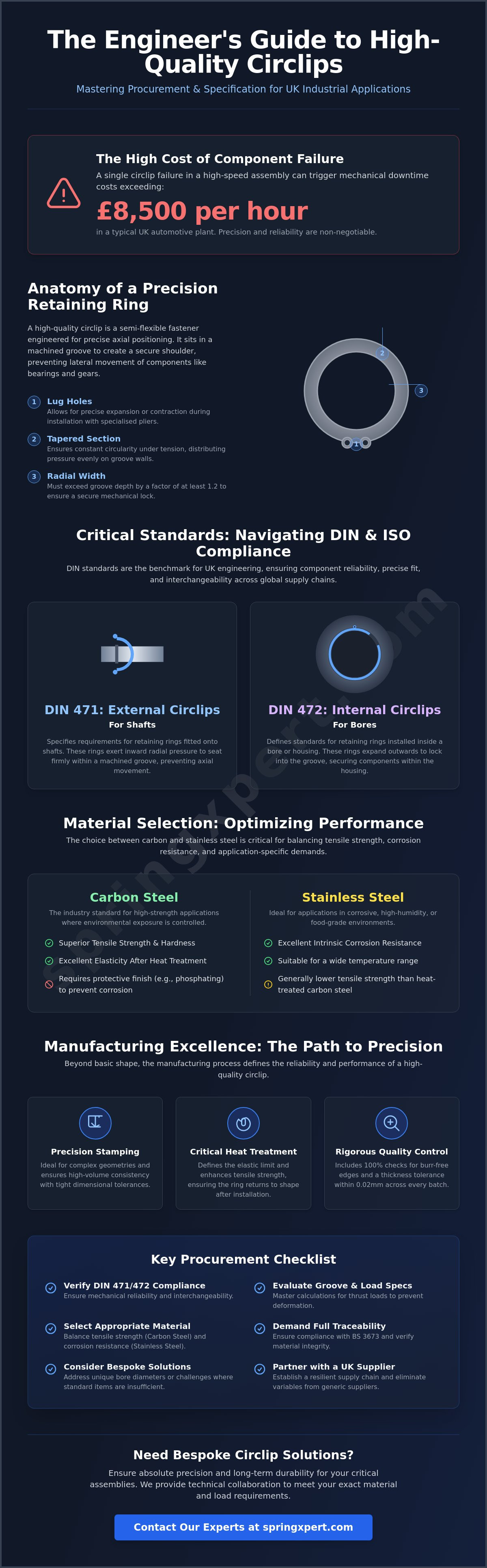
A single circlip failure in a high-speed assembly can trigger mechanical downtime costs exceeding £8,500 per hour in a typical UK automotive plant. You already know that component failure due to poor tensile strength or inconsistent tolerances isn't just a minor setback; it's a direct risk to your operational reputation. Finding high quality circlips UK that meet exact DIN 471 or DIN 472 standards is often the difference between a reliable build and a costly recall. We understand that sourcing components with verified material integrity is non-negotiable for engineers who value precision and stability.
This guide provides the technical framework you need to master procurement criteria and identify the correct alloy specifications for your specific application. You'll learn how to navigate the complexities of material fatigue and establish a resilient UK supply chain that eliminates the variables of generic suppliers. We'll examine the critical relationship between groove dimensions and axial load capacity to ensure your assemblies remain secure under peak industrial stress.
Key Takeaways
- Understand why DIN 471 and 472 compliance is essential for ensuring the mechanical reliability of retaining rings in high-performance UK machinery.
- Learn to evaluate the trade-offs between carbon and stainless steel to optimize tensile strength and corrosion resistance for specific operational environments.
- Master the calculations for maximum thrust loads and groove material hardness to prevent deformation in complex rotating assemblies.
- Identify the technical procurement criteria for sourcing high quality circlips UK that guarantee precise axial positioning and long-term durability.
- Discover how bespoke manufacturing solutions can address unique bore diameters and engineering challenges where standard catalog items are insufficient.
Defining High Quality Circlips for UK Industrial Applications
A high quality circlip is a precision-engineered retaining ring designed specifically for axial positioning within mechanical assemblies. These components sit within a machined groove on a shaft or inside a bore to create a physical shoulder that retains an assembly. For engineers seeking a foundational overview, What is a Circlip? explains the basic function of these semi-flexible fasteners in preventing the lateral movement of components like bearings, pulleys, or gears. In high-speed rotating environments, these rings must withstand significant centrifugal forces and vibration without migrating from their seated position.
Generic fasteners often lack the metallurgical integrity required for demanding UK industrial environments. Low-grade imports frequently suffer from hydrogen embrittlement, a phenomenon where the metal becomes brittle and fails catastrophically under stress. High quality circlips UK manufacturers provide undergo rigorous de-embrittlement processes and heat treatment to ensure long-term reliability. Sourcing components within the UK ensures compliance with BS 3673 standards and provides full material traceability. This documentation is essential for sectors like aerospace and automotive where material certification is a non-negotiable requirement for safety and compliance.
The Anatomy of a Retaining Ring
The lug hole design is central to the functionality of the ring, allowing for precise expansion or contraction during installation using specialised pliers. A tapered section ensures the ring maintains constant circularity when under tension, which distributes pressure evenly across the groove walls. The radial width of the circlip must be calculated to exceed the groove depth by a factor of at least 1.2 to ensure a secure mechanical lock against the shoulder.
Manufacturing Excellence: Beyond the Basic Shape
Industrial applications dictate the specific manufacturing method used. Precision stamping is the standard for high-volume internal and external rings, while wire forming is often utilised for heavy-duty snap rings. Heat treatment is the most critical phase because it defines the elastic limit of the fastener. A ring that is too brittle will snap during installation; one that is too soft will deform and fail under load.
- Precision Stamping: Ideal for complex geometries and high-volume consistency.
- Heat Treatment: Enhances tensile strength and ensures the ring returns to its original shape after expansion.
- Quality Control: Includes a 100% check for burr-free edges and a thickness tolerance within 0.02mm across every batch.
SpringXpert focuses on these granular details to ensure that every high quality circlips UK project meets the exact tolerances required for modern engineering. This level of precision prevents uneven wear and ensures the assembly remains balanced during operation. We invite technical collaboration to ensure your specific material and load requirements are met with absolute certainty.
Technical Standards: Navigating DIN and ISO Compliance
Engineering projects across Britain rely on the German Institute for Standardization (DIN) to ensure component reliability. DIN standards dominate the UK engineering landscape because they offer precise definitions for material composition and dimensional tolerances. For high-performance machinery, compliance with DIN 471 and 472 isn't optional; it's a safety requirement. These benchmarks guarantee that high quality circlips UK suppliers provide will fit exactly into pre-machined grooves without the risk of axial play or premature failure.
Standardized dimensions allow for seamless interchangeability across global manufacturing chains. A component designed in Birmingham will interface perfectly with a shaft manufactured in Stuttgart if both adhere to the same DIN specification. Modern ISO standards, specifically ISO 4648, are gradually modernizing these traditional specifications to align with global digital manufacturing. However, the legacy and technical depth of the DIN system remain the preferred choice for UK aerospace and automotive sectors.
DIN 471: External Circlips for Shafts
DIN 471 specifies the requirements for external retaining rings fitted onto shafts. These rings exert inward radial pressure to seat firmly within a machined groove. For a standard 25mm shaft, the groove must be precisely 1.2mm wide with a depth of 0.8mm to reach its maximum thrust load capacity. Heavy-duty variants increase the thickness of the ring to handle higher axial forces in automotive drive shafts and aerospace turbine assemblies. Engineers must calculate the shear strength of the ring material, typically carbon spring steel or stainless steel, against the expected load to prevent groove deformation.
DIN 472: Internal Circlips for Bores
Internal rings for housings and bores follow the DIN 472 standard. Unlike external rings, the lugs on a DIN 472 ring point toward the centre, allowing for installation inside a hole. Centrifugal force is a critical consideration here. In high-speed internal assemblies, the rotational energy can help seat the ring more securely against the groove wall. This differs from external variants, where extreme RPM can cause the ring to expand and lift out of its groove. The tension profile of DIN 472 is engineered to maintain contact even when the housing expands due to thermal fluctuations.
Specialty Standards: E-Clips and Snap Rings
DIN 6799, commonly known as E-Clips, provides a solution for radial installation. You choose these when axial access to a shaft is restricted. They don't require specialized pliers for installation, making them efficient for rapid assembly lines. Snap rings and wire rings serve applications with non-grooved or shallow-groove assemblies where a standard circlip might be too bulky. In many precision assemblies, these rings work alongside disc springs to provide a constant axial preload, ensuring that the assembly remains tight under vibration. If your project requires high quality circlips UK with specific tolerances, our technical team can assist in matching the correct standard to your application.
Material Selection: Carbon Steel vs Stainless Steel
Selecting the correct material for a circlip determines the long-term reliability of a mechanical assembly. Engineers must balance the required tensile strength against the environmental stressors of the application. While high-carbon spring steel provides the highest mechanical performance, it requires specific surface treatments to survive in corrosive environments. Choosing high quality circlips UK involves evaluating these trade-offs to ensure the fastener doesn't fail prematurely due to fatigue or oxidation.
High-carbon spring steel, typically conforming to BS EN 10132-4 standards, remains the industry benchmark for general mechanical use. This material offers superior elastic properties and high tensile strength, allowing the circlip to return to its original diameter after being expanded or contracted during installation. For specialised industrial processes, such as cryogenic storage or high-heat power generation, engineers often specify specialty alloys. Inconel X-750 is utilised for components operating in temperatures exceeding 500°C, while Beryllium Copper is selected for non-magnetic and spark-resistant requirements.
Carbon Spring Steel and Protective Coatings
Carbon steel circlips require surface protection to prevent rust. Chemical blacking is the standard finish for components used in dry, indoor environments. Zinc phosphate coatings offer a more robust barrier for mild corrosion protection in industrial settings. It's vital to recognise that electroplated carbon steel circlips carry a risk of hydrogen embrittlement. This chemical process can lead to sudden, catastrophic failure under load. For internal gearbox components, oil-dipped finishes are preferred because the constant immersion in transmission fluid provides permanent corrosion inhibition and eliminates the risk of hydrogen-related failure.
Stainless Steel: 304 vs 316 Grades
When environmental conditions are severe, stainless steel is the necessary choice for high quality circlips UK. Grade 420 is a martensitic stainless steel that can be hardened through heat treatment. This provides a functional balance of hardness and corrosion resistance for standard outdoor applications. Grade 316 stainless steel contains molybdenum, making it essential for marine, medical, and food-grade environments where exposure to chlorides or harsh cleaning chemicals is frequent.
Designers must account for the mechanical limitations of stainless steel. These alloys typically possess lower tensile strength than their carbon steel counterparts. This results in a reduction of the maximum allowable thrust load. In many specifications, a stainless steel circlip will have a load capacity 10% to 15% lower than a carbon steel fastener of the same dimensions. Precision engineering requires that these load calculations are verified before finalising material selection for high-stress assemblies.
Specification Guide: Calculating Loads and Installation
Calculating the maximum thrust load ($P_r$) is the primary requirement when selecting high quality circlips UK for heavy-duty applications. This calculation identifies the specific point where the ring or the groove will fail under axial pressure. For most standard external or internal circlips, the load capacity is restricted by either the shear strength of the ring material or the compressive strength of the groove. It's a common engineering reality that the groove material is softer than the circlip, particularly in aluminium housings, meaning the groove often fails before the ring itself.
Groove material hardness must be cross-referenced with the expected axial force. If the shaft or housing material has a low yield strength, the groove will deform, causing the circlip to "dish" or tilt. This deformation reduces the contact area and leads to premature ejection. In industrial motors where shock loads and high-frequency vibrations occur, static load ratings are insufficient. Engineers should apply a safety factor of 3.0 or higher for dynamic environments. This buffer accounts for momentary spikes in force that could otherwise dislodge the fastener.
Precision during assembly is vital for maintaining the integrity of the fastener. Using professional circlip pliers is the only way to prevent over-expansion or over-contraction. If a ring is stretched beyond its elastic limit during installation, it suffers a permanent set. This loss of tension means the ring won't seat securely in the groove, compromising the safety of the entire assembly.
Groove Geometry and Edge Margin
The "sharp corner" at the base of the groove is essential for effective axial load transfer. If this corner is radiused or poorly machined, the circlip cannot seat fully, which creates a lever effect that pries the ring out of the groove. Engineers must also calculate the edge margin, which is the distance from the groove to the end of the shaft. A standard industrial benchmark is to maintain an edge margin of at least 3 times the groove depth. When the retained component features a large chamfer, the effective load capacity of the high quality circlips UK decreases because the load is applied further away from the groove wall.
Installation Best Practices for Longevity
Assembly technique directly impacts the component's operational life. You must ensure the "sharp" side of the circlip faces the direction of the applied load. This side, which features a square edge from the stamping process, provides the maximum contact surface against the groove wall. In systems requiring constant axial tension to eliminate end-play or rattling, designers frequently incorporate compression springs. This configuration maintains a steady load against the circlip, compensating for thermal expansion or minor manufacturing tolerances.
Bespoke Circlip Solutions and UK Supply from SpringXpert
Standard catalog components frequently fail to meet the rigorous demands of specialized mechanical assemblies. While off-the-shelf items provide a cost-effective solution for general applications, they often lack the precise tolerances or specific material grades required for high-stress environments. SpringXpert specializes in the manufacture of high quality circlips UK, providing bespoke retaining rings designed for non-standard bore diameters and unique shaft configurations. We provide a technical consultancy service that evaluates material selection and load calculations to ensure every component performs under extreme pressure.
Specifying high quality circlips UK manufactured means accessing engineering expertise that goes beyond simple distribution. Our team conducts deep-dive analysis into radial clearance and thrust load capacities. This ensures the chosen alloy, whether it's carbon steel or a corrosion-resistant stainless steel, matches the environmental conditions of the final application. We prioritize industrial reliability; we focus on the physical reality of the assembly rather than approximate fits that lead to premature fatigue.
Custom Engineering and Prototyping
Our engineers assist in optimizing groove and ring design for new product development cycles. This collaboration is vital for specialized sectors like medical instrumentation or aerospace, where a standard ring's mass or centrifugal behavior might compromise the system. We utilize advanced CNC technology to produce non-standard wire form retaining rings with exact repeatability. Small-batch production runs allow for rapid testing of prototypes, which reduces the time from design to final implementation. We can adjust wire cross-sections and end-type configurations to meet specific axial load requirements that standard DIN 471 or 472 parts cannot accommodate.
Partnering with a UK Specialist
Reliability in the supply chain is just as critical as the components themselves. We maintain buffer stock for our high-volume manufacturing clients to mitigate the risks of global logistics delays. Every batch undergoes a rigorous quality assurance process. This includes material batch testing for tensile strength and final dimensional inspection to ensure compliance with strict internal standards and ISO requirements. Our UK-based facility allows for a rapid industrial turnaround that international suppliers struggle to match. By keeping production local, we offer full traceability on all raw materials, ensuring that the integrity of your project is never compromised by substandard alloys.
Precision manufacturing requires a partner who understands the nuances of mechanical stress and material fatigue. Consult with our engineering team for your high-quality circlip requirements to secure components built for longevity and performance.
Securing Your Industrial Assemblies with Engineering Precision
Selecting the right retaining ring involves more than simply matching diameters. It requires a technical understanding of tensile strength and DIN compliance to ensure long-term stability under load. Whether your application demands the corrosion resistance of a specific stainless steel alloy or the high load capacity of carbon steel, precise specification is vital for mechanical integrity. SpringXpert provides the technical depth needed to bridge the gap between standard components and custom-engineered requirements. We maintain ISO 9001:2015 certified manufacturing processes to ensure every component meets strict tolerances and performance benchmarks.
With over 20,000 standard products in stock for immediate UK dispatch, we've built a supply chain that supports both rapid maintenance and large-scale production schedules. Our team offers expert technical support for bespoke engineering requirements when off-the-shelf parts don't meet your specific load calculations or environmental conditions. Accessing high quality circlips UK ensures your machinery operates within its designed safety margins while reducing the risk of component failure. We're ready to act as your technical partner for all fastening and retention challenges.
Explore our range of high-quality industrial circlips and fasteners
Frequently Asked Questions
What is the difference between an internal and external circlip?
Internal circlips fit inside a cylindrical bore or housing, while external circlips fit over the outside of a shaft. You'll identify an internal circlip by its lugs which point inwards toward the centre. External versions have lugs that point outwards to allow pliers to expand the ring over the shaft diameter. Each type exerts pressure in the opposite direction to secure components against axial movement.
How do I measure a circlip to ensure I order the correct replacement?
Measure the nominal diameter of the shaft or the bore rather than the circlip's relaxed state. For an external application, use a calibrated vernier caliper to find the shaft diameter at the groove. For internal applications, measure the housing's bore diameter. This measurement ensures you receive high quality circlips UK that adhere to precise ISO tolerances for a secure fit within the assembly.
Can I reuse a circlip after it has been removed from an assembly?
Don't reuse circlips in any critical or high-load machinery. Removal often causes permanent deformation, reducing the component's elastic limit and its ability to grip the groove securely. Standard engineering protocols for DIN 471 and DIN 472 components recommend installing new rings during every maintenance cycle. A new circlip costs a fraction of the potential £2,500 repair bill resulting from a mechanical failure.
What causes a circlip to fail or "pop out" of its groove?
Failure usually stems from incorrect groove depth or excessive axial thrust that exceeds the ring's shear strength. If a groove is machined with rounded edges or is only 80% of the required depth, the circlip won't seat properly. This creates a ramp effect where the ring slides out under load. Debris trapped in the groove also prevents the 90 degree contact necessary for stability.
Which DIN standard should I use for a heavy-duty automotive shaft?
Use DIN 471 for external shafts and DIN 472 for internal bores in standard automotive applications. If your project involves extreme centrifugal forces or high thrust loads, consider DIN 983 or DIN 984. These variants include additional lugs that distribute pressure more evenly across the groove circumference. These standards provide a 15% increase in load capacity compared to basic retaining rings.
Are stainless steel circlips always better than carbon steel ones?
Stainless steel offers superior corrosion resistance, but carbon steel typically provides higher tensile strength and hardness. Grade 420 stainless steel works well in damp environments, yet carbon steel with a phosphate finish remains the industrial standard for high-stress dry applications. Carbon steel variants often achieve a hardness rating of 47 to 54 HRC, which exceeds the performance of many stainless alloys in heavy-duty cycles.
What tools are required for the safe installation of large industrial circlips?
Large industrial circlips require heavy-duty pliers with interchangeable tips or specialised pneumatic installation tools. For diameters exceeding 100mm, you must use manual pliers fitted with a ratcheting mechanism to prevent the ring from snapping shut unexpectedly. Safety goggles are essential during this process. A slipping circlip can release stored kinetic energy and travel at speeds reaching 30 metres per second.
Does SpringXpert offer custom sizes for non-standard metric bores?
SpringXpert manufactures custom-engineered retaining rings for non-standard bores ranging from 3mm to 1,000mm in diameter. Our CNC production facilities allow us to adjust thickness and radial width to meet your specific design tolerances. We provide the technical collaboration needed to ensure these high quality circlips UK integrate perfectly with bespoke groove dimensions. Our team handles small batch prototypes and high-volume production runs.