

Belleville Washers Stockist: A Procurement Guide for Industrial Disc Springs
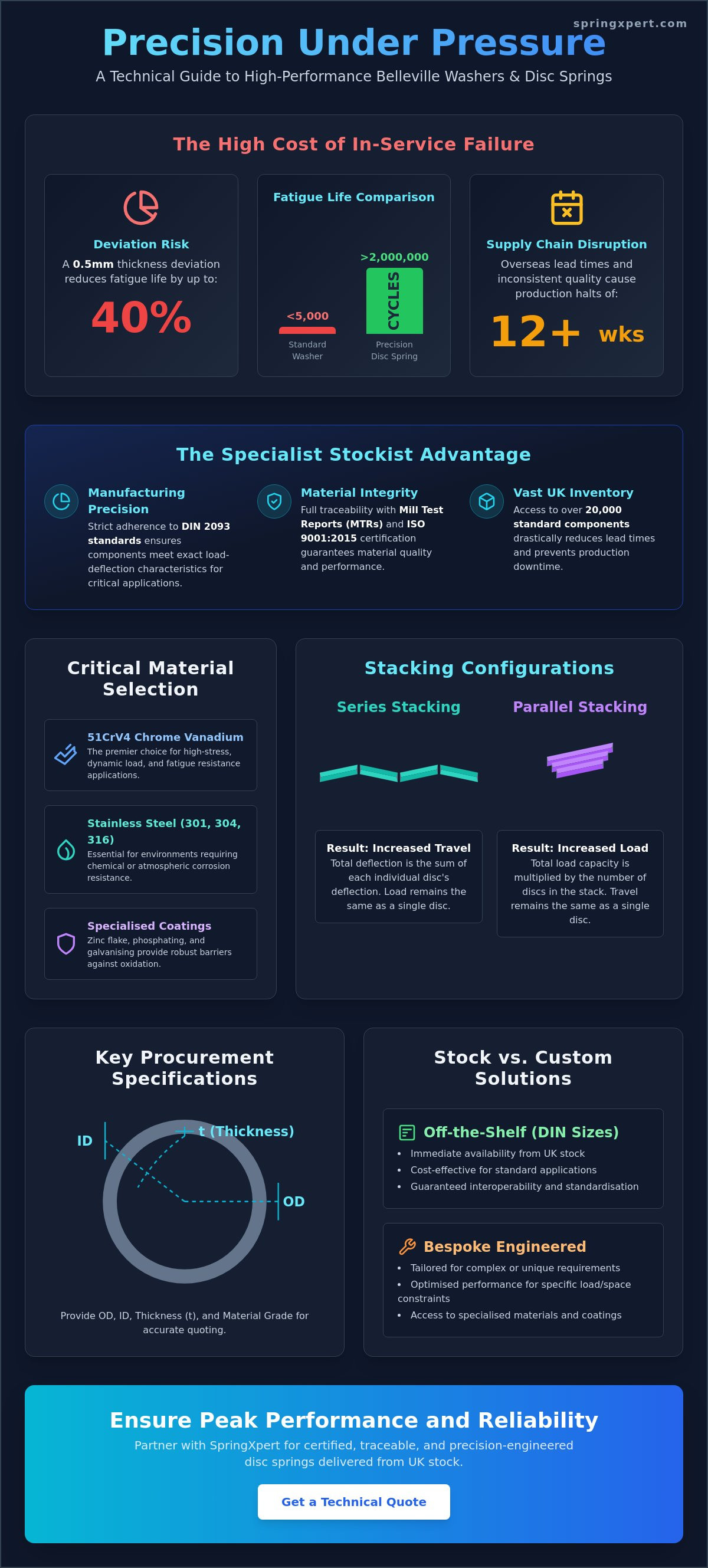
A single 0.5mm deviation in disc spring thickness can reduce the fatigue life of a bolted joint by up to 40% in high-vibration environments. For procurement teams, the cost of a failed component far outweighs the initial unit price, especially when standard washers succumb to fatigue after fewer than 5,000 cycles. You've likely experienced the frustration of inconsistent material quality from overseas suppliers or lead times that halt production lines for 12 weeks or more. Partnering with a specialist belleville washers stockist ensures that your components meet the exact tolerances required for critical industrial applications.
We've developed this technical guide to help you specify, stack, and source high-performance disc springs with precision. You'll learn the essential trade-offs between alloy grades like 51CrV4 and stainless steel, alongside strategies for achieving specific spring rates through series or parallel stacking. We'll conclude with a framework for securing a UK partner capable of delivering both off-the-shelf stock and custom-engineered solutions for your most demanding engineering projects.
Key Takeaways
- Identify how selecting a reliable belleville washers stockist ensures material traceability and manufacturing precision for high-load applications.
- Understand the importance of the DIN 2093 standard and material selection, such as Chrome Vanadium, in meeting specific industrial tolerances.
- Learn to calculate performance dynamics by utilising parallel and series stacking configurations to adjust load capacity and travel.
- Determine the essential technical specifications, including OD, ID, and material thickness, required for accurate procurement and quoting.
- Compare the benefits of off-the-shelf DIN sizes against bespoke, custom-engineered solutions for complex engineering requirements.
Selecting a Reliable Belleville Washers Stockist for Industrial Applications
A Belleville washer, technically identified as a conical disc spring, is a precision-engineered component designed to manage high axial loads in environments where space for travel is limited. These springs function by providing a predictable, non-linear or linear load-deflection characteristic that traditional coil springs can't replicate within the same footprint. For procurement teams, choosing a professional belleville washers stockist is a decision that impacts the long-term stability of mechanical assemblies. A supplier must demonstrate more than just a large catalog; they need to provide evidence of manufacturing precision and material integrity across a broad inventory of over 20,000 standard components.
Reliability in the UK industrial sector depends on the stockist's ability to maintain ISO 9001:2015 certified quality management systems. This certification ensures that every fastener, from a standard M6 to a heavy-duty 250mm disc, meets the rigorous tolerances required for high-stress applications. When a project requires immediate deployment, a stockist with a comprehensive range of DIN 2093 compliant parts reduces lead times and prevents costly production halts.
The Strategic Importance of Disc Springs in Mechanical Design
Disc springs offer superior force density, allowing engineers to achieve massive load capacities in a fraction of the space required by helical springs. This spatial efficiency is vital in the design of valve actuators, slip clutches, and heavy-duty bolted joints. In these systems, the washer acts as a dampener and a tensioner simultaneously. Live loading is the process of using disc springs to maintain a constant, high-tension load on a bolt to compensate for relaxation, vibration, or thermal expansion. This specific function ensures that joints remain leak-proof and secure even under fluctuating temperatures or intense mechanical cycles.
Quality Assurance and Material Traceability Standards
Material traceability is non-negotiable for safety-critical components. A reputable belleville washers stockist provides Mill Test Reports (MTRs) that detail the chemical composition and mechanical properties of the steel used. This level of documentation is the only way to verify that the alloy, such as 50CrV4 chrome vanadium, meets the required tensile strength and fatigue resistance. Without this data, there's a heightened risk of hydrogen embrittlement, particularly in carbon steel washers that haven't been correctly processed after zinc plating or galvanization.
Precision-engineered disc springs are distinct from commercial-grade hardware. While a commercial washer might suffice for basic spacing, a precision disc spring is designed for a fatigue life that often exceeds 2,000,000 cycles. Professional suppliers ensure their stock is free from surface imperfections and micro-cracks that lead to premature failure. This focus on metallurgical excellence distinguishes a specialized engineering partner from a general hardware merchant.
Technical Specifications and Material Grades in Disc Spring Manufacturing
Precision engineering requires adherence to strict standardisation. In the UK and across Europe, the DIN 2093 standard serves as the definitive benchmark for disc spring dimensions, tolerances, and quality requirements. This standard ensures that components sourced from a reputable belleville washers stockist meet the exact load-deflection characteristics required for critical industrial assemblies. Manufacturing quality hinges on the initial selection of raw materials. This choice directly influences the tensile strength and the fatigue life of the spring under cyclic loading.
Primary materials include high-carbon steel for standard applications and Chrome Vanadium (51CrV4) for high-stress environments. Stainless steel grades such as 301, 304, and 316 are specified when chemical or atmospheric corrosion resistance is a priority. For extreme conditions, specialised coatings like zinc flake, mechanical galvanising, or phosphating provide a robust barrier against oxidation. These coatings are essential in offshore or chemical processing plants where untreated steel would fail prematurely. Every material choice is a calculation of performance against environmental stressors.
Understanding DIN 2093 Classifications
The DIN 2093 standard categorises disc springs into three distinct groups based on material thickness. Group 1 covers thicknesses below 1.25mm. These are typically cold-formed from strip steel. Group 2 includes springs between 1.25mm and 6.0mm. These often require cold-forming followed by machining on the inner and outer diameters to achieve the necessary precision. Group 3 encompasses springs exceeding 6.0mm, which are machined all over from forged blanks. These manufacturing variations ensure that tolerances for inner and outer diameters remain tight, which is vital for maintaining stack integrity in heavy machinery. We maintain a diverse inventory as a leading belleville washers stockist to support these varying technical requirements.
Specialised Alloys for High-Performance Environments
Standard carbon steels often lose their mechanical properties when operating temperatures exceed 400°C. In these high-heat scenarios, engineers specify nickel-based alloys like Inconel 718 or Nimonic 90 to maintain consistent spring force. For applications requiring a balance of high fatigue resistance and corrosion protection, 17-7 PH stainless steel is the preferred choice due to its precipitation-hardened structure. You can find more detail on these properties in our material selection guide for industrial springs. If your project involves non-standard parameters, our technical team can assist with a bespoke engineering consultation to identify the ideal alloy for your specific load requirements.
Performance Dynamics: Stacking Configurations and Load Calculations
The primary advantage of using conical spring washers is their modularity. Engineers can manipulate the performance of a spring system without changing the housing dimensions simply by altering the stacking sequence. This flexibility allows for precise tuning of spring rates and travel distances. As a specialist belleville washers stockist, SpringXpert provides the high-tolerance components required to ensure these configurations perform reliably under industrial loads.
- Parallel Stacking: Washers are nested in the same orientation. This configuration multiplies the load capacity by the number of washers used, while the total deflection remains equal to that of a single unit.
- Series Stacking: Washers are placed in opposition, point-to-point. This increases the total deflection or "travel" of the assembly. The load capacity remains equal to a single washer, but the total deflection is the sum of each individual washer's travel.
- Parallel-Series: This hybrid approach combines both methods. It allows for bespoke load-deflection curves, providing high force and high travel simultaneously to meet specific mechanical requirements.
Calculating Load and Deflection in Stacks
Calculating the output of a stack requires a basic multiplicative logic. For parallel stacks, the formula is Load x Number of Washers. For series stacks, it's Deflection x Number of Washers. It's vital to account for friction in parallel configurations. As the washers slide against one another, friction increases the force required during the compression stroke and reduces it during the return stroke. This creates a hysteresis loop, which is often used in heavy machinery to provide natural damping and energy dissipation. Even a 5% variation in material thickness can significantly alter the performance of a stack containing 15 or 20 units.
Practical Stacking Constraints and Best Practices
Tall stacks are susceptible to buckling or lateral displacement under load. To prevent this, engineers should always use internal guide rods or external sleeves. The clearance between these guides and the washers must be precise. Excessive clearance leads to "cocking" or tilting, while insufficient clearance causes parasitic friction that interferes with load calculations. A standard engineering rule of thumb is that the total stack height shouldn't exceed three times the outside diameter of the washer. For more complex calculations involving material fatigue and stress limits, refer to our complete engineering guide for disc springs. As a trusted belleville washers stockist for the UK market, we provide the technical data necessary to ensure your assembly maintains its integrity over millions of cycles.
Procurement Criteria: Specifying Belleville Washers for Bespoke Engineering
Successful procurement requires precise technical data. To receive an accurate quote from a belleville washers stockist, you must provide four critical dimensions: Outside Diameter (OD), Inside Diameter (ID), material thickness (t), and the overall height (Ho). Material selection is equally vital to the component's longevity. Standard carbon steel suffices for many static applications, but aggressive environments require stainless steel or nickel alloys like Inconel. Technical consultancy at the design stage prevents over-specification. Specifying a ±0.01mm tolerance when ±0.05mm is acceptable increases production costs by up to 30% without improving performance. Small-batch prototyping for a single assembly might require a higher initial investment, whereas bulk procurement for 5,000 units reduces the per-unit cost through production efficiencies and material yield optimisation.
When to Choose Bespoke Manufacturing Over Stock Items
Standard DIN 2093 sizes cover most industrial needs. However, bespoke manufacturing becomes necessary when space constraints dictate non-standard diameters or when specific load-deflection characteristics aren't found in standard tables. SpringXpert uses CAD modelling and rapid prototyping to validate these custom designs before full-scale production. By operating as both a manufacturer and a belleville washers stockist, we bridge the gap between initial prototyping and high-volume supply. This Xpert approach ensures that custom components integrate seamlessly into existing assemblies while maintaining strict adherence to BS EN 16983 standards. Choosing a partner with massive stock inventory alongside manufacturing capabilities allows for faster lead times when transitioning from R&D to full production.
Specifying Protective Coatings and Finishes
Surface treatments extend the fatigue life and corrosion resistance of disc springs. Zinc plating and phosphating are standard for general industrial use, providing a reliable barrier against oxidation. Geomet coatings offer superior salt-spray resistance, often exceeding 1,000 hours in rigorous testing environments. Engineers must balance coating thickness with the risk of hydrogen embrittlement. Thick electroplated layers can trap hydrogen in the steel lattice, leading to sudden brittle failure under load. Mechanical galvanising provides a safer alternative for high-tensile springs because the process doesn't involve acid pickling or electrolysis. This eliminates the primary sources of hydrogen absorption during the finishing stage, ensuring the structural integrity of the spring remains uncompromised.
For technical guidance on material selection and tolerances, contact our engineering department today.
SpringXpert: Your Technical Partner for Stock and Custom Disc Springs
SpringXpert Ltd stands as a premier UK manufacturer and belleville washers stockist with more than 20 years of industrial experience. We don't just supply off-the-shelf components; we integrate deep manufacturing knowledge into every order. Our facility produces bespoke wire forms and flat springs alongside our extensive disc spring inventory. This dual capability allows us to bridge the gap between standard availability and custom engineering requirements. We maintain a focus on the physical reality of metallurgy, working with various grades of carbon and stainless steel to ensure your components withstand high-stress environments. Our identity is built on technical precision and the ability to solve complex mechanical challenges for our clients.
National Supply and Distribution Capabilities
Our distribution network is built for industrial efficiency. We move high-volume orders across the UK using a logistics system designed for speed. Stock items are typically processed and dispatched within 24 hours, while custom prototypes move through a streamlined production queue to prevent project delays. We prioritise B2B reliability because a delayed washer can stall an entire production line. Our warehouse maintains thousands of line items, allowing us to act as a primary belleville washers stockist for major infrastructure projects. We adhere to ISO 9001 quality standards, ensuring every batch meets the exact specifications required for precision engineering.
Technical Consultation and Engineering Support
Engineering challenges require specific data and collaboration. Our design team assists engineers with complex load requirement calculations and spring stack configurations. We evaluate factors such as tensile strength and material fatigue to recommend the most durable solution for your application. Our in-house testing facility allows us to validate spring performance under load before you commit to a final production run. This technical depth defines our role as a partner rather than just a vendor. We provide granular data on tolerances and alloy performance to help you make rational, evidence-based decisions. If your project involves non-standard dimensions or extreme temperature requirements, our engineers will develop a custom solution tailored to those parameters.
Contact SpringXpert Ltd for technical specifications or bulk procurement queries to discuss your project needs or to access our full product catalogue.
Optimising Your Industrial Disc Spring Procurement
Precision engineering demands more than just a component supplier; it requires a technical partnership built on data and durability. Selecting a reliable belleville washers stockist ensures your assembly benefits from accurate load calculations and appropriate material grades. Effective procurement relies on verifying ISO-certified manufacturing processes and ensuring tolerances align with your specific application requirements. Whether you're managing complex stacking configurations or specifying bespoke alloy compositions, the focus must remain on long-term performance stability. It's essential to partner with a supplier that understands the physical reality of tensile strength and fatigue life in UK industrial environments.
SpringXpert brings over 20 years of technical engineering expertise to every project. We've developed a structured approach to quality control that supports both rapid prototyping and high-volume production. Our facility provides the technical depth needed for custom-engineered solutions, ensuring your specifications are met with absolute accuracy. We're ready to assist with your next engineering challenge through our dedicated technical support team.
Explore our range of over 20, 000 industrial components at SpringXpert
Frequently Asked Questions
What is the main advantage of using a Belleville washer over a coil spring?
The primary advantage of a Belleville washer is its ability to generate high spring force within a very small axial space. Unlike coil springs, which require significant travel length to achieve high loads, a single disc spring can support loads exceeding 100,000 Newtons in a compact footprint. This makes them essential for bolted joints where thermal expansion occurs, as they maintain consistent tension where traditional springs would fail due to height constraints.
Can I stack Belleville washers of different thicknesses in the same assembly?
You shouldn't stack Belleville washers of different thicknesses in a single assembly. Mixing thicknesses creates non-linear load characteristics and leads to the premature failure of the thinner discs. Engineering standards recommend using identical washers to ensure uniform stress distribution throughout the stack. If your application requires variable spring rates, you must design separate stacks or use specific spacer elements to isolate the different disc groups safely.
How do I prevent corrosion in Belleville washers used in offshore environments?
To prevent corrosion in offshore environments, you should specify washers manufactured from high-grade alloys like Inconel 718 or 17-7 PH stainless steel. Standard carbon steel variants will degrade rapidly in salt-spray conditions. As a leading belleville washers stockist, we provide components with Geomet or Zinc-Flake coatings that withstand over 1,000 hours of salt spray testing. These finishes offer superior protection compared to traditional electro-galvanising which risks hydrogen embrittlement.
What is the difference between a disc spring and a standard conical washer?
The difference lies in precision engineering and load predictability. A standard conical washer is typically used for static locking, while a disc spring is manufactured to DIN 2093 standards for dynamic or high-load applications. Disc springs feature controlled material properties and calculated force-deflection curves. Standard conical washers often lack the fatigue life data required for industrial machinery, whereas disc springs are rated for millions of cycles under specific stress limits.
How does the DIN 2093 standard affect my procurement process?
The DIN 2093 standard dictates the dimensions, tolerances, and material requirements for all disc springs. This standard ensures that every component meets specific force requirements at defined deflection points. For your procurement process, it simplifies sourcing by providing a universal quality benchmark. As a specialist belleville washers stockist, we ensure all stock complies with these German industrial standards to guarantee performance reliability across your UK manufacturing sites.
What are the common causes of failure in high-cycle disc spring applications?
Fatigue failure is the most common issue, often caused by exceeding the recommended 75% deflection limit. When a washer is flattened completely, internal stresses rise exponentially, leading to cracks. Improper lubrication also causes friction-induced wear at the contact points. Research indicates that maintaining a minimum preload of 15% to 20% of the total travel significantly extends the fatigue life of the spring assembly in dynamic industrial environments.
How do I calculate the total height of a series stack of Belleville washers?
You calculate the total free height of a series stack by multiplying the uncompressed height of a single washer by the total number of washers in the column. For a stack of 10 washers with a free height of 2.5mm, the total height is 25mm. Note that this calculation doesn't account for guide rod friction or stack misalignment. You'll need to include a guide rod or sleeve for any stack where the height exceeds three times the outside diameter.
Do you provide material test certificates for bulk industrial orders?
We provide full material traceability through EN 10204 3.1 certificates for all bulk industrial orders. These documents verify the chemical composition and mechanical properties of the steel used in production. Our quality management system tracks every batch from the melt stage through to final heat treatment. This level of documentation is standard for our UK aerospace and petrochemical clients who require strict adherence to safety and performance specifications.