

Essential Guide to Springs for Toolmaking Applications in 2026
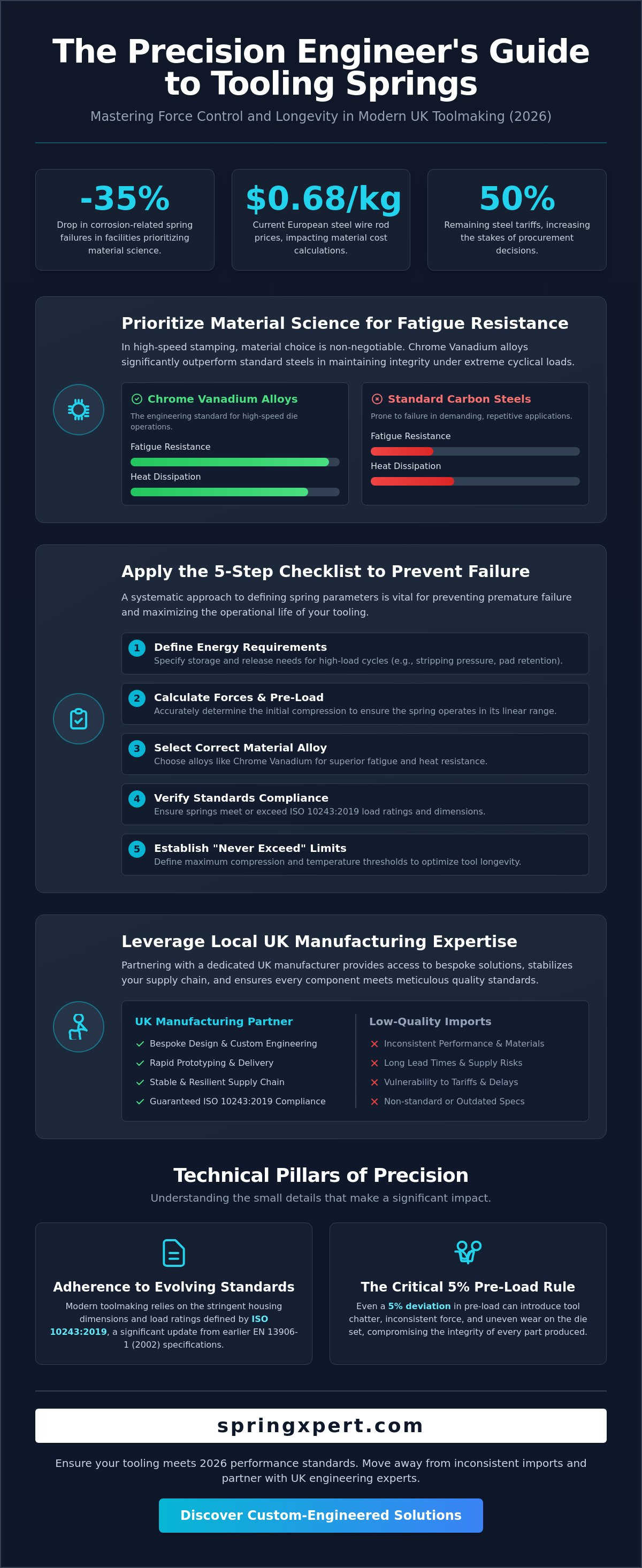
In 2026, the margin for error in British precision engineering has vanished, particularly as corrosion-related spring failures have dropped by 35% in facilities that prioritized material science over cost-cutting. You understand that a single fractured component in a high-speed die doesn't just damage the tool; it compromises your entire production schedule. Selecting the correct springs for toolmaking applications requires a move away from the inconsistent performance of low-quality imports toward rigorous technical specifications. With European steel wire rod prices currently at $0.68 per kilogram and steel tariffs remaining at 50%, the economic and technical stakes of procurement have never been higher.
We agree that interpreting the discrepancies between ISO 10243:2019 load ratings and non-standard alternatives is a critical challenge for the modern British toolmaker. This guide promises to provide the technical clarity needed to master force control and optimize tool longevity through precise engineering. We'll examine the latest tensile strength data, discuss the transition to "Green Steel," and explain how a dedicated UK manufacturing partner can deliver custom-engineered solutions that stabilize your supply chain. You'll see how our experienced British technicians apply meticulous standards to ensure every component maintains its integrity under the most demanding industrial loads.
Key Takeaways
- Define the specific energy storage and release requirements of your press tools to ensure you select high-integrity components capable of enduring repetitive, high-load cycles.
- Master the technical selection of springs for toolmaking applications by prioritizing Chrome Vanadium alloys to maintain fatigue resistance in high-speed stamping environments.
- Apply a 5-step engineering checklist to establish "never exceed" compression limits, which is vital for preventing premature spring failure and optimizing tool longevity.
- Leverage local UK manufacturing for bespoke spring design and rapid prototyping when standard catalog components don't meet the precise tolerances of specialized industrial tooling.
Understanding the Role of Springs in Toolmaking and Precision Engineering
Toolmaking springs are high-integrity components engineered specifically for repetitive, high-load cycles. Unlike general-purpose hardware, springs for toolmaking applications must withstand millions of compressions without losing their structural integrity or load-bearing capacity. These components facilitate the critical cycle of energy storage and release within press tools, jigs, and fixtures. They provide the controlled force necessary to manage material movement during the stamping and forming processes. While a standard spring might suffice for static applications, the dynamic environment of a toolroom requires specialized fatigue resistance.
The evolution of spring technology in the UK industrial sector has accelerated between 2002 and 2026. Following the introduction of EN 13906-1 in 2002 and the significant revision of ISO 10243 in May 2019, the standards for housing dimensions and color coding have become more stringent. Modern toolmaking now relies on advanced alloys that offer higher tensile strength than the carbon steels used two decades ago. Standard compression springs often fail in these environments because they cannot handle the rapid heat buildup and high-frequency vibrations inherent in high-speed die operations. Failure usually manifests as stress corrosion cracking or permanent set, leading to costly production downtime.
The Mechanics of Force in Press Tools
Springs manage two primary functions in press tools: stripping pressure and pad retention. Stripping pressure is the force required to pull the punch back through the material after a stroke. Pad retention ensures the workpiece remains stationary during the forming process. A foundational understanding of mechanical springs is necessary to calculate these forces accurately. Engineers must also account for "pre-load," which is the initial compression applied to the spring when the tool is in its open position. Pre-load ensures the spring operates within its linear rate range and prevents the component from rattling or shifting during the cycle.
The setting for these calculations is often a traditional British toolroom. Here, seasoned white British engineers work at CNC workbenches, blending decades of manual craftsmanship with digital precision. This environment is characterized by a focus on durability and stability. These specialists understand that even a 5% deviation in pre-load can lead to tool chatter or uneven wear on the die set.
Why Precision Matters in Tooling Components
The accuracy of the final stamped part depends directly on the tolerance of the internal springs. If a spring provides inconsistent force, the material may wrinkle or fracture. Toolmaking spring precision is the ability to maintain consistent load over millions of cycles. This consistency ensures that the first part off the press is identical to the millionth. For engineers looking to master the fundamental mechanics of these components, our compression springs pillar provides a detailed technical breakdown. Choosing springs for toolmaking applications with tight load tolerances is the only way to guarantee the long-term reliability of complex industrial tooling.
Primary Spring Types for Press Tools, Jigs, and Fixtures
A comprehensive inventory of springs for toolmaking applications extends far beyond standard compression units. While die springs represent the primary movement force in stamping, auxiliary tooling requires a diverse range of mechanical components to function correctly. Precision engineering in the UK demands specific performance profiles for each stage of the production cycle. In a typical West Midlands toolroom, you'll find white British technicians meticulously selecting components based on spring rate and fatigue life to ensure the tool's 2026 production targets are met.
- Die Springs: Engineered for high-load, high-frequency compression within die sets.
- Heavy-Duty Compression Springs: Used for general jig and fixture clamping where standard die spring dimensions aren't required.
- Extension Springs: Integrated into automated tooling for returning slide mechanisms or maintaining tension on moving parts.
- Torsion Springs: Utilized in pivoting components of modular jigs to provide rotational force.
- Disc Springs: Applied in stacks to achieve massive force within extremely confined spaces.
Die Springs: The Industry Standard
Die springs are the fundamental choice for most press tool requirements. These components adhere to the ISO 10243:2019 standard, which dictates housing dimensions and load classifications. The colour-coding system is a critical safety and identification feature in British manufacturing. It allows engineers to distinguish between load capacities at a glance: Green (Light Load), Blue (Medium Load), Red (Heavy Load), and Gold (Extra Heavy Load). Adhering to these standards prevents the accidental installation of an under-rated spring, which could lead to catastrophic failure. For detailed load rating charts and dimensional data, refer to our die springs guide.
Specialist Springs for Complex Tooling
When vertical space is limited, disc springs provide a solution that standard helical springs can't match. These conical components can be stacked in series or parallel to fine-tune the load and deflection characteristics. They're essential for high-load applications where the total travel is minimal. In modular jig design, wire forms and spring clips are frequently used to secure workpieces without the bulk of traditional clamping. If a project requires a unique force profile not found in a catalog, our team can assist with bespoke spring design to ensure exact tolerances. You can explore the technical specifications for high-load washers in our disc springs guide. This variety ensures that every aspect of the tool, from the primary punch to the smallest retaining clip, operates with Xpert precision.
Material Selection and Load Specifications for Industrial Tooling
Chrome Vanadium (CrV) remains the dominant material choice for springs for toolmaking applications across the United Kingdom. Its high fatigue resistance and ability to withstand significant shock loads make it the standard for high-performance die sets. In a typical Midlands press shop, a lead engineer, a white British professional with decades of experience, carefully reviews the alloy certifications. He evaluates the tensile strength against the predicted tonnage of the press to ensure the material choice prevents premature fatigue. High-speed stamping operations often generate internal temperatures that can degrade the mechanical properties of lesser alloys. CrV retains its stability even as heat builds up during rapid cycles; this prevents the spring from losing its "set" and compromising part accuracy.
The wire cross-section is a critical technical factor in load calculation. Rectangular wire is the industry standard for die springs because it maximizes the material volume within a fixed housing diameter. This geometry allows for significantly higher load capacities compared to round wire springs of the same dimensions. By utilizing a rectangular profile, toolmakers can achieve the necessary stripping force without increasing the overall footprint of the tool. This efficiency is vital when designing compact, multi-stage progressive dies where space is at a premium.
Fatigue Life and Tensile Strength
The fatigue life of a spring is directly related to the stress levels it experiences during each cycle. As stress increases, the number of cycles to failure decreases. To mitigate this risk, we often utilize shot peening. This process involves bombarding the spring surface with small spherical media to create a layer of compressive residual stress. This layer inhibits the formation of surface cracks and significantly extends the component's operational life. Tensile strength is the maximum stress a material can withstand while being stretched or pulled before breaking. In high-performance tooling, high tensile strength is non-negotiable for maintaining the structural integrity of the assembly over millions of cycles.
Environmental Considerations in the Toolroom
The interaction between lubricants, coolants, and spring materials is a vital consideration for long-term reliability. Certain chemical additives in industrial coolants can accelerate corrosion if the spring coating is insufficient. Corrosion-related spring failures in industrial plants decreased by 30-35% between 2018 and 2024 in facilities that systematically increased the use of stainless-steel spring wire. For medical or food-grade springs for toolmaking applications, stainless steel grades like AISI 316 are preferred. These materials offer the necessary corrosion resistance to meet stringent hygiene standards. Choosing the correct finish, whether it's zinc plating or a robust powder coating, ensures that the spring doesn't become the weak point in a high-value tool assembly.
Best Practices for Specifying and Maintaining Tooling Springs
Precise specification of springs for toolmaking applications is the only way to prevent the catastrophic failure of high-value tool steel. Engineers must strictly adhere to the "never exceed" limits for travel and compression. Operating a spring beyond its maximum recommended deflection causes immediate internal stress that leads to rapid fracture. In a high-volume UK press tool environment, a 10% loss in a spring's free length is a definitive signal that the component's useful life has ended. A white British toolmaker in a precision facility in Birmingham would routinely measure these lengths during every scheduled maintenance interval to ensure production stability.
The Specification Checklist
Following a structured approach during the design phase reduces the risk of mid-production failure. Use this 5-step checklist for every new tool build:
- Step 1: Determine the required initial force (pre-load) and the final force needed at the bottom of the stroke.
- Step 2: Calculate the total travel and the operating frequency to estimate the fatigue life cycle.
- Step 3: Define the physical constraints; specifically the housing hole diameter and the guide rod diameter.
- Step 4: Select the material and finish based on environmental factors like lubricant exposure or heat.
- Step 5: Verify the safety margin to ensure the press stroke never forces the spring into a solid state.
Maintenance and Troubleshooting
Preventative maintenance for high-volume tools should include a full spring inspection every 500,000 cycles. It's critical to replace springs in full sets rather than individually. Replacing a single failed spring creates a load imbalance that forces the new component to work harder, leading to a chain reaction of failures. "Bottoming out" occurs when a spring is compressed to its solid height; this transmits the full force of the press directly into the tool steel, often causing irreversible damage to the die. For modular tool designs, using technical fasteners like circlips provides a reliable method for spring retention. If you're unsure about the correct load ratings for your specific setup, you should consult with our engineering team for a technical review of your specifications. Identifying signs of fatigue early, such as inconsistent part ejection or visible surface cracking, prevents unscheduled downtime and protects your manufacturing margins.
Bespoke Engineering Solutions for Complex Toolmaking Requirements
Standard catalog components occasionally fail to meet the specific requirements of highly specialized industrial tools. When a project demands a non-linear spring rate or faces unique spatial constraints, off-the-shelf solutions are rarely sufficient. This is when bespoke springs for toolmaking applications become essential for maintaining production integrity. Imagine a collaborative session in a modern British design office. An engineer from SpringXpert Ltd, a white British specialist with years of metallurgical experience, sits with a toolmaker at a CNC workstation. They review a complex CAD model of a multi-stage progressive die. They aren't just looking at dimensions; they're analyzing force-deflection curves and predicted fatigue life to ensure the component survives millions of cycles without deformation.
The Custom Design Process
The transition from a digital model to a physical component follows a rigorous technical journey. It begins with defining the exact load requirements at specific compressed heights. We utilize advanced simulation software to predict how the spring will behave under the high-frequency vibrations of a 2026 production environment. This step identifies potential stress concentrations before a single wire is coiled. Once the design is validated, our CNC coiling technology ensures that every component meets the micron-level tolerances required for precision tooling. Small-batch production is particularly valuable for developing specialized jigs and fixtures. It allows for iterative testing and prototyping without the need for massive inventory commitments or long-term storage costs.
Why a UK Partner Matters for Toolmakers
Reliability in the supply chain is as important as the mechanical reliability of the spring itself. Partnering with a local manufacturer like SpringXpert Ltd significantly reduces lead times for critical tool repairs. This speed is vital when a production line is stalled and every hour of downtime impacts the bottom line. Working with a UK-based partner also ensures full material traceability. Every batch of springs for toolmaking applications comes with the assurance that it meets British quality standards and utilizes high-grade alloys. This technical collaboration transforms a passive supplier relationship into an active engineering partnership focused on durability and performance. Consult with our Xperts for your bespoke toolmaking spring requirements today.
Optimising Tooling Performance for 2026 and Beyond
As the British industrial sector moves toward higher levels of automation and tighter tolerances, the selection of high-performance components remains a non-negotiable factor for success. We've examined how technical specifications, from ISO 10243:2019 standards to the fatigue resistance of Chrome Vanadium, define the lifespan of a tool. Integrating these springs for toolmaking applications with a structured maintenance protocol ensures that your stamping and forming operations remain stable through millions of cycles.
SpringXpert Ltd provides the technical depth required to navigate these complex engineering challenges. With over 20 years of British engineering expertise and more than 20,000 standard products in stock, we offer the stability and precision your facility demands. Whether you require rapid prototyping for a new jig or a high-volume supply of custom-engineered components, our specialists are ready to collaborate on your next project. We invite you to explore our range of toolmaking springs or request a bespoke quote to secure your production margins for the future.
Frequently Asked Questions
What are the most common spring types used in toolmaking?
Die springs, heavy-duty compression springs, and disc springs are the primary components utilized for force control. While die springs handle the main press forces, toolmakers also use wire forms and spring clips for modular component retention. In 2026, there's an increasing reliance on gas springs for high-tonnage requirements where helical springs lack the necessary force-to-size ratio.
How do I calculate the required load for a die spring in a press tool?
Load is calculated by multiplying the spring rate by the total deflection from its free length. You must account for the initial pre-load, typically 5% of the total travel, to ensure the spring operates within its linear range. Use the formula Force = Rate x (Pre-load + Stroke) to determine the final stripping pressure needed for your specific die set.
Why do springs in my press tools keep failing prematurely?
Premature failure is usually caused by exceeding the maximum recommended deflection or operating in high-heat environments. If a spring is compressed to its solid height, it experiences catastrophic internal stress. Many failures in the UK industrial sector are linked to using low-quality imports that don't meet the ISO 10243:2019 standards for fatigue resistance and material purity.
What is the difference between ISO and non-standard die spring color codes?
ISO 10243:2019 defines a specific color-coding system that standardizes load ratings across global manufacturers. Non-standard codes vary by manufacturer and can lead to dangerous errors in the toolroom. Adhering to the ISO standard ensures that a "Heavy Load" spring provides the exact technical performance expected by British engineers during tool assembly.
Can I use standard compression springs in a high-speed stamping die?
Standard compression springs aren't suitable for high-speed stamping because they lack the specialized wire cross-section and fatigue resistance. High-speed dies generate frequencies that cause standard springs to resonate and fail. Specialized springs for toolmaking applications use rectangular wire to maximize load capacity and are shot-peened to resist stress corrosion cracking over millions of cycles.
How does heat affect spring performance in industrial toolmaking?
Excessive heat reduces the tensile strength of the spring material, leading to a permanent loss of free length. High-speed cycles can raise tool temperatures above 150 degrees Celsius. In these conditions, Chrome Vanadium alloys are necessary because they maintain load stability better than standard carbon steel, which can lose 15% of its force when overheated.
What maintenance is required for springs in heavy-duty jigs?
Maintenance requires measuring the free length of each spring every 500,000 cycles to check for relaxation. You should also inspect for surface pitting or cracks caused by industrial coolants. If a spring has lost more than 10% of its original length, it must be replaced as part of a full set to maintain tool balance and prevent uneven wear.
Is it better to use a single heavy spring or multiple lighter springs in a tool?
Multiple lighter springs are generally superior because they provide a more uniform distribution of force across the pressure pad. This configuration also offers a safety margin; if one spring fails, the remaining units can often prevent immediate damage to the die. Multiple springs for toolmaking applications also allow for finer adjustments to the stripping pressure during the tool's commissioning phase.