

Cost of Custom Springs UK: A Comprehensive 2026 Buying Guide
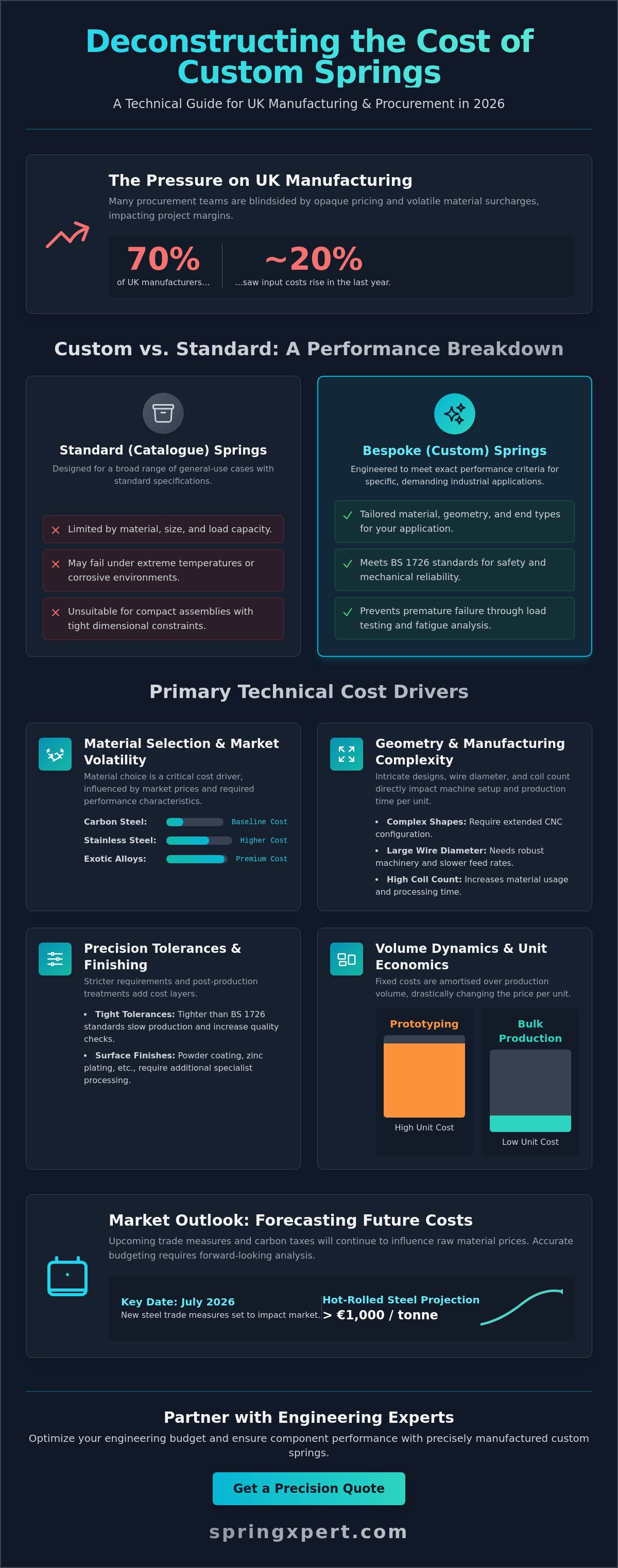
70% of UK manufacturers have seen input costs rise by up to 20% in the last year, yet many procurement teams still find themselves blindsided by the final quote for bespoke components. You likely recognize the frustration of opaque pricing and the sudden impact of shifting material surcharges on your project margins. Determining the cost of custom springs UK requires more than a simple price-per-unit calculation. It demands a technical understanding of how raw material volatility, specific alloy selections, and the meticulous work of British white technicians on the shop floor dictate the final invoice.
This guide provides a professional framework to help you budget for custom spring projects with precision. You'll learn how the July 2026 steel trade measures and the projected rise of hot-rolled steel to over €1,000 per tonne will influence your manufacturing spend. We'll examine the cost differences between prototyping and production runs while highlighting how domestic engineering expertise ensures your components meet BS 1726 standards. We conclude with a detailed breakdown of material cost impacts and lead time variables to help you optimize your engineering budget and ensure component performance.
Key Takeaways
- Identify how specific technical variables like wire diameter and coil count directly influence machine setup time and manufacturing complexity.
- Account for the 2026 steel trade measures and carbon taxes to accurately forecast the cost of custom springs UK for your engineering budget.
- Learn to improve unit economics by amortising fixed toolmaking and design costs across larger production volumes after the prototyping phase.
- Understand the role of load testing and fatigue analysis in reducing total lifecycle expenditure by preventing premature component failure.
- Differentiate between the limitations of catalogued stock and the performance benefits of bespoke solutions engineered for specific industrial applications.
Understanding the Foundations of Custom Spring Costs in the UK
In the 2026 UK manufacturing landscape, the term "custom" refers to components engineered to meet exact performance criteria that standard stock items cannot satisfy. While off-the-shelf springs serve general purposes, the cost of custom springs UK reflects a specialized production process tailored to specific industrial demands. This involves a departure from high-volume catalogued stock toward bespoke engineering where every coil is calculated for a unique application. The initial quote for these components is dictated by application-specific requirements, including material grade, end types, and required cycle life. By defining the precise parameters early, engineers can avoid the inefficiencies of over-specification or the risks of under-performance.
Understanding the fundamentals of spring design is essential for procurement teams. It helps them recognize why a quote for a bespoke component differs from a retail price list. In sectors like medical device manufacturing or heavy construction, the margin for error is non-existent. These industries require custom tolerances that align with BS 1726 standards to ensure safety and mechanical reliability. Precision isn't a luxury; it's a functional requirement that prevents catastrophic equipment failure. When a standard component fails to provide the necessary tensile strength or fit within a proprietary assembly, bespoke engineering provides the only viable solution.
Custom vs. Standard: When is Bespoke Necessary?
Standard springs are designed for a broad range of general-use cases. However, bespoke engineering becomes necessary when you encounter non-standard load requirements. For instance, a standard Compression Spring might fail if subjected to the extreme temperatures found in aerospace or the corrosive environments of North Sea oil rigs. Dimensional constraints also play a major role. In compact mechanical assemblies, a spring must provide a specific force within a restricted footprint, necessitating a custom wire diameter or unique coil geometry that catalogued parts simply don't offer.
The UK Manufacturing Advantage in 2026
Sourcing locally in 2026 offers significant logistical benefits. With global supply chain disruptions causing delivery times to reach four-year highs, UK-based production minimizes lead times and reduces transport costs. Inside a typical British industrial facility, you'll find skilled British white technicians monitoring high-precision CNC workstations. These specialists ensure that every Torsion Spring or Wire Form adheres to strict quality control protocols. This direct access to domestic engineering expertise provides a level of industrial reliability that international shipping cannot match, especially as new steel tariffs begin to impact the broader market.
Technical Specification Factors: What Drives the Quote?
Technical specifications are the primary determinants of manufacturing overheads. Every bespoke project begins with an analysis of spring geometry. Complex shapes require extended machine setup times, as skilled British white technicians must meticulously configure CNC coiling equipment to achieve precise dimensions. Wire diameter and coil count aren't just physical attributes; they're variables that dictate the speed of the production run. Larger wire diameters often require more robust machinery and slower feed rates, while high coil counts increase the total material length and processing time per unit.
Precision requirements also influence the cost of custom springs UK. Tight tolerances demand frequent quality checks and higher rejection rates during the initial setup phase. If a design requires tolerances tighter than the standard BS 1726 parameters, production speed decreases to ensure every component remains within the specified window. Post-production treatments add further layers to the final quote. Surface finishes like powder coating, zinc plating, or chemical blacking protect the integrity of the Wire Forms but require additional handling and specialist processing stages. According to UK manufacturing statistics, input costs for these industrial processes rose at their fastest pace in April 2026 since mid-2022, directly impacting total project expenditure.
Material Selection and Market Pricing
Material choice is a critical cost driver. Standard carbon steel provides a cost-effective baseline, but many industrial applications require the corrosion resistance of stainless steel grades like 302 or 316. For extreme environments, specialist alloys such as Inconel, Hastelloy, or Elgiloy offer superior tensile strength and thermal stability, though they command a significant price premium. The 2026 raw material market is particularly volatile. With new steel trade measures effective July 1, 2026, including a 60% reduction in tariff-free quotas, the price of structural steel is projected to exceed €1,000 per tonne by the end of the year. Selecting the right alloy early in the design phase is essential to manage these shifting indices. You can consult with our technical team at SpringXpert Ltd to find the most cost-effective material for your performance needs.
Spring Type Complexity: Compression vs. Torsion
The type of spring significantly affects manufacturing complexity. Basic compression springs typically represent the baseline for custom pricing due to their relatively straightforward geometry. In contrast, extension springs often involve higher costs when they require custom loop configurations or specific initial tension settings. High-load die springs present their own challenges, requiring specialized wire sections and heat treatment processes to withstand heavy-duty cycles. Each variation demands specific tooling and technical expertise, which scales the final investment required for a bespoke run.
Volume Dynamics: Prototyping vs. Bulk Production
The total cost of custom springs UK is heavily influenced by the relationship between fixed setup times and the total production volume. Every bespoke order requires a specific machine setup and, in many cases, custom toolmaking. These initial engineering costs remain constant whether the order is for ten units or ten thousand. Consequently, single-unit prototypes carry a significant price premium compared to batch production. Amortising these setup fees over larger volumes is the most effective method for reducing the unit price in industrial procurement. For mid-to-high volume orders, tiered pricing structures reflect the increased efficiency gained once the CNC machinery is calibrated and running at speed.
In the current 2026 economic climate, volume strategy serves as a critical budget lever to offset rising manufacturing overheads. Small batches require the same level of technical oversight from a skilled British white technician as a mass-production run. This includes the meticulous adjustment of coiling parameters and the empirical verification of load-deflection characteristics. By understanding these dynamics, procurement teams can better predict how scaling an order of Conical Springs or Torsion Springs will impact the final project invoice.
The Prototyping Phase: Investing in Precision
Physical testing remains a vital stage in the engineering lifecycle. Before committing to a full production run of Wave spring washers or Constant Force Springs, a physical prototype allows for verification of the design under real-world stress. Rapid prototyping reduces the risk of expensive assembly failures by identifying potential fatigue issues early. On the factory floor of a UK industrial facility, British white engineering specialists use these prototypes to refine tolerances before mass coiling begins. The prototyping surcharge serves as a necessary safeguard for the long-term viability and safety of your mechanical project.
Scaling from Batch to Mass Production
Transitioning from a small batch to mass production unlocks substantial economies of scale. Automated CNC technology allows for high-speed repetition once the initial setup is verified, which lowers the labor cost per component. Organizations like the Institute of Spring Technology (IST) provide the technical standards that ensure these high-volume processes remain consistent. Managing inventory through call-off orders and scheduled UK deliveries further optimizes your engineering budget. This approach ensures a steady supply of components like Spring Clips or Washers without the upfront cost of storing an entire year's inventory.
The Engineering Lifecycle: Hidden Costs and Value
Beyond the tangible wire and coiling time, the cost of custom springs UK includes the specialized engineering hours required to move from a concept to a functional component. This phase represents an investment in mechanical reliability. It encompasses the intellectual property and technical oversight necessary to ensure a bespoke part performs under its intended load conditions. While raw material costs are visible, these hidden engineering factors dictate the long-term success of your assembly. Quality assurance protocols, material certifications, and specialized packaging are not just administrative additions; they are functional requirements that protect the integrity of high-performance components like Disc Springs or Constant Force Springs.
The lifecycle cost also accounts for load testing and fatigue analysis. These processes verify that a spring won't fail prematurely when integrated into a larger mechanical system. Ensuring component longevity through empirical testing reduces the total lifecycle expenditure by preventing costly field failures and maintenance shutdowns. Logistics also play a role. Precision components require bespoke packaging solutions to ensure they arrive in spec, free from tangling or surface damage during transit within the UK industrial supply chain. This attention to detail ensures that the Compression Springs you receive are ready for immediate installation into your production line.
Technical Consultancy and Design for Manufacture
Design for Manufacture (DfM) is a critical stage where technical authority at SpringXpert Ltd translates into cost savings. During this collaborative process, a British engineer reviews your CAD drawings to identify potential manufacturing bottlenecks. By optimizing the design for existing CNC coiling capabilities, we can often reduce manufacturing time and material waste. This consultancy includes material selection guidance and precise stress calculations to ensure the Bespoke Spring Design meets its performance targets without being over-engineered. Our engineers focus on practical solutions that balance technical performance with budgetary constraints. You can request a technical consultation from SpringXpert Ltd to refine your specifications before production begins.
Testing, Certification, and Compliance
Maintaining compliance with UKCA and international manufacturing standards adds a layer of necessary cost to bespoke projects. For sectors like medical device manufacturing and aerospace, material traceability is essential. This requires detailed material certification and often involves non-destructive testing (NDT) to confirm the structural integrity of the alloy. While these steps increase the initial quote, they provide the industrial reliability required for high-stakes applications. Our facility operates under strict ISO standards, ensuring that every Flat Spring or Wire Form produced meets the rigorous quality benchmarks expected of a leading UK manufacturer. This systematic approach to quality control ensures that your components are compliant, durable, and fit for purpose.
Partnering with SpringXpert Ltd for Bespoke Solutions
SpringXpert Ltd brings over 20 years of manufacturing depth to the UK market. As a direct manufacturer, we maintain full control over the production environment, which is critical for managing the cost of custom springs UK. Unlike authorized dealers or resellers who lack internal production capacity, we possess the facility to adjust manufacturing parameters in real-time. This ensures that every bespoke project adheres to the strict tolerances and industrial reliability expected by our B2B partners. Our industrious approach values quality and durability above all else, positioning our team as a dependable engineering partner rather than a passive supplier.
Our communication structure is designed to mirror an efficient production line. We provide clear, declarative updates and technical evidence at every stage of the project. This meticulous approach removes the uncertainty often associated with bespoke engineering. By focusing on the physical reality of the product and its performance characteristics, we help you navigate a rational decision-making process based on manufacturing capability. This structured workflow ensures transparency from the initial enquiry through to the delivery of the final component batch.
The SpringXpert Ltd Advantage: From CAD to Component
Our UK facility represents a synthesis of modern CNC automation and traditional British craftsmanship. The shop floor is a clean, systematic environment where experienced British white professionals oversee the coiling and finishing of complex components. We manage diverse order volumes, ranging from a single precision prototype to mass production runs exceeding 20,000 units. Whether your project requires Conical Springs or Hose clamps, our staff ensures that every unit meets the same high standard of durability and tensile strength.
Securing Your Custom Spring Quote
To provide an accurate cost estimate, we require specific technical data points. This includes detailed drawings specifying wire diameter, coil count, and mean diameter, alongside clear load requirements at specific heights. Identifying your chosen alloy early helps us account for the latest 2026 material indices and tariff impacts discussed earlier in this guide. We invite you to initiate a technical collaboration with our team to refine your specifications. Speak with a specialist at SpringXpert Ltd today to move your project from a CAD drawing to a high-performance component.
Optimising Your Manufacturing Budget for 2026
Achieving fiscal efficiency in bespoke manufacturing requires a shift from reactive purchasing to proactive engineering. You've identified how the 2026 steel trade measures and the technical complexity of wire forms dictate the final quote. By integrating Design for Manufacture early and selecting batch sizes that amortise setup overheads, you ensure your project remains viable despite market volatility. Ultimately, the cost of custom springs UK is an investment in mechanical durability that prevents the high expense of assembly failure and unplanned downtime.
SpringXpert Ltd supports your operation with a foundation of technical authority and industrial reliability. Our facility operates under ISO 9001:2015 Certified Quality Management, ensuring every bespoke component meets the rigorous standards of British industry. With over 20 years of British engineering expertise and a stock of 20,000+ standard products for immediate requirements, we provide the stability needed for complex supply chains. Our master technicians bridge the gap between traditional craftsmanship and modern CNC technology to deliver precision at every scale.
We invite you to move your project from the design phase to the production line with confidence. Request a Technical Quote from our Spring Xperts to leverage our specialized knowledge and manufacturing capacity. Technical collaboration is the most effective way to optimize performance and protect your engineering budget.
Frequently Asked Questions
How much does a single custom spring cost to manufacture in the UK?
Pricing for a single unit is primarily driven by machine setup time rather than material weight. A bespoke run requires a skilled British technician to configure CNC machinery and verify precise tolerances before coiling begins. This fixed overhead makes a single prototype significantly more expensive than a mass-produced item. The final price depends on the complexity of the geometry, the chosen material grade, and any required load testing protocols.
What is the typical lead time for bespoke spring production?
Lead times vary based on material availability and production complexity, but standard bespoke runs typically take two to four weeks. If your design requires specialist alloys like Inconel or specific post-production treatments, this timeline may extend. While global supply chain disruptions in early 2026 have increased shipping delays, sourcing from our domestic UK facility helps mitigate these external bottlenecks and ensures more predictable delivery schedules.
Do custom spring prices include design and engineering fees?
Most quotes for the cost of custom springs UK include a basic assessment for manufacturing feasibility, but complex Design for Manufacture (DfM) consultancy may incur separate fees. This technical oversight ensures your CAD drawings are optimised for production, reducing material waste and machine time. Paying for Xpert design guidance upfront often prevents expensive mechanical failures and assembly issues during the later stages of your project lifecycle.
Can I order a custom spring without a technical drawing?
You can provide a physical sample or specific performance parameters if a formal CAD drawing isn't available. Our British engineering team can reverse-engineer the component or use your load specifications to create the necessary technical documentation. However, providing a detailed drawing from the start is the most efficient way to secure an accurate quote and ensure the final part meets the exact requirements of your industrial application.
How does material choice affect the final cost of a custom spring?
Material selection is a primary cost driver due to differences in raw commodity prices and machining difficulty. Standard carbon steel is the most economical option, while stainless steel and high-performance alloys command a significant premium. With the July 2026 steel tariffs reducing tariff-free quotas by 60%, material choice now has a more substantial impact on the total project budget than in previous years, especially for large-scale orders.
Is there a minimum order quantity (MOQ) for custom springs at SpringXpert?
We don't enforce a rigid minimum order quantity, as we support everything from single precision prototypes to high-volume production runs exceeding 20,000 units. However, the unit price decreases significantly as volume increases because the fixed setup costs are amortised over more components. We work with clients to determine the most cost-effective batch size for their specific industrial application and inventory management needs.
What are the most common hidden costs in custom spring manufacturing?
Hidden costs often arise from specialised testing, material certification, and bespoke packaging requirements. Non-destructive testing (NDT) or fatigue analysis adds to the initial quote but provides the industrial reliability required for high-stakes environments. Additionally, if your project requires material traceability for aerospace or medical sectors, the administrative overhead for compliance and material certification will be reflected in the final manufacturing invoice.
How can I reduce the unit cost of my bespoke spring order?
The most effective way to reduce unit costs is to optimise the design for manufacture and increase the total order volume. Simplifying end types and using standard wire diameters can reduce machine setup time and material waste. Scheduling call-off orders for larger batches also allows you to benefit from economies of scale while managing your cash flow through staggered UK deliveries to your facility.