

Spring Manufacturing Quality Standards: A Complete Guide
Table of Contents
- Spring Manufacturing Quality Standards: What You Need to Know
- Spring Types, Materials, and Design Specifications
- Manufacturing Processes: From Forming to Heat Treatment
- Dimensional Tolerance, Precision, and Engineering Specifications
- Industrial Spring Testing Methods and Acceptance Criteria
- Spring Fatigue Testing: Performance and Durability Assessment
- Spring Inspection Checklist: Quality Assurance and Documentation
- European Standards, ISO Certification, and Compliance
- Supplier Qualification and Quality Documentation
- Frequently Asked Questions
Last Updated: October 10, 2026
Spring Manufacturing Quality Standards: What You Need to Know
Spring manufacturing quality standards define the specifications, testing protocols, and documentation requirements that ensure springs perform reliably in demanding industrial applications. Understanding these standards is critical to preventing premature failure and ensuring consistent supply chain results.
The standards, EN 15800, DIN specifications, and ISO 9001 certification, define measurable engineering specifications that directly impact whether a spring lasts months or years in the field.
This guide covers spring manufacturing quality standards: material specifications, manufacturing processes, testing methods, and inspection practices. You'll learn what to look for in a supplier and how to avoid costly failures from overlooking these standards.
Spring Types, Materials, and Design Specifications
Compression, extension, and torsion springs each have distinct engineering specifications that influence their suitability for specific applications.
Compression springs resist axial loading and are coiled to precise specifications; wire diameter, free length, and coil pitch affect spring rate and load capacity. Extension springs work in tension with end configurations requiring additional precision.
Most industrial springs use high-carbon steel (EN 10264) for excellent fatigue resistance when properly heat-treated. Stainless steel springs (DIN 1.4310 or DIN 1.4568) provide corrosion resistance for subsea, medical, and food-processing applications but require different heat treatment protocols.

Round wire is the industry standard for helical springs because it distributes stress evenly and simplifies manufacturing. Material specifications must define the alloy, wire surface finish, residual stress limits, and decarburisation limits.
Design specifications capture engineering intent: free length, solid height, pitch, number of active coils, and spring rate. These parameters must be documented clearly as the basis for dimensional tolerance and acceptance testing.
Manufacturing Processes: From Forming to Heat Treatment
Precision forming, heat treatment, and surface finishing each directly affect spring manufacturing quality standards compliance and real-world reliability.
Coiling winds wire around a mandrel at high speed to create the helical form. Precision coiling equipment maintains consistent pitch and diameter; any variation creates stress concentration points that accelerate fatigue failure.
Heat treatment removes residual stress and establishes desired hardness. High-carbon steel requires different temperatures and cooling rates than stainless steel.
Surface finish directly influences fatigue life. Shot peening significantly extends fatigue life by introducing beneficial compressive residual stress, making it essential for high-cycle applications. Phosphate coating protects against corrosion but doesn't improve fatigue resistance.
Finishing steps must be controlled to specification because surface defects become stress concentration points. Passivation removes surface contamination on stainless steel; plating or painting protects carbon steel in harsh environments.
Dimensional Tolerance, Precision, and Engineering Specifications
Dimensional tolerance defines the acceptable range of variation for each critical dimension, making spring manufacturing quality standards quantifiable and testable.
Free length tolerance is typically ±5% to ±10%; out-of-specification springs won't sit correctly in the assembly, creating uneven loading.
Pitch tolerance affects spring rate and stress distribution. Inconsistent pitch creates stress concentration, accelerating fatigue failure. Modern coiling equipment maintains pitch tolerance within ±0.3 mm.
For torsion springs, leg angle tolerance is critical; typical tolerance is ±2 to ±3 degrees. Incorrect angles prevent proper rotational force delivery or assembly fit.
Spring rate tolerance is typically ±5% to ±10%, confirmed by measuring load at specific deflection points.
Engineering specifications must document target dimensions, tolerances, test methods, and acceptance criteria. This specification becomes the contract between designer and manufacturer.
Key Takeaway
Spring manufacturing quality standards translate engineering intent into measurable, testable specifications. Without clear dimensional tolerance and acceptance criteria, you have no objective way to verify that a spring meets your requirements.
Industrial Spring Testing Methods and Acceptance Criteria
Testing validates that springs meet their design specifications and will perform reliably in service.
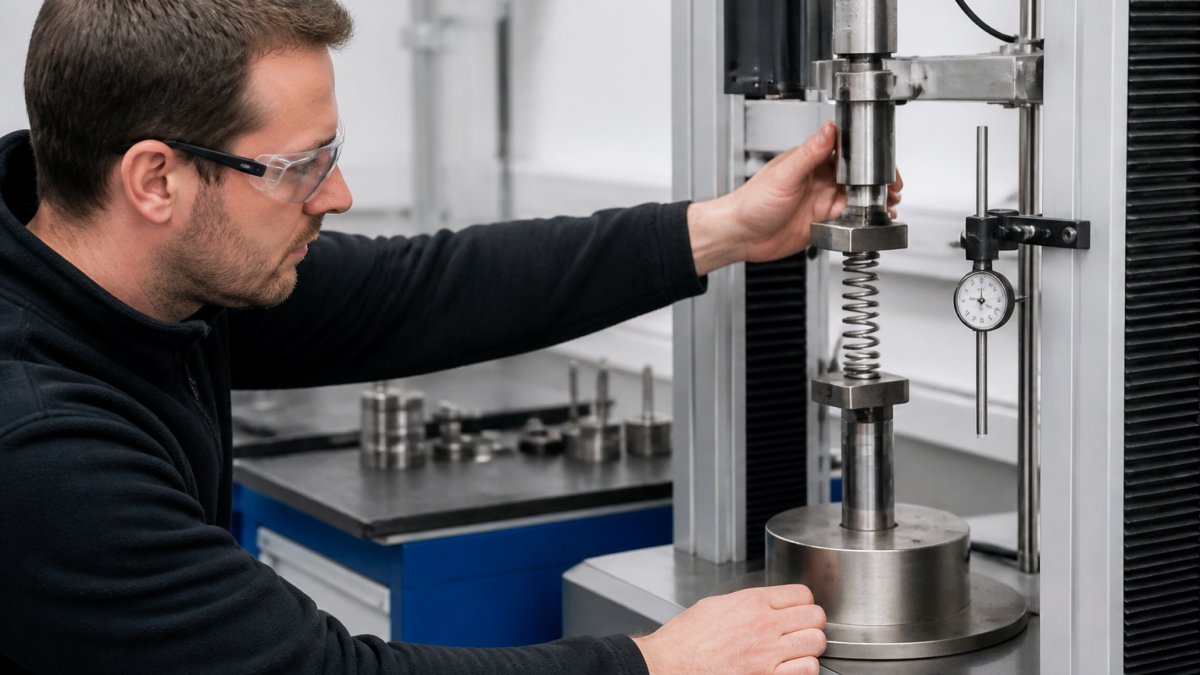
Load testing measures force at specific deflection points and compares measured load against specification.
Spring rate verification confirms the proportional relationship between load and deflection. Non-linear response indicates a manufacturing defect.
Free length checks compare measured length to specification. Out-of-specification springs are rejected because they create assembly problems.
Solid height verification confirms the spring doesn't bind prematurely.
Surface inspection identifies cracks, decarburisation, surface defects, or corrosion. Any visible crack results in rejection.
Dimensional verification uses precision measuring tools to confirm wire diameter, pitch, and coil diameter fall within tolerance.
Acceptance criteria define the pass/fail threshold for each test. Springs that fail any test are segregated and documented for root cause analysis.
Spring Fatigue Testing: Performance and Durability Assessment
Fatigue life is the number of load cycles a spring can withstand before failure.
Fatigue testing applies cyclic load and counts cycles to failure, producing a fatigue life curve that shows how many cycles the spring can survive at different stress levels.
Fatigue life is influenced by material quality, surface finish, residual stress, and dimensional accuracy.
Disc Springs EN 16983 DIN 2093 6mm to 28mm O/D →
Reliability testing applies the intended service load for the expected number of cycles and measures residual properties. Springs that drift beyond tolerance or exceed permanent set specifications fail the test.
Life assessment predicts spring survival based on expected load cycle frequency and magnitude.
Springs that fail fatigue or reliability testing indicate a manufacturing or design problem. Common causes include improper heat treatment, surface defects, material defects, or dimensional variation.
Watch Out
A spring that passes static load testing may still fail in the field if it hasn't been fatigue-tested at the intended service load. Fatigue failure is sudden and often catastrophic. Always specify fatigue testing for applications involving cyclic loading.
Spring Inspection Checklist: Quality Assurance and Documentation
Quality assurance begins with a clear inspection plan that defines what will be tested, how, and when, providing objective evidence that the spring meets specification.
Visual inspection examines springs under bright light for surface cracks, decarburisation, corrosion, or mechanical damage. Any visible defect results in rejection.
Dimensional verification confirms critical dimensions: wire diameter, free length, solid height, and pitch. Measurements recorded on control charts detect trends before parts are rejected.
Spring rate testing confirms the load-deflection relationship. Acceptance criterion is typically ±5% to ±10% of the target rate.
Traceability records link each spring to its manufacturing lot, heat treatment batch, raw material lot, and test results. This documentation is essential for failure investigation and recalls.
Documentation includes the certificate of conformity, which certifies that springs meet specification and have been tested according to defined acceptance criteria.
| Inspection Element | Method | Acceptance Criteria | Frequency |
|---|---|---|---|
| Visual Surface | Bright light inspection | No visible cracks, decarburisation, or corrosion | 100% |
| Wire Diameter | Micrometer | ±0.05 to ±0.10 mm of target | Sample per lot |
| Free Length | Caliper or height gauge | ±5% to ±10% of specification | Sample per lot |
| Spring Rate | Load testing at specified deflection | ±5% to ±10% of target | Sample per lot |
| Solid Height | Compressed measurement | Within specification | Sample per lot |
| Traceability | Certificate of conformity | Lot number, heat treat batch, test results documented | 100% |
European Standards, ISO Certification, and Compliance
Spring manufacturing quality standards in the UK and Europe are governed by European standards, DIN standards, and ISO standards for quality management.
EN 15800 is the primary European standard for helical springs, defining material grades, dimensional tolerances, testing methods, and acceptance criteria.
DIN standards provide detailed specifications for specific spring types: DIN 2095 (compression), DIN 2096 (extension), and DIN 2097 (torsion).
ISO 9001 certification confirms the manufacturer has implemented a quality management system with documented procedures for material control, process control, testing, and corrective action.
A certificate of conformity certifies springs have been manufactured to specification and tested according to defined acceptance criteria.
Compliance verification requires asking the supplier for documentation: copies of the EN 15800 or DIN specification, evidence of ISO 9001 certification, and sample certificates of conformity.
Pro Tip
When qualifying a new spring supplier, request a sample lot with full test documentation. This allows you to verify that their testing methods match your requirements and that their acceptance criteria are appropriate for your application. It's far cheaper to discover a mismatch on a sample order than on a production run of 10,000 units.
Supplier Qualification and Quality Documentation
Qualifying a spring supplier means verifying they can consistently deliver springs that meet your specification, requiring evaluation of process capability and documentation practices.
Evaluate their documentation system: material traceability records, heat treatment logs, and corrective action reports.
Assess equipment capability: precision coiling equipment, heat treatment furnaces with temperature control, and calibrated testing equipment. Ask about age, maintenance, and periodic calibration of testing instruments.
Conduct an on-site audit if order volume justifies it. Observe the coiling process, check heat treatment furnace logs, and review testing setup.
Define acceptance criteria in writing: dimensional tolerance, test methods, and acceptance criteria for each test.
Establish a corrective action process.
Spring manufacturing quality standards exist because springs are often hidden components whose failure can be catastrophic. A failed suspension spring can cause loss of vehicle control.
At SpringXpert, our over 20 years of manufacturing experience means we know not just what the standards require, but why those requirements matter. When you source compression springs, extension springs, torsion springs, or custom-engineered wire forms from SpringXpert, you're getting springs backed by full traceability, tested to specification, and supported by a certificate of conformity that documents exactly what you're getting.
Frequently Asked Questions
What quality standards apply to spring manufacturing?
Spring manufacturing quality standards vary by application and region. In Europe, EN 15800 governs helical compression springs, whilst DIN standards cover disc springs and other forms. ISO 9001 certification ensures overall quality management systems are in place. Suppliers must provide a certificate of conformity confirming compliance with applicable standards. Your choice of standard depends on your industry (automotive, subsea, oil and gas) and the specific spring type required for your application.
How do manufacturers check spring fatigue life?
Spring fatigue testing involves subjecting springs to repeated load cycling under controlled conditions to assess durability. Manufacturers measure how many cycles a spring can withstand before failure occurs. Testing parameters include load amplitude, frequency, and environmental conditions. Results determine the spring's reliability for dynamic applications. Life assessment data helps predict performance in real-world machinery. Quality suppliers document all fatigue test results and provide this data with your order, ensuring transparency on expected service life.
What should a spring inspection checklist include?
A comprehensive spring inspection checklist covers visual examination for surface defects, dimensional verification of wire diameter and free length, load testing to confirm spring rate, and hardness testing post-heat treatment. Inspectors verify that springs meet specification tolerances and check for surface cracks or corrosion. Traceability records must link each batch to material certs and test results. Documentation should include acceptance criteria, test dates, and inspector sign-off. This checklist prevents premature spring failure by catching defects before deployment.
Which material properties affect spring quality most?
Wire diameter, material grade, and heat treatment directly impact spring performance. High-carbon steel (such as 51CrV4) offers strength and fatigue resistance; stainless steel variants (DIN 1.4310, DIN 1.4568) provide corrosion resistance for subsea and chemical applications. Proper heat treatment creates the correct hardness and internal stress state. Surface finish (phosphate, shot-peening) improves fatigue life. Material specifications must match your load, environment, and cycle count. Suppliers should provide certified material test reports confirming composition and mechanical properties before production.
How can I prevent premature spring failure in my machinery?
Prevent failure by selecting springs engineered for your exact load, cycle count, and environment. Verify that the supplier conducts fatigue testing and provides documented results. Inspect springs upon delivery using a checklist covering dimensions, surface quality, and load verification. Ensure proper installation and alignment to avoid uneven loading. Request traceability documentation and material certificates. Work with ISO 9001-certified suppliers who perform corrective action when issues arise. Regular maintenance checks and monitoring of spring performance help catch wear early.
What information should a spring quality certificate include?
A quality certificate must include material specification (grade, heat lot number), dimensional data (wire diameter, free length, spring rate), test results (load tests, hardness, fatigue data), manufacturing date, batch/serial number, and the supplier's certification statement. It should confirm compliance with applicable standards (EN 15800, DIN, ISO). The certificate links traceability back to material certs and test reports. For custom springs, it should document that the design meets your engineering specifications. This documentation proves quality and supports failure analysis if issues occur.
How does consolidating suppliers improve spring quality?
Consolidating with a single ISO 9001-certified supplier reduces variability across prototypes, standard springs, and custom components. One supplier maintains consistent processes, material sourcing, and quality control. You eliminate compatibility issues between parts from different makers and simplify traceability records. A dedicated supplier learns your application requirements, reduces lead times, and responds faster to urgent needs. Quality issues are resolved by one team rather than juggling multiple vendors. For startups scaling from prototypes to high-volume production, a single capable partner adapts capacity without switching suppliers mid-growth.