

Industrial Metal Component Sourcing Guide
Table of Contents
- Understanding Industrial Metal Component Sourcing
- Defining Component Function and Technical Requirements
- Standard vs Bespoke Metal Components
- Creating a Metal Parts RFQ Template
- Supplier Qualification and Evaluation
- Metal Component Quality Inspection Standards
- Metal Component Lead Times and Cost Drivers
- Risk Management and Supplier Resilience
- Frequently Asked Questions
Last Updated: October 19, 2026
Understanding Industrial Metal Component Sourcing
Metal component sourcing is the process of identifying, evaluating, and procuring metal parts and assemblies that meet precise technical, quality, and delivery requirements for industrial applications.
The stakes are high. A single poor supplier choice can cascade through your production line. Delayed deliveries halt assembly. Quality failures trigger field failures and warranty claims. Undersized suppliers disappear mid-contract, leaving you scrambling. We've learned what separates reliable metal component sourcing from the kind that keeps you up at night.
This guide walks you through the complete sourcing process: defining what you actually need, creating RFQs that suppliers can quote accurately, qualifying suppliers who can deliver consistently, and managing the relationship to catch problems before they hit your production floor. The framework applies whether you're sourcing compression springs, disc springs, circlips, or custom-engineered wire forms.

Defining Component Function and Technical Requirements
Before you approach a single supplier, you need to know exactly what you're buying. Vague specifications lead to misquotes, rejected samples, and wasted time. Precision specifications lead to fast quotes and first-time acceptance.
Material selection and alloy grade
The material you choose determines performance, cost, and manufacturability. Carbon steel offers cost efficiency for high-volume applications. Stainless steel provides corrosion resistance for subsea, chemical, or outdoor environments.
Your choice isn't just about the base metal. EN 10270 spring steel comes in different tempers (BS EN 10270). DIN 2093 disc springs specify material group and hardness range. Circlips to DIN 471 or DIN 6799 use carbon steel with defined hardness.

Document the material standard, alloy designation, and hardness range. If heat treatment is critical, because surface cracks or brittle failure has been a problem, say so explicitly. Suppliers need to know whether metallurgical consistency is a deal-breaker or a nice-to-have.
Dimensions, tolerances, and surface finish
Dimensions drive manufacturability and cost. Tighter tolerances cost more. Surface finish specifications trigger additional process steps. A component finished to Ra 0.8 µm costs less than Ra 0.4 µm, but Ra 0.4 µm may be what your application actually requires.
Create or obtain technical drawings with all critical dimensions, tolerances, and surface finish specifications. If you don't have drawings, create a detailed specification sheet that includes:
- Outer diameter, inner diameter, length, or other key dimensions with tolerance bands
- Material and alloy grade
- Surface finish requirement (e.g., Ra 1.6 µm, electropolished, passivated)
- Any plating, coating, or protective treatment
- Hardness range if applicable
Suppliers use these specifications to estimate manufacturing difficulty and set pricing. Missing or ambiguous details force them to guess, which leads to quotes that don't match your actual needs.
Standard vs Bespoke Metal Components
The choice between standard and bespoke components shapes your entire sourcing strategy and cost structure.
Standard components are manufactured to published specifications: DIN, EN, or ISO standards. Disc Springs EN 16983, Shim Washers DIN 988, E-Type Circlips DIN 6799, and Heavy Duty Bolting Washers DIN 6796 are examples.

Use standard components whenever they fit your application. They reduce sourcing complexity, shorten lead times, and lower per-unit cost.
Bespoke components are engineered for your specific application.
Choose bespoke when standard components don't meet your performance, dimensional, or material requirements. Don't default to bespoke just because you want something "custom." Standard components are often the right answer.
Creating a Metal Parts RFQ Template
An RFQ (Request for Quotation) that's clear and complete gets accurate quotes back. A vague RFQ generates guesses, mismatched pricing, and follow-up email chains that delay everything.
Essential information to include
Your RFQ should contain:
- Component name and application: What is this part? What does it do? (e.g., "Compression spring for automotive suspension damping")
- Material and alloy: EN 10270-1 spring steel, stainless steel 316L, carbon steel per DIN 1654
- Dimensions and tolerances: Outer diameter ±0.1 mm, free length ±1 mm, wire diameter ±0.05 mm
- Surface finish: Passivated, electropolished, oil-coated, zinc-plated
- Performance requirements: Load range, deflection, fatigue cycles, temperature range
- Certifications required: ISO 9001, material traceability, test reports, compliance documentation
- Drawings or technical specifications: Attach CAD files, sketches, or detailed specification sheets
- Quantity and volume profile: Initial order quantity, expected annual volume, forecast for next 24 months
Suppliers use this information to identify which manufacturing processes apply, estimate labour and material costs, and quote accurately. Missing details force them to make assumptions, which almost always result in quotes that don't match your actual requirements.
Volume, lead time, and delivery requirements
State your volume clearly. A supplier quoting 1,000 pieces may offer a different price per unit than one quoting 10,000 pieces.
Specify lead time requirements. "First delivery required within 8 weeks" is different from "first delivery required within 4 weeks." Aggressive lead times may require expedited tooling or priority scheduling, which increases cost.
State delivery requirements: single shipment or split shipments, delivery frequency, packaging requirements, and any export or compliance documentation needed.
Supplier Qualification and Evaluation
Not all suppliers are equal. A supplier who can deliver 1,000 compression springs on time may collapse under a 50,000-unit order. A supplier with excellent quality at low volume may struggle with consistency at scale. Qualifying suppliers before you commit orders prevents costly surprises.
Assessing production capacity and expertise
Ask suppliers directly: What is your maximum production capacity for this component type? How many units per month can you reliably deliver?
Visit their facility if possible, or request photographs and videos of their production equipment. Do they have CNC machinery for precision machining?
Ask about their experience with similar components. Have they manufactured custom wire forms for your industry?
Verifying certifications and quality systems
ISO 9001 certification indicates a documented quality management system. It doesn't guarantee quality, but it means the supplier has defined processes, documented procedures, and regular audits.
Ask suppliers whether they maintain material traceability. Can they provide mill certificates showing the alloy composition and mechanical properties of the material used in your components?
Request test reports for first-article samples. Tensile strength, hardness, fatigue life, and surface finish should be documented and traceable to your specific order. This establishes a baseline for ongoing production quality.
Disc Springs EN 16983 DIN 2093 6mm to 28mm O/D →
Metal Component Quality Inspection Standards
Quality inspection catches problems before components reach your production line. A systematic inspection approach protects your reputation and reduces warranty costs.
Sampling and first-article inspection
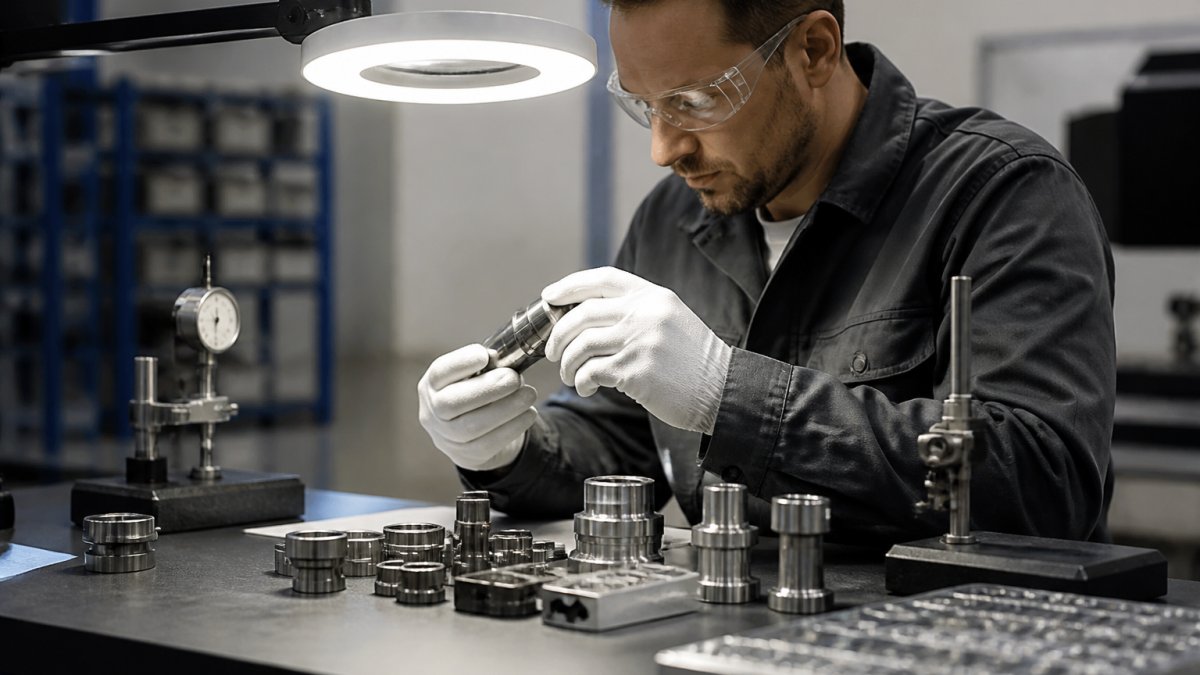
First-article inspection (FAI) is your baseline. Before accepting full production, inspect the first sample lot thoroughly. Measure critical dimensions. Run hardness tests. Perform tensile or fatigue testing if the application demands it. Document all results.
For ongoing production, implement statistical sampling. Don't inspect every component, that's expensive and unnecessary. Instead, define an Acceptable Quality Level (AQL).
Sampling plans based on lot size are published in ISO 2859-1 standard for acceptance sampling. Your supplier should be familiar with these standards. If they're not, that's a warning sign.
Ongoing inspection and corrective action
Don't wait for field failures to discover problems. Implement ongoing inspection at receiving. Measure a sample from each delivery lot. Track results over time. If you see a trend, dimensions drifting out of tolerance, hardness creeping lower, escalate immediately.
Define a corrective-action process with your supplier. If components fail inspection, the supplier should investigate root cause, implement a fix, and verify the fix works. Document everything. This creates accountability and prevents the same problem recurring.
Metal Component Lead Times and Cost Drivers
Lead time and cost are intertwined. Understanding what drives both helps you make trade-offs and negotiate effectively.
Understanding typical lead times by component type
Standard components carry short lead times because suppliers stock them. Disc Springs EN 16983 or Shim Washers DIN 988 from SpringXpert typically ship within days.
Custom compression springs: 4-8 weeks from order to first delivery, depending on complexity and design changes.
Custom wire forms: 6-10 weeks, especially if the cross-section or winding geometry is unusual.
Custom pressed metal components: 8-12 weeks if new tooling is required.
Lead times compress if you accept longer production runs.
Total cost of ownership and landed-cost modelling
Price per unit is not total cost. Factor in:
- Tooling costs: If the supplier charges for custom tooling, that cost is amortized across your order quantity. Larger orders spread tooling cost thinner.
- Freight and logistics: International shipments cost more than domestic. Consolidated shipments cost less per unit than frequent small shipments.
- Quality and rework: A supplier quoting low price but delivering high defect rates forces you to rework or scrap components. That cost is real.
- Lead time risk: A supplier with long lead times forces you to hold larger inventory buffers. Inventory carrying cost is real.
- Supply continuity: A single-source supplier who goes out of business leaves you stranded. Dual-sourcing costs more upfront but protects you.
Build a landed-cost model: unit price + tooling amortized + freight + inspection labour + inventory carrying cost + contingency for rework. This reveals the true cost and often shows that a higher unit price from a reliable supplier beats a lower price from a risky one.
Risk Management and Supplier Resilience
A single supplier failure can halt your production. Building resilience into your supply chain is not optional.
Identify single points of failure.
Communicate forecasts to suppliers early. If you expect volume to surge in Q3, tell suppliers in Q1.
Build contractual protections. Define lead times, quality standards, and consequences for non-compliance.
Diversify geographically if possible.
Monitor supplier health. If a supplier stops responding to emails, misses deliveries, or shows signs of financial distress, escalate.
Frequently Asked Questions
What information should be included in a metal parts RFQ template?
A comprehensive metal parts RFQ template must include component function and intended use, detailed technical drawings with dimensions and tolerances, material specification and alloy grade, required surface finish and heat treatment, production volume and delivery schedule, quality standards and inspection requirements, and any special certifications needed. Include packaging requirements, payment terms, and communication protocols. This ensures suppliers can provide accurate quotations and meet your exact specifications.
How do I verify a supplier's metal component quality claims?
Request proof of ISO 9001 certification and review their quality management documentation. Ask for references from similar industrial applications and request first-article inspection reports from previous projects. Conduct a supplier audit if possible, examining their manufacturing processes, testing equipment, and corrective-action records. Review their sampling plans and inspection standards. Request certificates of conformance for materials and heat treatment. SpringXpert, for example, maintains ISO 9001 certification.
What's the difference between standard and bespoke metal components?
Standard metal components are mass-produced to established specifications, offering lower cost and shorter lead times. They suit applications where off-the-shelf solutions meet your requirements. Bespoke metal components are custom-engineered to your exact specifications, tolerances, and material requirements, ideal for unique applications or tight performance demands. Bespoke components cost more upfront but eliminate design compromises. SpringXpert offers over 20,000 standard products alongside custom-engineered solutions, allowing you to choose based on your application needs and budget.
How do metal component lead times affect my sourcing strategy?
Lead times vary by component type and complexity. Standard metal components typically ship within 2-4 weeks, while custom wire forms and machined components may require 6-12 weeks depending on production volume and tooling requirements. Plan sourcing early and communicate urgent needs clearly to suppliers. Build buffer time into your project schedule. SpringXpert works with you on lead-time requirements for both standard and custom metal components.
What are the main cost drivers when sourcing industrial metal components?
Key cost drivers include material type and alloy grade, component complexity and machining requirements, production volume (higher volumes reduce per-unit cost), surface finish and heat treatment specifications, and lead-time urgency. Tooling and setup costs impact small-batch orders significantly. Total cost of ownership includes material, labour, quality control, delivery, and inventory holding. Compare landed costs across suppliers rather than unit price alone, factoring in payment terms, shipping, and duty.
How should I handle supplier risk and ensure continuity of supply?
Qualify multiple suppliers for critical components and maintain a secondary source list. Assess supplier financial stability, production capacity, and geographic resilience. Build contractual provisions for contingency planning and change control. Establish communication protocols for urgent issues. Request documented corrective-action procedures for quality failures. Consider sustainability and responsible sourcing practices as part of supplier evaluation. Review supplier performance quarterly and maintain relationships with backup suppliers.
What quality inspection standards apply to industrial metal components?
Inspection standards depend on your industry and application. Common frameworks include ISO 9001 quality management, DIN and EN standards for specific component types (such as disc springs to EN 16983), and industry-specific standards for automotive, aerospace, or subsea applications. Implement first-article inspection for new suppliers or designs, ongoing statistical sampling during production, and 100% inspection for critical safety components. Document all inspection results and establish corrective-action procedures for non-conformances.